Archive for the ‘Observation’ Category

Dust Devils on Mars

Wednesday, October 11th, 2006

This morning we stumbled across this article in the Columbus Dispatch (written under contract by NASA), and we were reminded again of one of the cooler images to come from our solar system in the last few years.

The image is of a dust devil moving across a Martian plain on a hot spring afternoon a year ago:


The image was caught by NASA’s ‘Spirit’ Mars Rover in April, 2005. 

Both rovers (Spirit and Opportunity) have recently been upgraded with new software that enables them to better understand when a dust devil is moving across the martian surface, and to begin snapping pictures when they sense that movement:

NASA’s Space Technology 6 mission, or ST6, had already proven this "artificial intelligence" software in space. ST6 used it to help an Earth-orbiting satellite take pictures of erupting volcanoes on Earth. So NASA knew the software would help Spirit and Opportunity capture images of dust devils.

ST6 is part of NASA’s New Millennium Program, whose job is to test new technologies in space before putting them on NASA missions of discovery.

Other images and video from Mars can be found on NASA’s Mars Exploration Program website. 

Labrador Internet Connections At Risk

Tuesday, October 10th, 2006

Sailing from England with one vessel, the Matthew, on 20 May 1497, John Cabot (Giovanni Caboto) and a crew of 18 reached what some historians now believe was Labrador on 24 June 1497. He went ashore to take possession of the land, exploring the coast for some time and departing on or about the 20th of July.

Upon his return to England, Cabot was well rewarded (a pension of 20 pounds a year), and a patent was written for a new voyage. In 1498, he sailed for America with 5 ships. One of the ships became distressed and diverted to an Irish port. Nothing was ever heard of the other — or John Cabot — ever since.

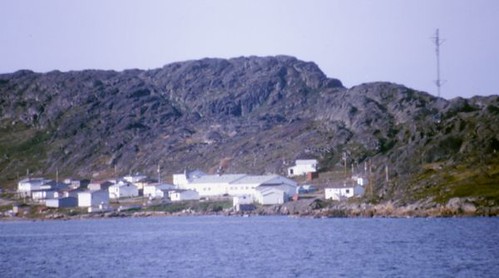
Will the same happen to Internet connections in Labrador today? The CBC reports that’s what might happen if Industry Canada’s Community Access Program (CAP) cuts funding. In a town like Black Tickle, where dial-up service became available only recently, people see the need:

The cut may mean the closure of 21 internet sites in Labrador. In many coastal communities, the only efficient way to connect to the internet is via satellite.

Brenda Roberts, principal of St. Peter’s school in the southern Labrador community of Black Tickle, said CAP sites are used broadly. Students use the connection for research, and the school’s administration depends on it.

"Our fee for this internet connection to [the] satellite system is around $220 a month, so basically, if you compare it to a human body, well, we’re going to die of heart failure in January," Roberts said.

Residents in the community rely on satellite-based CAP sites for everyday things, including commerce and filling out government forms.

"We’ve got no bank here now and it’s easier to get a piece of gold nugget here than cash, so being able to bank online is all right," she said.

Who will step in to help? Will it be Canada’s dominant satellite operator, Telesat? Perhaps this is the type of situation where Telesat’s new competitor, Ciel Satellite, saves the day? There are other options, of course: resellers such as Barrett Xplore, who use satellites operated by Intelsat.

Korean Ping-Pong

Tuesday, October 10th, 2006

As the debate rages in the press as to whether Pyongyang’s 60-year obsession came to fruition on Sunday — or, if, as Drudge is reporting, the North Korean blast was a  "dud" — it’s worth taking a moment to ask: how do we come to conclusions about what really happened?

To do so, it’s worth recounting how the United States learned about the blast.  

Our initial warning that the nuclear test was about to take place came not from a high-tech gizmo, but in a phone call from the Chinese:

The White House said Monday the United States received word from China of North Korea’s intent to conduct a nuclear test minutes ahead of the reported event.

According to spokesman Tony Snow, North Korea had called its ally China to advise them on the imminent explosion at about 9 p.m. EST Sunday. China in turn notified the U.S. Embassy in Beijing, which relayed the message to Washington.

Secretary of State Condoleeza Rice received notification about 9:45 p.m. and notified national security adviser Stephen Hadley. Hadley called President George W. Bush at about 9:52 p.m.

South Korean authorities said they felt the seismic tremor from an apparent explosion in North Korea in about the same time frame of Hadley and Bush being notified.

 In addition to indications on the ground in South Korea, there was the on-the-air announcement in North Korea:

 

Soon thereafter, the USGS and other agencies began to analyze the seismic data to locate the epicenter and identify the magnitude of the tremors that were registered on seismic monitors. In this case, the magnitude was 4.2, and the location was pinned down (though not literally, of course) on the map.

NOAA’s NESDIS satellite likely played a key role in communicating the scientific (non-intelligence) data, and satellite telemetry helped pinpoint the location of the tremor. 

The result? So far, a good deal of doubt on behalf of the West in regards to North Korea’s claims of success:

U.S. officials, speaking on the condition of anonymity, said that seismic readings show that the conventional high explosives used to create a chain reaction in a plutonium-based device went off, but that the blast’s readings were shy of a typical nuclear detonation.
   
"We’re still evaluating the data, and as more data comes in, we hope to develop a clearer picture," said one official familiar with intelligence reports.
   
"There was a seismic event that registered about 4 on the Richter scale, but it still isn’t clear if it was a nuclear test. You can get that kind of seismic reading from high explosives."
   
The underground explosion, which Pyongyang dubbed a historic nuclear test, is thought to have been the equivalent of several hundred tons of TNT, far short of the several thousand tons of TNT, or kilotons, that are signs of a nuclear blast, the official said.

The official said that so far, "it appears there was more fizz than pop."

Without satellites and seismic monitors, however, it would be impossible to say whether it was fizz, pop, or outright propaganda on the part of North Korea.

 

The Years Fly By

Thursday, October 5th, 2006

MSNBC reports on the most recent Hubble exoplanet discovery:


WASHINGTON – A recently spied planet orbits so close to its star that a new year comes every 10 hours.

Called SWEEPS-10, the planet belongs to a newfound class of zippy exoplanets called ultra-short-period planets that have orbits of less than a day.

The Hubble Space Telescope recently spotted five ultra-short-period planets, all about the size of Jupiter, in a crowded star field near the galactic bulge of our Milky Way galaxy as part of an exoplanet survey called the Sagittarius Window Eclipsing Extrasolar Planet Search, or SWEEPS. A total of 16 planet candidates were found, all with relatively short orbital periods…

"These are the farthest planets detected so far around some of the faintest stars," study leader Kailash Sahu of the Space Telescope Science Institute in Maryland told reporters at a NASA press conference.

Extrapolated to the entire galaxy, the Hubble results suggest the Milky Way contains at least 6 billion Jupiter-sized planets, researchers say.

The findings are detailed in Thursday’s issue of the journal Nature.

More info and images can be found on the HubbleSite.

Mach 23 Will Set You Free

Tuesday, October 3rd, 2006

The U.S. Air Force Office of Scientific Research thinks it’s possible, and a company in California wants to prove it: a large electromagnetic ring will be able to launch small satellites into space. Discovery Channel Canada gives us the scoop:

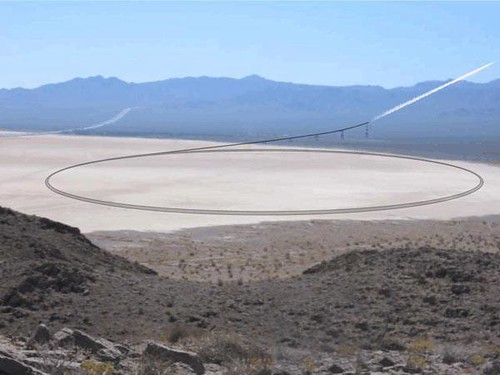
A large circular metal track could accelerate objects to supersonic speed using electromagnets and spit them out into space, says a report from the U.S. air force’s Office of Scientific research.

Tagged as the Launch Ring by its inventing company, Launch Point Technologies, the track would be several kilometers in diameter. Similar to trains that hover on electromagnetic tracks, a sled would hover over the ring and be propelled forward using powerful magnets.

According to the company, a satellite protected by an eggshell-like capsule could sit atop the sled and slowly accelerate over a matter of hours to a supersonic 10 km/sec. Then a small explosion could detach the capsule from the sled and it would hurtle into a side tunnel.

From there, it would shoot up a ramp and through the atmosphere into outer space. Traveling at a 23 times the speed of sound, the capsule would experience forces 2,000 times that of normal gravity on Earth.

A rocket strapped on the capsule would correct the trajectory so that it correctly aligned itself in orbit.

The Goleta California company has received funding to begin a two-year study within several weeks. Boosters of the ring hope to one day use it for thousands of launches a year, at a fraction of today’s cost of putting things in space.

Humans could never withstand the forces exerted during the ring’s launch process. Under existing technological limitations, it could only be used to propel supplies to be used by humans on a long-term mission in outer space, or to put satellites into orbit.

The Air Force also suggests it could be used for military purposes, quickly launching weapons around the world.

For more details, try NewScientist.com.


Thai Business Destabilized, Thai Satellite Deorbited

Tuesday, October 3rd, 2006

Let’s face it: military juntas make businessmen nervous.

Last week’s military coup in Thailand has destabilized the business climate — if only briefly — with many business leaders holding off on planned deals as they assess the situation in Bangkok.

One big example of the law of unintended consequences: GE Capital put its deal with Bank of Ayudhya on hold until the situation clarifies itself.

But what impact has the coup had on satcom in Thailand?

For Shin Satellite Plc, the greatest problem in recent weeks is not change in power in the governement but a sudden loss of power on their Thaicom 3 satellite:

Shin Satellite Plc yesterday immediately de-orbited its glitch-ridden Thaicom 3 broadcasting satellite, following its power loss, which affects its plan to tap the Middle East market.

However, the company’s executive chairman Dumrong Kasemset denied that the de-orbit would affect the company’s projected revenue this year as it has yet to include Thaicom 3 income’s from the Middle East into the calculation.

He added during the teleconference with the presses that the company is also evaluating the deeper financial impact of the de-orbit incidence. He said ShinSat de-orbited Thaicom 3 at approximately 01.37 am, due to the power loss to such extent that it could not provide further service.

t de-orbited Thaicom 3 by moving it beyond its existing orbital slot of 50.5 Degrees East.

Thaicom 3 has had its share of problems, as has Thaicom’s owner, Shincorp. Thailand’s Ministry of Commerce recentely completed its investigations of the sale of Shin Corp to Singapore’s Temasek Holdings.

One thing’s for certain — businessmen, and those of us hoping for a Christmas trip to Phuket, will welcome a return to normalcy.

Hand-Held at Sea

Monday, October 2nd, 2006

According to Lloyd’s List (subscription required), Inmarsat is focusing on hand-held satellite communications devices for maritime service:

LEADING satellite communications provider Inmarsat is gearing up for a major entry into the hand-held market after signing off the deal with voice service provider ACeS International.

“This was the final piece in the jigsaw for our services, and we are now ready to make big strides in the mobile voice sector,” said Robert Johnson, director of maritime services for Inmarsat.

The deal will give Inmarsat the means to compete with Iridium, its principal rival in the commodity voice segment.

The London-listed company bought the intellectual property rights of ACeS International last month and expects initial annualised revenues from the collaboration to be in the region of $3m-$5m from capital expenditures of approximately $40-$50m over two years for ground infrastructure and development on the ACeS R190 phone. 

The ACeS press release on the partnership can be found here. The InMarsat/ACeS system relies upon low-bandwidth communications using geosynchronous satellites in the L-band, which is a global allocation. Thus, you can operate in the same frequency anywhere in the world.

Iridium tried (and failed in) the hand-held satcom market in the 1990s, as The Wall Street Journal recently reminded us:

"They were targeting people in deserts and on ships in the middle of oceans, and one of my life lessons is that you can’t get a good business serving the fringe," said George Calhoun, a telecom entrepreneur and professor of technology management at Stevens Institute of Technology in Hoboken, N.J. "I remember thinking at the time that this was a trial balloon and that they weren’t serious."

Well, the creditors to Iridium remain serious; now they’re going after parent company Motorola to recoup their losses.

So who, exactly, needs handheld satcom equipment? The big boats with lots of people (cruise ships, naval vessels) have big dishes for TV — and they can spend the money required for marine-stabilized antennas.

The Inmarsat maritime service is useful, we suppose, if you want to blog while floating on a raft in the middle of the ocean. Or if you’re rowing a boat to the Canary Islands. But the question remains — is there a mass market for handheld sat phones?

What do you think? 

Farm Aid 2006 on Satellite

Friday, September 29th, 2006

 FARM AID® 2006 takes place on Saturday, September 30 at the Tweeter Center at the Waterfront in Camden, New Jersey. The entire event will be broadcast live on XM Satellite Radio starting at 3:30 p.m., EDT (on X Country, XM Channel 12).

The event will feature president and founder Willie Nelson, board members Neil Young, John Mellencamp and Dave Matthews, as well as Jerry Lee Lewis with Roy Head, Los Lonely Boys, Arlo Guthrie, Gov’t Mule, Steve Earle, Allison Moorer, Steel Pulse, Shelby Lynne, Nitty Gritty Dirt Band, Jimmy Sturr & his Orchestra, Pauline Reese and Danielle Evin.

Of course, there’s also a webcast. I like their blog, too. Philly’s Bling blog will be covering it as well.

What’s espcially interesting is how the environmental impact of this year’s concert is being worked. Purchasing Green Tags from the Bonneville Environmental Foundation is offsetting all of the electricity used at the concert, replacing it with sustainable wind energy. Title sponsor Silk Soymilk has also purchased additional Green Tags to offset the energy used for an estimated 25,000 attendees to drive to the venue. Last I checked, tickets were still available.

Their local promotion, Fresh from the Family Farm, a restaurant promotion to benefit Farm Aid, is well worth it (if you live, work or plan to visit the area this weekend).

Japanese Launch Sun Microscope

Tuesday, September 26th, 2006

On Saturday, the Japanese Aerospace Exploration Agency (JAXA) successfully launched  the M-V Launch Vehicle No. 7 (M-V-7) at 6:36 a.m. Japan Standard Time from the Uchinoura Space Center.

Within an hour, JAXA started receiving signals from the rocket’s satellite payload —  the SOLAR-B, a sun observation "microscrope" nicknamed "Hinode" ("sunrise") by JAXA engineers.

The BBC has more
on the SOLAR-B and its mission of studying solar flares, which "release the equivalent of tens of millions of hydrogen bombs in just a few minutes:"

 The probe will attempt to find out more about the magnetic fields thought to power solar flares, and try to identify the trigger that sets them off.

The ultimate goal for scientists is to use the new insights to make better forecasts of the Sun’s behaviour.

Flares can hurl radiation and super-fast particles in the direction of the Earth, disrupting radio signals, frying satellite electronics, and damaging the health of astronauts….

Solar-B is expected to transform our understanding [of solar flares].

It carries three instruments: a Solar Optical Telescope (SOT), an X-ray Telescope and an Extreme Ultraviolet Imaging Spectrometer.

They will make continuous, simultaneous observations of specific solar features, to observe how changes in the magnetic field at the Sun’s surface can spread through the layers of the solar atmosphere to produce, ultimately, a flare.

"Solar-B acts essentially like a microscope, probing the fine details of what the magnetic field is doing as it builds up to a flare," said mission scientist Professor Louise Harra, from the Mullard Space Science Laboratory, UCL, UK.

"What we don’t know is what triggers a flare; we don’t understand the physics of that phase at all. Solar-B will show us how tangled the field is, and how the field lines collide to produce all that energy."

In October, NASA will contribute to the growing understanding of solar flares when it launches its Stereo mission – twin spacecraft that will make 3D observations of the sun.

Better understanding of solar flares is critical, as John Davis, Solar-B project scientist at Nasa’s Marshall Center, told the BBC.

"The information that Solar-B will provide is significant for understanding and forecasting of solar disturbances, which can interfere with satellite communications, electric power transmission grids, and threaten the safety of astronauts travelling beyond the safety of the Earth’s magnetic field," he said.

(Video of the M-V-7 launch can be found here (in the right hand column).) 

Launch Day Monday — Delta II: Good; SpaceLoft XL1: Almost.

Tuesday, September 26th, 2006
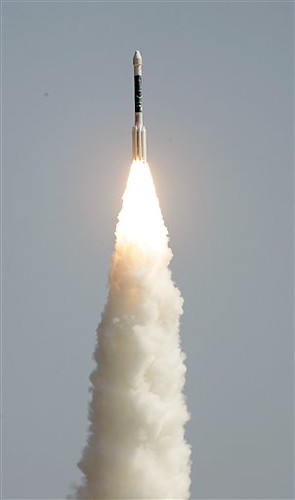
Watched the Delta II launch a GPS payload yesterday, live on HD-Net. Gorgeous launch on a beautiful day at Cape Canaveral Air Force Station in Florida. Seeing it in HDTV does make a difference.

Boeing’s workhouse did its job:

The Delta II rocket carrying the GPS IIR-15 (M) spacecraft lifted off from Space Launch Complex 17A at Cape Canaveral Air Force Station, Fla., at 2:50 p.m. EDT, Sept. 24. Following a nominal 68-minute flight, the rocket deployed the satellite to a transfer orbit.

The Boeing Delta II 7925-9.5 configuration vehicle used for today’s mission featured a Boeing first stage booster powered by a Pratt & Whitney Rocketdyne RS-27A main engine and nine Alliant Techsystems (ATK) solid rocket boosters. An Aerojet AJ10-118K engine powered the storable propellant restartable second stage. A Thiokol Star-48B solid rocket motor propelled the third stage prior to spacecraft deployment. The rocket also flew with a nine-and-a-half-foot-diameter Boeing payload fairing.

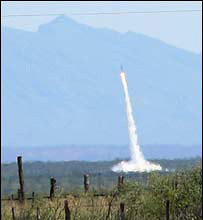
Monday’s other launch event, at Spaceport America in New Mexico, did not do as well. The SpaceLoft XL1 rocket failed at around 40,000 feet, eliciting this gem of a quote from launch logistical coordinator Tracey Larson:

"If it was easy, everyone would be doing it."