Archive for the ‘Observation’ Category

Optus Satellite Fueled for Launch in October

Monday, September 25th, 2006

Seems the next Ariane 5 launch is now scheduled for 12 October 2006.

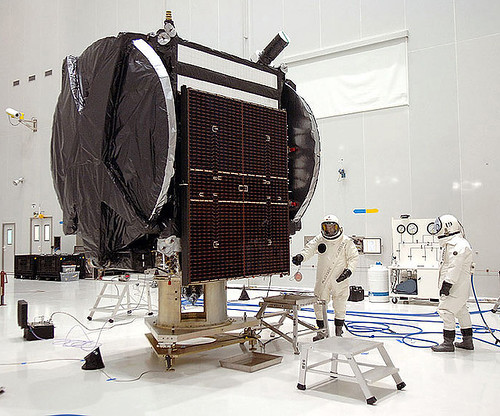
Here’s one of the rocket’s "passengers" being fueled. Evidently, rocket science is still a dangerous business…

TV on Wheels

Monday, September 25th, 2006

We’ve written recently about DIY techniques for getting satellite reception on your RV. But doing it yourself, we readily admit, requires actually doing something yourself, which can be a drag (especially on Mondays!) .

Sometimes, after all, you just want to lean back and have the sort of unbridled fun that the guys in the photo to the right are clearly having.

Luckily for the want-it-now crowd, there are several consumer options already on the market that will bring you (or, more precisely and safely, your passengers) satellite television reception in your minivan or SUV while you barrel down the interstate.

One such system is RaySat’s T5 low-profile in-motion satellite antenna,  which "can work across multiple Ku-Band frequencies (factory option) in either linear or circular polarization (field option) and operate over many geographical regions, multiple satellites and any DTH (dedicated) infrastructure." Another system — the TracVision A7 mobile satellite system — is now being offered by DIRECTV, which also offers a mobile programming option:

Recognizing the growing interest among American motorists who want the same DIRECTV entertainment experience in their cars that they have in their homes, DIRECTV is now delivering to car video screens live local news, weather, traffic, sports and other local entertainment programming.

Local broadcast channels via DIRECTV are now available to mobile customers on the open road within the continental United States to vehicles that have been equipped with a TracVision A7 mobile satellite TV system, launched today by KVH Industries, Inc. DIRECTV will provide mobile customers their local broadcast channels within the designated market areas where it already offers them to home viewers. Local channels availability may vary by market. DIRECTV delivers local programming in 142 markets, representing 94 percent of U.S. television households.

DIRECTV’s TOTAL CHOICE(R) Mobile with local channels package, created exclusively for mobile customers with a low-profile automotive TracVision system, is available for $44.99, and offers more than 185 channels. To receive local channels in their car, DIRECTV customers must purchase a new TracVision A7 satellite TV system, which includes an integrated GPS unit and new 12-volt receiver jointly developed by DIRECTV and KVH.

The mobile local channels offering is part of a larger strategy by DIRECTV to target the more than 20 million U.S. vehicles expected to have in-vehicle passenger video systems by 2011, according to the leading analyst firm Frost & Sullivan.

Delivering uninterrupted satellite reception while an antenna moves at nearly 70 miles per hour is no simple engineering feat, which helps explain why the KVH system is loaded with patents.

It also helps explain why the system will currently set you back about 3,000 clams. (To keep a low wind profile, it looks like a clam, too.)

Just remember, though, that 20 million vehicles are expected to have such a system in place by 2011. So keep your eyes on the road.
 

Rescuing Inflight Broadband

Thursday, September 21st, 2006


According to Shephard Group’s Inflight-Online, Panasonic Avionics wants to offer the same inflight broadband service being shut down by Connexion by Boeing:

JUST when the Inmarsat community was relishing the prospect of an unobstructed run at the passenger broadband market, Panasonic has announced a plan to take up where Connexion by Boeing left off. The IFE giant has no intention of rushing in, though, and will not launch unless it has commitments covering a critical mass of aircraft. 

“We have a complete system designed, developed and ready to go,” strategic marketing director David Bruner told Inflight Online at the WAEA show in Miami Beach last week. “But we’re determined to avoid one of the things that brought Connexion down – lack of an initial fleet big enough to assure acceptable pricing for the airlines.”

Panasonic has set about securing agreements covering a minimum of 500 aircraft in the next 60 days. That schedule is being driven by the need to be ready to serve ex-Connexion airlines within a tolerable time after the discontinuation of that service by the end of the year. “We can’t drag our launch decision on until, say, February,” Bruner said. “There will inevitably be a dark period between the end of Connexion and the start of our service, and we want to keep that as short as possible. We already have 150 aircraft committed and feel confident we’ll make the 500. But if we’re falling badly short in 60 days’ time we will not go.”

Early takers would enjoy significant advantages over airlines that were slower of the mark, Bruner said. “In return for a minimum five-year commitment we’ll reward our launch customers with very preferential service pricing, and they will also get priority access to bandwidth.”

Panasonic’s standard wholesale price to the airlines would represent a comparatively small premium on terrestrial broadband access tariffs, Bruner said. “So far we are seeing little indication that the airlines are planning to mark this up for passengers. It’s a service they want to offer – they don’t currently see it as a revenue-generator.”

The new offering is designed to be as attractive as possible to airlines that are already equipped for Connexion. “Our solution for them is to replace only the modem on the aircraft and leave all the rest of the hardware, including the antenna, in place,” said Bruner. “That will spare them the expense of reversing the Connexion installations and then putting in our definitive equipment suite.”

That includes a compact Ku-band antenna from Californian-based L-3 Datron Advanced Technologies. Another L-3 Communications operation, the Linkabit division, is supplying the modem. Both are already fully developed for US military applications and have been modified for civil use by removing the encryption provision. Working with an existing Ku-band satellite system, the hardware is capable of delivering 12Mbit/sec to the aircraft and 3Mbit/sec in the opposite direction, according to Bruner.

Panasonic has selected a single Ku-band satellite operator to provide transponder capacity and geographical coverage at least equivalent to Connexion’s. “With an initial fleet of 500 aircraft we would anyway pay significantly less for transponders than Connexion,” Bruner pointed out. “But our technical solution will also be more efficient than theirs, allowing us to put more traffic through each transponder and thus reduce our total requirement for satellite capacity.”

Panasonic saw itself as a system designer and integrator and had no intention of incurring the costs associated with being a service provider, Bruner said. The as yet unidentified satellite operator would be responsible for system management, operation and capacity planning, and Panasonic is in talks with a global wireless roaming company for the provision of services such as customer care, billing and retail promotion. 

“We’re intent on learning from what happened to Connexion,” said Bruner. “9/11 lost them their start-up fleet, and after that they were always struggling to catch up. Our onboard equipment is lighter and cheaper, and our approach to buying transponder capacity is altogether more economical. We think these advantages will persuade the airlines and that in a couple of months’ time we’ll be ready to go ahead.”

Should the magic 500 not be achieved, however, Panasonic will continue to look for another way into connectivity. “If Ku-band proves not to make sense after all, then we’ll go down another path,” Bruner concluded.

At least one other passenger communications provider will be watching developments carefully. AeroMobile is currently to committed to L-band operator Inmarsat as the bearer system for its soon to be introduced onboard cellphone offering. But it is also looking to offer email and Internet/VPN access in the longer term, and would be open to integration with the Panasonic Ku-band system in the same way its new GSM/GPRS cellular offering is being integrated with the company’s onboard IFE infrastructure.

“We’re completely agnostic when it comes to air-to-ground data pipes,” commented AeroMobile strategic relationships and marketing director David Coiley. “In the end we could find ourselves working with Inmarsat, Panasonic and even the AirCell terrestrial broadband system in North America.”


Although some still have doubts, Australian airline Qantas is moving forward with their test.

Walkie Talkie via IP

Thursday, September 21st, 2006

We’ve written before about the nexus between IPTV and satellite communications technology, including SES Americom’s IP-PRIME (which recently signed up more than 120 channels through transport agreements with leading television programmers and networks) — but what about IP Radio?

Companies like Barix (whose consumer products can be viewed here) utilize IP radio and satellite technology for IP connections as a backup against studio power outages, as Radio World reports:

Barix AG said Clear Channel Satellite Services is using its products for point-to-multipoint IP connectivity from Englewood, Colo., to Clear Channel radio towers in the southeastern United States….

The system was launched in June in advance of the hurricane season and connects stations in the Gulf region. Stations there “now can remain on the air in the event that studios go dark in extreme weather or other disaster conditions, allowing stations to broadcast important information to local populations in emergency situations,” the supplier stated.

Englewood streams audio to towers sites in preparation for broadcast should studios experience power outages. Barionets at those sites are used to activate and switch the Exstreamer backup audio feed for transmission over the air. The latter devices are controlled from Englewood via the IP connection established over the satellite.

Stations in Texas, Louisiana, Alabama, Mississippi, Florida, Georgia, and the Carolinas are connected; the broadcast group hopes to expand the system to around 900 towers over the next year.

Such systems provide important redundancy to over-the-air broadcasts, but radio (eh, Marconi?) is not just about broadcasting from one to many — it’s about multi-point, multi-way communications, as well.

Which, when you think about it, is exactly the model upon which internet protocol is designed. So why aren’t we seeing more IP Walkie Talkies?

Well, we may soon. Cisco last fall announced technology and a new business unit "focused on integrating two-way radio, cellular, VoIP and other communications methods into an IP backbone:"

 The IP Interoperability and Collaboration System (IPICS) consists of existing Cisco products and new server software that Cisco says will let public safety organizations and companies IP-enable two-way radio voice traffic and integrate disparate radio infrastructures with other public safety or private organizations.

While initially focused on public safety and government users – patching together systems of separate police, fire and governmental organizations, for example – Cisco says the IPICS platform will appeal to a broad range of public and private enterprise customers because the system also is capable of integrating disparate data and video signals with an IP infrastructure.

"[IPICS] is not a communications system in itself; it’s something that enables disparate communication systems out there to work together in an IP format," says Brad Curran, an industry analyst with Frost and Sullivan who tracks government and military communications technology industries.

Cisco Systems president and Chairman  John Chambers recently gave the keynote address (more info here) and a demonstration of IPICS at the Security Standard Conference in Boston:

IPICS focuses on voice interoperability across multiple networks, and provides services for user management, policy creation, and integration of diverse PTT devices. But Chambers said its underlying architecture would enable IPICS to extend beyond voice to provide complete information-based interoperability and collaboration, with the contextual integration of voice, video, and data resources.

The potential for a company as large as Cisco to transform IP Radio and push past the barriers of interoperability should not be underestimated. Indeed, it could be as transformative as radio itself.

Before radio, after all, instant communications across great distances relied upon point-to-point connections via the telegraph. Today’s networks similarly limit communications to those with devices capable of communicating on those networks. True interoperability — a result of the nexus between satcom, IP and radio — could literally change the way we communicate.

But then, as Rocket Scientists (cough, cough), we’ve always been excited by the potential of new technology. 
China to Launch New Communications Satellite in October

Thursday, September 14th, 2006

We wrote last month about the Chinese launch of their seed-breeding satellite.

Now the Chinese hope to breed lots of new channels for millions of people with the launch of its SinoSat 2 satellite at the end of October:

A Chinese Chang Zheng (Long March) 3B carrier rocket is scheduled to launch the SinoSat 2 (a.k.a. Xinnuo 2), satellite… from Launch Complex 2 at the Xichang Satellite Launch Centre. According to Sun Laiyan, administrator of the China National Space Administration, the Xinnuo 2 large-capacity communications satellite, with an anti-jamming system, will provide direct television broadcasting services to the Chinese mainland, as well as Hong Kong, Macao and Taiwan. On Monday, August 4, the satellite left the production facility after receiving its final checks by the Commission of Science, Technology and Industry for National Defence. Xinnuo 2 is based on the Dongfanghong 4 platform and has been designed to work with the ChinaSat 9 satellite in the same orbit, to provide communications services to the Chinese mainland. The ChinaSat 9 satellite is based on the Spacebus 4000 C1 platform and will be positioned at 92.2 degrees east. The Xinnuo 2 satellite, which has taken China six years to develop, is designed to have a lifespan of 15 years, and operated in geosynchronous orbit at 110.5 deg E. China has managed to launch 70 satellites since the 1970’s, of which, currently only 20 are still in service today.

China Daily has additonal information on how the Chinasat 9 and Sinosat 2 satellites will improve television coverage in local areas; the Asia-Pacific Broadcasting Union notes that the new satellite will provide up to 300 million mainland households with "access to cable-quality TV services that have so far been restricted to China’s more urban areas."

The launch of SinoSat 9 comes just in time a new cultural great leap forward in China, as January, 2007 will bring the introduction of a Chinese version of America’s Next Top Model to Chinese television.

(The photo above shows the areas of coverage for the new satellite.)

Lockheed Pulls Out of Russian J.V.

Friday, September 8th, 2006

As reported in this morning’s Kommersant (Коммерсантъ):

The Lockheed Martin Corp. announced yesterday that it will withdraw from the Russian-American joint venture that markets Russian Proton rockets. The company cited the rising prices being demanded by the rockets maker, the Khrunichev State Space Research Center, and a number of unfulfilled obligations of the center, as the motivation for its decision. In the 11 years of its existence, the International Launch Services sold 37 Proton rockets for a total of $2.5 billion.

Lockheed Martin said yesterday that Space Transport Inc., a company registered in the Virgin Islands, would be the purchaser of its shares in ILS as well as Lockheed Khrunichev Energia International. A source in the Russian space industry said that Space Transport was being launched as a temporary holder of the assets Lockheed is selling. Eventually, those assets will be bought by Khrunichev, apparently with Vneshtorgbank acting as creditor. The value of the deal was estimated by the source as about $150 million. He added that the ILS would remain as a company registered in the United States and would also market Khrunichev’s new Angara rocket in the future. Lockheed Martin will sell its Atlas rockets through its Lockheed Martin Commercial Launch Services.

ILS has 11 open contracts for launches with a value of $500 million. At the center, they told Kommersant yesterday that they expect orders to increase. Analysts also predict that the industry will have a healthy growth rate in the next several years. Vitaly Davydov, deputy head of Roscosmos, the Russian space agency, predicted recently that Russian rockets account for 40 percent of the world market. Roscosmos press secretary Igor Panarin commented to Kommersant yesterday that “Lockheed Martin’s decision will not affect Russian interests in launch services in the least. On the contrary, it will strengthen bilateral relations between Russia and the U.S. in the space field.” Khrunichev press secretary Alexander Bobrenev concurred, saying that “The Russian side will continue marketing the Proton and Angara carrier rockets. We are capable of meeting our obligations to our clients.”

A Lockheed Martin spokesman told Kommersant that that ending its partnership with Khrunichev was a purely business decision and does not affect its joint ventures with other Russian enterprises, such as Energomash. “Our collaboration with them [Khrunichev] was very fruitful and we still have projects that we will possibly work on jointly in the future,” the spokesman said.

Kommersant has learned that Lockheed informed Khrunichev of its intentions to pull out of the joint business in May. The official explanation for the move is a change in Lockheed’s marketing strategy. “After analyzing conditions on the world market, we decided to concentrate on launches of satellites with masses of 4.5-6.5 tons,” ILS president Dr. Mark Albrecht said in June. In essence, that means that Lockheed has decided to leave the commercial market in favor of more profitable state orders. Boeing made the same decision in 2003. Of the 11 Proton launches in the last three years only five of them were heavier then 4.5 tons.

Another source at Lockheed said that the company disagreed with Khrunichev’s decision to raise the price of the rockets by 15 percent, to $45-50 million each, to pay for the services of an intermediary to conclude contracts with ILS. ILS also received 15 percent of every contract. Another source of contention was $68 million that Lockheed paid in 1999 under an agreement to market the new Angara rocket. The first launch of that rocket was to take place in 2003, but now plans call for the first launch in 2010. “Lockheed Martin will consider its investment in the purchase of the marketing rights to the Angara and include them in the cost of its package in ILS and LKEI,” a source said.

DIY Friday: Satellite Reception on the Move

Friday, September 8th, 2006

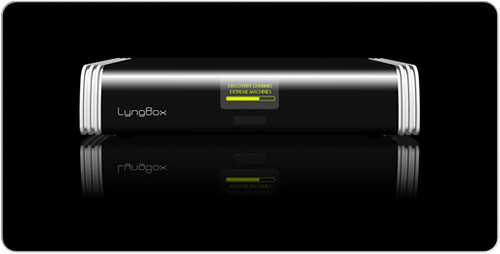
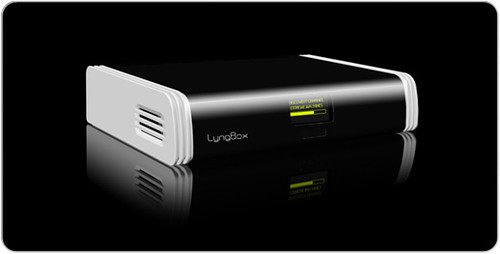
On Wednesday, Rocco scooped the world with the first photographs of the Lyngbox, which was officially unveiled today in Europe.

What makes the Lyngbox "officially cool" by Really Rocket Science standards is its database of worldwide satellite ladder charts, which essentially allows users to "plug and play" the Lyngbox anywhere in the world. Travelling from London to Capetown? Just bring your Lyngbox with you, plug it in, peruse the database, and within moments you’ll be watching the local satellite channels.

Of course, there has always been an alternative to purchasing cool gadgets — and that alternative is to Do It Yourself. This site has long offered instructions on Satellite for Caravans — how you can rig your RV (or car or "caravan") and stay connected to the world of satellite TV while on the road in Europe: 

You will not get a picture by simply waving the dish around; the digibox has to decode the signal before a picture can appear for the first time and that can take a couple of minutes or more. So if you just swing the dish around, you’ll have already moved it out of the signal again long before the picture has a chance to appear. Providing you know the technique however, it is fairly straightforward to tune in a digital system and once you’ve got the hang of it you would be very unlucky if it took longer than about 5 minutes. I’ve had people writing to say they got a signal within a few minutes, others took longer. For myself, it normally takes me only a minute or two these days. My own record is 10 seconds – pure fluke, I stuck the dish on its mast and obtained an immediate signal – just happened to point it in precisely the right direction first time!

You’ll need a satellite dish, a digibox, and a TV (don’t forget that) to catch signals while on the road from Astra or Sky:

 The Astra 2 system consists of 3 satellites close together in space so that your dish will ‘see’ all of them as if they were a single unit. All 3 transmit signals aimed at Europe but the coverage on the ground varies considerably. The 2 older satellites, 2A and 2B, can be thought of as flood lights, lighting up a huge area of Europe, whereas the newer Astra 2D is more like a spot light focused on the British Isles. For the sake of convenience the signals are referred to as the north beam, south beam and narrow beam (or more usually just the 2D beam).

If all of this is sounding confusing, the alternative to DIY is always to buy. Newsfactor magazine has a great article on gadgets available to bring you satellite content while in the fast lane, including some DIY tips for acquiring satellite radio in the U.S.:

Do-it-yourselfers have plenty of options too. There are two ways to go with DIY satellite radio: purchasing a car stereo with satellite radio built-in (requires professional installation) or purchasing a dashboard mounted controller that uses a vacant FM frequency to provide the satellite programming.

Dashboard-mounted models, such as the Delphi Roady XT ($79.99) or the Sirius Sportster Replay radio ($139.99), plug into the vehicle’s cigarette adapter and use a roof mounted magnetic antenna to capture the satellite signal. There is a caveat: as a vehicle travels over long distances an FM channel may no longer be unused and available for satellite signals, so the satellite signal will lose clarity as the FM signal gains strength. At that point, a new vacant FM frequency will have to be selected to improve satellite signal clarity. In spite of the limitations, these dash-mounted models provide a quick way to get satellite radio without having to install a compatible stereo system professionally.

So when it comes to acquiring satellite signals while on the road, the question is not whether or not you can receive them. The question is simply: DIY or buy?

New Satellite Receiver Stores 50,000 Channels; Can Be Used Worldwide

Wednesday, September 6th, 2006

Most “satellite people” are very familiar with the Lyngsat Web site. It could very well be the world’s most complete database of accurate satellite ladder charts. Pick a satellite and you can view all the channels available for viewing. For example, the AMC-4 satellite carries a number faith-based and international channels in North America. On another site, LyngSat Address, select a country and you can find out which satellites their channels are using for broadcasting – in their home market and internationally. TV Prima Romania, for instance, is using several satellites over Europe, Asia and the Atlantic.

Get ready for the LyngBox.

We were tipped off by a Polish Web site in February about a new project involving LyngSat for a “super receiver” based on the DVB-S2 standard, but also capable of receiving DVB-T and decoding HDTV:

Christian Lyngemark – właściciel legendarnego serwisu satelitarnego www.lyngsat.com – zamierza wprowadzić na rynek "superodbiornik" HD combo DVB-S/DVB-T.

Projekt prowadzony jest przez firmę Lyngsat Media AB i Europejską Agencję Kosmiczną ESA. Najważniejsze cechy planowanego odbiornika to dwie głowice – satelitarna i naziemna, odbiór w nowym standardzie DVBS2, dekodowanie zarówno MPEG-2 jak i MPEG-4 oraz dysk do zgrywania programów.

Największą nowością ma być łączność przez internet z portalem www.lyngsat.com i automatyczne aktualizowanie listy programów satelitarnych.


The Swedish National Space Board found it interesting as well:

Lyngbox är ett av de företag som för första gången 2005 genomför projekt med Rymdstyrelsens stöd. Lyngbox utvecklar ett intressant koncept för att via en databas på Internet automatiskt ställa in kanalerna på satellit-TV-mottagare, oberoende av var I världen man befinner sig.

More than a little intrigued, we looked it up and found it: a European Space Agency (ESA) project, for a telecom application called “LyngBox.” They set out to build a satellite receiver last July that would be able to continuously update itself from data published on the Internet. Brilliant. The ESA and Hollycroft Associates got together with LyngSat to develop this new “super satcom box” and got into the development work last December. Could they be using some of the new chips introduced at CES? According to the Swedish patent filing (see PDF, page 26) from earlier this year, this receiver can do it all.

With the patent issued, Lyngbox is set to debut at the IBC show in Amsterdam on Friday, 8 September 2006. Along with a 160-gig drive, it has all the features you’d expect:

Features:
> Can store up to 50,000 channels
> Free access to all LyngSat Network services (LyngSat, LyngSat Guide and LyngSat Maps) with exclusivity to the LyngBox. No other receiver has access to these services
> Always corrects channel names, not relying on service names in the DVB stream
> Family user profiles and parental lock. Each user can have their own selection of channels based on countries, languages and genres which will be updated automatically
> HDTV support (720p and 1080i)
> Supports H.264/MPEG-4 AVC and MPEG-2
> Built-in tuners for both satellite TV (DVB-S/DVB-S2) and terrestrial TV (DVB-T)
> Internal slot system which makes it possible to install an additional tuner card
> 4:3 and 16:9 TV screen format support
> Teletext decoding
> Dual Common Interface slots for use with pay-TV channels
> PVR functionality with hard disk
> Possibilities to store recordings on an external DVD recorder connected with USB2
> DiSEqC 1.2 support for controlling LNB and motorised dish
> Remote control as standard and a wireless remote keyboard as accessories
> Channel selection by typing the name of the channel on the keyboard
> View images from a digital camera connected to the LyngBox

Interfaces:
> DVB-S2 input
> DVB-T input + output (pass-through)
> Expansion slot for additional tuner card
> 2 Common Interface slots
> HDMI-output.
> Component output
> Composite output
> SCART output (RGB and composite)
> S/PDIF optical output with AC-3 support
> Stereo audio (2 RCA)
> 4 USB 2.0 ports
> Ethernet connection (100BaseT)


The UAV Invasion

Wednesday, August 30th, 2006

I’m picturing a sky filled with flying robots. Believe me, I’m not being paranoid here. I know I keep going on and on and on about them, but they seem to be everywhere lately. Everyone’s using them for something, and building better versions of them every day.

Remember that competition in Europe? Remember that European robotics contest back in May, that featured flying robots (a/k/a UAVs)? Turns out there was one that took place stateside back in July, in Fort Benning, GA: the International Aerial Robotics Competition.

The winners were a team of students from the South Dakota School of Mines and Technology. And this after losing their primary remote-controlled helicopter. Luckily they waited a few hours after the final competition to crash their back-up device.

sduav4Long days and sleepless nights paid off for a team of students at South Dakota School of Mines & Technology that finished first in the International Aerial Robotics Competition at Fort Benning, Ga., July 24-27.

The team rebounded from the loss of its primary remote-controlled helicopter only to crash its backup helicopter within hours of the final round of competition.

“Not many of us slept before it (the competition),” team manager D.J. Kjar of Custer said. He said some team members worked 43 consecutive hours, slept for five to six hours … and then went back at it.”

…After crashing the primary helicopter two weeks before the event, the team’s backup helicopter was wrecked during a practice flight when its engine failed the day before the flight competition.

Tech learned at a banquet the night before the flight contest that it was leading with firsts in best paper, best presentation and best team T-shirt design.

“That really renewed everybody’s strength,” Kjar said. The team worked all night to rebuild the helicopter.

Tech and the University of Alabama had the only vehicles that successfully completed the flight course.

The South Dakota team has website featuring photos and videos of their robots in flight.

One of the South Dakota students quoted in the article above mentioned that this technology might have potential for military use. Um, yeah. Turns out the Army already has one — called the Shadow 200 TUAV — zipping around the skies above Alaska.

shadowtuav

There’s photos and videos of that one in action too.

Now, if you’ll excuse me, there’s a buzzing I keep hearing outside my window and I must investigate…

How’d They Get That Shot?

Wednesday, August 30th, 2006

More UAV posting. Have you ever watched a movie or even a television commercial and asked "How’d they get that shot?" I know I have, and I usually find myself wondering just how they maneuvered a helicopter to get that shot. Until now I thought that maybe it was due some pilots with very steady hands. Now it turns out there aren’t any pilots at all.

Companies like 1 Advanced Technologies employ UAVs (those flying robots that haunt my dreams) to get some of the best shots in film and television. But some of these shots would be impossible with a helicopter. (Where’s the wind?) That’s where this little thing comes in.

I don’t know what it’s called, but it gets into some tight spots that no manned aerial vehicle could, to produce the kinds of visual shots that we pretty much take for granted. And I won’t even get into the maneuvers it makes possible. I’m not sure how it all happens, but the company has a video demo on its "Film Industry" page that shows this flying robot in action, making movie and commercial magic (OK, "commercial magic is probably a stretch) you might have seen before.