Archive for the ‘Observation’ Category

Flying Robots & Free Fuel?

Monday, August 28th, 2006

I don’t mean to go on about those flying robots. You know, the ones with the tentacles? In Europe? Yeah, those. I don’t mean to go on about them, but they always seem to be in the news.

This time they’re going by a different name: Stratellites. And they’re taking up a new function: wi-fi.

StratelliteBob Jones has a lofty idea for improving communications around the world: Strategically float robotic airships above Earth as an alternative to unsightly telecom towers on the ground and expensive satellites in space.

Jones, a former NASA manager, envisions a fleet of unmanned “Stratellites” hovering in the atmosphere and blanketing large swaths of territory with wireless access for high-speed data and voice communications.

…Jones believes his solar-powered, helium-filled Stratellites _ so named because they would hang in the stratosphere — could replace unsightly cell towers and cost less than satellites. Because of the airship’s altitude according to Jones, its radio equipment can cover an area the size of Texas.

Cell towers are hampered by line-of-sight limitations and limited range. Geostationary satellites suffer from the quarter-second it takes a signal to travel out 22,300 miles and back — insignificant in one-way TV transmissions, but terrible for two-way Internet computer communications.

The idea bubbled up and popped around the same time as the dot.com bust, yet it may be an idea whose time has come again. If so, Jones might want to consider some alternative fuels for getting his stratellites aloft.
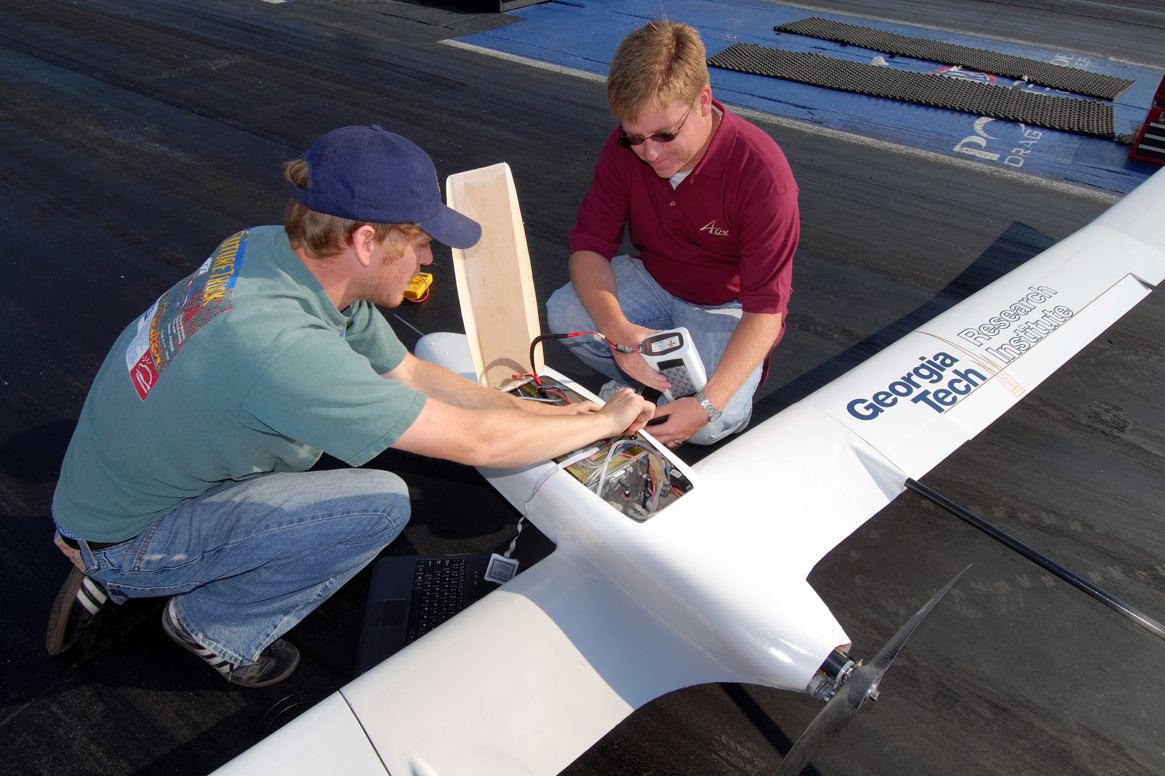

Fuel Cell UAV

For example, he might look into fuel cells. These guys at the Georgia Institute of Technology got their flying robot aloft using a hydrogen fuel cell. And if hydrogen is cost prohibitive, Boing Boing says this company has build a machine that generates free energy.

Then again, if the comments and tags on that Google video are right, maybe not.

Katrina: How Satcom Walked the Talk

Monday, August 28th, 2006

Hurricane Katrina was the costliest storm in American history, which occurred during what became one of the nation’s busiest hurricane seasons. The category 5 hurricane hit the Gulf of Mexico’s northern coastlilne on 29 August 2005, including the city of Biloxi, Miss.

Sustained winds of approximately 150 miles per hour, accompanied by its rain and storm surge, caused catastrophic flooding in Biloxi – dozens of feet above and further inland than normal – destroying important terrestrial infrastructures vital for adequate shelter, economic sustainability and civic functions. Homes, office buildings, telephone poles, hospitals, television and cell phone antennas, government headquarters and places of worship, were completely flattened.

Since most of the area’s terrestrial-based forms of communication had been destroyed and were near useless, a satellite-based WiMAX (Worldwide Interoperability for Microwave Access) WAN (Wide Area Network) communication network for the city of Biloxi was a viable option. WiMAX is a wireless communications technology that provides high-throughput broadband connections for considerably longer distances than that offered via a WiFi (Wireless Fidelity) LAN (Local Area Network) network.

Motivated to immediately help in relief efforts after the hurricane dissipated, Craig McCaw, who through his investment company Eagle River, has an ownership in Clearwire, offered the Clearwire WiMAX service to government leaders in Mississippi in order to provide the needed communications after the hurricane. Clearwire is a high-speed, wireless broadband Internet service provider. SES AMERICOM was then contacted to join in his quest to help reestablish Biloxi’s communication network.

SES AMERICOM employees were dispatched to Biloxi, and immediately installed and connected two-way satellite ground stations called VSATs (Very Small Aperture Terminals) to Clearwire’s WiMAX towers. Relief agencies, hospitals, fire, police as well as businesses and residences within the established WiMAX network were able to get reliable, 24×7 voice and data connectivity to the outside world via this hybrid satellite/WiMAX network.

It’s experiences like these that prompted the Satellite Industry Association to publish a "First Reponder’s Guide to Satellite Communications" earlier this summer.

A year later, businesses in the area are still squabbling over what resources get restored first.

Webinar on Satellite Communications

Thursday, August 24th, 2006

Here’s a plug: SES AMERICOM is presenting a Webinar next Tuesday called "Satcom Talk" — a discussion of how businesses are using a mix of both land-based and space-based communications.  As new and innovative technologies continue to evolve and converge with established approaches, enhanced business solutions are developing in:  

  • Corporate Communications and Intranets
  • Training and Distance Learning
  • File Transfers and Information Delivery
  • Inventory Management
  • News Media and Financial Market Updates
  • Business Continuity and Disaster Recovery

Tuesday, 29 August 2006 @ 11:30 a.m. EDT (15:30 GMT). Click here for more details and how to register.

Construction to Resume on Space Station

Tuesday, August 22nd, 2006

"For more than three years, the International Space Station has floated half-built above the Earth. Maintained by a skeleton crew, the station — an assemblage of modules and girders — has not come close to its stated goal of becoming a world-class research outpost," the New York Times reports.

But the long break in building out the International Space Station— a result of the grounding of the space shuttle fleet following the Columbia disaster— is about to come to an end:

Since the project began in late 1998 with the joining of two American and Russian modules, the United States and 15 other nations have slowly put together a structure that weighs more than 400,000 pounds, with a habitable volume of almost 15,000 cubic feet. When completed, it is to weigh almost a million pounds and have a cabin volume of more than 33,000 cubic feet, larger than a typical five-bedroom house.

Getting to that goal will require some of the most difficult shuttle missions ever mounted by the National Aeronautics and Space Administration, starting with the Atlantis’s launching from the Kennedy Space Center at Cape Canaveral, Fla [next Sunday]. The shuttle and its crew of six will haul a 30,000-pound, 45-foot truss segment to the station, delicately remove it from the cargo bay and install it during three spacewalks by two teams of astronauts….

NASA has allotted about 15 flights to complete the project before the shuttles are retired in 2010. The next four missions will carry other massive truss segments to extend the station’s central girder to more than 350 feet. The girder will eventually support four huge sets of solar-power arrays, batteries and heat-dispensing radiators.

The additional truss segments, which will increase the mass of the station by 40 tons, will also include 10-foot-wide rotary joints shaped like wagon wheels that will allow the solar arrays to track the sun for optimum power as the station moves in orbit. The Atlantis is delivering the second array, joining one put on the station in 2000.

You can learn more about the International Space Station here

Mugunghwa ho ga uhjea balsa hesamnida (Koreasat Launched)

Tuesday, August 22nd, 2006

Sea Launch launched the Koreasat 5 satellite last night from a converted oil platform in the Pacific Ocean, 1500 miles south of Hawaii. Named after the Korean national flower, Mugunghwa, the satellite will be replacing Koreasat 2. Incidently, the number 4 was skipped when naming this satelite (4 is a very unlucky number in Korea; its pronunciation is similar to the pronunciation of the Chinese character for Death). The satellite itself has a very interesting payload.


Koreasat-5 to Launch Tonight

Monday, August 21st, 2006

As we reported last week, SeaLaunch is set to lift the Koreasat-5 communications satellite from its launch facility in the Pacific this evening.


The Korea Times reports: 

KT, South Korea’s largest fixedline and broadband operator, said Monday that it will send its fourth commercial satellite into orbit from the Pacific Ocean this week, marking the nation’s first satellite launch from the open sea.

The Koreasat-5 will be launched at 12:27 p.m. Tuesday [8:27 p.m. U.S. Pacific time on Monday evening] from an area south of Hawaii. The launch will be controlled by an assembly and command ship and a launch platform ship, KT said.

The satellite will replace the Koreasat-2 satellite in providing wireless communications and broadcasting services, the company said.

Unlike previous KT satellites that helped telecommunications in local areas, the Koreasat- 5 will cover other Asian countries, including Japan, China, the Philippines and Taiwan.

The satellite will start its service after four months of testing, it added.

 The SeaLaunch Mission page can be found here.

Real Russian Rocket Report

Tuesday, August 15th, 2006

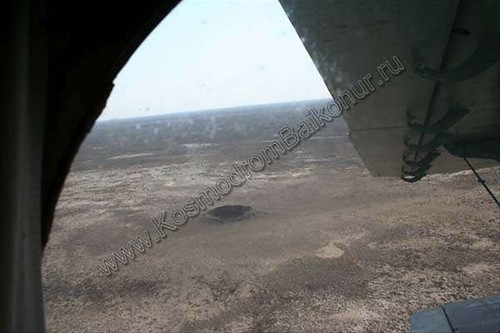
Last month’s Dnepr rocket crash in Kazakhstan, which destroyed Montana’s first satellite, blasted a crater 165 feet wide and 50 feet deep. Fortunately, there were no injuries or fatalities in the vast arid steppes near the Uzbek border. What about the environmental damage? Keep in mind most rocket fuel is considered "nasty stuff." According to NBC News space analyst James Oberg, this launch failure’s aftermath is reminiscent of old habits:

Last month’s crash of a Russian Dnepr space booster with 100 tons of toxic rocket propellant poisoned a small corner of the empty steppes in Central Asia — but may have left a wider legacy of bitterness that will impact Russian space activities for years to come.

And whatever the actual cause of the rocket’s embarrassing failure, the poisonous consequences could have been largely avoided if Moscow space officials hadn’t reverted to almost Soviet-style cover-ups and hollow reassurances about the accident.


I found Mr. Oberg’s piece on this topic, featured recently on the MSNBC site, superbly written, accurate and insightful.

Feeling adventurous? Try reading the original report, in Russian, from 31 July 2006. At least you’ll understand the pictures, and the gist of the English translation (scroll down for both).


All Hail Hale

Tuesday, August 15th, 2006

We found NASA’s Picture of the Day on Sunday to be particularly fascinating.

This Mars Global Surveyor (MGS) Mars Orbiter Camera (MOC) image shows dried streambeds—martian gullies— in the mountainous central peak region of Hale Crater. Some scientists have suggested that the fluid which carved these gullies was liquid water, and that it either resulted from ancient snowmelt or from release of groundwater that percolated to the surface in the intensely fractured rock of Hale’s central peak. In either case, the gullies are dry today, and dark sand can be seen as dunes near the right/lower right part of the image.


Arianespace Successfully Launches Twin Satellite Payload; Koreasat 5 to Lift via Sea Launch Next Week

Monday, August 14th, 2006

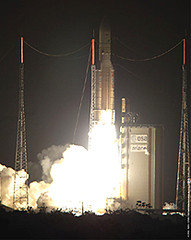
Arianspace’s Friday evening launch of a twin satellite payload, which Spektor previewed last week, was a success. From the mission update:

After an on-time lift-off at 7:15 p.m. from Europe’s Spaceport in French Guiana, the heavy-lift Ariane 5 delivered Japan’s JCSAT-10 telecommunications spacecraft and the European Syracuse 3B secure military relay platform into an accurate geostationary transfer orbit.

Tonight’s flight was Ariane 5’s 28th mission, and marked its 14th consecutive success – underscoring the launcher’s maturity. JCSAT-10 was installed in the upper payload position on Ariane 5, and was released approximately 27 min. into the mission. This was followed some 5 minutes later by the separation of Syracuse 3B, which occupied the lower slot in the payload "stack." 

A series of photographs from the launch can be seen here

In other commercial satellite launch news, Sea Launch will be lifting the Koreasat 5 communications satellite on the evening of August 21st. Sea Launch has provided a nice graphical display of the satellite launche’s profile and groundtrack here.

As always, we’ll have more updates on the launch as it approaches. 

Blast from the Past: Saving Skylab

Friday, August 11th, 2006

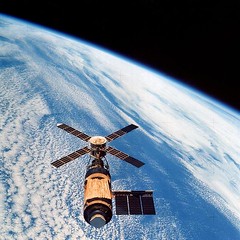
Although Skylab, America’s first space station, fell back to Earth more than 17 years ago, the full-size training mock-up of Skylab is still intact — although in incredible disrepair (and inhabited by several raccoons) —  outside the U.S. Space and Rocket Center near NASA’s Marshall Space Flight Center in Hunstville, Alabama.

Now, a group of volunteers has launched the Skylab Restoration Project with the goal of restoring the training module to its former glory. CNN reports:

Tom Hancock, a board member of the American Institute of Aeronautics and Astronautics, is the leader of the project. He said he is working on the restoration for people like his 18-year-old daughter.

"It’s history. It’s a chance for people my daughter’s age to kick back and see what it was like when I was young," said Hancock.

Made primarily from spare parts left over from the Apollo program, Skylab orbited the Earth for six years beginning in 1973. It helped pave the way for science projects aboard the space shuttle and the International Space Station currently in orbit.

Astronauts learning to live in space trained in Skylab mock-ups at Marshall and the Johnson Space Center in Houston. Three crews of three astronauts each spent a total of 171 days in Skylab, which re-entered the atmosphere in a fiery blaze in 1979.

The Skylab mock-up was displayed for years inside the Space and Rocket Center. But exhibits change, and it was eventually moved outside to a back lot.

 The Skylab Restoration Project is seeking volunteers in the Huntsville area and donations to assist with the project. Visit SaveSkylab.org to learn more and to see "then and now" photos and videos of the Skylab training module.