Satellite Used to Study Effects of General Relativity
Tuesday, February 14th, 2006The Tartan Online, Carnegie-Mellon’s student newspaper, chooses Gravity Probe B as its "Experiment of the Week":
Gravity Probe B, a well-endowed NASA/Stanford satellite, is at this moment orbiting the Earth. The satellite’s main feature is its four perfectly spherical, shiny balls. These balls serve as the world’s most perfect gyroscopes, used in an extraordinarily complex and expensive experiment to observe the effects of general relativity…. Einstein’s theory predicts that a rotating massive body should slowly “frame-drag” space and time around with it. Over time, this dragging effect should push the gyroscope’s axis of rotation about 40 milliarc-seconds out of alignment. That’s the width of a human hair as seen from 10 miles. The probe intends to measure this to an accuracy of one percent.
Stanford University, which is working with NASA on the mission, has a mission status webpage that is worth checking out. Also be sure to check out the vehicle tour and the image gallery, featuring schematics of the satellite and pictures of the launch. What other satellite mission websites have you found? Post a link in the comment, or post your own blog entry, and we may promote your link to the homepage.
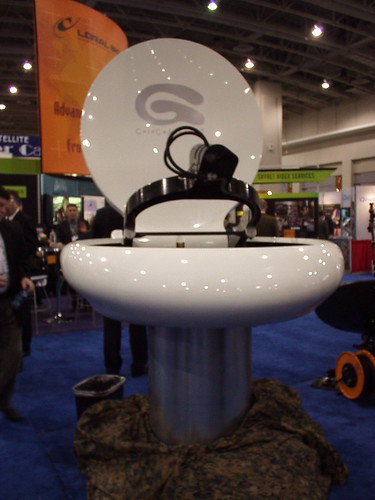
 I’m not exactly what anyone would call a “car guy.” As long as it has four wheels, a radio, and A/C (a necessity in the South), I don’t need to know much more. But when I saw a car at the Sattelite2006 exhibit hall, I figured it must have something to do with satellite radio. Besides, if it involves any sort of gadgetry, that’s enough to get my attention as long as I don’t have to look under the hood.


