Archive for the ‘Observation’ Category

New Falcon 1 Rocket Destroyed on Maiden Voyage

Monday, March 27th, 2006

An engine fire destroyed Space-X’s Falcon 1 rocket on its maiden voyage today, according to reports.
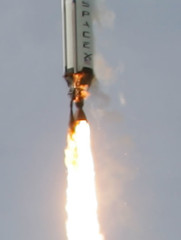
Close up of Falcon 1 Engine Fire The International Reporter has early details:

The US vehicle, developed by the Space Exploration Technologies Corp, was destroyed soon after take-off from the Marshall Islands in the Pacific Ocean. The vision of Elon Musk, co-founder of the electronic payment system PayPal, the Falcon was designed to cut the cost of current satellite launches.

An onboard camera appeared to show the rocket rolling out of control shortly before the video signal was lost….

The rocket was attempting to carry a 19.5kg satellite to a low-Earth orbit of 450km. The satellite, FalconSat-2, was built by US Air Force Academy cadets to investigate the phenomenon known as "space weather".

Elon Musk has additional details on the Space-X blog

The good news is that all vehicle systems, including the main engine, thrust vector control, structures, avionics, software, guidance algorithm, etc. were picture perfect.  Falcon’s trajectory was within 0.2 degrees of nominal during powered flight. 


However, at T+25s, a fuel leak of currently unknown origin caused a fire around the top of the main engine that cut into the first stage helium pneumatic system.  On high resolution imagery, the fire is clearly visible within seconds after liftoff.  Once the pneumatic pressure decayed below a critical value, the spring return safety function of the pre-valves forced them closed, shutting down the main engine at T+29s. 
 

It does not appear as though the first stage insulation played a negative role, nor are any other vehicle anomalies apparent from either the telemetry or imaging.  Falcon was executing perfectly on all fronts until fire impaired the first stage pneumatic system.
 

Our plan at this point is to analyze data and debris to be certain that the above preliminary analysis is correct and then isolate and address all possible causes for the fuel leak.  In addition, we will do another ground up systems review of the entire vehicle to flush out any other potential issues.
 
The company says it is too soon to determine when the next flight will take place. 


Making MobTV Work

Friday, March 24th, 2006

I’ve decided to try my hand at coining a new phrase: mobTV. I figure if mobile blogging can become "moblogging", then mobile television can become "mobTV." Besides, as I’m learning more about it and writing more about it I’m going to need a more efficient way to refer to it if I want to keep up, given the way its spreading and the number of terms I have to learn. 

Since my last post on the mobTV taking off in Korea, it looks like mobTV is coming to China next, if Radioscope has its way.  And on a pretty cool looking phone, if you ask me.

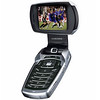
Samsung MobTV PhoneRadioscape has won contracts to supply five more Digital Multimedia Broadcast (DMB) and Enhanced Packet Mode (EPM) transmission systems for mobile TV operators in China, bringing the total to nine in the past few months.

 The company says the contracts are the fruits of at least two years of courting Chinese authorities about its DAB-based mobile TV technology and helping them evaluate the most appropriate technologies for the service, and choosing between DMB, DVB-H and DMB-T.

From there it gets interesting. Qualcomm announced last year that it was bringing mobTV to the states via a  technology called MediaFLO, which Verzion also adopted late last year. For the curious, Mobile Content News has video of MediaFLO in action. (Found via Engadget, and I believe that’s Shrek on the small screen.)  The question is, can it work? The experts aren’t  exactly in agreement. Depending on who you ask, MediaFLO and another technology called DVB-H are doomed because EV-DO already gets the job done and new networks are too expensive to build and support, or DVB-H will be the de facto standard once spectrum allocation problems are solved.

Got all that? Good, because I’m about to add some French to the mix. Alcatel just announced that it’s overcome the spectrum allocation issue by using a satellite frequency.

With the help of satellites, Alcatel aims to overcome a key hurdle in rolling out broadcast television services over mobile phones: the lack of available spectrum. 

The French telecommunications-equipment manufacturer proposes using the widely available S-Band frequency reserved for satellites to transmit broadcast signals both terrestrially and via satellite to mobile phones based on the DVB-H (digital video broadcasting – handheld) standard, instead of the UHF band. 

… The Alcatel proposal calls for equipping base stations with S-Band repeaters and, in addition, using satellites capable of transmitting in the S-Band to deliver content to 3G (third-generation) phones enabled with DVB-H technology in three different ways: base-station streaming, base-station broadcasting and satellite broadcasting.

The article also does a good job of explaining the drawbacks of the three delivery systems. Streaming offers unlimited channels and great indoor coverage, but only for a limited number of users on a network. Broadcast matches it on indoor coverage, and supports unlimited users, but only 27 channels. Satellite matches them on channels and user support, but falls short on indoor coverage. Alcatel claims the answer is an "intelligent content-management system" that seamlessly chooses the right delivery system. 

Leave it to the French to come up with an elegant solution. I just hope it works well enough to eventually get picked up in the U.S. It would be great to catch up on Desperate Housewives reruns on the subway, and get all the way up the street to my office without losing the signal.

Maps in Greater Detail

Monday, March 20th, 2006

Wired has a good article out today on how the next-generation of commercial imaging satellites is going to change, er, the way we view the world– or at least the details of our view:

Critics of overhead imagery services like Google Earth and Microsoft Virtual Earth generally fall into two categories: government agencies who say the services show too much, and users who lament they can’t see more.

As the next generation of commercial imaging satellites moves closer to launch, the first camp may be out of luck.

Forthcoming features such as enhanced zoom capabilities, higher-resolution views and faster updates of stock imagery will reveal far more detail of Earth’s surface than anything visible on a computer screen today. While satellite imagery won’t be real-time, or capable of distinguishing individuals, it will be good enough to pinpoint ground-level details too blurry to identify using today’s technology.

"We’re just starting," said Matthew M. O’Connell, CEO of GeoEye (formerly Orbimage), which plans to launch a satellite in early 2007 that can show images of objects as small as 1.3 feet across. "At that resolution, we can literally count the manhole covers in Manhattan."

Just a few years ago, the idea of zooming in from a PC screen to any point on Earth would have seemed like the stuff of fantasy. Now that it’s reality, satellite and aerial mapping applications are drawing millions of addicted users. Hardly a week goes by without news of some strange or scandalous finding: Last week amateur astronomer Emilio González of Spain used Google Earth to find what might be a previously unknown impact crater in Chad.


Read the whole story here


Rocket Launch Tonight

Thursday, March 9th, 2006

Arianespace is launching two satellites: HOT BIRD 7A and SPAINSAT. I plan to watch it live — on Saturday night.
 
Launch window opens 22:05 GMT  on 11 March 2006 (7:05 p.m. local time in Kourou, French Guiana; 5:05 p.m. in Washington, D.C.). Webcast begins 20 minutes prior.

Kourou is known as Europe’s Spaceport. First settled by the French in 1604, French Guiana was the site of notorious penal settlements (see Devil’s Island) until 1951.

GPS for Lost Pets

Tuesday, March 7th, 2006

Here’s a use for satellites I hadn’t thought of, but wish I had. No matter where you live, chances are you’ve seen "lost pet" signs stapled to telephone poles, stapled to streetlights, or tacked to grocery store bulletin boards. I always wondered if those signs really helped people find pets who’ve been struck with wanderlust. My guess is that it’s probably hit-or-miss. Via Gizmodo comes news of Global Pet Finder, which uses GPS and 2-way wireless technology to help customers find their lost pets. Their customer testimonials don’t mention any lost pets that have been found, but some owners have gotten pet location alerts via SMS, so my guess it that it’s probably more effective than posting signs all over town.

Satellites Track Climate Change

Thursday, March 2nd, 2006

Back in March of 2002, twin satellites launched called GRACE (short for Gravity Recovery and Climate Experiment) were launched by NASA to make detailed measurements of Earth’s gravity field and to the Earth’s natural systems.
Today, MSNBC reports that new data from the satellites reveal that global warming is causing ice loss in Antartica: 


 Joining the growing list of places on this planet that are melting, Antarctica is losing about 36 cubic miles (150 cubic kilometers) of ice every year, scientists reported Thursday.

For comparison, Los Angeles consumes roughly 1 cubic mile of fresh water a year.

The south polar region holds 90 percent of Earth’s ice and 70 percent of the total fresh water on the planet, so any significant pace of melting there is important and could contribute to an already rising sea….

"This is the first study to indicate the total mass balance of the Antarctic ice sheet is in significant decline," said Isabella Velicogna of the University of Colorado at Boulder.

More information on GRACE can be found here


Further Scenes from a Universe

Wednesday, March 1st, 2006

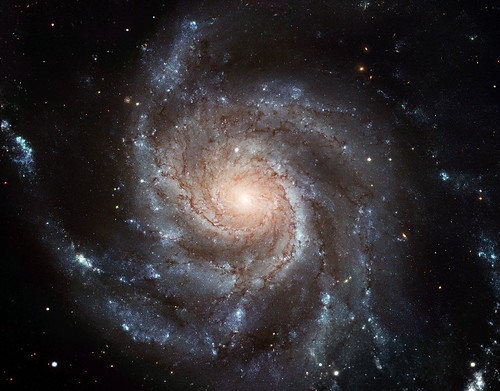
Pinwheel

This time it’s the Hubble telescope, bringing you the Messier 101 spiral galaxy (a/k/a the Pinwheel Galaxy) head-on, in just 51 exposures and coming in at a mere 16,000 by 12,000 pixels

Scenes from a Universe

Tuesday, February 28th, 2006

Gamma Ray BurstUniverse Today has a couple of posts up featuring some fascinting satellite imagery, and even a link to some pretty cool imagination. One features some images of Jupiter, Neptune and Uranus from NASA Astrobiology, while the other concerns a cosmic explosion seen by NASA’s Swift satellite

The Swift satellite, whose mission control center is in State College, has detected a cosmic explosion that has sent scientists around the world scrambling to telescopes to document this startling event. Gamma-ray radiation from the source, detected on 18 February and lasting about half an hour, appears to be a precursor to a supernova, which is the death throes of a star much more massive than the Sun. "The observations indicate that this is an incredibly rare glimpse of an initial gamma-ray burst at the beginning of a supernova," said Peter Brown, a Penn State graduate student and a member of the Swift science team.

The Penn State release also links to a pretty cool collapsing star animation, collapsing stars being one of the "leading contenders" for causing gamma ray bursts like the one Swift detected. Also check out the link to NASA’s Goddard Space Center for multimedia from Goddard TV

Space Archaeology?

Thursday, February 16th, 2006

Who knew that NASA did archaeology? Unless someone’s sifting through the sands of some distant planet for signs of ancient intelligent life, I’ve always thought of archeology as the earthbound realm of the Discovery Channel and maybe Indiana Jones. That is, at least until I read that NASA helped uncover lost Maya ruins in the Central American jungle. 

Remains of the ancient Maya culture, mysteriously destroyed at the height of its reign in the ninth century, have been hidden in the rainforests of Central America for more than 1,000 years. Now, NASA and University of New Hampshire scientists are using space- and aircraft-based “remote-sensing” technology to uncover those ruins, using the chemical signature of the civilization’s ancient building materials.

NASA archaeologist Tom Sever and scientist Dan Irwin, both from NASA’s Marshall Space Flight Center in Huntsville, Ala., are teaming with William Saturno, an archaeologist at the University of New Hampshire, to locate the ruins of the ancient culture. Saturno discovered the oldest known intact Maya mural at the site in 2001.

… Sever has explored the capacity of remote sensing technology and the science of collecting information about the Earth’s surface using aerial or space-based photography to serve archeology. He and Irwin provided Saturno with high-resolution commercial satellite images of the rainforest, and collected data from NASA’s Airborne Synthetic Aperture Radar, an instrument flown aboard a high-altitude weather plane, capable of penetrating clouds, snow and forest canopies.

These resulting Earth observations have helped the team survey an uncharted region around San Bartolo, Guatemala. They discovered a correlation between the color and reflectivity of the vegetation seen in the images – their “signature,” which is captured by instruments measuring light in the visible and near-infrared spectrums – and the location of known archaeological sites.

My first thought was that if it’s possible to be an archaeologist without having to tromp around deserts and rain forests, I might start considering a new line of work. (Those mummy-related specials on Discovery and TLC inspire me.) I did a little searching online and found a bit more information about the research team and their research in Petén, Guatemala. Turns out, it’s still archaeology, so they still had to hack through the jungle — using satellite images to guide them — to “ground test” the data. They uncovered a series of ancient sites, right where the data and images predicted they’d be. 

So much for doing archaeology from a nice, air conditioned, indoor space — which I’m guessing were the conditions at the National Space Science and Technology Center, where Sever and Irwin conducted their space-based research before heading out into the field. Sever and Irwin can use satellites to lead them to ancient ruins, and I’ll wait for the same to beam their findings down to my living room.

Alphabet Soup

Tuesday, February 14th, 2006

One of the things I came away with at Satellite2006 (besides some pretty cool pictures) was a head full of acronyms that I still haven’t sorted out. I was reminded of that when I came across CNet’s “Wireless Alphabet Soup” post. I did a little poking around online, and found even more. I’m not sure how many of these I saw or heard at the conference, but it bears more than a passing resemblance to alphabet soup:

3G, 3GPP, BREW, BSS, CDMA, CDMA2000, CDPD, CME-CU, DVB-H, EDGE, ESS, EV-DO, FLO, GGSN, GPRS, GSM, HDML, HIPERLAN, HSCSD, HSDPA, HSUPA, IM1, MAC, MIMO, PKI, RAN, RASP, RU12, SGSN, TDMA, TD-SCDMA, UMTS, WAP, WCDMA, WEP, WIBRO, WIM, WLAN, WiMax, WTLS

I’m sure there are more that I’ve never even heard of before, but this is enough to wrap my brain around for now. If you know any that got left out, drop ’em in the comments. (And help a newbie out by throwing in a definition or two.)

Oh, and just for fun I made up a few of my own and tossed them in. Can ya find ’em? If so, good. Take notes. I have a feeling there might be a quiz of some sort later.