Archive for the ‘Observation’ Category

Atlas V Rocket to Launch ASTRA 1KR Today

Thursday, April 20th, 2006

ASTRA’s newest satellite will be launched into geosynchronous orbit and will become part of a system that provides television reception to 107 million households in Europe. Launch window opens at 4:27 p.m. EDT (20:27 GMT), and remains opens until 7:16 p.m. (23:16 GMT). Watch the launch live via webcast from launch complex 41 at the Cape Canaveral Air Force Station in Florida. Broadcast begins at 4:05 p.m. (20:05 GMT). Here’s how you can receive it directly via satellite:
 
In North America, AMC-4, transponder 17, C-band analog, 101 degrees West, downlink frequency 4040 MHz (vertical).

In Europe, on ASTRA, transponder 116 on ASTRA 1G at 19.2E with following reception parameters: downlink frequency: 12669.50 MHz / downlink polarization: vertical / transponder transmission rate: 22 MB/s QPSK FEC 5/6; Service name: ASTRA VISION 3

Test signals begin about 3:45 p.m. EDT (19:45 GMT).

If you are not able to watch it, then you can follow it via live text updates.
Space Junk

Wednesday, April 19th, 2006

No, I don’t mean the song by Devo. But there’s gonna be some more junk up there, do you need to get one of those hats the band used to wear back in the day, on the off chance that some of that junk finds it’s way back down here? Apparently the FCC ruled that U.S.-licensed satellites launched after March 22, 2002 have to go into disposal orbit when they’ve beamed down their last signal. The latest is the Spacenet 4 satellite, which was launched in 1985.

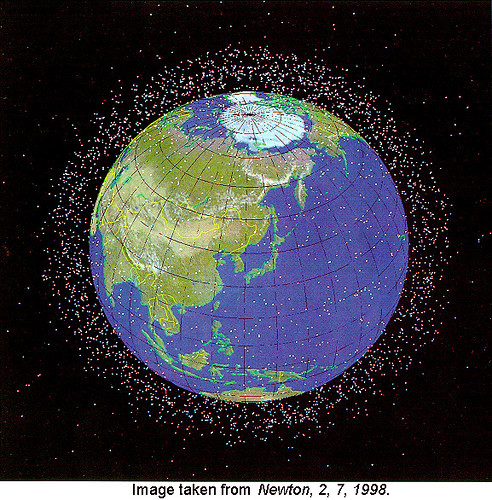
I’ve blogged about the satellite graveyard before, and apparently we’ve left a lot of stuff up there in the past 25 years or so; more than 9,000 man-made objects, which can break into little pieces and cause problems for current space missions. It looks something like this.

Space Junk

I’ve also blogged before about how stuff gets knocked around up there. And it’s not all that unusual for some of it to fall to earth. It can land in your garden, or even on you. Don’t believe me? Ask Devo

She was walking all alone
Down the street in the alley
Her name was sally
She never saw it
When she was hit by space junk

At least now we know why they wore these. 

Space Helmet

Either wear a helmet or practice catching the stuff

I’ll enjoy the latter for now. In the meantime can someone tell me, now that this stuff is up there what are the chances it’s gonna stay up there?

COSMIC Launch

Monday, April 17th, 2006

COSMIC— the Constellation Observing System for Meteorology, Ionosphere and Climate– was successfully launched from Vandenberg Air Force Base in California on Friday night. The AP reports:


Six weather satellites successfully reached orbit and were ready to begin their five-year mission to track hurricanes, monitor climate change and study space weather, it was announced Saturday.

"Ground stations have received signals from all six satellites," according to an update on the Web site for the project’s manager, University Corporation for Atmospheric Research in Boulder, Colo.

The satellites were launched on a rocket booster Friday evening from this Central Coast base. They were placed into orbit about 500 miles above Earth, where they separated to form a chain.

The satellites will take about 2,500 daily measurements by using global positioning receivers to track radio signals passing through the atmosphere, scientists said.

The information gathered will be used to enhance research and improve weather forecasting. Scientists hope the data will help them better track storms and monitor long-term climate change.

The COSMIC web page can be found here


GPS Tracking for Parents

Thursday, April 13th, 2006

Before I had a kid of my own, I used to shake my head at parents who used "tethers," that looked like old fashioned telephone cords, to keep their toddlers from toddling off in public. Three years into parenthood, I haven’t succumbed to the "urge to tether" yet, but I’m a little less judgmental about the whole thing.

I have enough trouble keeping up with my three-year-old now. I’m already wondering how I’m going to keep up with him when he’s a teenager with enough subway fare to go where he wants. The answer is simple than I thought: GPS. If it can help find lost pets, it ought to work with kids too. So, though my little one isn’t big enough for a cell phone yet, I was relieved to read on Mobile Wireless News that Sprint just rolled a GPS-driven kid locator service for parents.

Using the Global Positioning System, the service allows parents to track up to four cell phones over the Internet or on their own wireless device. Parents can periodically ask the service to find the child’s phone, displaying the location on a road map.

Parents can also set alerts, automatically warning the parent if the child isn’t at a certain place, such as school or soccer practice, at a specific time.

The child’s phone also displays a text message, letting the child know they’ve been searched for and found.

Of course, there are other uses, like keeping track of elderly parents (as the article notes) or keeping tabs on a wandering spouse, which leads to charges that Big Brother is in the house.  I guess there’s two sides to every technology, and whether it’s used benevolently or not depends on whose pushing the buttons. But, as a parent, if kids can’t remember to be in the house when the streetlights come on, this seems like a pretty good way to remind them, when yelling down the street isn’t an option.

Satellite Launched at Sea

Thursday, April 13th, 2006

The word from the rocket scientists in Japan is good:
 

JSAT Corporation ("JSAT"; Head office: Chiyoda-ku, Tokyo; President and CEO: Kiyoshi Isozaki) is pleased to announce that today it has successfully launched JCSAT-9 communications satellite. JCSAT-9 lifted off at 08:30 a.m. (Japan Standard Time) from a launch platform at 154º West Longitude on the Equator (approximately 2,240km south of Hawaii on sea). After this launch, JCSAT-9 was also successfully separated from its launch vehicle.


Sea Launch, an international consortium of Ukrainian, Norwegian, Russian and U.S. companies, does a great job of describing the launch sequence. And an even better job of broadcasting it (watch the video presentation).

Mars, In Color

Monday, April 10th, 2006

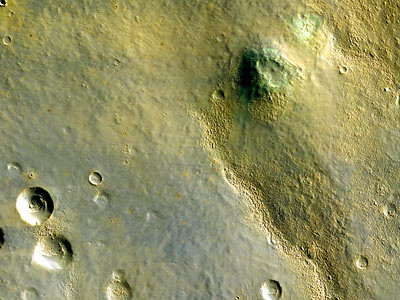
Friday saw the release of the first color image from NASA’s Mars Reconnaissance Orbiter.

ABC News reports:

The crisp test images released Friday revealed pocked craters, carved gullies and wind-formed dunes in Mars’ southern hemisphere. The diverse geologic features show the importance of water, wind and meteor impacts in shaping the Martian surface, scientists said.


The orbiter, the most advanced spacecraft ever sent to another planet, reached Mars on March 10 and slipped into an elliptical orbit. Over the next six months, it will dip into the upper atmosphere to shrink its orbit, lowering itself to 158 miles above the surface.

Last month, the orbiter beamed back the first view of Mars from an altitude of 1,547 miles. Those first test images were meant to calibrate the high-resolution camera aboard the spacecraft. The latest images were taken at the same time, but scientists spent several weeks processing them.

The Reconnaissance Orbiter will begin collecting data in November, and scientists expect the resolution of those images to be nine times higher.

The image is in infrared color– so the colors seen in this post are not what would be seen by the human eye.

 For additional information on the above image, click here.


Calling from the Sea

Monday, April 3rd, 2006

Imagine this problem:

 You’re on-board a ferry cruising across the North Sea between Newcastle and Amsterdam and you realize that you have to call home. Or someone back home has to call you. But you’re hundreds of kilometers from the nearest cellular operator’s service area. So what do you do? What can they do back home?

One alternative is to see if the ferry is equipped with a satellite telephone, but these services tend to be expensive and do not solve the problem of being accessible via your own cell phone number. Increasingly, therefore, a Base Transceiver Station (BTS) has become a permanent fixture on cruise ships and ferries. A BTS, connected to a cellular operator’s land-based Base Station Controller (BSC) over a satellite link, enables passengers to use their regular GSM telephones while at sea, but, given the expense of leasing satellite bandwidth, this alternative cannot serve a large number of simultaneous users either. So how can ship operators ensure that every passenger who wants or needs GSM service coverage will be able to afford it?

Maritime Communications Partner AS (MCP), a Norwegian-based provider of onboard cell phone connectivity to cruise ships and ferries that provides global coverage through leading suppliers of maritime satellite services, has come up with an ideal solution.

 MCP is based in Grimstad, Norway– the port of the poets. "It’s the place to be/ when you must make a call/ at sea," as our own in-house poet (we got him cheap, from a temp service) tells us.

The key technology used by MCP are GSM A-bis optimization gateways designed by RAD Data Communications. The gateways reduce costs by saving on satellite bandwidth.

But you don’t have to be on a Danish-owned cruiseship on the North Sea (where MCP has deployed the product) to enjoy the benefits of the new technology. Skywave Communications Solutions resells the Globalstar Maritime Satellite Phone System for use on private boats.

A Hard Knock Life for Satellites

Friday, March 31st, 2006

I’m probably giving away my age when I say this, but I remember when our television had a "rabbit ear" antenna, and adjusting the picture just meant moving the "ears" around. Later we had an antenna on the roof. Adjusting the picture meant someone had to climb a ladder to the roof, while someone else yelled out of a window until the picture was clear. Then there was cable. If we lost the signal, we called the cable company and waited.

Now we have satellite TV, and we rarely lose a the signal — except for occasionally during a storm, when it flickers on and off briefly before returning. If we have snow, it can interrupt the signal if it piles up on the dish, but that just means a quick trip to the back yard to brush it off. The dish in the back yard, however, is just a receiver; pointing at at a satellite so high up that a ladder on the roof doesn’t begin to do the trick. So, what happens if a satellite gets bonked by an asteroid or other random space junk?

Well, you lose the signal, which is what happened to a lot of Russians this week when a telecom satellite failed after a "sudden impact" shut down its thermal control, causing it to end up in space disposal orbit.  (Yeah. I didn’t know what that meant either. Apparently there’s a whole part of space where satellites go to die. Who knew?)  New Zealand had an outage too, due to loss of pointing control.  (Another hard knock?) A European satellite got bonked in 1993 when the earth passed through a trail of comet dust. 

So, what to do? Some people are trying to predict problems, and others are working on better materials. (What can withstand getting smacked by an asteroid?) And some are focusing on better monitoring and forecasting of sunspots and space weather (space weather?), which apparently can also cause problems for satellites. 

I can’t say how it all works. I just hope it keeps working. I don’t want to miss any of my favorite shows, and I don’t want to have to climb any higher than the roof.

iPod-from-Space Mystery Unfolds?

Wednesday, March 29th, 2006

After getting some comments from our readers on the iPod-from-Space post, concerning the accuracy of the dates in the Terrabyte screenshot, we dropped an email to TerraServers to see if we could get any further answers. Here’s what they sent us:

You can’t get the whole planet shot all in one day, so it is made up of various collection dates in 1999. When you have a large date range over a big mosaic like this, the company that took it will often just give the month or year taken. In cases like this, to specify a date, we use the first of the month or first of the year. So, all of the 1/1/1999 pictures would be made up of shots taken during 1999 or possibly some in 1998 or 2000. They’d probably go with the year with the majority. This 15m satellite mosaic covers most or all of the earth’s surface and is the last full collection that we know of. That’s partly because one of the Landsat satellites failed or crashed a couple of years back. It is the main baseline imagery that us and the rest of the major imagery sites use to show basic coverage worldwide. That’s why you’ll see the same picture between us because it’s all coming from the same original imagery.

I was able to pick off the coordinates from the image at full size on Flickr and get to it on our site. My best guess from looking at the area just north of it is that it’s part of a strip mining operation. The “screen” of the iPod might be a big holding pond or quarry pond

 Anywhere from 1998 to 2000, huh? Strip mine? Quarry pond? Sounds feasible, given the original post, but still doesn’t nail down an absolute date. So perhaps it still remains a mystery.

iPod From Space Falls to Earth

Tuesday, March 28th, 2006

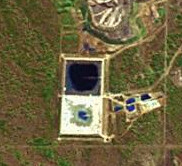
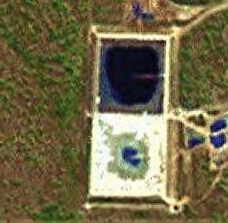
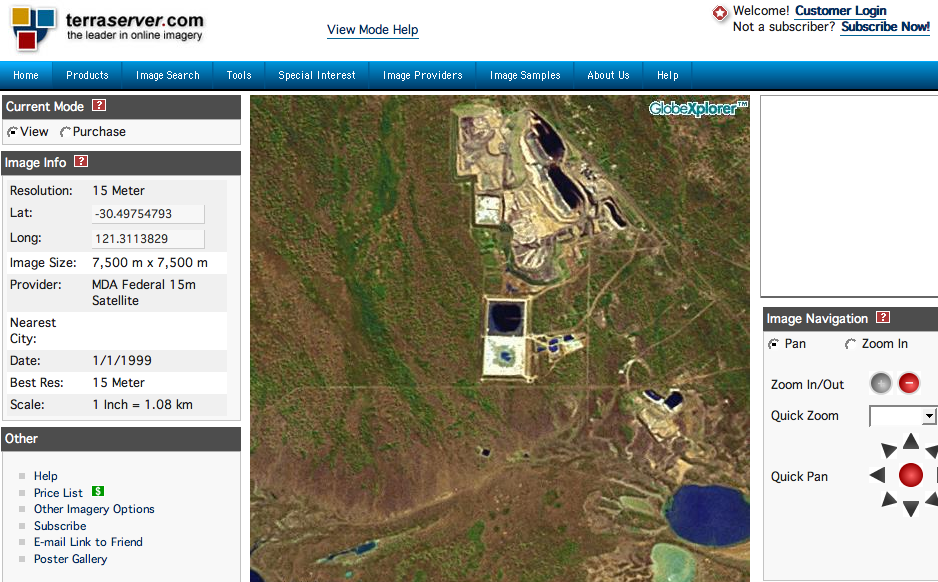
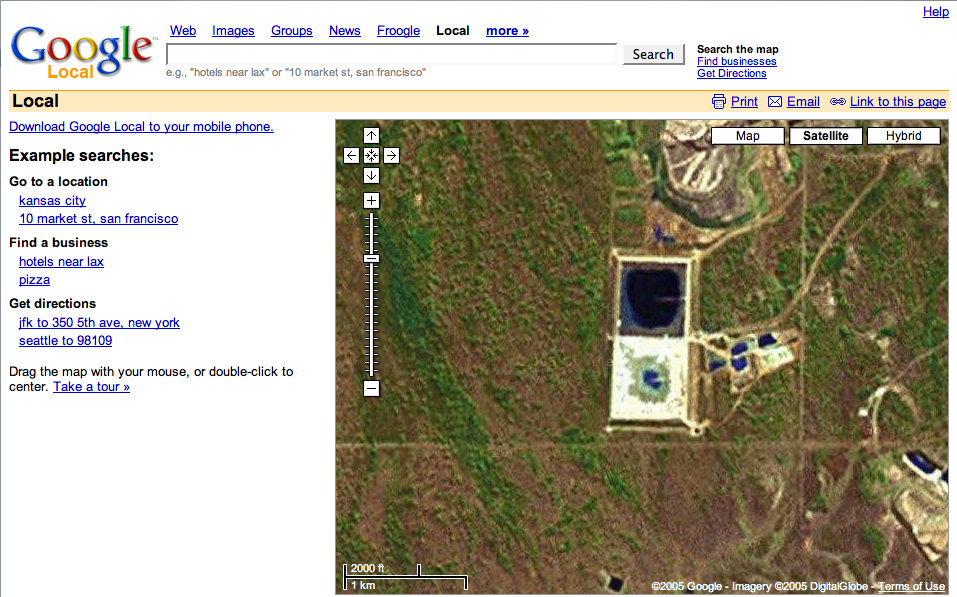
It was fun while it lasted, huh? We saw the Gizmodo post yesterday, about the iPod advertisement that’s viewable from space, and filed it away for future reference. Turns out that, after rocketing around the blogosphere, it’s probably not what it looks like. Some intrepid bloggers noted that the Terrabyte satellite image for that location on January 1, 1999 — before the iPod launched — looks the same  as it does Google Earth today.

We’ve got both images. Care to guess which is which?


It gets better. The Terabyte server’s been rather busy, so when we got a chance we grabbed a screenshot of the whole page. (Note the date.)


terrabyte1999

And we grabbed a shot of Google Earth as well. 


googleearth

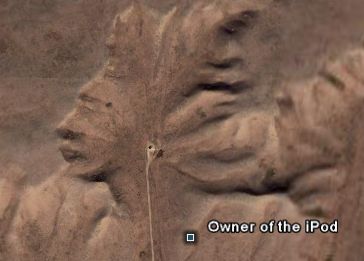
And fun would it bit of snark? The author of the the original post suggests he knows the identity of the legendary space-iPod’s owner.

It is just me? Do things not always look like what they are when seen from space? Or is am I seeing ancient Egyptian royalty here? 

So, is there anything else that looks like an iPod from space? How many can you find?