Archive for the ‘Satellites’ Category

The Future of C-Band

Tuesday, November 6th, 2007

 

In Geneva, Switzerland, the World Radiocommunication Conference 2007 is currently underway — and at the center of the discussions is the future of C-Band (known colloquially as the "compromise band").

C-band is characterized by larger antennas and is preferred by a variety of full-time service providers. C-band is a portion of electromagnetic spectrum in the microwave range of frequencies ranging from 4 to 6 GHz — normally downlink 3.7–4.2 GHz, uplink 5.9–6.4 GHz.  

From Satellite News (subscription required): 

 During the first week of the World Radiocommunication Conference (WRC-07), administrations from Asia, Africa, and Latin America made clear their broad and deep support for keeping the status quo for satellite services by calling for no change to the current use of the C band. This campaign, which exhorts the Conference not to identify international mobile telecommunications (IMT) systems in C-band has been gathering pace throughout the past year, driven by both national policy imperatives and the satellite industry.

In the weeks prior to the meeting, the number of countries expressing positions in support of protecting C-band for satellite use outnumbered those in favor of identifying C-band for IMT. Since the opening of the conference, support for protection of the whole band for satellite services has increased in strength from an already solid base. Governments have been assisted by the argumentation of regional and international satellite operators, spearheaded by SES Global, Inmarsat and Intelsat as well as regional operators such as Arabsat and Rascom, and network integrators such as Schlumberger, which all attended the WRC to rally their constituencies.

Advocates of no change in C-band allocations have come from many parts of the world, each with their particular reasons for supporting the position. These include concerns based on pre-existing interference between IMT-like technologies and satellite services which have, in some examples, ruptured Interpol’s communications in Gambia and caused severe problems to Bolivia’s direct-to-home satellite services during the 2006 FIFA World Cup. African governments have been at pains to emphasise the importance of C-band in areas that experience rain fade and the risk to satellite services if neighboring countries were to implement IMT. Asian governments, in clear allusions to recent tsunamis, have emphasised the role of satellite communications in disaster and emergency circumstances, as well as the growing demand for those services

Archived audio feeds of the discussion can be found here.

Proponents of keeping C-Band as it is have pointed to its value in providing a critical communications link during emergencies:

 During the first week and a half of the 2007 World Radio Conference in Geneva, some 3000 attendees were given an opportunity to see how Radio Amateurs can provide Emergency and Disaster communications. A van, constructed and manned by German Radio amateurs, was parked in front of the main entrance of the conference centre for delegates to visit. IARU Emergency Communications coordinator Hans Zimmerman F5VKP also participated in the demonstration. The IARU flag was flown at the top of van’s extendable mast.

José Albuquerque, the Senior Director of Spectrum Engineering at Intelsat, also makes the case for C-Band:

Currently, there are some 160 satellites in the geostationary orbit using C-band frequencies for their downlink transmissions (see Figure 1). This is the equivalent of more than 3000 satellite transponders with a 36 MHz bandwidth with the potential for transmitting about 180 Gbit/s at any given instant. This infrastructure represents an investment in excess of USD 30 billion in spacecraft and launch costs alone, without taking into account investment in the ground segment made by users and satellite operators.

Deployment of IMT systems in these frequencies would drastically reduce the benefits that these resources have brought to users around the world, because fixed-satellite services and IMT systems cannot share frequencies in the same geographic area.

C-band frequencies are used for downlink satellite transmissions that provide a wide range of services in developed and developing countries, including critical applications such as distance learning, telemedicine and universal access services; backhaul services (telephony, Internet); very small aperture terminal (VSAT) data links such as bank transactions or corporate networks; distribution of television programmes; mobile-satellite service feeder links, and emergency links, including disaster recovery services and meteorological tracking. These services require the high reliability and broad geographic coverage that can only be delivered in the C-band….

It is not feasible to undertake co-frequency operation of FSS receiving Earth stations and transmitting fixed or mobile stations in IMT systems. ITU–R studies have concluded that separation distances of between tens of kilometres and a few hundred are required to ensure protection of FSS Earth stations. Considering that a typical city covers an area with radius of between 15 and 30 km, sharing between IMT systems and FSS receiving Earth stations is not realistic.

In addition, IMT transmitters can also interfere with FSS Earth stations operating in adjacent bands. Unwanted emissions generated by IMT transmitters falling within the FSS desired signal cannot be filtered and will therefore generate interference. Furthermore, signals generated by an IMT transmitter can be strong enough to saturate the low-noise amplifier (LNA) of the FSS receiver. In view of the significant difference between the levels of the desired signal (originating at the satellite transmitter about 36 000 km away) and the interfering signal (originating at the IMT transmitter only a few kilometres away), filtering the IMT signal to the required levels might become unfeasible.

The adjacent-band interference effects described above highlight the fact that identification of a portion of C-band frequencies for IMT systems, while keeping another contiguous portion for FSS use, is not free of interference problems and does not constitute a desirable approach.

The message from SES, in video form:


We’ll keep you updated on the fate of C-Band as it becomes clear (no pun intended).

China: To the Moon!

Monday, November 5th, 2007


A Chinese satellite successfully entered lunar orbit Monday, a month after Japan put its own probe into orbit around the moon, the AP reports:


Chinese space officials said the Chang’e 1 satellite, part of the country’s ambitious space exploration plans, entered lunar orbit after completing a planned braking operation.

China plans to keep the Chang’e 1 – named after a mythical Chinese goddess who flew to the moon – there for one year, about the same length of time as Japan’s probe. China launched its satellite late last month, while Japan put its into space in September.

The timing of the launches raises the prospect of a space rivalry between the two Asian nations, with India possibly joining in if it carries through on a plan to send its own lunar probe into space in April.


We blogged about the Japanese lunar probe when it launched in September. Meanwhile, back at the 73rd annual meeting of the Indian Academy of Sciences, the lunar probe referenced above is indeed planned for April, 2008, with more missions to follow:

Work on Chandrayaan-1, India’s first lunar probe, was progressing, said J.N. Goswami, Director, Physical Research Laboratory, Ahmedabad. The plan was to launch the spacecraft around April 2008.

Planning for the follow-on mission had started, he said. Apart from an orbiter that would circle the moon, Chandrayaan-2 could also have a soft-lander carrying a robotic rover.

A slide projected by Dr. Goswami during his talk indicated that the Chandrayaan-2 mission could take place around 2011-12.

Wikipedia has some good information on Chandrayaan

So is this the beginning of an Asian space race? Here’s an opinion piece from Japan, translated into English and published in the China Daily, which argues that China is way ahead of the game:

China already has a high level of space technology. It has launched more than 100 Long March rockets since 1970, while Japan’s H2-A rocket has been launched only 13 times…..

[Now], China’s space development has drastically accelerated. Starting with the launch of the orbiter, China’s lunar exploration program comprises a moon landing and deployment of a moon rover with the retrieval of lunar soil and stone samples. China also aims to advance its technologies for manned spacecraft.

Further, it is moving forward with projects to launch a reconnaissance satellite and another one for its own global positioning system.

In addition, China is launching communication satellites for Venezuela, Brazil and Nigeria, and also received an order from France to launch a communication satellite, showing the commercial success of its program.

China has voiced a strong desire to participate in the International Space Station (ISS) program in which Japan is involved and the United States and Russia play pivotal roles.

Some observers say that in the near future China will become one of the world’s leading nations in the field of space development, equivalent to the United States and Russia.

In contrast, Japan’s space program, despite its successful development of the H2-A rocket, lacks specific targets – including what type of satellite it will launch in the future – due to budget woes.


German Eye in the Sky

Thursday, November 1st, 2007

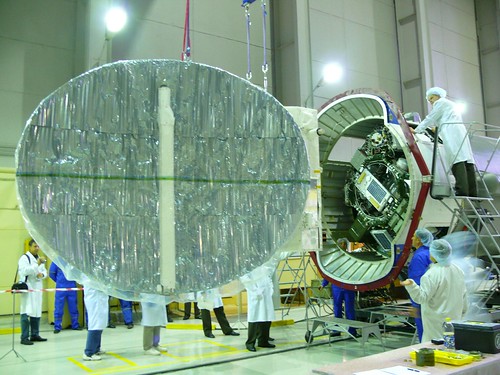
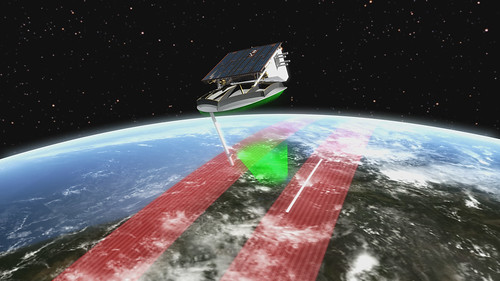
The SAR-Lupe satellite was launched via a Kosmos-3M rocket from the Plesetsk Cosmodrome in Russia earlier this morning. Built by OHB-System AG in Germany ("lupe" is German for magnifying glass; SAR = synthetic aperture radar), the satellite will be used for earth observation, day or night, in any weather condition — according to Wikipedia:

They use an X-band radar with a three-metre dish, providing a resolution of about 50 centimetres over a frame size of 5.5km on a side (‘spotlight mode’, in which the satellite rotates to keep the dish pointed at a single target) or about one metre over a frame size of 8km x 60km (‘stripmap mode’, in which the satellite maintains a fixed orientation over the earth and the radar image is formed simply by the satellite’s motion along its orbit). Response time for imaging of a given area is 10 hours or less.

The Bundesamt für Wehrtechnik und Beschaffung (German Federal Office of Defense Technology and Procurement) runs this program. Here’s what they like best about this system:

Satellites as carriers of optical or radar sensors can, unlike aircraft or unmanned aerial vehicles, carry out reconnaissance operations without infringing sovereign rights. They are thus particularly suited to gather information – without escalating effect – about early crisis detection and prevention and about effective crisis management.

Name That Asteroid

Tuesday, October 30th, 2007

赵九章 – "Zhao Jiuzhang"


That who we’re naming an asteroid after, according to eViewWeek:


An asteroid has been named after late Chinese geo-scientist Zhao Jiuzhang with the approval of the International Minor Planet Center (IMPC) and the International Minor Planet Nomenclature Committee (IMPNC).


Asteroid No. 7811 was discovered on Feb. 23, 1982, by astronomers at the Purple Mountain Observatory of the Chinese Academy of Sciences, according to a gazette of the IMPC and IMPNC.


Zhao Jiuzhang, who was born in central China’s Henan Province in 1907 and died in 1968, made significant contributions to the development of atmospheric science, geophysics and space science, especially the development of China’s first satellite. He is also one of the founders of modern meteorology in China.


According to international convention, those who discover minorplanets and have confirmation from the IMPC and the IMPNC have the right to name them.


So far, more than 30 minor planets have been named after ancient and contemporary Chinese scientists by Chinese or overseas astronomical observatories.


I thought I read somewhere he was killed by the Red Guards during the "Cultural Revolution" in 1968. Does having an asteroid named after you make up for it? Maybe.


Read more about the Minor Planet Center.

Malagasy Cup Uses Satcom to Stay Connected

Friday, October 26th, 2007

We recognize the what cup? might be your first response to the title of this post. What is this, as Rocco asked, a geography lesson?

Well, sort of. Malagasy, of course, refers to Madagascar, and the Malagasy Cup is a race from Anakao to Andavadoaka “for traditional Malagasy vessels, boutry and pirogue/lakarna vezo…. with dozens of vessels making the 200 kilometre journey in five stages stopping at: Tulear; Ifaty; Salary; Ambatamilo and finally Andavadoaka.”

Anakoa looks particularly inviting to us on this gray rainy East Coast of America day:

Vizada is helping the general public follow the race:

 New video satellite communications will make it possible for the general public to follow the five stages of the Malagasy Cup…  occurring along the Madagascar Coast. This is because Vizada (formerly FTMSC) and Satellite Air Time will manage the race communications as well as communicate photos and videos from these remote areas. The BGAN (Broadband Global Area Network) service will allow journalists to follow the race as well as to send video and photo reports from the race’s five, staging point villages. The BGAN laptop sized satellite terminal uses high-speed Internet connections of up to 492 kbps to send large volume of data in areas that lack mainstream telecom networks.

Iridium satphones will allow competitors and organizers the ability to stay in permanent contact with the capital city, Antananarivo, as 200 canoes and 30 dhows cross the staring line of the Malagasy Cup. This is a 200 km race along the world’s third largest reef in southwest Madagascar and offers a unique opportunity to showcase the traditional sailing boats of the Vezo “people of the sea” as well as the preserved landscape of this area of the world.

Vizada is also a reseller of aeronautical satcom services from Inmarsat; two days ago, they announced the release of Swiftbroadband, which is “Inmarsat’s first fully IP-based, high-speed data service offering broadband in-flight connectivity including both cockpit communications and cabin applications.”

But back to Madagascar. Among its many fascinating natural wonders are lemurs; check out this video on YouTube to experience them firsthand.

Black Hole Sun

Thursday, October 18th, 2007

The Chandra X-Ray Observatory, run by the Smithsonian Astrophysical Observatory in Cambridge, MA, helped astronomers find a huge black hole orbiting a buddy star. Image above: artist’s representation of M33 X-7, a binary system in the nearby galaxy M33 (Credit: Illustration: NASA/CXC/M.Weiss; X-ray: NASA/CXC/CfA/ P.Plucinsky et al.; Optical: NASA/STScI/SDSU/J.Orosz et al.). Check out the Chandra blog, too.

Here’s the NASA release:

Astronomers have located an exceptionally massive black hole in orbit around a huge companion star. This result has intriguing implications for the evolution and ultimate fate of massive stars.

The black hole is part of a binary system in M33, a nearby galaxy about 3 million light years from Earth. By combining data from NASA’s Chandra X-ray Observatory and the Gemini telescope on Mauna Kea, Hawaii, the mass of the black hole, known as M33 X-7, was determined to be 15.7 times that of the Sun. This makes M33 X-7 the most massive stellar black hole known. A stellar black hole is formed from the collapse of the core of a massive star at the end of its life.

"This discovery raises all sorts of questions about how such a big black hole could have been formed,” said Jerome Orosz of San Diego State University, lead author of the paper appearing in the October 18th issue of the journal Nature.

M33 X-7 orbits a companion star that eclipses the black hole every three and a half days. The companion star also has an unusually large mass, 70 times that of the Sun. This makes it the most massive companion star in a binary system containing a black hole.

"This is a huge star that is partnered with a huge black hole," said coauthor Jeffrey McClintock of the Harvard-Smithsonian Center for Astrophysics in Cambridge, Mass. "Eventually, the companion will also go supernova and then we’ll have a pair of black holes."

The properties of the M33 X-7 binary system – a massive black hole in a close orbit around a massive companion star – are difficult to explain using conventional models for the evolution of massive stars. The parent star for the black hole must have had a mass greater than the existing companion in order to have formed a black hole before the companion star. Such a massive star would have had a radius larger than the present separation between the stars, so the stars must have been brought closer while sharing a common outer atmosphere. This process typically results in a large amount of mass being lost from the system, so much that the parent star should not have been able to form a 15.7 solar-mass black hole.

The black hole’s progenitor must have shed gas at a rate about 10 times less than predicted by models before it exploded. If even more massive stars also lose very little material, it could explain the incredibly luminous supernova seen recently as SN 2006gy. The progenitor for SN 2006gy is thought to have been about 150 times the mass of the Sun when it exploded.

"Massive stars can be much less extravagant than people think by hanging onto a lot more of their mass toward the end of their lives," said Orosz. “This can have a big effect on the black holes that these stellar time-bombs make."

Coauthor Wolfgang Pietsch was also the lead author of an article in the Astrophysical Journal that used Chandra observations to report that M33 X-7 is the first black hole in a binary system observed to undergo eclipses. The eclipsing nature enables unusually accurate estimates for the mass of the black hole and its companion.

"Because it’s eclipsing and because it has such extreme properties, this black hole is an incredible test-bed for studying astrophysics," said Pietsch.

The length of the eclipse seen by Chandra gives information about the size of the companion. The scale of the companion’s motion, as inferred from the Gemini observations, gives information about the mass of the black hole and its companion. Other observed properties of the binary were used to constrain the mass estimates.


This animation sequence begins with a wide-field optical image from Kitt Peak of M33, a spiral galaxy about 3 million light years from Earth, and then zooms into a view from the Gemini telescope on Mauna Kea, Hawaii. Next, the view zooms into an even smaller field, from the Hubble Space Telescope, that includes M33 X-7, the most massive known black hole to be formed from the collapse of a star. The final image is a composite of the region around M33 X-7 that contains both the Chandra and Hubble data.
(Credit: Kitt Peak: NOAO/AURA/NSF/T.A.Rector; Gemini: AURA/Gemini Obs./SDSU/J.Orosz et al.; HST: NASA/STScI/SDSU/J.Orosz et al.; Chandra: NASA/CXC/CfA/P.Plucinsky et al.)

China to hit the moon?

Wednesday, October 17th, 2007


We’ve discussed China’s space ambitions before (here and here), including Tom Delay’s over-the-top (if not ridiculous) assertion that the U.S. is losing a 21st "Space Race" with China.

And now it appears that China plans to "hit" the moon.

Gasp. Don’t worry — our Eastern "space race competitor" is not bombing the moon:

Chang’e I, China’s first lunar probe satellite will hit the moon to end its one-year orbital tour as part of the research mission, said Professor Xiao Naiyuan from the Department of Astronomy of Nanjing University in a scientific lecture held on October 6, according to a report by Nanjing Daily on October 8. The launch day of the satellite is yet to be determined.

The satellite is expected to shoot high-resolution photos when crashing into the moon, said Xiao.

I can’t wait to see the photos from that. The launch is in its final stages:

Chinese researchers and technicians are making final preparations for the launch of the country’s first moon orbiter.

Zhang Qingwei, minister in charge of the Commission of Science, Technology and Industry for National Defense, says his team has nearly finished pre-launch tests.

The rocket and orbiter have been transported to the launch site and will blast off at the end of October. The mission has three main goals: to map three-dimensional images of the lunar surface, analyze dust on the moon, and study the space environment between the Earth and the moon. The minister says the next mission will be to launch a moon vehicle, and then safely return it to Earth.

A video of the orbiter is available here.

And if you want to see the launch in-person, you better be a Chinese national and line-up for your tickets now:

China is offering 2,000 tickets to view the launch of the country’s first lunar mission, the Chang’e 1 probe satellite, a company said Friday.

Only Chinese nationals are allowed to buy the tickets, priced at 800 yuan (107 dollars) each, Yang Pei, a spokeswoman for the ticket agency, Chengdu Chang’e Benyue Co. Ltd., told AFP.

Viewers can choose from three viewing points, with two located 2.5 kilometres (1.6 miles) away from the launch site and one four kilometres away, according to Friday’s Shanghai Morning Post.

$10 Billion to Get Solar From Space?

Friday, October 12th, 2007

Here’s an interesting proposal to meet our future energy needs, perfectly timed with Al Gore’s receipt of the Nobel Peace Prize and the heightened awareness that brings to the need for clean, non-carbon energy:


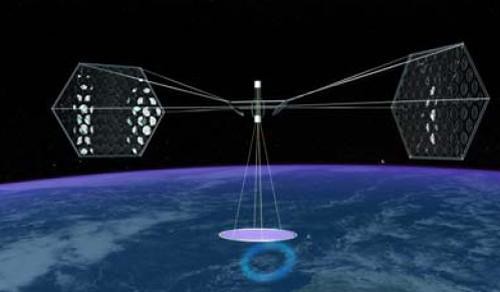
A futuristic scheme to collect solar energy on satellites and beam it to Earth has gained a large supporter in the US military. A report released yesterday by the National Security Space Office recommends that the US government sponsor projects to demonstrate solar-power-generating satellites and provide financial incentives for further private development of the technology.

Space-based solar power would use kilometre-sized solar panel arrays to gather sunlight in orbit. It would then beam power down to Earth in the form of microwaves or a laser, which would be collected in antennas on the ground and then converted to electricity. Unlike solar panels based on the ground, solar power satellites placed in geostationary orbit above the Earth could operate at night and during cloudy conditions.

"We think we can be a catalyst to make this technology advance," said US Marine Corps lieutenant colonel Paul Damphousse of the NSSO at a press conference yesterday in Washington, DC, US.

The NSSO report recommends that the US government spend $10 billion over the next 10 years to build a test satellite capable of beaming 10 megawatts of electric power down to Earth.

The NSSO report can be found here


First Wideband Global SATCOM Launched

Wednesday, October 10th, 2007


Nice launch of the WGS SV-1 satellite. The news, via The A.P. and International Herald Tribune:

A rocket carrying a satellite used for communication by the United States Air Force lifted off Wednesday night.

The Atlas V, which launched at 8:22 p.m. (0022 Thursday), is carrying a Wideband Global SATCOM satellite. It is the first of at least five satellites that will be placed in orbit through 2008.

The system will replace the current Defense Satellite Communications System that has been used for military communications for the last two decades. This first satellite will cover the Pacific Zone which includes Hawaii, Japan and Southeast Asia. Each spacecraft will cost $350 million (€247.42 million).

The DSCS system will be used in conjunction with WGS until being phased out within the next few years.

Col. David Urich, the Military Satellite Communications Systems Wing vice commander, said the first spacecraft alone "will provide more capacity than all the current DSCS satellites currently in use."

The launch was scheduled for Tuesday, but delayed a day as engineers checked data that might have indicated the Atlas V rocket would have fallen short of its intended orbit.

Always Low Prices on Satellite Broadband, Always

Wednesday, October 10th, 2007

Here’s some big news from the world of direct-to-consumer satellite broadband marketing:

Hughes Network Systems, LLC (HUGHES) today announced that consumers across North America will be able to purchase HughesNet®, the leading satellite broadband Internet access service, from Wal-Mart, giving customers in rural areas the opportunity to experience the benefits of high-speed Internet access. The HughesNet service will be sold in 2,800 Wal-Mart stores across the U.S., including locations throughout most of rural America where terrestrial broadband services, such as cable and DSL, are often not available.

With HughesNet, consumers in any region in the continental U.S. need only a view of the southern sky to have access to high-speed Internet. And with millions of Americans shopping at Wal-Mart each week, being able to purchase HughesNet at the stores makes broadband more accessible in many more areas across the country than ever before.

BusinessWeek looks at the implications: 

[T]he market for satellite broadband is small, given the widespread availability of digital subscriber line access from phone companies and cable modem services from cable operators. Currently, satellite service tends to be more expensive and it’s available mainly in hard-to-reach rural areas. Fewer than 500,000 Americans subscribe to satellite broadband access, according to consultancy Parks Associates. "It’s still mainly for people who don’t have a choice," says Michael Cai, an analyst at Parks. Only about 10% of Americans have no access to DSL or cable broadband.

But Wal-Mart, which will provide satellite broadband in 800 stores, could make the service more appealing—and give existing providers cause for concern. Whenever Wal-Mart enters a new market, it tends to push down prices and squeeze out competition. Consider what happened when Wal-Mart began offering sub-$1,000 flat-panel TVs. After trying to match these prices, rival Circuit City (CC) had to close 70 stores (BusinessWeek.com, 4/23/07) and lay off 3,400 employees earlier this year. CompUSA had to shutter more than half of its stores.

Wal-Mart could have a similar impact on sellers of broadband services, especially if the Hughes deal presages a bigger push into services related to high-speed Internet access. Retailers are stepping up their emphasis on services, partly in response to Wal-Mart’s penchant for bargain-basement prices. 

Broadband Reports says Walmart is "working on a tech support service akin to Best Buy’s Geek Squad," in order to support the new offerings as well as to combat the high return rates that tend to accompany the sale of new technology to consumers who still haven’t figured out how to program their VCR DVD.