Archive for the ‘Satellites’ Category

SNG Costs Less With BGAN

Thursday, August 16th, 2007

We’ve seen live or near-live video news reports on CNN or the BBC where a journalist uses an inexpensive terminal to uplink to a satellite — alone. No truck, camera operator, teleprompter or boom microphone. At first the frame rate was less than perfect, but hey, it’s live and very cheap. Packs up quickly, too.

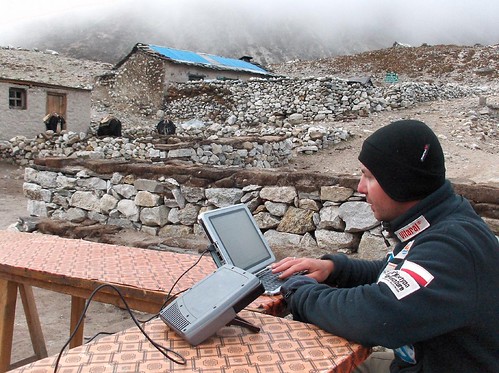
Inmarsat’s BGAN service is getting better now. Upgraded equipment on the ground, and in orbit. Traditionally, they’ve promoted themselves by helping extremely remote locations connect, like this Polish expedition on Mt. Everest.


As with the Slingbox Traffic Web Cam in San Francisco, TV news people are getting more creative in using this new technology. We read in Broadcasting & Cable last week how WDIV in Detroit covered the Bayview-Mackinac Yacht Race from Lake Huron:

When WDIV Detroit covered the Bayview-Mackinac yacht race last month, it didn’t rely on traditional microwave or satellite equipment to pull live video from the middle of Lake Huron.

Instead, the Post-Newsweek NBC affiliate used a combination of IP-based streaming technology and wireless EVDO and broadband satellite transmitters to provide live broadcast and Website coverage of the four-day race, which drew more than 250 competing yachts.

WDIV is one of a growing number of news organizations to use the Streambox from Seattle-based Streambox Inc., an IP-based streaming device designed with broadcasters in mind. Costing around $20,000, the system includes a laptop loaded with proprietary compression software that is used to encode and stream images and a rack-mounted receive device that features professional video connections and is designed to interface with conventional broadcast equipment.



$20,000? Even the smallest SNG Trucks cost much more than that. How long before Streambox and NewTek’s "truck-in-a-box" change the game? Probably sooner than we think.

Beer in Space

Thursday, August 9th, 2007

Let’s start by saying that when you’re truly miles away from ordinary — ie, in space — drinking one of these is no swing in the hammock.

We don’t raise this issue because of Endeavor’s successful launch yesterday with Canadian astronaut Dave Williams on board. On shorter missions such as shuttle flights, we side with the teetotalers — astronauts can do without.

And they generally do, with some exceptions. "Small amounts of alcohol were apparently allowed on the Soviet space station Mir, and when Russian astronauts joined the International Space Station, there were some grumblings about the decree that it be dry," according to NewScientistSpace.

And in 1969, "Buzz Aldrin took communion after landing on the Moon, sipping wine from a small chalice. In the Moon’s feeble gravity, he later wrote, the wine swirled like syrup around the cup."

But when you start talking about multi-year voyages to Mars, for example, the question of beer in space — or any carbonated beverage, for that matter — becomes more than just a question at the bottom of your glass. Keeping astronauts on such extended voyages happy is a concern, and while kegstands in zero G aren’t likely to ever appear on the rec schedule, an occasional beer or even soda pop might help astronauts relax during the 2-year haul to Mars.

One of the chief obstacles to consuming carbonated beverages in space, however, is the wet burp:

Unfortunately for thirsty astronauts, beer is poorly suited to space consumption because of the gas it includes. Without gravity to draw liquids to the bottoms of their stomachs, leaving gases at the top, astronauts tend to produce wet burps.

"That’s one of the reasons why we don’t have carbonated beverages on the space menu," NASA spokesperson William Jeffs told New Scientist.

There are also questions about the effects of alcohol in space:

Jeffs says no research has been done on the effects of alcohol in a microgravity environment. But he says: "There may be differences in alcohol absorption and metabolism in space, which makes one suspect that there may be differences in the effects of alcohol in space."

Clark says medications sometimes have unusual effects in space, which "run the gamut from increased to decreased reactions".

At least one study has been done, however, on where astronauts would get their beer when the closest CircleK is a few million miles away:

 Graduate student Kirsten Sterrett at the University of Colorado in the US wrote a thesis on fermentation in space, with support from US beer behemoth Coors. She sent a miniature brewing kit into orbit aboard a space shuttle several years ago and produced a few sips of beer. She later sampled the space brew, but because of chemicals in and near it from her analysis, it didn’t taste great by the time she tried it.

Ok, so maybe even getting beer in space is still a problem. Still, as extended space voyages become a reality in the future, expect the question of drinks in space to come up — though hopefully not in the form of a wet burp.

Yahsat Means Billions

Wednesday, August 8th, 2007


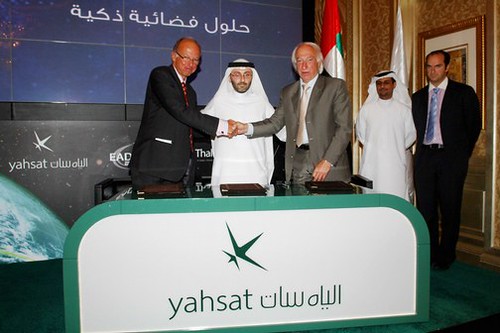
First, Dubai rises from the desert seemingly overnight to become a first-class economic center. Haliburton’s CEO is moving his office there. It’s becoming a major airline hub. It’s building huge, jaw-dropping buildings and developments. Today we learned they’re ready to spend $1.66 billion to get into the satellite business.


$1.66 billion.  That’s a nice big bag of money. And a consortium of Thales Alenia Space and EADS Astrium are getting it. Abu Dhabi’s Al Yah Satellite Communications Company (Yahsat) announced a contract for the consotium to build a new satellite system, via Gulf News:

Two satellites and an earth station will comprise the system that will serve military and commercial communication purposes, providing broadcasting, tele-communication and broadband services.

"The system initially will serve the Middle East, Africa, most of Europe, and South East Asia regions," Jasem Mohammad Al Za’abi, Yahsat’s chief executive officer, said.

Sixty-five per cent of the financing will be through a syndicated loan, and the remaining 35 per cent will be through Yahsat, 100 per cent owned by Abu Dhabi’s Mubadala Development Company, according to Waleed Ahmad Al Mokarrab, Yahsat’s chairman, and Mubadala’s chief operating officer.


Not a bad idea, considering how the oil market is behaving. Take the money and invest it in something that will last for generations: satcom, baby!  The people who run Yahsat-backers Mubadala seem to know what they’re doing.


Dropping the SpookSat

Tuesday, August 7th, 2007

If you don’t like that headline, try The Register’s leader: "Cheesed-off spooks give up on duff spy-sat."

Reuters explains:

The National Reconnaissance Office has deemed an experimental U.S. spy satellite a total loss and will allow it to slowly drop from orbit and burn up in the atmosphere, two defense officials told Reuters this week.

The classified L-21, built by Lockheed Martin Corp at a cost of hundreds of millions of dollars, was launched on December 14 but has been out of touch since reaching its low-earth orbit, put by satellite watchers at about 220 miles above the earth.

It will now gradually fall out of orbit over the coming decades, said the officials, who asked not to be named. At some later date, it will burn up as it enters the earth’s atmosphere, posing no danger to people below, they said.

We discussed these technology failures earlier in June. Now that the L-21 is a loss, what’s next?

Meanwhile, the Pentagon will likely now have to test aspects of new technologies that were on the L-21 by piggybacking them onto other satellites over the next four to five years, the officials said.

For instance, the military could put the new sensors aboard TacSat 3, the latest in a series of smaller satellites, when it launches later this year.

The NRO could still try to build a new spacecraft to test the technology, but it would take several years to get the funding for such a satellite and build it, one official said.

The U.S. may be lagging behind in this technology race:

The two officials declined to identify what exactly the experimental Lockheed satellite was meant to test, but said its failure was troubling, given that other countries were rapidly plowing ahead with development and launch of new capabilities, especially in the area of synthetic aperture radars.

Synthetic aperture radars offer high-resolution and can pierce darkness and thick clouds to identify targets, even peering below the surface of the ground or peeking into foliage that might obstruct the view of photo-based sensors.

One official said Germany in June launched TerraSAR-X, a sophisticated new satellite armed with a synthetic aperture radar that analysts say marks the start of a new level of quality in the mapping of the earth.

Canada is also working on this technology.

Ukraine Announces New Space Program

Thursday, August 2nd, 2007

Politically, Ukraine is somewhat at a cross-roads, being pulled in one direction by its Russian-Soviet past and in the other direction by its Western EU-NATO neighbors. The 2004 "Orange revolution," which discarded the Kremlin’s favoured candidate, may have been the turning point.

Ukraine’s space program reflects Russia’s declining influence. First it was Ukraine’s agreement to participate in EU’s Galileo System (a system similar to GPS), not joining Russia’s developing Glonass system.

Now, Ukraine has announced an ambitious new 4-year independent space program. An English translation of a Ukranian news report explains:

The Cabinet of Ministers today at the session has affirmed the national target scientific and technical space program of Ukraine for 2008-2012. General Director of National space agency Yuriy Alekseev told journalists.

According to him, financing of the State program amounts UAH 1,5 milliard.

According to the program, in particular, Ukraine should launch two satellites of remote sensing of the Earth, to create a satellite of connection and to participate in tenders of satellites creation for the other countries.

“The satellite has been already made for Egypt, and in autumn it can be given to the customer,” Alekseev noted.

Also, according to Alekseev, the program foresees the training of Ukrainian specialists at the European space enterprises, “UNIAN” reports.

Russia’s WPS news agency (subscription only) has more on the satellites:

Two of the satellites are intended for remote Earth probing and the third is a communication satellite. General Director of the National Space Agency, Yury Alexeev, announced this after approval of the draft space program of the country for the next five years at a meeting of the government. The document makes provisions for active international cooperation including cooperation with Russia, European Union and the US. The costs of the program exceed $400 million and state financing will account for about $300 million of this amount.

Sirius/XM Merger Update

Tuesday, July 31st, 2007

It has been while since we’ve discussed the XM-Sirius merger announced in February. For two companies that had combined losses nearing two billion last year, they are understandably anxious for action.

Whether you favor the merger or not, there has been progress. On the most recent XM earnings call, it was noted that four out of every five comments filed with the Federal Communications Commission (FCC) were in favor of the merger. Twice elaborates:

XM chairman Gary Parsons said that overall the company “feels pretty good” that the merger will pass regulatory hurdles. “We didn’t go to great lengths to generate [public comments to the FCC] and it was 4 to 1 for the merger. And a strong constituency of groups who felt underserved by radio came out positively for this and that’s pretty impactful. And the announcement of the various pricing plans is by any measure a bold and pioneering move” that will add support for the merger, he added.

Sirius adds their take in today’s second-quarter report (link):

"Momentum for the pending merger with XM continues to build," said CEO Mel Karmazin. "Support from our customers, suppliers and other groups representing a diverse cross-section of Americans clearly demonstrates the public interest benefits and enhanced competition that will come from the merger. We continue to work with the [Federal Communications Commission] and the [Department of Justice] to make the case that the merger offers more choices, including a la carte offerings, and lower prices for subscribers, and we continue to expect that the merger will be completed by year-end."

Recognizing this momentum, XM’s CEO, Hugh Panero, has announced he will leave XM, apparently to make room for the merged company:

Noting that Sirius CEO Mel Karmazin would lead the proposed merged Sirius/XM, and that Nate Davis, XM, president and COO had taken over much of the day-to-day operations at XM, he added, “My role was to do strategy and work with bigger partners and I’ve helped with the merger. I felt the merger had progressed and was hitting a number of milestones … And understanding there would be one CEO at the end of it, I felt it was time to move on.”

The 10-year XM veteran told analysts, “When I first came to XM it was merely a PowerPoint presentation and many were skeptical that anyone would pay for radio,” Panero said, noting that now satellite radio has 14 million subscribers.

The companies also laid out their plans for future subscription plans, mimicking content tiers offered by cable and satellite television providers:

Satellite radio providers Sirius and XM said Monday they could offer a variety of subscription packages that cost as much as 46% less than current plans if their merger is approved.

In a bid to allay concerns among lawmakers that their merger would raise prices and limit programming choices, the companies announced several new packages that they say offer subscribers more choice than they can individually.

Under one package, customers could pick 50 channels on either Washington-based XM Satellite Radio Holdings Inc.’s or New York-based Sirius Satellite Radio Inc.’s systems for $6.99 a month. Additional channels could be added for 25 cents apiece. Currently, subscribers of either system pay about $13 a month for more than 100 stations.

"We need to build the subscription business base of satellite radio to strengthen our business and better leverage our high fixed costs," Sirius Chief Executive Mel Karmazin said in Washington. "We are confident that a lower price point [and] more programming choices will help us do just that."

Rolling Out the Big Gun

Monday, July 30th, 2007

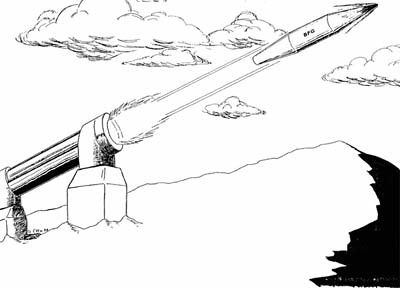
If you ever read Jules Verne’s From the Earth to the Moon, you’ll recall that it’s the story of three wealthy members of a gun club who build a huge cannon and shoot themselves to the moon.

In writing the novel, Verne did a number of calculations to determine how a space gun would work. Although his figures proved to be surprisingly accurate, space guns have since been ruled as a means of manned space flight because the accelerating forces (up to 2,000 Gs!) are too powerful for any living thing to survive.

But now, a group of graduate students and academics hopes to use a similar concept to launch low-cost satellites into orbit.


Space Review reports: 

Ben Joseph, a 25-year-old aerospace engineering graduate of MIT, and a team of students and professors are resurrecting [the space gun idea… with] a radically new kind of impulsive launch technology known as the “ram accelerator.”

Joseph and his colleagues have formed a company called Ballistic Flight Group, with the goal of commercializing the space gun launch concept for satellites:

A typical artillery weapon uses a large explosive force at the base of a gun to propel a shell down a rifled metal tube, which is angled to provide the projectile with its trajectory.

In the space gun launcher being promoted by BFG this cannon type of firing is merely the first step in the process. The main step is the ram accelerator, a technology invented and developed by faculty and staff at the University of Washington in Seattle, where Ben Joseph studied as an undergraduate. After a pre-launcher gun (e.g., light gas or gunpowder propelled) accelerates the projectile up to speeds of over 500 meters per second, the projectile enters the ram accelerator by passing through a breakable diaphragm and entering another tube, this one filled with a more volatile propellant, such as oxygen and methane. Because the projectile enters this second tube at supersonic speeds, it interacts with the tube wall to produce a ramjet–like effect inside the barrel. This ramjet effect forces the projectile to combust the fuel behind it, increasing its acceleration through the tube. The projectile exits the barrel with a muzzle velocity of around 8 kilometers per second. An upper stage rocket would circularize the trajectory of the payload (approximately one third of the projectile’s 2,000-kilogram mass) to a low Earth orbit of around 800 kilometers….

So that’s the technology, as envisioned. What about the cost? 

What makes the ram accelerator so appealing is its economic potential. BFG estimates that the accelerator could be built for an estimated $157 million, a price tag that includes the launch tube and its supports, the pre-launcher gun for initial acceleration, and propellant handling system for the oxygen, hydrogen, and methane gases for the ram accelerator portion of the launch system. This price tag is astonishingly low—cheaper than some expendable rockets—and it could be fired hundreds or thousands of times. Depending on the gun’s final muzzle velocity, prices for payloads could drop to nearly $500 per kilogram, a drastic reduction from current market prices…

During Joseph’s presentation on the commerce track of the International Space Development Conference, he concentrated on the most obvious markets for the ram accelerator: commercial satellite launches. BFG has taken particular interest in the Iridium and Globalstar constellations, which were financial failures but technically viable. Those satellites are nearing the end of their service life, and the ram accelerator would reduce the costs launching new satellites to nearly one tenth of their projected value. At those prices, a large LEO constellation becomes financially competitive with a high-bandwidth satellite chain in geosynchronous orbit. This does not change the economics of human spaceflight, but it does represent the order-of-magnitude cost improvement NASA and the private sector has sought for over 20 years.

Whether a space gun or BFG’s efforts can deliver on the dream of low(er) cost satellite launches remains to be seen. We’ll keep you posted. 


GSM Satellite Backhaul

Thursday, July 26th, 2007

Remote regions and developing nations are seeing a massive expansion in their GSM networks. Nigeria, for example, has only 1.25 million landline phones, but more than 30 million mobile subscribers. This presents a number of challenges: foremost, how do you expand a network to remote places that lack the infrastructure for conventional GSM networks?
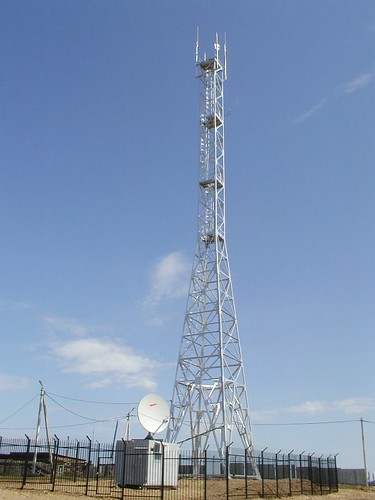
The solution: satellites, of course! In Papua New Guinea, SES NEW SKIES signed a contract with the national telecom company, Telikom Papua New Guinea, to provide GSM backhaul services using its NSS-5 spacecraft. Details from Cellular-News:

The NSS-5 satellite capacity will allow Telikom PNG to expand its GSM services into new regions and provide telephone services over mountainous terrain by providing GSM backhaul between a large number of sites around the country back to the capital Port Moresby.

States Scott Sprague, Senior Vice President Global Sales of SES NEW SKIES: "The ubiquitous coverage of the NSS-5 satellite allows Telikom Papua New Guinea to significantly increase its GSM service area across the rugged geography of Papua New Guinea. SES NEW SKIES is proud to assist the country’s premier telecommunications provider to offer vital communications services to widespread, mainly rural populations and across terrains that make it difficult to develop even basic transportation infrastructures."

Remote deployment is only one use of satellite backhaul services. As satellite modem manufacturer Radyne expains, two other uses could prove critical: temporary installations during disaster recovery (when the broadband infrastructure has been damaged) and when a rapid deployment is required.

Communications technology giant Cisco hasn’t ignored this developing industry (abbreviations in description have been expanded):

At the cell site, GSM traffic is compressed and aggregated with [Universal Mobile Telecommunications Service (UMTS)] traffic by the [mobile wireless router]. The result is lower bandwidth aggregated traffic that is routed to the satellite modem and transmitted to the other side. Depending on actual T1/E1 link utilization for both GSM and UMTS, Cisco RAN Optimization can reduce the bandwidth required on the satellite link up to 50 percent, providing significant savings in [operating expenses].

Phoenix & Mars Are All Right

Wednesday, July 25th, 2007


Great animation, via Phoenix Mars Mission, which launches next week:

Rough-Cut Launch, Entry, Descent, and Landing Animation Developed in the summer of 2004, this animation visulaizes launch in August 2007 and entry, descent, and landing of the Phoenix Mars Mission in May 2008. Currently the animation is in the rough-cut phase and is being modified as the spacecraft develops. The animation was created by Maas Digital under the direction of the Jet Propulsion Laboratory’s Solar System Visualization Project.


DIY Fridays: Portable Satellite Radio

Friday, July 20th, 2007

Satellite radio is becoming somewhat commonplace while traveling: its a good move if you drive in rural places, many car rental companies offer XM or Sirius standard or as an upgrade, car dealerships throw in satellite radios as promotions, and even airlines are offering satellite content.

It’s even starting to show up in homes, with home receivers and antennas being stacked right next to amps, cd-players, and turntables.

But while iPod’s seem to be taking over, you rarely see someone sporting portable satellite radio. Why not enjoy Bluegrass Junction, XM Cafe, or Sirius Classic Soul in between car-trips and living room lounging? Of course, you could purchase a device, but that wouldn’t be any fun.

Make has the instructions (subscription only):

The basic prescription is to mount a Terk XMicro antenna on headphones and connect to a Delphi roady. There are a few complicated steps:

Modifying the antenna: You need to alter the antenna by…

removing the pink plastic connector shroud. I used a small screwdriver to get between the white and pink plastic and gently extracted the white plastic looking piece. Then I heat-shrank a "strain relief" over the top of the connector and the exposed wire from breaking. This rubber "shrinky dink" tubing will contract tightly over the wires once you apply heat from a hair dryer to it.

Create a power supply: Connect a battery-pack with five AA batteries to the Delphi using a RadioShack Adaptaplug "Type B" tip. This should generate six to nine volts.

Turning it on:

Using the power button to turn the unit on will turn on the display’s LEDs, eating up battery power. Instead, input the sequence "232" into the keypad and then push in the scroll wheel on the side.

Enjoy the tunes!