Archive for the ‘Satellites’ Category
GSA Awards $750m in Satcom II Contracts to 24 Companies
Thursday, May 3rd, 2007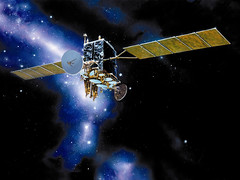 The General Services Administration (GSA) yesterday inked deals with 24 satellite communications companies to deliver the next-generation satellite solutions for government agencies, known as Satcom II.
The Satcom II program is meant "to provide an expanded range of end-to-end satellite solutions for government agencies and serves as the primary replacement vehicle for the highly successful Satellite Services contracts."
Among the service providers are nine small business contractors, according to Washington Technology:
The large contractors are Americom Government Services Inc.; Arrowhead Global Solutions Inc.; Artel, Inc.; AT&T Corp.; DRS Technical Services; EDS Corp.; Global Communications Solutions Inc.; Hughes Network Systems LLC; Intelsat General Corp.; Mackay Communications Inc.; Segovia Inc.; Stratos Mobile Network Inc.; Telecommunications Systems Inc.; Telenor Satellite Services and ViaSat Inc. The small business awardees are CVG Inc.; DasNet Corp.; E&E Enterprises Global; Knight Sky Consulting and Associates LLC; New Orleans Teleport Inc.; Psi Systems Inc.; RiteNet Corp.; Satellite Communication Systems Inc. and Skjei Telecom Inc.
The same story provides details on the Satcom II system:
The Satcom II system will allow federal workers to use hand-held receivers similar to cell phones, as well as access full broadband computer networks, anywhere in the world. It is designed for use in areas where no phone or cable lines exist and to help federal workers fight wilderness wildfires, patrol remote borders and rescue the trapped and injured from hurricanes or tornadoes.
The system also makes possible broadcast services in distance learning for federal customers throughout the world…
The GSA press release notes that the "SATCOM-II program has an estimated value of $750 million over the life of the five-year, indefinite delivery, indefinite quantity contracts, and… offers competitive pricing throughout the life of the contract, as well as flexible ordering and billing."
Computerworld also files a report on the contracts, which, while certainly important to the businesses that inked them, essentially provide basic satcom services. The really cool technological breakthroughs (such as the next-stage C4ISR bandwidth, advanced extremely high frequency satellites and Wideband Global Satcom program) tend to come through military contracts.
Ariane Launching ASTRA 1L Satellite
Wednesday, May 2nd, 2007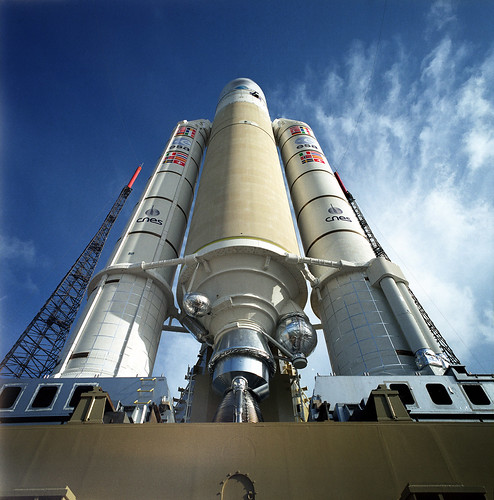
We have a potentially record-setting launch coming up on Thursday, 3 May 2007, from the jungles of French Guiana. We’re talking some heavy payload here. The news via L’Express:
La fusée européenne Ariane 5 doit décoller jeudi soir de Kourou pour mettre en orbite une masse sans précédent constituée de deux satellites de communication.
La masse totale – celle des deux satellites Astra 1L et Galaxy 17 et des interfaces – s’élève à 9,4 tonnes, un record mondial pour un lancement sur orbite géostationnaire, rapporte Arianespace, l’exploitant du lanceur.
Le décollage est prévu à 19h29 (22h29 GMT) du Centre spatial guyanais, la base de l’Agence Spatiale Européenne.
Il s’agit du 176e lancement d’Ariane, du 32e vol d’une Ariane 5 et du 10e d’une Ariane 5 ECA, modèle le plus puissant de la gamme, qui peut mettre jusqu’à dix tonnes sur orbite.
Le satellite Astra 1L doit être placé sur orbite 27 minutes après le décollage et Galaxy 17 cinq minutes plus tard.
Construit par l’industriel américain Lockeed Martin Commercial Space Systems en Californie, Astra 1L a une masse au décollage de 4,1 tonnes, selon Arianespace.
Il sera positionné au-dessus de l’Europe continentale, d’où il assurera la diffusion de chaînes de télévision de haute définition (HD) pour le compte de SES Astra, société du groupe Société Européenne des Satellites (SES), basée au Luxembourg.
I’m making plans to watch it myself. The launch window opens at 22:29 GMT and closes at 23:13 GMT on 3 May 2007. Local time in French Guiana is right after dinner (between 19:29 and 08:13 on 3 May 2007), but I doubt anyone will be able to eat beforehand. Here are some local times:
New York: 18:29 to 19:13 on 3 May 2007
Luxembourg: 00:29 to 01:13 on 4 May 2007
Singapore: 06:29 to 07:13 on 4 May 2007
Live television broadcast begins at 21:50 GMT (17:50 EDT; 23:50 CET):
- In Europe, the launch will also be broadcast live via ASTRA satellite from the orbital position 19.2° East (downlink frequency: 12.5515 GHz, vertical polarization, service ID 12122, service name ASTRA Vision 2).
- In North America, lock your antenna on Galaxy 3 at 95 West (transponder 22, C-band; Format: digital 9 MHZ, 4126.5 Vertical, FEC: 3/4, Symbol Rate: 6.1113).
- Click here to watch the live webcast.
According to our friends at ASTRA, the satellite will be performing a critical mission:
ASTRA 1L will be located at 19.2° East, ASTRA’s prime orbital position for delivering broadcast services to continental Europe, where it will also transmit the increasing number of HDTV channels. The new satellite will allow SES ASTRA to move its satellite ASTRA 2C from 19.2° East to 28.2° East, in order to meet the high demand for capacity from the U.K. and Irish markets. It will also extend the ASTRA coverage from the Canary Islands in the West to the Russian border in the East and further strengthen SES ASTRA`s unique in-orbit back-up scheme.
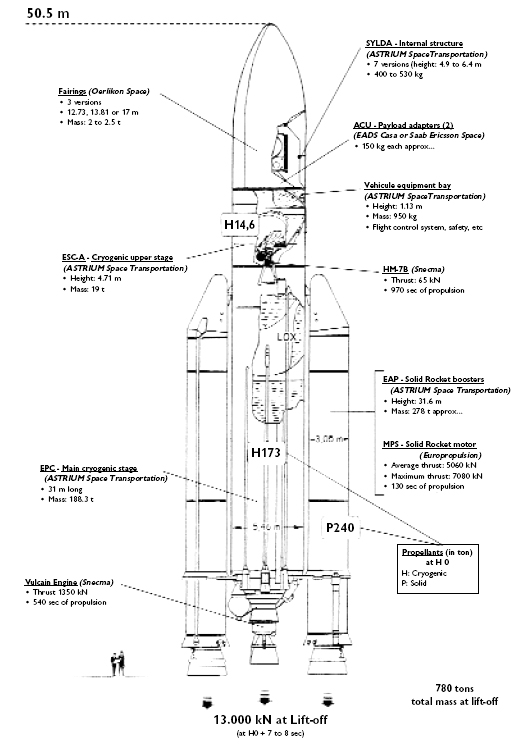
The launcher itself is described in great detail on the ESA Web site.
TO SAVE MY COUNTRY, I NEED TO BORROW THE SUM OF $200 MILLION
Tuesday, May 1st, 2007Nigeria is a country best known for its email marketing scams. You know, the ones written in all caps and started off something like…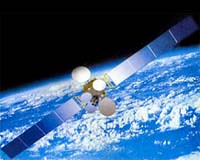
"Dear Friend,
It is with heartfelt hope that I write to seek your co-operation and assistance in the context stated below, I am Barrister Fenner Mark Elvis, the personal Attorney to the late Mr. Nobert Spagele. I got your contact through the help of my brother-in-law that works with the American Chambers of Commerce and Tourism, though I did not disclose to him my humble intention for an honest foreigner like you, having noted the confidence reposed on your person by the sponsor of the recommendation…
Well, according to SpaceMart, last January a Chinese Bank fell for a similar line and, at present, is financing the construction of Nigeria’s first communications satellite, NigComSat, which is now set to launch before the end of this month.
While this is not Nigeria’s first satellite, a title held, according to allAfrica.com, NigeriaSat-1, launched in 2003 to take photos of Nigeria’s environs, it does mark the first time a Sub-Saharan African country has launched and retained control of their own communications satellite.
Recently "replaced" Nigerian President General Olusegun Obasanjo said that the satellite is a part of his country’s commitment to development:
"This commitment has informed our embarking on programmes and initiatives that would effectively address the challenges of poverty, food security, infrastructural development, sustainable energy, affordable health and housing, and protection from natural and man-induced disasters.
Space technology is key to the realization of the Millennium Development Goals (MDGs) and the objectives of our holistic reform agenda as encapsulated in the NEEDS document. It guarantees the availability and speedy access to real-team data and geo-partial information, as well as the availability of relevant infrastructure and backbone for information communication"
The Chinese, who are financing, building, and launching the project, are also proud of the effort, the first step in a move to develop a satellite design and construction export business. The launch will take place at the Jiuquan Satellite Launch Center, which has launched some 30 satellite since 1990, 24 of which were commercial launches for overseas clients.

The satellite itself is being constructed by China Great Wall Industry Corp., based on China’s latest model of satellite platform, DFH No. 4, and will feature 28 transponders, including 4 C band, 18 Ku band, 4 Ka band and 2 L bands. The whole thing weighs somewhere around 5000 kg and has an anticipated life-span of 15 years.
NASA’s AIM Spacecraft Launch via Pegasus XL
Wednesday, April 25th, 2007
Nice launch of the AIM spacecraft, via NASA press release:
During the next two years, AIM scientists will methodically address each of six fundamental objectives that will provide critical information needed to understand cloud formation and behavior.
"This mission has many firsts, including that Hampton University is the first historically black college and university to have the principle investigator and total mission responsibility for a NASA satellite mission," said Program Executive Victoria Elsbernd, NASA Headquarters, Washington.
NASA’s Kennedy Space Center, Fla., is responsible for launch vehicle/spacecraft integration and launch countdown management. NASA’s Goddard Space Flight Center, Greenbelt, Md., is responsible for the overall AIM mission management in collaboration with Hampton University, the University of Colorado, Boulder, and Virginia Polytechnic Institute and State University, Blacksburg. Orbital Sciences Corporation, Dulles, Va., is responsible for providing the Pegasus XL launch service to NASA.
GE Deal For AsiaSat
Wednesday, April 25th, 2007
Remember Tianamen Square? To many people, it remains a fuzzy memory. The U.S. State Dept. remembers it well — especially the laws and regulations created since then regarding technology transfer. Satcom falls under that category.
We thought AsiaSat was going to be taken private by GE (see this comment from 2 months ago) after SES bought them out. The South China Post reports this US$295 million deal won’t be happening:
The Bush administration’s decision to stop a General Electric subsidiary from teaming up with state-owned Citic Group to privatise Asia Satellite Telecommunications Holdings is the latest in a long line of mainland-related deals that the United States has blocked for political reasons.
At the root is a policy put in place by former US president George H.W. Bush, father of the current president. On June 5, 1989, the day after the Tiananmen Square crackdown, Mr Bush issued a moratorium on all US military exports to the mainland, including satellites.
Shortly after, the US Congress passed laws banning satellite exports to China. There were two exceptions: the president could issue a special waiver on the grounds that either the mainland had achieved political and human rights reforms or the deal was in the US national interest.
What constitutes "national interest" has since been a subject of keen debate in Washington, and it appears that Citic and GE’s HK$2.3 billion bid for AsiaSat is the latest victim.
"The US Department of State has in correspondence with General Electric said it will not grant the approval necessary to implement the proposed privatisation," AsiaSat said yesterday in an announcement on the scuttling of the deal.
As the leading regional satellite operator in the Asia-Pacific, the company makes for an attractive target. It serves more than two-thirds of the world’s population with its three satellites: AsiaSat 2, AsiaSat 3S and AsiaSat 4. They provide services to the broadcast and telecommunications industries.
More than 240 digital television channels and 130 radio channels are now delivered by AsiaSat’s satellites, reaching about 96 million households with more than 360 million viewers across the Asia-Pacific.
Last year, AsiaSat tapped California’s Space Systems/Loral, a subsidiary of US high technology firm Loral Space & Communications, to build AsiaSat 5. The new-generation satellite is slated for launch next year and it is unclear what impact, if any, the State Department’s latest action will have on that deal.
It is not the first time the company has been at the centre of the US-China export dispute.
In December 1989, despite an outcry in the Congress, the elder Bush ruled that exporting satellites – the manufacture of which is dominated by several US companies – was in the national interest. That cleared the way for AsiaSat 1, which in April 1990 became China’s first commercially launched US-made satellite.
But the following year, Mr Bush blocked the sale of satellite components to the mainland.
The move was interpreted as an attempt to appease Congress – which was upset with Chinese sales of military equipment to Middle East nations – and to win support for Mr Bush’s plans to further liberalise trade with the mainland.
The present-day Bush administration’s move against the Citic-GE deal may have had a similar political motive.
As the US prepares for another presidential election cycle, analysts have interpreted the recent World Trade Organisation case against China as an attempt by beleaguered Republicans to head off some of the inevitable China-bashing that is likely to emerge from a Democrat-controlled Congress.
But, for now, the only obvious loser is business.
And this from Variety:
A plan to take Asia Satellite Telecommunications Holdings, which operates three satellites across the region, into private ownership was quashed Tuesday (April 24) when it was blocked by the U.S. Dept. of State.
The private-ownership plan was proposed by AsiaSat and AsiaCo, a joint venture between China’s state-owned Citic Group and GE Capital Equity Investments from the U.S.
If the company had gone private, Citic and GE would each have owned 50%. GE became a major shareholder of AsiaSat in early April with a 34% holding.
Deal was subject to a number of conditions, one of which was approval by the State Dept. and compliance with U.S. International Traffic in Arms Regulations.
As a result, a court meeting and special general meeting scheduled for Tuesday morning were "adjourned indefinitely" only hours before they were skedded to take place.
The deal appears to have raised national security hackles at the U.S. State Dept. concerning transfer of satellite technology to China.
AsiaSat didn’t immediately return phone calls for comment.
Trading in AsiaSat shares were suspended from just before noon on Monday and trading in American Depositary Shares (ADS) on the New York Stock Exchange was suspended Monday.
Trading resumed Wednesday morning at 9:30 in Hong Kong and once the NYSE opens its trading day Wednesday, ADS trading will start up again.
In an increasingly competitive market, AsiaSat’s shares have continued to drop over the past three years. Price of shares decreased almost 12% during that period compared to a more than 51% increase in the Hang Seng Index.
The company hoped being taken private would give it greater flexibility to focus on the development of business and marketing activities; and relieve it of the financial and administrative burden of dual listings on both the Hong Kong Stock Exchange and the New York Stock Exchange, according to a press release dated Feb. 14.
AsiaSat’s three satellites serve two-thirds of the world’s population with its three satellites, which provide services to the broadcast and telecom industries.
It has more than 270 TV channels and 130 radio channels delivered via its satellites and reaches 96 million households in the Asia-Pacific region.
AsiaSat’s shares fell 5.7% on Wednesday, closing at HK$16.50. It’s U.S. ADRs were down 8.97% on the NYSE.
Televisa Eyes Satmex
Tuesday, April 24th, 2007
Last week, Rocco pointed in the comment threads to a Wall Street Journal (subscription required) report that Intelsat may be for sale. As Rocco so succinctly put it in the comments:
FOR SALE: Global communications satellite business. Only $11 billion in debt. Good cash flow. Nice office in Bermuda; half-empty building in Washington. Heavy regulatory environment. Price: $6 billion.
We wrote a bit about Intelsat’s history in this post; the Wall Street Journal’s report (here) has more details on Intelsat’s recent history as a private entity.
Yet Intelsat isn’t the only satcom firm in the midst of (possibly) changing hands. Asiasat yesterday asked to have their stock trading suspended due to a pending announcement, and now come reports that Satmex, too, may be in the sites of a takeover entity.
Variety reports:
MEXICO CITY — Mexican conglom Televisa is hooking up with the Chinese. VP of broadcasting Jose Baston signed an agreement to distrib state broadcaster CCTV’s international feed in Mexico on Monday. Televisa execs will travel to China in the coming weeks to explore sales of telenovelas and formats to that country…
Net also is considering bids for Endemol and Mexican satellite firm Satmex as possible destinations for its bulging cash reserves.
With Satmex in its fold, Televisa could cut its own international distribution costs as well adding revenue from Satmex’s three birds that cover the American continents. Global sat firms such as PamAmSat also are expected to go after Satmex.
Business News America has greater detail on Televisa’s thinking behind a Satmex buyout:
Televisa is analyzing what sorts of operational synergies exist between its own operations and Satmex’s coverage, according to de Angoitia….
However, Alberto Moreno, an analyst with corporate ratings firm Fitch Ratings México, downplayed the news saying that it is just one of many investment options that Televisa is weighing up and that it is too early to tell whether the company is a serious contender.
If the company is indeed seriously interested, an official announcement should be made in the short term, Moreno told BNamericas.
Despite the uncertainty, Moreno said that Televisa is looking for new investment opportunities to grow their business particularly to address the US Hispanic market.
Satmex has decent coverage of the Americas with only three satellites. Although Televisa’s recent sale of its stake in Univision was big news, it’s clear from the Satmex reports that Televisa’s interest in the growing U.S. Hispanic market is far from over.
Breakout Your 3-D Glasses… the First STEREO Pictures are In
Monday, April 23rd, 2007
With you kind of coverage you’d expect from RRS, we’ve been following NASA’s stereo since its launch last October and some of the first non-3-D photos were released in late February.
As seen in the photo above, NASA is releasing the first 3-D photos taken by the STEREO project at a press conference taking place in the next few minutes. According to the NASA press release, these photos represent a significant advance in astronomy, allowing those who study the heavens an opportunity to finally really see what they’re observing.
"In the solar atmosphere, there are no clues to help us judge distance. Everything appears flat in the 2-D plane of the sky. Having a stereo perspective just makes it so much easier," said Dr. Russell Howard of the Naval Research Laboratory, Washington, the Principal Investigator for the SECCHI (Sun Earth Connection Coronal and Heliospheric Investigation) suite of telescopes on the spacecraft.
‘With STEREO’s 3-D imagery, we’ll be able to discern where matter and energy flows in the solar atmosphere much more precisely than with the 2-D views available before. This will really help us understand the complex physics going on,’ said Howard."
Oh, and the knowledge gained by the observation will do more than look pretty, helping scientists better gauge changes in space weather patterns and forecasts by helping them better understand Coronal Mass Ejections (CMEs).
"CMEs are eruptions of electrically charged gas, called plasma, from the sun’s atmosphere. A CME cloud can contain billions of tons of plasma and move at a million miles per hour.
The CME cloud is laced with magnetic fields, and CMEs directed toward Earth smash into our planet’s magnetic field. If the CME magnetic fields have the proper orientation, they dump energy and particles into Earth’s magnetic field, causing magnetic storms that can overload power line equipment and radiation storms that disrupt satellites.
Satellite and utility operators can take precautions to minimize CME damage, but they need an accurate forecast of when the CME will arrive. To do this, forecasters need to know the location of the front of the CME cloud. STEREO will allow scientists to accurately locate the CME cloud front. ‘Knowing where the front of the CME cloud is will improve estimates of the arrival time from within a day or so to just a few hours,’ said Howard. ‘STEREO also will help forecasters estimate how severe the resulting magnetic storm will be.’"
Those interested in seeing more will definitely want to check out the STEREO mission page following the press conference (11:00am EDT) when additional photos will be released.
(Don’t have a pair of 3-D Glasses on you? Check out the NASA Guide on how to make your own 3-D specs.)
India’s PSLV Launched
Monday, April 23rd, 2007Via The Times of India:
The Polar Satellite Launch Vehicle-C8 (PSLV-C8) has been launched successfully today from Sriharikota.
PSLV is carrying the Italian Satellite Agile along with it. The countdown progressed smoothly for the first commercial launch of PSLV-C8 with a 352 kg Italian astronomical satellite onboard from Sriharikota spaceport, about 150 kms from Chennai.
“The atmosphere is calm and quiet. Countdown is progressing as per schedule," said an ISRO spokesman.
The launch vehicle lifted off at 1530 hrs.
The 42-hour countdown for the launch of the 11th flight of PSLV-C8 began on Friday evening. It was launched from the second launch pad at the Satish Dhawan Space Centre, SHAR.
Apart from the Italian satellite, Agile, PSLV-C8 would also carry an Advanced Avionics Module (AAM), weighing 185 kg, to test advanced launch vehicle avionics systems like mission computers, navigation and telemetry systems.
A workhorse launch vehicle of ISRO, PSLV has launched nine successful consecutive flights till now since its first launch in 1994. It would also launch India’s first mission to the moon, Chandrayaan-1 in 2008.
Shields On, Captain!
Thursday, April 19th, 2007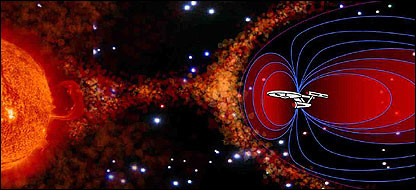
The image above may look like science fiction, but today it’s actually science.
The BBC reports that "British scientists are planning to see whether a Star Trek-style deflector shield could be built to protect astronauts from radiation."
The cancer-causing radiation from cosmic rays and solar flares has always been a danger to astronauts, but that danger has been mitigated by the minimal durations of time that most individual astronauts have spent in space.
Crew members on the International Space Station have a thick-walled room that they can retreat to during times of increased solar radiation:
But these protective shelters would not be practical on long-duration space journeys, since the "drip-drip" of energised particles is thought to be as harmful to the health of astronauts as large solar storms.
The harmful particles come from the Sun, in the form of the solar wind, and from sources outside our Solar System.
To create the deflector shield around a spacecraft or on the surface of a planet or moon, scientists need to generate a magnetic field and then fill it with ionised gas called plasma….
"You don’t need much of a magnetic field to hold off the solar wind. You could produce the shield 20-30 kilometres away from the spacecraft," explained Dr Ruth Bamford, from the Rutherford-Appleton Laboratory in Didcot, UK, one of the scientists on the team.
Dr Mike Hapgood, from the Didcot-based research centre, told BBC News: "The nice thing is that magnet technology is really quite evolved here on Earth. The question is can you take it into space?’"
The team from Rutherford-Appleton plans to build an artificial magnetosphere in the laboratory. They would eventually like to fly a test satellite which would test the technology in space…
The idea has been likened to the deflector shields which protect the USS Enterprise and other spacecraft in Star Trek. Like their fictional counterparts, these shields could also be switched on and off….
The idea for the shields draws on technology pioneered in experimental nuclear fusion reactors. Nuclear fusion is not yet a mature technology.
It works on the principle that energy can be released by forcing together atomic nuclei rather than by splitting them, as in the case of the fission reactions that drive existing nuclear power stations.
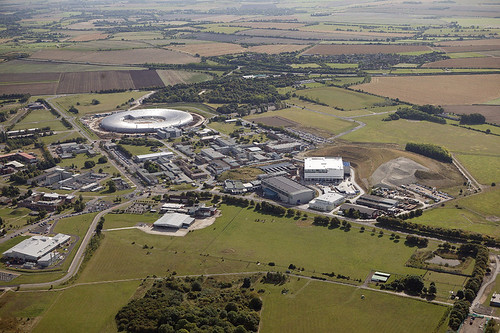
The Rutherford Appleton Laboratory (pictured below), where the research is taking place, "has a staff of around 1200 who support the work of over 10000 scientists and engineers." Located in Oxfordshire, RAL is one of the largest space research laboratories in Europe.
For more information on magnetic fields and the debate about their effectiveness, check out this active discussion on Slashdot, including this comment:
The big engineering problems with this approach still have not been solved. (1) If you’re not using superconducting magnet coils, a large, static magnetic field requires a huge power supply to keep it going. That’s not practical for foreseeable, near-future technologies for going to Mars, which will need to use very small payloads. (2) Superconducting magnets are unreliable, finicky beasts, at least from my experience here on earth. You need big, heavy cryostats full of liquified gases. It’s not necessarily a good idea to have a vital piece of safety equipment for your spaceship depend on an inherently high-maintenance, low-reliability technology. (3) Large electric fields are hard to maintain because you get arcing and discharges. I used to work at an electrostatic accelerator that used megavolt potentials, and it would start sparking at the most inopportune times, for reasons like, e.g., someone leaving behind a speck of lint inside the accelerator. When a spark would happen, you could hear it all through the building, and the energy released was equivalent to dropping a VW bug off the roof of a building. Again, low-reliability, high maintenance. (4) Although it’s possible to use tricks to get rid of some of the particles, or channel particles to a place where they’re not as harmful, you still have to deal with the fact that you have particles with both signs of charge, which feel forces in opposite directions from the same field. What repels one attracts the other. Also, if the particles get channeled to a certain place, and impact on something solid, then you get extremely intense secondary radiation at that spot.
Of course, this is pessimistic nonsense. We’ve seen magnetic fields work nearly 80 times.