Archive for the ‘Satellites’ Category

BlackBerry NOC Down

Wednesday, April 18th, 2007

Chuck Scarborough used to live down the street from me in Bronxville years ago. Last night I watched him tell me my BlackBerry‘s not working. Neither is anybody’s in North America, according to Computerworld:

The BlackBerry wireless e-mail service from Research In Motion Ltd. appears to have suffered a widespread outage that started last night in the U.S.

Customers on the BlackBerry Forums discussion board complained of having no service starting at about 5.15 p.m. PDT yesterday.

Callers to the BlackBerry U.S. technical support line were still greeted with the following message early this morning: "We are currently experiencing a service interruption that is causing delays in sending or receiving messages. We apologize for the inconvenience and will provide updates as soon as they become available."

New York television news channel NewsChannel4 reported last night that the problem affected "all users in the Western hemisphere."

However, comments from operators in Asia and Europe, as well as postings to the BlackBerry Forums, suggested that the problem may be limited to North America.

"Officials with RIM said they are trying to reset the system and told NewsChannel4 that they are concerned that the backlog of data, which will rush through when it comes back on line, could cause a bigger problem," the news channel reported on its Web site.

RIM officials advised people who use Blackberry as a major way of communications to make back-up plans, the channel reported.

A RIM official contacted in France was unaware of the problems, and said she had received messages sent to her BlackBerry as normal. Other RIM officials did not return calls seeking comment.

The outage may have been cause by one of RIM’s Network Operating Centers (NOC) going down, according to Emma Mohr-McClune, principal analyst with Current Analysis Inc. "This has happened before," she said.

RIM operates two NOCs, both located in Canada, according to Mohr-McClune. The company has considered locating additional NOCs outside of Canada, she said.

Companies that provide BlackBerry service connect their mail servers to a BlackBerry Enterprise Solution (BES) server located on their premises, which in turn is linked to one of RIM’s NOCs, according to Mohr-McClune. "All data slides to Canada and back," she said.

RIM may have been fortunate that the outage began at about 5 p.m. Pacific Time, because it would have been after the busiest part of the U.S. work day. Engineers were likely scrambling through the night to bring the service back online before the start of the U.S. workday today.

Other parts of the world appeared to have been unaffected. A representative for Taiwan Mobile Ltd., RIM’s BlackBerry partner for the island, said the problem is limited to North America, and that users would not be affected unless they are sending or receiving e-mail through a BlackBerry server there.

"RIM has not communicated with Taiwan Mobile about when this problem might be fixed," said the representative, April Hong.

NTT DoCoMo Inc. in Tokyo said its BlackBerry users in Japan were also unaffected. And In Europe, a spokesman for T-Mobile Deutschland GmbH was unaware of any problems, and Blackberry users in Germany and France reported no interruption of service.

The problems come at a time of continued rapid growth for the company, based in Waterloo, Ontario. It added 1.02 million subscribers in the quarter ended March 3, for a total of approximately 8 million BlackBerry subscribers worldwide. Revenue for the quarter was $930.4 million, up 66% from a year earlier. Net income for the quarter before adjustments was $187,928, the company said.

Wish they had built-in satellite connectivity. Thuraya phones have it.

The Great Turtle Race!

Tuesday, April 17th, 2007

Here’s a great story about how the combination of satellite tracking technology and the Internet can be used to raise awareness about conservation efforts around the world.

The Leatherback Sea Turtle is the biggest of all living turtles and the world’s fourth-largest reptile, reaching more than 6 feet in length and weighing up to 2000 lbs. It is also listed as endangered worldwide by the U.S. government, with the global population of female leatherbacks plunging from an estimated 115,000 in 1980 to fewer than 43,000 today.

Ranging throughout the Pacific, Atlantic and Indian oceans, leatherbacks worldwide are threatened not only by coastal development and loss of habitat, but by ocean pollution and "floating plastic bags or sheets which they mistake for jellyfish — a staple of their diet." 90 percent of the leatherbacks have vanished and the species may disappear within 10 years due to illegal poaching of their eggs, according to conservationists.

To draw attention to the plight of the leatherbacks, conservationists yesterday launched the Great Turtle Race.

The AP reports:

Biologists will switch on satellite trackers strapped to the backs of 11 female leatherback turtles on Monday, starting what conservationists have dubbed the "Great Turtle Race" to raise awareness of a species threatened with extinction.

Sponsored by U.S. and Costa Rican environmental groups and businesses, the race will track the turtles on their annual 1,200 mile journey from Costa Rica’s Pacific coast to the Galapagos Islands….

Most of the competing turtles are expected to be in the water by Monday after laying their eggs on the beach at Playa Grande in Costa Rica.

The Web site features virtual trading cards with caricatures of the turtles with names like Freedom, Windy and Stephanie Colburtle after U.S. comedian Stephen Colbert of Comedy Central fame. It also has stats on their egg-laying history…

Ten race sponsors — including Yahoo Inc., Plantronics Inc., Philadelphia’s Drexel University and Dreyer’s Ice Cream — donated $25,000 each to purchase the tracking equipment and protect nesting areas from development.

Leatherbacks aren’t the only sea creatures that are getting tagged with satellite trackers to raise awareness and scientific knowledge about  the world’s oceans. The Census of Marine Life has a great site, Tagging of Pacific Pelagics, where users can track tracking projects of a variety of species and view real time data of the movement of sharks and other animals in the Pacific. And NASA is tracking sea lions to gain a better understanding of the world’s oceans.

For ease of use and entertaining presentation — especially for a younger audience — it’s hard to beat the Great Turtle Race website. Check it  out, because those turtles are, um, making some quick tracks.

I Love You, C-band

Monday, April 16th, 2007

This may not be the same love as the backyard-dish people were feeling 20 years ago, but these folks are digging IP-PRIME, which is carried nationally via AMC-9’s C-band payload in the U.S.:

“We have an extraordinary partnership with SES AMERICOM and with the launch of IP-PRIME we can now reach out securely and effectively to IPTV viewers across the country who will be able to access their favorite NBCU programs,” commented Henry Ahn, executive vice president, NBC Universal TV Networks Distribution.

“Showtime Networks is excited about the ability of SES AMERICOM to securely and reliably deliver all of our networks to the telcos with video initiatives, using enabling technologies such as MPEG4,” said Michael Tas, Senior Vice President, Distribution and Sales Strategy for Showtime Networks. “SES AMERICOM has been a proven partner of Showtime Networks for decades now and we look forward to extending the relationship well into the future.”

“We are sensitive to the costs of getting into the distribution business and are happy IP-PRIME is in place to fill the technology gap for small operators,” said Karen Byko, executive vice president of operations for Turner Network Sales.

“Consumers want alternatives in how they spend their entertainment dollars,” said Mike Biard, Senior Vice President, Affiliate Sales, Fox Cable Networks. “IP-PRIME will deliver Fox’s networks securely to a new generation of distributors, and we are delighted to be working with SES AMERICOM to do so.”

"We’re excited to be a part of SES AMERICOM’s new IP-PRIME programming lineup," said Mark Cuban, chairman and co-founder, HDNet. "By including HDNet and HDNet Movies, SES AMERICOM is making sure IPTV viewers receive the highest quality HD programming, including our acclaimed movies, original programming, investigative news, popular series and sports.”

Multichannel News followed up with a question on ESPN, of course.

Will this revive the backyard dish market? I can almost imagine a DTH service using C-band. I want my IPTV!

Space Tether Experiment Launches Today

Monday, April 16th, 2007

If you were up with the sun (or the clouds, if you’re in the eastern portion of the US) this morning, you might have caught the report on NPR on Space Tethers and Tethers Unlimited efforts to change the way satellites are transported.

While science fiction, Victoria’s Secret, and long-woven ropes are rarely mentioned in the same breath (unless of course you’re in some bizarre John Waters movie), the work of Dr. Robert P. Hoyt and Dr. Robert L. Forward have brought the two strangely together to solve a real problems posed by simply moving obejcts around space.


"For 50 years, people have relied on rockets to move things around in space. But rocket fuel is expensive and heavy. [Hoyt with the help of Forward realized how] much easier it would be to just fling things around using orbiting tethers.

‘It’s sort of like using the techniques of Tarzan to move around in space,’ explains Hoyt. ‘You’re basically grabbing onto a long, high-strength rope and using it to swing you from one place to another.’"

The problem, of course, was how you got those ropes to last in an environment where they were being constantly pounded by the debris that litters our orbit. And that’s where the underwear comes into Tethers Unlimited business plan…

"The company makes tethers by starting with light but strong fibers, like Kevlar. Then the strands are woven together using a computerized machine.

‘[That machine is] normally used for fabricating things like lacy edgings on Victoria’s Secret undergarments," says Hoyt. "We’ve developed ways to use that to braid the multi-line tether structure that we’re testing in space.’"

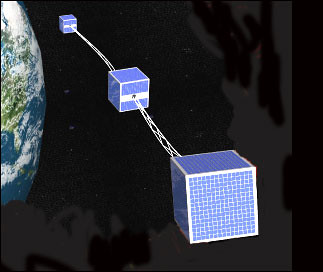
That testing begins imminently, a Dnepr rocket blasting off from Baikonur Cosmodrome today contains, within its payload, three mini-satellites that will deploy a half-mile tether, two of the satellites anchoring either end. The third, dubbed, according to a recent Engadget report, Inspector Gadget (Ted and Ralph make up the other two members of the trio), will move up and down the tether taking pictures that will allow those on the ground to learn how many cuts or tears the rope takes on over the next few months.

While it might be awhile until we see tether’s in action, propelling satellites in space, this initial experiment is an important first step in a lot of new space technology, possibly including space elevators.

High-Speed Internet for Movin’ Military

Tuesday, April 10th, 2007

Is this the future of acquisition procedures for the U.S. government’s satcom needs?

The Wall Street Journal (subscription required) reports that the U.S. Defense Department has formed an unusual partnership with Intelsat Ltd., Cisco Systems Inc., and private investors to bring high speed internet connections to military units on the go:

 The demonstration project requires private investors led by a fledgling private-equity fund to shoulder the entire cost of a networking system for directing messages, a sort of Internet router in the sky for soldiers and intelligence gatherers…..

Private investors are gambling that the U.S. military will make long-term commitments to support technical breakthroughs and new acquisition procedures….

Claire Fairfield, managing director of venture fund Concerto Advisors Inc., said his group is looking to raise as much as $200 million to fund four total satellites involving Intelsat or other commercial operators.

Cisco top executive for the program, Rick Sanford, says the project is "really a business approach, not a government program." By acting like a consumer, the DoD hopes to overcome the delays and cost overruns that have frustrated their more traditional attempts to meet the military’s soaring demand for satellite IP connections. (Cisco is providing software integration for the project.)

By developing and deploying such technology in about two years — dramatically faster than traditional military-satellite programs — such shared commercial-government payloads could pave the way for providing lower-cost, more flexible digital-communications links to fighting forces and intelligence operatives in the field. If successful, the model also will help the military, along with users of navigation, homeland-security and other civilian applications better coordinate future satellite needs.

In this case, "We get to test something for a fraction of what it would cost" if the Air Force funded it, said Mike Florio, the military’s lead manager for the program. "And we’ve got some stars of industry trying to make this work." 

The deal marks another milestone in Intelsat’s history. Intelsat was established in 1964 by 11 countries as an international intergovernmental agency to provide satellite services to member countries; by 1973, more than 80 countries had joined the consortium. In 2001, Intelsat became a private company, opening up new avenues of business — including deals like this one with the DoD. Still, vestigal problems remain from its days as the satcom provider to a broad spectrum of political organizations (see here and here,  as well as this odd entanglement between Sri Lanka, Amnesty International, and the International Cricket Council (whose Cricket World Cup is taking place now.)


As in the civilian world, the U.S. military’s need for faster and more reliable IP communications has grown exponentially as the convergence between IP technology and two-way and broadcast communications accelerates. AMERICOM Government Services’ C2OTM (Comms-on-the-Move, pictured above) for example,  provides "real time support for a full range of IP applications including VOIP, two way video surveillance, warfighter coordination tools such as common operational perspective and force tracking, and a full range of logistics and training applications" by integrating with ArcLight(r) modem technology from ViaSat

Anik F3 Launch Update

Monday, April 9th, 2007


As you probably know those of us here at Really Rocket Science love a good launch, especially that of a big GEO satellite.

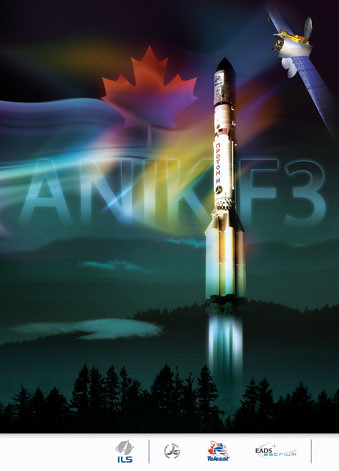
The Anik F3 will be launching tonight (04:54 April 10 Baikonur, 22:54 April 9 GMT, 18:54 April 9 EDT) this from launch pad 39 of the Baikonur Cosmodrome in Kazakhstan. You can, of course, catch the launch live via streaming, although hopefully we’ll be able to find on YouTube sometime tomorrow for those looking to beat a wicked case of the Mondays by heading to Happy Hour early.

Those nerdier than us might want to catch a live feed of the launch via satellite or over the phone at the following locations.

Live Broadcast
North America: Telstar 6 @ 93° West, transponder C11, downlink 3920 MHz (vertical), analog NTSC. Test signals start at 18:00 EDT.

Live Broadcast
Europe: NSS-7 @ 338° East, transponder WHL4/EUH3 CH1, Ku-band, 338 degrees West downlink 11098.9 MHz (horizontal), digital PAL symbol rate 6.1113, fec: 3/4. Test signals start at 22:00 GMT.

U.S. domestic Launch Hotline at 1-800-852-4980.

What does Anik F3 do? Basically its a comm sat for Telsat Canada, but since you asked:

"Multipurpose communications satellite with payloadsin Ku-, C- and Ka-band. The Ku- and C-bands will carry a wide range of broadcasting, telecommunications, business and Internet-based services throughout North America"

See you at the launch!

Satcom, Chicago

Wednesday, April 4th, 2007


As Robert Johnson wrote… 

Now, one and one is two, two and two is four
I’m heavy loaded baby, I’m booked, I gotta go
Cryin’ baby, honey, don’t you want to go
Back to the same old place, my sweet home Chicago

70 years later, still sounds good. In fact, Amazon has a nice box set available.

Last month, it was one and one and one is "no go:" the FCC dismissed (PDF) an application from the City of Chicago’s Office of Emergency Communications to operate a small satellite communications network consisting of a hub and two remote VSAT stations using sub-one-meter antennas. Besides not including a radiation hazard study, which is standard for earth station applications, the FCC found other details lacking:

Section 25.220(e)(1) of the Commission’s rules, 47 C.F.R. § 25.220(a)(1), requires applicants proposing non-routine earth stations to include with the application a certification from each target satellite operator that the target operator has reached agreements with adjacent satellite operators regarding the non-routine operations.

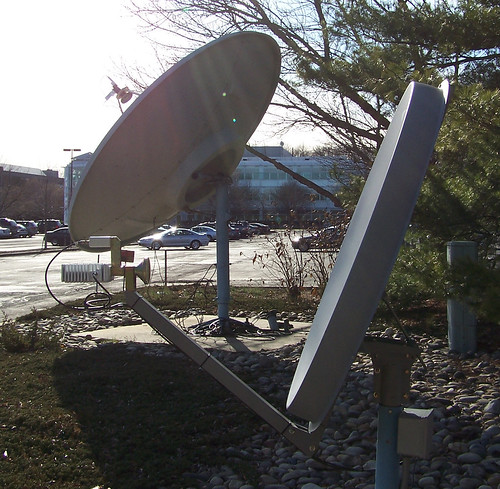
Chicago also wanted to be able to connect with any available satellite over the U.S. during an actual emergency. I’m sure they’ll refile their application, but they should probably consider using a pre-engineered, commercially-licensed emergency communications system such as REDiSat — which uses a the AMC-6 satellite’s Ku-band payload (which is actually pretty hot over Chicago) to connect to a fully-licensed earth station in Maryland. It uses an antenna that’s approved for two-way communications anywhere in the lower 48, typically a 1.2m Patriot antenna and an iDirect modem.

Los Angeles County installed an extensive VSAT network years ago, as did the State of Florida. But these are "hot spots" for these types of networks and they went to great lengths in designing and installing them. Other large cities have done likewise since 9/11. With simpler configurations such as the type REDiSat offers, smaller municipalities can now begin considering a communications network that uses the ultimate diverse path: through space.

Hey, it worked in Biloxi.

Space Video: On-orbit Servicing with NextSat

Tuesday, April 3rd, 2007

We told you about the launch a few weeks back, but the Orbital Express refueling system appears to be up, running, and pretty effective. For those that don’t remember here’s the story about the new technology:

The goal of the Orbital Express Space Operations Architecture program is to validate the technical feasibility of robotic, autonomous on-orbit refueling and reconfiguration of satellites to support a broad range of future U.S. national security and commercial space programs. Refueling satellites will enable frequent maneuver to improve coverage, change arrival times to counter denial and deception and improve survivability, as well as extend satellite lifetime. Electronics upgrades on-orbit can provide regular performance improvements and dramatically reduce the time to deploy new technology on-orbit.

The full story about the mission of the Orbital Express satellite can be found at NASA’s Automated Rendezvous & Docking program website.

The video you see about you is a survey of the NextSat, the kind of serviceable satellite the Orbital Express is designed to fuel, and its refueling buddy as taken by the camera on its own arm.

DIY Friday: Satellite Radio Round-Up

Friday, March 30th, 2007

We tend to write a lot about Satellite Radio here on DIY Fridays, but that’s probably because it represents the next frontier for true satellite geeks. Digital quality audio, anywhere in the country, in your home or on the road, satellite radio represents a dream come true for nerdy enthusiasts: technical superiority, freedom, and a new chance to tinker with technology. So while, its not a purely DIY task, I thought I might use this week’s DIY Friday to talk a little bit about our new favorite technology.

First of all, for those who admit that they need to learn a little bit more about satellite radio technology, this article by the folks over at Crutchfield Advisor explains the reality of the satellite radio marketplace and the options out there for those looking to tune in in an incredibly readable way. While normally I’d be a little concerned about passing along a guide about a product from a company that looks to sell you something (especially on a DIY Friday), Crutchfield is famous for being a dream company for DIYers looking to add new and improved audio technology to their car. Not only does every install kit from Crutchfield come with thorough, user-friendly instructions, but the company’s sales and help lines are famous for their knowledgeable, no pressure operators most of whom are willing to talk you through almost any car stereo installation troubles you can imagine.

But what about those times that you’re not in your car or near an otherwise wonderful satellite radio receiver. Well, have no fear, an amazingly productive community of open source developers is here to bail you out of radio-less existence. According to WIRED, developers have rolled their own solution to the problem of no satellite signal =ing no radio with Pocket Satellite Radio and Mobile Satellite Radio which are able to grab the streams using a cell phone’s internet connection. While it means you might be limited to whatever stations Sirius or XM stream over the net (which means no Howard for dedicated Stern-ites), it does give you access to most stations when your in a dire situation (read: without a satellite signal). The best part? It’s a receiver for only $20.

Nortel, MSV to build Hybrid Satellite-Terrestrial Network

Thursday, March 29th, 2007

We’ve seen the future, and it contains uninterrupted service.

Mobile Satellite Ventures (MSV) and Nortel this week announced that they are partnering to deploy the first integrated 4G and satellite broadband network:

"This trial is a significant step toward next-generation mobility," said Drew Caplan, MSV chief network officer. "Nortel’s 4G and IMS expertise will help us demonstrate our transparency network architecture to support hybrid satellite-terrestrial communications on the basis of a 4G broadband platform, enabling new dimensions of service for our customers."

The trial with Nortel, which will be conducted in the Reston, Virginia area, will initially feature high-speed wireless voice, data and Web access, file sharing, and VoIP connectivity using residential gateway devices and PC Cards for users in fixed and portable modes of use. Subsequently, MSV expects to incorporate push-to-talk, video calling, picture-caller ID, and presence capabilities, full MSS/ATC integration, and support for a range of mobile devices. Nortel will integrate its WiMAX and IMS connectivity as well as devices and ASIC technology from Kyocera, WiNetworks, and Runcom Technologies.

The Ottawa Business Journal also has coverage of the joint venture, which was announced this week at the CTIA Wireless 2007 Conference in Orlando, Florida. (Some other interesting and hip tidbits from CTIA: Nokia had one of the cooler displays, and AT&T’s COO was spotted with an iPhone.)

Although MSV  was the first company to get an Ancillary Terrestrial Component license from the FCC, which provides the legal permit for the hybrid system, they’re certainly not the only company pursuing the promise of a network that combines the best of tower and satellite mobile communications. TerreStar Networks is building "North America’s first all-IP enabled, next generation mobile communications network over an integrated satellite-terrestrial system" that "will provide universal access and tailored applications to millions of users throughout North America via mass market commercial wireless devices." Low-Earth Orbit satcom company LeoTerra is also involved.

Whichever company gets there first with a hybrid system, however, the 4G broadband marketplace is likely to be tumultous in the coming years, as we wrote earlier this month. In January of 2008, the FCC will be auctioning off "the last beachfront-property" spectrum in the nation — the 60 megahertz spectrum being vacated by television broadcasters when they cease analog broadcasting in 2009 — and there are some big names — including Yahoo! and Google — that are lobbying the FCC to allow bidders to aggregate enough licenses to create new national 4G networks.

It truly is a brave new world.