Archive for the ‘Satellites’ Category

Look out below!!!

Wednesday, March 28th, 2007


Flaming space junk from a Russian satellite narrowly missed hitting a Chilean airliner over the Pacific Ocean, reports said Wednesday.

The pilot of a LAN Chile Airbus A340 en route to New Zealand told air traffic controllers he had seen pieces of flaming space junk falling about eight kilometres (four miles) in front of the plane and behind it, TV3 said.

The aircraft was not struck by any of the debris and later landed safely in Auckland.

Airways New Zealand, which manages New Zealand’s air traffic, said it had been warned by Russian authorities that an obsolete satellite was due to fall into the Pacific Ocean on Wednesday.

But the debris had apparently fallen into the area 12 hours earlier than the time advised by the Russians.

A spokesman for the Civil Aviation Authority, which is responsible for air safety, said it would launch an inquiry after it was advised of the details of the incident.

Hu, Putin Orbit Around Mars

Tuesday, March 27th, 2007


We blogged about the Chinese-Russian mission to Mars last August, so this isn’t really news to us. But during Chinese President Hu Jintao’s visit to Russia the other day, a formal announcement was made about a mission to Phobos, a Martian moon. Here’s the story from People’s Daily:

A Chinese satellite is expected to orbit Mars in 2009, thanks to an agreement the country signed with Russia on Monday

During President Hu Jintao’s current visit to Moscow, the two countries agreed to stage a joint unmanned mission to the red planet and one of its moons in two years, the China National Space Administration said yesterday in Beijing.

The agreement represents a "milestone" in the history of space cooperation between the two neighbors, the agency said in a statement.

"It indicates the two sides have taken a key step forward to working together on a large space program."

According to the agreement, a micro-satellite developed by China will be launched along with "Phobos Explorer", the Russia spacecraft, atop a Russian rocket in 2009.

A timetable was not mentioned, but earlier Russian reports said the launch window for the 10-11 month voyage to Phobos, a Martian moon, will be October 2009.

Phobos became a satellite of Mars millions of years ago, so studying material from the asteroid will give scientists information on the origins of the solar system and of Earth, the Russian news agency RIA Novosti cited Russian Academy of Sciences member Mikhail Marov as saying.

After entering Mars’ orbit, the Chinese micro-satellite will be detached from the Russian spacecraft, and probe the Martian space environment, according to the statement.

The "Phobos Explorer" spacecraft, with some equipment developed by the Hong Kong Polytechnic University, will land on the Martian moon and return to Earth with soil samples.

Monday’s agreement was signed by the China National Space Administration head Sun Laiyan and the Russian Federal Space Agency chief Anatoly Perminov and witnessed by the two countries’ presidents.

Last year, the Russian space chief revealed that his country would work "closely" with China on lunar exploration.

Youriy Nosenko, deputy chief of the Russian space agency, told a press conference in Beijing last November that Russia regards China as a "partner" in space exploration, and the two sides have shown interest in a lunar project.

China has started a three-stage moon exploration project, including sending a lunar orbiter some time this year, followed by a soft landing in 2012 and the return of lunar samples in another five years.


Unlike NASA, a civilian agency,  the China National Space Administration falls under the supervision of the Commission of Science Technology and Industry for National Defence. But hey, the Taikonauts have their fans.


These Old Eyes Need New Glasses

Tuesday, March 20th, 2007

An aging satellite that has been in operation for seven years but was expected to last for only five is putting America’s hurricane forecasting ability at risk, according to a story from the Associated Press.


The QuickSCAT satellite "conducts daily surveys of 90 percent of the ice-free oceans, using a so-called radar scatterometer to measure surface wind speed and direction."

The resulting images are not only visually compelling — they provide scientists with fresh information about our planet’s weather patterns.

(For example, this set of images helped scientists understand that the Santa Ana winds that dry out coastal and interior regions of California and help fan the flames of wildfires produce a previously unknown benefit to the region’s fisheries.)

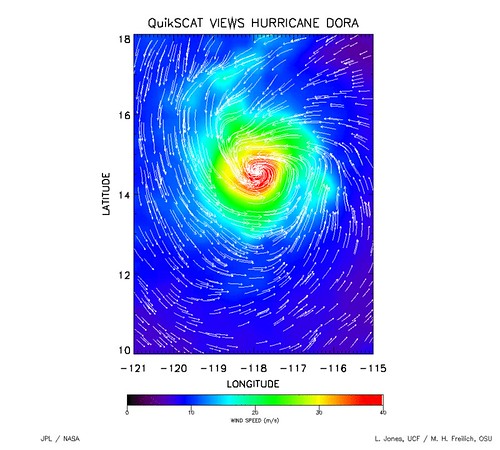
But the cause celebre of QuickSCAT are images like the one above, showing the wind speeds of Hurricane Dora back in 1999.

But scientists may have to attempt hurricane forecasts without the aid of QuickSCAT, according to the AP report:

Certain hurricane forecasts could be up to 16 percent less accurate if a key weather satellite that is already beyond its expected lifespan fails, the National Hurricane Center’s new director said Friday in calling for hundreds of millions of dollars in new funding for expanded research and predictions….

One of Proenza’s immediate concerns is the so-called "QuikScat" weather satellite, which lets forecasters measure basics such as wind speed. Replacing it would take at least four years even if the estimated $400 million cost were available immediately, he said.

It’s in its seventh year of operation and was expected to last five, Proenza said, and it’s only a matter of time until it fails.

Without the satellite providing key data, Proenza said, two- and three-day forecasts of a storm’s path would be affected. The two-day forecast could be 10 percent worse, while the three-day one could be affected up to 16 percent, Proenza said.

That would mean longer stretches of coastline would have to be placed under warnings, and more people than necessary would have to evacuate, he said.

We’ll keep you updated (as we always do) on efforts to replace QuickSCAT and other observation satellites that help bring people the accurate forecasts (we’re not joking here!) that they’ve come to expect.

A Boatload of Bandwidth

Thursday, March 15th, 2007

Have you ever contracted the annoying song virus?

You know, you’re minding your own business in the office when someone says to you, "I can’t get this annoying song out of my head."

And proceeds to tell you what is is — or sings it. 

And then you’ve got that thing stuck in your head for the rest of the day?

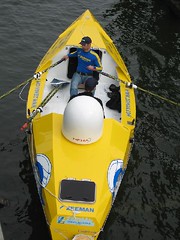
Well we contracted that virus via the Internet this morning when we saw the photo to the left.

We’ll let you guess the song (we won’t be cruel), but what the heck is that a photo of? 

It’s the Zeeman Ocean Challenge, an attempt to do what no one has ever done before: row across the Pacific Ocean at its widest point with no support at all. (9 people have done it with support.)

That’s 16,000 kilometers, and a pretty amazing thing to attempt. But what really caught our eye was the white umbrella on the stern deck.

We’ve written before about the use of satellite communications to keep in touch on maritime adventures (such as when the Kon-Tiki sailed again). It’s worth taking a moment to look at the marketplace again.

How does one stay in touch while in the middle of the ocean?

First, one needs a good maritime satellite antenna — such as this new C2SAT antenna. Then, if you’re not going to subscribe to Direct to Sailor TV, you’ll need to subscribe to a service for phone and internet connections.

So you can surf while you drift, as it were.

Eutelsat offers always on net capability, whether you’re in a rowboat or something bigger or something bigger still. Their maritime service is available on their W3A satellite (7 East), which is good for the Mediterranean and coastal Europe as well as coastal sub-Saharan Africa, or on Atlantic Bird 1 (12.5 West), which covers the Western European coast, North Sea, and the coastal waters off eastern North America.

But the "King of the Hill" in maritime communications is Inmarsat, which provides flexible pricing plans for the little guy in the rowboat but also the bandwidth to broadcast a rare Marathon in Antarctica.

Now if we could just get that song out of our head.

Facing the Next Katrina with Satellite

Monday, March 12th, 2007

Nearly five and a half years after September 11 and eighteen months since Katrina, the U.S. Department of Homeland Security and many of the country’s public safety agencies and organizations have yet to solve the problem of interoperatable communications. While this might seem pretty nerdy, its the lack of communication system cross compatibility that prevented firefighters from hearing police calls to escape the WTC when its exterior began crumbling and ultimately limited the execution of a full-scale evacuation of the Gulf Region in August 2005.

Fortunately, the U.S. Congress is finally starting to make some headway, albeit after Former DHS head Tom Ridge slammed the government for failing to deal with the problem. In addition to pushing legislation that would modernize the 911 system throughout the country (particularly in rural areas), the Senate recently approved Interoperable Emergency Communications Act (S.385), which according to Senator Ted Stevens (R-Alaska)’s website,

"provides the National Telecommunications and Information Administration (NTIA) with more guidance as it awards $1 billion in interoperable emergency communications grants to police, firemen, and emergency medical personnel… This bill would allow up to $100 million of the expedited $1 billion to be used to establish technology reserves that would assist emergency response agencies in pre-positioning communications equipment in state or regional facilities. These reserves can be activated quickly in the event of a major emergency or natural disaster"

While this has led to Nextel co-founder Morgan O’Brien to suggest (and for Fmr. Sec. Ridge to support) the creation of a national broadband public safety network using "a slice of spectrum in the 700 MHz band that is scheduled for auction in 2008," there is another more immediate and potentially less costly option… satellite. As Satellite Industry Association (SIA) Executive Director David Cavossa recently pointed out in a press release,

"Hurricane Katrina and other recent disasters have shown, satellite communications are uniquely able to provide resilient, redundant, and ubiquitous communications when all other terrestrial-based communications fail."

While its probably not the only solution, it seems that Katrina probably taught us that satellite technology should be included in any robust, interoperatable emergency communication systems solution. Working together with standard radio-based wireless technologies, options built on technology similar to SES-Americom’s REDiSat Network might be just the ticket.

Insat 4B and Skynet 5A Launched by Ariane 5

Sunday, March 11th, 2007

The news from Arianespace

Coup double pour Arianespace / Mission réussie pour Skynet 5A et Insat 4B

Dans la nuit du dimanche 11  au lundi 12 mars 2007, Arianespace a mis en orbite de transfert géostationnaire deux charges utiles : le satellite de télécommunications militaires Skynet 5A pour le Ministère britannique de la Défense (MoD) et le satellite de télécommunications civiles Insat 4B pour l’Agence Spatiale Indienne (ISRO).

Trente-et-unième lancement d’Ariane 5, dix-septième succès d’affilée.


Sounds a lot better than the English translation:

Arianespace begins its 2007 mission activity with a successful dual-payload launch

Ariane 5 underscored its mission capability and operational maturity with tonight’s successful dual-passenger mission, which placed the Skynet 5A and INSAT 4B satellites into geostationary transfer orbit.

The March 11 mission was Ariane 5’s 31st liftoff from the Spaceport and the launch vehicle’s 17th consecutive success.

Lifting off from the Spaceport in French Guiana, the Ariane 5 deployed Skynet 5A at 26 minutes into the mission, followed four minutes later by INSAT 4B.

"With this first launch of the year 2007, Arianespace has once again demonstrated its leadership," said CEO Jean-Yves Le Gall. "The satisfaction of every customer is our keyword, offering the best possible Service & Solutions to each one."

Dish Network & DirecTV Team Up with Google, Intel, Skype and Yahoo!

Tuesday, March 6th, 2007

Very interesting twist to the upcoming spectrum auctions. Breaking story via Multichannel News:

DirecTV and EchoStar Communications formed an alliance with Google, Intel, Yahoo and Skype in support of a national licensing plan for a pending federal spectrum auction expected to take in at least $10 billion, according to draft of the plan obtained by Multichannel News Tuesday. The formation of the alliance doesn’t mean that the companies are going to bid together in the auction, which, by law, has to begin by Jan. 28, 2008. Instead, each alliance member has an interest in seeing that the Federal Communications Commission permits bidders to aggregate enough licenses to cover substantially all of the United States. The 60 megahertz of spectrum up for auction is returning to the FCC as a result of TV broadcasters’ transition to digital-only transmission. Broadcasters won’t require the same amount of bandwidth in total because digital signals are spectrally more efficient than analog airwaves.

Every full-power TV station is required to terminate analog TV service no later than Feb. 17, 2009. The analog cutoff would also allow public-safety entities to obtain 24 MHz of former analog-TV spectrum.


Space Weather Forecast Sees (STEREO) Gain

Tuesday, March 6th, 2007

To the left: An image of a February 25 eclipse taken from NASA’s STEREO-B satellite.
Back in October, we wrote about the successful launch of of NASA’s STEREO mission. (Click here for video of the Delta II launch.)

The STEREO (Solar TErrestrial RElations Observatory) Mission uses stereoscopic 3D vision to construct a complete picture of the sun and the nature of solar flares. Among the uses of such knowledge: protecting future astronauts from the dangerous effects of solar flares and providing better space forecasting.

The Washington Post now gives us an update on STEREO’s progress

The effort to improve space weather capabilities took a major step forward last week with the transmission of never-before-seen images of a solar eruption traveling the 93 million miles from the sun to Earth.

Sent back by the twin satellites of NASA’s newly launched Solar Terrestrial Relations Observatory (STEREO), the video is part of an ambitious new effort to learn more about massive electromagnetic storms on the sun, and the dynamics and characteristics of their eruptions. The sun is a huge furnace of nuclear fusion, in constant turmoil with flares, eruptions, convections and the release of lower-energy solar winds.

The "fronts" produced by coronal mass ejections, as the biggest eruptions are called, are the prime movers of space weather in Earth’s neighborhood, and understanding them better is essential to space weather forecasting.

"With STEREO, we can track the front from the sun all the way to Earth and forecast its arrival within a couple hours," said Russell Howard, principal investigator for STEREO’s most cutting-edge instrument, which will allow researchers to observe the movements of solar eruptions in three dimensions. "The new views from STEREO are like having a curtain lift from our eyes — they are extraordinarily instructive."

They are also pretty amazing, as this video animation taken from STEREO images shows. 

The Washington Post continues: 

STEREO cost NASA and its European partners about $600 million to build and is expected to operate for at least two years. It has already detected somewhat surprising characteristics of the solar eruptions. Researchers have, for instance, located "hot spots" within a solar eruption as it speeds from the sun, and they have seen loops and arcs formed from the hot plasma. They have also begun to measure the velocity of the eruptions, which gradually slow as they collide with other solar matter moving far more slowly in the solar winds.

Like most researchers, STEREO team members say they are looking for solar surprises as much as confirmation of existing hypotheses. The detailed study of space weather is in its infancy, they said, and the opportunity for discovery is vast.

We’ll keep you updated on STEREO’s discoveries as they are reported; in the interem, be sure to check out the STEREO mission homepage for the latest developments. 

Satellite Distributed Movies Set to Emerge in 2007

Monday, March 5th, 2007

While the technology has been talked about for years, many experts are positioning 2007 as the year that digital movies and satellite distribution of box-office blockbusters take flight. Working in conjunction with Warner Bros. Entertainment and Universal Pictures, Digital Cinema Implementation Partners (made up of big name theater companies AMC, Cinemark and Regal) is working to "use satellite and broadband delivery systems to beam digital films directly to theaters, rather than have them copied onto hard drives and delivered by hand, as they usually are now."

While the theater chains and studios are looking at the technology as a great way to decrease the likelihood of piracy (the theory being that encrypted satellite transmissions would mean fewer hands are on the prints), it could also mean improved access to popular films and big screen showings of smaller films that struggle for an audience large enough to usually get them. As the AP article about the technology notes that satelite distribution,

"would give U.S. theater operators the flexibility to put a popular movie on an extra screen as quickly as the demand arises… At the same time, theater operators could stop showing a surprisingly unpopular film and even book an art-house film with a small but devoted audience for a day or two."

While Variety and Hollywood are explicitly concerned with the digital cinema’s implications for the US market, the Hindustan Times points out that the technology may be even more welcome throughout the developing world where, although movie theaters are plentiful (with over 12,500 movie houses throughout India alone), the relatively small number of "prints" (sometimes only 500) available of any given film arbitrarily limits distribution.

Wok TV System

Thursday, March 1st, 2007

Love this story about Kiwi ingenuity from the New Zealand Herald:

$10 wok keeps TV station on air

Why pay $20,000 for a commercial link to run your television station when a $10 kitchen wok from the Warehouse is just as effective?

This is exactly how North Otago’s newest television station 45 South is transmitting its signal from its studio to the top of Cape Wanbrow, in a bid to keep costs down.

45 South volunteer Ken Jones designed the wok transmitter in his spare time last year when he wanted to provide wireless broadband to his Ardgowan home.

"A group of us wanted to connect our computers to each other and then we worked out a way to get of getting the signal between two points," he said.

He discovered satellite dishes were between $100 to $400 retail and that smaller dishes, the same size as a wok, were $80.

Mr Jones thought he could do better.

Along with friend Murray Bobbette they worked out mathematical equations to prove the curved metal face of a wok would have the same effect as a small satellite dish.

"We have spent a lot of time getting it right — the first time we installed one we had it up a pole with the handle still on the end of the wok," he said.

"We had it connected to the woolshed and initially you couldn’t get a signal the width of the paddock and now it can reach up to 20km."

When the television station 45 South (UHF channel 41) started up in September last year, Mr Jones thought the same technique could be applied.

"The $20,000 for a commercial link was just money we didn’t have, so we bought several woks from The Warehouse instead which was convenient and cheap," he said.

Pre-recorded clips at the studio are fed through a computer and beamed to Cape Wanbrow where they are relayed off to television sets around North Otago.

The classic case of Kiwi ingenuity has made its way onto the internet and the technique has been posted by an American website, Mr Jones said.

"People wanted to know all the details about how to make their own, so it is now all publicly documented," he said.

One of the issues they had to deal with was making the pole that the wok sits on high enough to clear the Kingsgate Brydone Hotel.

Of course, this story found it’s way to Make a day after it was published.