Archive for the ‘Satellites’ Category

To Pluto at 52,000 MPH

Wednesday, February 28th, 2007

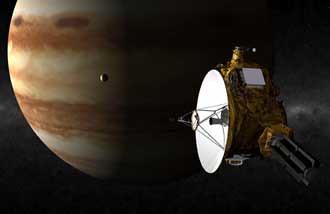
The New Horizons spacecraft used Jupiter’s gravitational pull to increase its speed by 9,000 MPH to a total of 52,000 MPH, as reported by Alex DeMetrick at WJZ in Baltimore:

Heading To Pluto With Help From Jupiter

LAUREL, Md. There are all kinds of test drives, but only one at 52,000 miles per hour.

That’s the speed scientists here in Maryland are aiming for and as Alex DeMetrick reports, the test track is Jupiter.

Man’s first journey to Pluto left a little over a year ago. But for the New Horizons Spacecraft to get there, it’s difficult.

"There’s this little keyhole the spacecraft must reach," Dr. Hal Weaver from the Hopkins Applied Physics Lab said.

That little keyhole just happens to be the biggest planet in the solar system. Jupiter is the spacecraft’s turbo charger, guided by controllers at Hopkins Applied Physics Lab in Laurel.

"We’re using Jupiter as a catapult. By passing fairly close to Jupiter, it’s going to sling-shot us faster toward Pluto. We’re gaining 9,000 miles per hour," Weaver said.

It’s man’s fastest vehicle. While passing by, instruments will be checked out, observations made, including a ride down the planet’s massive magnetic tail.

New Horizons will train its instruments on Pluto in a fly-by in 2015. That’s a long time, but scientists hope it will get there thanks to Jupiter’s assistance.

Not only will New Horizons provide scientists with their first close look at Pluto, the spacecraft will also continue on into the Kuyper belt in search of other Pluto-type objects.


That spacecraft was speeding from the moment it was launched. Watch this launch video and you’ll see the camera operator had trouble keeping up with it:

Anti-Jamming Technology Goes Commercial

Tuesday, February 27th, 2007

The Times reported yesterday that Boeing is looking to put anti-jamming technology previously reserved only for the military on commercial satellites used by business and the communications industry. According to the article,

"Anti-jamming technology is already used by military and spy satellites, but proposals to install similar protection in the 250 large satellites in commercial operation have been prompted by the threat of disruption.

The successful jamming of video, data, or voice signals by individuals or groups could jeopardise the millions of dollars spent on just a handful of satellites, operators fear.

Such jamming of government navigation satellites has already occurred, according to Lieutenant General Robert Kehler of the US Air Force, ‘as has jamming of commercial telecommunications satellites.’"

Space.com has a great background report on Spy Satellites for those who want to know a little bit more about the technology and the American Military and Intelligence communities uses of the technology. While Spy Satellites have been used for quite a long time, even the latest anti-jamming technologies are unable to prevent detection, the spy satellite holy grail. While satellite project, such as MISTY, have been able to avoid detection by laser and microwave radar, none has been able to completely avoid visible detection, a limitation which has prompted the emergence of a small, but strong spy satellite monitoring enthusiast community.

Oh, and for those of you who might be worried about the commercial anti-jamming technologies making it into the wrong hands, it looks like your not alone. While Boeing seems confident that they’ll win it, the U.S. government does have to approve the use of the "top secret" anti-jamming technology on commercial satellites before the company can start introducing it on products sold to foreign customers.

Boring Press Releases

Sunday, February 25th, 2007

I’m so glad we have journalists around to make the news interesting. Imagine if we only had press releases.  B-O-R-I-N-G !

Just look at all these releases surrounding the Satellite 2007 show in Washington last week. Open your eyes wide and read these exciting excerpts:

"…released two new software options to their industry leading product lines that extend their already unique ability to…"

"This flexibility makes the product line more accessible to the networking requirements of government, military, and commercial customers who increasingly value high uplink and downlink speeds at a node and desire to blend terrestrial solutions with their satellite backhaul."

"The company’s DVB-RCS/S2 solutions are the only multiple-access satellite solutions capable of delivering data transfer rates of up to 80 Mbps for downloads and up to 8 Mbps for uploads at each remote terminal, or enough bandwidth to support a variety of users such as a small business or battalion unit to an entire community/military base from a single remote terminal."

And this quote is typical from apparently happy customers:

“We are looking forward to working with X on the development of this next generation intelligent network. Significant improvements can be made to future VSAT systems with the addition of artificial intelligence to the network. These capabilities offer the promise of enhanced performance and economic gains which will allow us to offer new and more cost effective services to our customers.”

I think it’s time we put some excitement in our "realeases" and start making some real news. I’ve noticed NASA’s public affairs people are putting some fun into their work and coming up with some very creative angles over the past year or so — just take a look at this "Camping on the Moon" release. Brilliant!

Japan Launches Spy Satellites

Saturday, February 24th, 2007


Japan Times reports a Japanese H-IIA rocket carrying two satellites blasted off from the Tanegashima Space Center (see web cam) in Kagoshima Prefecture:

JAXA used an H-IIA rocket Saturday to successfully place a radar satellite in orbit to complete Japan’s spy system for full global coverage.

The rocket also carried an experimental optical satellite.

Both satellites were placed in orbit about 20 minutes after the 1:40 p.m. launch from the Tanegashima Space Center in Kagoshima Prefecture, the Japan Aerospace Exploration Agency said.

They began functioning and their solar-battery panels are open, JAXA said.

If the radar satellite continues to perform as planned, Japan’s compliment of four spy satellites will be able to photograph any point on Earth once a day for intelligence-gathering, the agency said.

The government decided to launch spy satellites after North Korea fired a Taepodong-1 ballistic missile in 1998, part of which flew over Japan into the Pacific Ocean. Pyongyang maintains it was for sending a satellite into orbit.

The launch of the radar satellite enhances a multibillion dollar, decade-old plan for Japan to have round-the-clock surveillance of the secretive North and other areas Japan wants to peer in on.

In the spy project, two optical satellites and one radar satellite have already been placed into orbit.

But weaknesses in the satellites’ capabilities have led to criticism that the program is a waste of money and, with better data available on the commercial market, that the government will continue to be dependent on Washington for its core intelligence.

The launch also comes just a month after China demonstrated its ability to shoot satellites out of orbit with ground-based missiles. Japan and other countries, including the United States, have strongly protested Beijing’s antisatellite test.

China has defended the test as peaceful, and said it presents no country with a threat.

JAXA officials say the satellites provide an important means for the country to independently collect intelligence, and say improvements in the satellites’ capabilities are in the works.

The experimental optical satellite launched Saturday features higher-resolution optics that can be used in the future to improve the quality of orbital photographs taken by Japanese satellites.

The two optical satellites already in orbit are reportedly capable of detecting objects about 1 meter in size. The plan is to work toward a satellite capable of detecting objects half that size.

JAXA had originally intended to launch the rocket Feb. 15 but postponed it three times due to thunder and poor weather conditions.

Who Owns That Satellite?

Thursday, February 22nd, 2007

According to Channel NewsAsia, things are heating up in Thailand, where concerns about spying may force the country to buy back satellites it sold to a Singapore investment firm, Temasek, last year. As you might expect, things get a little complicated when you viewed up closer:

"[The controversy]… centers around four satellites owned by ShinSat, which is a subsidiary of Shin Corp.

Shin Corp was founded by former [Thai] premier Thaksin Shinawatra, whose family sold a 49 percent stake in the company to Singapore investment firm Temasek in January 2006.

General Sonthi [Boonyaratglin, who led last September’s coup d’état] said the government should buy back these satellites, which transmit encrypted military communications, in the interest of national security.

The estimated price tag is US$294 million."

Most Thai’s on the street believe that the Thailand should reclaim ownership of the old satellite’s for reasons of national security, although many don’t think the country should have to pay for the reacquisition. As one Thai citizen said in an interview:

"Thaksin sold it, so he should buy it back for Thailand. Thai people are already paying taxes to the government, so we shouldn’t use the country’s money to buy it from Singapore."

The problem for Thailand is, however, that such an oddball move with a foreign company would probably inhibit the future foreign direct investment so crucial to their development.

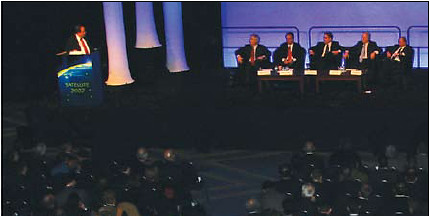
Opening General Session at Satellite 2007

Wednesday, February 21st, 2007

Here’s the write up of Tuesday’s Opening General Session by Mark Holmes in the Satellite 2007 Daily:

FSS operators Seek Ways To Capitalize on Growth Patterns

The satellite industry finds itself in a strong position, top executives said at the SATELLITE 2007 opening session, but there was an undercurrent of caution in their comments.

Overall, the panel was increasingly optimistic about the growth prospects for the satellite industry. “I think we see an industry that is healthier every day,” said Intelsat CEO David McGlade.. We see economies improving around the world. It is a great time to be in the industry. In 2004, the industry was not as healthy as it was today. It is improving even in areas like Asia.”

There was also a sense of renewed optimism in traditional market segments such as broadcasting with new direct-to-home (DTH) operators springing up throughout the world as well the move to high definition (HD) which is increasing capacity demands.
 
“People are going back to basics,” said Giuliano Berretta, CEO of Eutelsat. “TV is picking up very strongly. There is a resurgence in the TV business. For example, I think SES is becoming more traditional when you look at their recent divestments. In our most recent results, 70 percent mof revenues were derived from broadcasting. There are new countries which want pay TV.”

The optimism also extended to new market opportunities and the opportunities for satellites to play an increased role in areas such as mobilebroadcasting, broadband and other areas. McGlade spoke of the need of making “small, smart, bets” when going into new areas. “When you see a take-up you grow with it. You have to seed some new activities. I feel there is the right kind of climate for responsible growth. Huge bets have been taken before, but we won’t be doing that again.”

Romain Bausch, CEO of SES Global, said there are strong growth opportunities for satellite manufacturers and launch providers, but admitted the industry “could be in trouble” if companies do not move quickly when attacking new markets and consolidating positions in existing markets.

Bausch admitted he was concerned of the impact players such as Deutsche Telekom (DT) could have on satellite players. “We need to make sure the satellite solution is developed further to compete with terrestrial solutions,” he said. “You look at someone like DT who is going into the video business, this may be dangerous for us, because of the vertical integration of such players.”

Changing landscape

The satellite landscape has changed since these CEOs gathered at SATELLITE 2006. In recent weeks, Eutelsat has announced new shareholders, SES has done a deal with GE to divest certain assets and repurchase stock, Loral and Telesat have hooked up. Unsurprisingly, all the executives painted a bright picture of these moves.

Bausch made the point that divesting certain assets was almost as important as acquiring new assets. “When we bought New Skies, we got new assets in Asia and Latin America. It allowed us to divest in minority of assets such as AsiaSat and StarOne,” he said. “Divestiture is also a key trend. It is removing the overhang and having a currency to use in the future. It is a rationalization of assets. It is clear with overlapping footprints you have to rationalize. From a strategic perspective, we are now built on three 100 percent-owned companies. This will allow us to be more aggressive and in control of our developments.”

McGlade said Intelsat believed in a different approach. “I do not believe as much as the regional entities standing alone,” he said. “We have put more people out into the field. I think the integration process has transformed us and been a tool to bring us forward. There are many areas of growth. I think broadband will continue to grow. We have an investment in WildBlue and that has done well. When I look at video, HDTV has reached an inflexion point. Once that trend starts to accelerate you will see many programmers go to HD both for offensive and defensive reasons. There are new DTH platforms being launched. As we see liberalization of regulatory regimes there are growth opportunities in every sector.”

Michael Targoff, CEO of Loral Space & Communications, said his company’s acquisition of Telesat was vital for the operator to be a long-term player in the market and would help Loral compete more effectively with the big guns in the industry.

“You need to offer the customer a sense of capability,” Targoff said. “It was clear to Loral when we sold assets to Intelsat we did not have a sustainable position in the long term. By buying Telesat, we believe we can compete. We are comfortable it provides us with the mass to compete. I don’t just see it as a step along the way.”

In terms of how he views new opportunities for Loral and other operators, “We will be using satellites to deliver video to handheld nphones,” Targoff said. “We will use satellites to deliver broadband where there is not broadband infrastructure. There will be a role of satellites. While there is clear strength in the traditional services, it is also clear the future the role of satellites is how we participate in the way people access content now.”

Besides competing with the other satellite players, Berretta called for more cooperation within the satellite industry as they look to compete against other infrastructures and operators.

His views were shared by McGlade. “I think an association together could make a lot of sense and add a lot of value,” he said. “… “We are such a small fish in the media and telecoms pond. We need to look at how we can spur growth. We can do more. When we look overall, we have to look at what is happening with customers as well as our competitors. We are moving the industry forward, but we could do more. We are not doing enough.”

Mobile satellite services

Andy Sukawaty, CEO of Inmarsat and the lone Mobile Satellite Services (MSS) representative, told the session that some of the plans being offered by the low-Earth orbit (LEO) operators are “deeply flawed”.

Sukawaty warned that the investment community may not have learned from its previous efforts in funding LEO constellations if investors believe there was so much money to be made from the MSS industry. “In the 1990s, $15 billion was lost by investors that invested in this business,” he said. “We have instilled a capital discipline. It is capital intensive business. I think that is where investors need to focus. If you look at the fund raising at the MSS sector people are looking to raise $12 billion over the next five years. I don’t think there is $12 billion of business out there.”

Sukawaty saved his strongest comments for some of the LEO operators. He said in a blistering attack on some of the players, “To spend $2 billion on a LEO constellation will not work. They have a distinct competitive disadvantage. That thinking is deeply flawed. That cannot compete against GEO systems.”

However, Sukawaty was optimistic about his own company’s growth prospects. While price erosion on the voice side means revenue growth is difficult despite volume growth, data applications could be the key to a successful future for the operator. “Historically, we have had targeted a 3 percent growth rate, but now we want to accelerate that to 6 [percent] to 8 percent growth,” he said. “That will be driven by data applications. Data applications will provide double digit growth. The question is who captures that double-digit growth."


Satellite Broadband Gets to Europe

Wednesday, February 21st, 2007

Looking to go check out the Northern Lights in Europe, but afraid the lack of a solid connection to the net will prevent you from convincing the boss you can work in the Arctic Circle? Well, have no fear, according to CNET UK, it looks like even the farthest reaches of Europe will be wired just in time for a summer roll-out in June and in place in time for next year’s show.

The expansion will, employing Eutelsat’s birds, use ViaSat’s Surfbeam system (the same one SES-Americom started using with enterprise customers a couple of years ago) to bring two-way broadband Internet connections to EU citizens in Germany, Switzerland, Spain & Portugal who live in areas that don’t generally have access to wire and wireless-based broadband.  The hub will be run by Skylogic from the SkyPark teleport in Turin, Italy, home of the 2006 Winter Olympics. The full story can be found in a surprisingly informative press release on ViaSat’s site.

The even better news for those in Europe looking to connect via satellite is that you may not have to pay an arm-and-a-leg or necessarily suffer with dial-up technology for uploads. Wildblue, the company utilizing the two-way satellite broadband technology in the states, has been around for around two years and seems to be charging rates that are comparable to wired-broadband rates in some of the country’s more expensive markets (between $50-80/month) with upload speeds starting at 128Kbps. While equipment fees might eat away at some of the initial savings, the possibility of being able to do your work and watch nature’s greatest light show at the top of the world? Well, that’s priceless.

Ed’s “What’s Next?” Speech

Tuesday, February 20th, 2007

SES AMERICOM CEO Ed Horowitz was the guest speaker at the Washington Space Business Roundtable’s Flagship Lunch and Silent Auction on Tuesday, 20 February 2007.

We don’t have a podcast or video available, so here’s the text of the speech:

“What’s Next?”

I appreciate this chance to speak with you today in this beautiful new facility. Not long ago, as many of you remember, this spot was part of a run down community — which has obviously been brought back to life.

It’s changed.

And — in the midst of the good change around us, I feel it is appropriate to ask, “What’s Next” for our  business and for us?

Where will we be in 20 years?

Will we be in 20 years?

I subscribe to Stanford’s “Growth Theory” economist Paul Romer’s view that growth occurs whenever people take resources and rearrange them in ways that are more valuable”.

To know what is “more valuable” is a matter of vision.

At the Twenty-second Communist Party Congress in 1961, Soviet Premier Nikita
Khrushchev’s vision was that within 20 years the Soviet Union would out-produce the United States in all the traditional sectors of industrial might — coal, steel, cement, fertilizer and so on.

In 1981, that vision was indeed fulfilled: that year the Soviet Union outdid America in every one of those industries.

They successfully reproduced a late 19th, century manufacturing based industrial economy…while the US was inventing a 21st Century chip, computer and information based economy.

A new world happened, shaped by a furious and unplanned burst of technological, cultural and economic force. 

The Soviet vision of the future was as over-confident, but more importantly it was simply — over.

Nikita Khrushchev saw the future through the wrong end of a telescope where the moment seemed larger than it was — and the horizon smaller. He believed he could outwit history with a good plan built on dedicated incrementalism which had one gear — sideways.

As we meet today and at other conferences persistently speaking —to each other —my fear is that we might be inclined to use Nikita’s telescope to envision what’s next for us.

The satellite industry, including SES, has dictated broad global changes in other businesses from entertainment to defense; from detection and GPS to secure communication.

Today, the satellite business is producing reliable earnings for our shareholders. But undeniably, there are changes on the horizon dictated, if nothing else, by the changing worlds of our customers…. And they expect us to “get it”. They expect us to anticipate needs.

What the future holds is an exciting mystery. But, we are better off addressing possibilities while we have a chance to invest in them; to own them —-rather than to ignore or possibly be displaced by them. That’s what we will talk about today.

What we know is that the future will be vastly different.

It is estimated that within the next 25 years, science and technology will advance by a factor of 4 – 7x beyond the advancements over the last 25 years.

While we may hear this in stride — it is absolutely stunning in its business and social implications.

It means that where we stand today on the technology and science scale versus where we will be in the next 25 years — is a moment equivalent to being in the year 1650.

Think about it …1650!

Of course the 25 years from 1650 – 1675 saw their own dramatic developments. The English started drinking tea. Cromwell dissolved Parliament, and the first bank note was issued in Sweden.

During this time the world population expanded to 500 million, which is about one-third the size of India today.

Isaac Newton began experiments with gravity and Cheddar Cheese was invented.

The great Plague of London commenced and the English settled in Charlestown, Virginia.

Ice cream was invented and La Grand Vetel, a famous French chef killed himself because Louis the 14th didn’t like the dinner La Grand had prepared.

You could say a lot happened in those 25 Years…But, the world had seen nothing yet.

1650 was 225 years before the phone was invented and…a century and a half before the ratification of the US Constitution.

It was 200 years before Edison was born.  It was 200 years before the US population would reach 23 million and China’s population then — was almost the same number as China Mobile’s cellular customers today (about 350 million).

1650 was 307 years before Sputnik and 315 years before the first satellite.

We are all familiar with the advances made in the satellite industry through compression. Well, get ready for the advances in history made by an unprecedented compression of knowledge in the next 25 years.

We’re about to enter “The Great Compression”.

We are looking at the equivalent change of the last 315 years — about to be compressed into the next 25 years.

What does this mean?

It means — for example — that if you are in the transportation business — the worst four words you could imagine for your business — may actually be heard in the next 25 years…The four words? — “Beam me up Scotty”.

The odds that the massive changes coming in the “Great Compression” will leave the satellite industry untouched — are zero. Change will come to us whatever we choose to do or not to do.

What will we be doing when it comes?

While technology is a “business”, it is also a force not to be controlled even by the best of intentions.

The genie is out of the bottle and the question is whether the genie is working for us or are we working for the genie?

Let’s spend a little time today on some broad issues of concern to our industry and to our customers:

1. U.S. Government business…

2. The commercial and media business…

3. The ramifications of change in both worlds and lastly …

4. I want to discuss a looming talent deficit as we face the  coming “Great Compression”.

The US government business is, as you all know, changing rapidly. Saddam Hussein invaded Kuwait in August, 1990 and the US and Coalition forces liberated it in January of 1991.

During the 5 ½ months between Hussein’s invasion and ours, the American military was caught without the satellite capacity to track and mount the offensive.

They scrambled to acquire the needed transponders and didn’t have time for emergency appropriations to acquire them, so the costs were guaranteed —- by Private Citizen Ted Turner.

It was no coincidence that Turner’s CNN had the best and for a time the only video from Desert Storm.

The US military will never be caught like that again. Six months after our troops landed, DISA was created to make sure it wouldn’t happen again.

In the intervening years between Desert Storm and 9/11, the US military changed. 

When 9/11 came, the military was ready with a system in place to fund $78 million dollars worth of contracts to provide the satellite and communications services needed. The contracts were in large part for bundled solutions in addition to the broadband commodity.

We learned then that in the future we need to leverage what only satellites can provide — advanced mobile communications and high speed internet access — while on the move —-anywhere in the world — via aircraft, boat, humvee or on foot.

What the military needs is megabytes, not megahertz. The military expects a ground and mobile capacity consistently capable of facial recognition.

Increasingly, the US government wants net-centric bundled solutions as well as broadband and they are calling upon us to be creative about it.

There is a demand for specific megabyte capacity per war fighter and we also know that this demand will only grow over time.

Increasing our military business means persistently increasing capacity and solutions.

For example, there is an ever expanding need for video teleconference capability (VTC) — for commanders in the field, in Washington, and for soldiers on the ground.

The invasion of Iraq was witnessed live on multiple screens in the White House Situation Room. Decisions could be made in real time with real data. Before that it was almost like Abraham Lincoln waiting for a telegram telling him that Grant had taken Richmond.

Soldiers on the ground also have growing “human terrain” needs in addition to VTC — also things like  IM and secure chat capability.

Remember, in five years … 50% of the military will be Gen X and Y. They grew up in a digital world. The military has to grow with them – and so do we.

Whenever we speak of high speed mobile communications we must, in the same breath, speak of advanced development of “in-orbit” flexibility and new antennae development.

Satellites must increasingly have capabilities for re-direction and re-programming in space.

We must advance efforts to change frequencies and footprints in orbit.

We look over our shoulders for our competitors and can’t see some of them because they’re in front of us. They may not even be in our business.

For example, let’s look for a moment at the world of Nano-technology, once viewed as science fiction, but today may represent the “key enabling technology” of the 21st century.

Nano- technology is the “purposeful creation, manipulation and use of matter, physical structures and engineered devices with previously unimaginable dimensions”.

Nano-technology is starting to impact chemistry, biology, applied physics and medicine. The inevitable applications to the space and satellite world are just beginning to be imagined.

But, one way to think of it, knowing that a nanometer is one billionth of a meter, is to see every person as a nano-unit in a world with six billion people. That is the level of services and connection we must contemplate.

What are some of the ramifications of these great changes for our customers and for our business?

One ramification could be friction with our current customers and we have to think about that.

Many of our major customers are in the commercial media world — where things are also changing at a furious pace.

You Tube, MP3, file sharing and a host of  other technological and social changes are threatening old business models like “Beam me up Scotty” would threaten transportation.

Our media customers are losing control of their customers who are increasingly less dependent on mass packaged media which we reliably deliver.

User generated and niche media (nano media) are replacing mass media.

Remember the 1998 Jim Carrey movie, “The Truman Show” where an unsuspecting insurance salesman’s life was made into a 24/7 movie for the entertainment of the town’s people?

Everyone in his fabricated town, his mother included, made a fool of him everyday — in their controlled entertainment world.

It was all run out of a network studio from which Truman eventually escaped– heartbroken.

Now think of The Truman Show in reverse where the insurance salesman watches everyone and anyone all day and all night, as he chooses.

Imagine control gone from the entertainment business into the hands of Truman… and the walls of the entertainment and media world come tumbling down.

That’s where we’re headed — along with our customers. User generated content and demand is going to turn the media world upside down.

Control will shift and it will be a new challenge to make an honest buck for the old institutions.

What is the response of the media and entertainment business to this creative destruction threat?

A recent book called “Wikinomics” – gives one example of how the media world is responding in the field of music… and I quote:

“Rather than embracing MP3 and adopting new business models, the industry has adopted a defensive posture. Obsession with control, piracy, and proprietary standards on the part of large industry players has only served to further alienate and anger music listeners…If your invention can be replicated at no cost, why should anyone pay?…Today a new economic model of intellectual property is prevailing”.

What is our response?

In the commercial and media world, let’s look at two business prospects on extreme ends of the continuum.

On one end, is the real prospect for business in the under and un-developed world. Half the world does not participate in the global economy in any way shape or form.

The developed world is increasingly understanding the value of changing this through governmental, private and NGO enterprises. It is not strictly a charitable exercise but a way to grow demand and markets.

The economy cannot be called global until this succeeds on a much greater scale. Central to these prospects are enterprises within our expertise. The sooner undeveloped countries have access to the information and communication revolution which, in many ways we can steer, the sooner there will be unprecedented growth and demand not evident in mature economies.

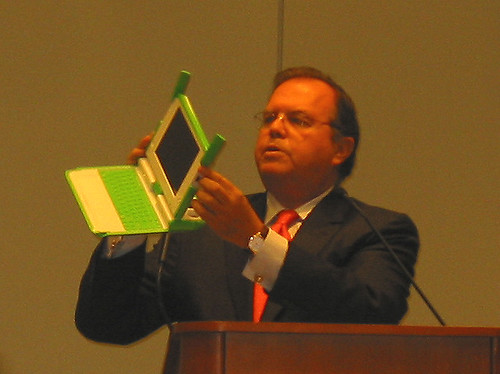
An example of how we extend the reach into being  called “truly global” may be characterized by SES’ support of One Laptop Per Child (OLPC) Initiative.

OLPC is designed to put into the hands of children around the world the capacity of accessing information and connectivity with others ranging from people in their village or nearby villages, anywhere in their country and potentially around the world.

On the other end of the continuum are the possibilities in the media world with the disruption of old models.

But before we go any further, let’s make something clear. When we say “user generated content” we all think of You Tube or something like it. But You Tube makes no money and never has — except for its original creators who profited handsomely when they sold to Google. 

When Google purchased You Tube and was asked how they intended to monetize it, the answer was: “we’ll figure that out later.”

Let’s be honest. You tube content is dominated by really, really bad material —and the most frequently viewed material inclines toward quality production and content.

But, as you have seen, Viacom is now demanding that You Tube remove all of its Viacom material. Others will surely follow. And You Tube’s offerings will begin to diminish.

Then there is Current TV, Vice President Gore’s effort, which is totally user-generated content. But it’s still part of the standard Dish and cable mass media package.

It’s user-generated content but it’s still part of the old business model for the system providers.

From our point of view, the revolution may have little to do with user generated content and everything to do with user “dictated” content.

I’m talking about free enterprise — for real.

Very recently, an outfit called Virtual Digital Cable in Illinois, has started a service to deliver cable programming without cable — by using only the internet.  No trench digging or coaxial cable or fibre placement… no local franchise or fees. Naturally,
the legal challenges to VDC are blocks long but the point is Disruption for our customers and for us — is inevitable.

Product development and innovative bundled Solutions like IP Prime are important targets. But how do we most effectively and most profitably adapt to the new net-centric content world?

One answer is to consider what I called “My Geosynchronous Media” but someone told me that MGM was taken. Then I tried “My TV” but of course, MTV was taken. So for now let’s just call it “My TV Station”.  “MTVS”

MTVS is a niche media for one; a nano niche.

It is the creation of a net-centric and net- neutral, trusted third party content aggregator designed as “My TV Station” which runs exactly what you want, when you want it on whatever device you choose.

The customer pays only for the exact content they want… whether it’s sports or Friends re-runs, all CSI or whatever. MTVS delivers it and pays the content provider — as a trusted 3rd party must.

Unlike cable and traditional satellite mass programming where you pay for things you never watch, MTVS gathers exactly and only what one person wants to watch when they want to watch it.

This direction means we would become a “Relationship Management” business in addition to our conventional business.

It also means we would, to an unavoidable extent, be in competition with our current customers.

Does that matter? Of course it does. But, these are the kinds of questions we need to face now before it’s too late to do anything about it.

My last issue is “People”. Are the Human resources and talent out there? Can we keep what we have and get what we need? What about the Demographic Wall?

Business Week Magazine recently advised new professionals to stay away from the space business because it offered “no future”. The engineering and science expertise that is the fundament of our industry is aging and this means on one hand that many are near retirement with a thin bench of possible replacement.

On the other hand, those who choose to stay in the business, and we need them desperately,  are making it hard for new people we do attract to move up —- and also difficult to make change.

The truth is that as we move forward, this is not your “Father’s Satellite” world.

When it comes to attracting talent, you could say, we have an image problem natural to a maturing industry and …we have an advancement opportunity problem for the ambitious new engineer we do attract.

It is the science and invention that makes us grow. There is a clear shortage on the horizon.  It is also true that as an industry, we have very poor public communication and we tell no exciting stories which we need to attract talent.

Just as the American military will be 50% composed of X and Y Gen soldiers who grew up in a digital world, my fondest hope for our industry is that we can say the same. If we can’t –then the future will be a lot harder to face.

I have shared some things to think about with you today and I appreciate your listening to them. I’m glad to hear your ideas as well — any time.

But for now, I see my time is up so I guess all I can say is Thank You and…“Beam Me Up — Frank ”.

Thank you very much.
Dean O’s “Hot Tango” Speech

Tuesday, February 20th, 2007
As reported in today’s Satellite 2007 Daily:

Dean Olmstead, director of Loral Space and Communications, said the satellite industry is in the midst of a “hot tango” with the financial community but warned that the industry needs to make sure that the tango does “not turn into a rave.” The financial community is enthusiastic to invest in the satellite industry, especially new opportunities being driven by huge demand for content on the move, Olmstead said Monday
at SATELLITE 2007. But with history littered with spectacular failures, the industry needed to proceed with caution when approaching these new opportunities and not charge headlong into these new market segments “like five-year old kids chasing a soccer ball.”

Olmstead pinpointed numerous opportunities for the satellite industry in areas such as Digital Multimedia Broadcasting and Digital Audio Radio Satellite, but while the broad tone of his speech was optimistic, there was an undercurrent of caution behind his statements. “The financial markets have a lot of money that they are offering,” he said. “You could say there is almost too much money. There are lots of opportunities for new business and to take risks.”

Throughout his speech, Olmstead would paint a bright picture but then invariably put in the odd dark cloud of warning. He also stressed the importance of “satellite fundamentals,” a more old-school type term amongst the new market opportunities. Olmstead pointed to the strengths of the satellite such as point-to-multipoint broadcasting. He pointed to the success of SES Astra and the strong position they have in the market, as well as the Intelsat/Panamsat merger and the importance of point-to-multipoint distribution in the context of that deal.

The other key fundamental Olmstead pointed to was something he dubbed “white spaces” where satellite could provide coverage beyond terrestrial alternatives. However, the demand from the new generation of users for mobile communication services is such that services like Digital Multimedia Broadcasting are no longer dependent on having these so-called “white spaces” to succeed. Olmstead spoke of the multi-faceted nature of modern communications and how the younger generation was anxious to consume video and have a more “liquid” form of communications. With these stronger consumption patterns in mind, Olmstead believes there has never been a better time for the satellite industry to have a stronger impact in the modern communications world.

Olmstead believed satellite operators need to take a more outward approach in its thinking. He referred to Terrestar, a company that likes to see itself as a network company and not a satellite company, and also noted the trend of different people running satellite operators, pointing out David McGlade at Intelsat and Andy Sukawaty at Inmarsat, two executives with strong telecoms backgrounds.

Another key theme of Olmstead’s speech related to the Asia Pacific market. He spoke in-depth about AsiaSat, as well as the impact China could have on the global communications market. According to Olmstead, the SES deal with GE was a “win-win” situation and “is excellent for the Asian marketplace.” Olmstead also hinted at a more vibrant communications landscape in Asia, noting that governments in the region “were acting in a more pragmatic way than before.”

However, Olmstead again followed with a warning. He talked of the growing influence of China and the financial firepower it now carries, warning if Congress adopted a more aggressive stance towards China, it could create long-term ramifications for the satellite industry. In a direct warning to U.S. politicians, Olmstead said, “As an industry, that would not be a cool thing (if Congress flexed its muscles) to happen if they were to buy fewer U.S. treasuries, the kind of low-cost debt money fuelling acquisitions would begin to change. I think you would see fewer [private equity] owners, and more strategic owners.”


Sirius and XM Plan to Merge

Monday, February 19th, 2007


They’ve been talking about it for a while, and we blogged how you can have both Sirius and XM integrated in your car. It got real today.

This morning, the New York Post, America’s oldest continuously published daily newspaper, got the scoop:

HEAVENLY DEAL

By PETER LAURIA

February 19, 2007 — Satellite radio operators Sirius and XM are expected to announce their long-awaited merger today, according to a source familiar with the deal.

The two sides were locked in negotiations over the weekend trying to hammer out a final agreement with an eye toward going public with the merger today in Washington, D.C., where XM is based, this source said.

Talks were still going on at press time and the deal could fall apart at any time. With antitrust issues of paramount importance, this source said lawyers for both companies were working overtime to fine-tune the language of the agreement and frame the discussion around the deal itself and not regulatory concerns.

The transaction is expected to be structured as a merger of equals, but given Sirius’ higher enterprise value, shareholders in the Mel Karmazin-led firm will likely come away with a larger percentage of a combined company.

According to the source, XM Chairman Gary Parsons will retain that title in the combined entity, with Karmazin likely taking the CEO role. It is unclear what role, if any, XM CEO Hugh Panero will play.

Combining Sirius and XM would result in a single satellite radio operator with more than 12 million total subscribers. A deal would also marry Sirius content, such as Howard Stern, Frank Sinatra and Nascar with XM’s Oprah Winfrey, Bob Dylan and Major League Baseball.

More important, analysts widely predict that a deal would also save the two companies nearly $7 billion annually.

Karmazin and Parsons have been dropping hints since last summer about a possible tie-up, believing that competition from terrestrial radio, online radio and mobile music devices such as iPods have not only expanded the marketplace but also lowered the regulatory hurdles to a deal.

In a note on Friday, Bear Stearns analyst Robert Peck speculated that Sirius and XM needed to move quickly before their window of opportunity closed.

Gaining regulatory approval "could take up to 15 months; hence, we think any proposed deal needs to be announced by the end of March to close by mid-2008," Peck wrote.

On Friday, XM shares hit their lowest point since early November while Sirius shares were approaching 52-week lows. Shares in both companies did trade on heavy volume and ended the session higher, with Sirius gaining 10 cents to close at $3.70 and XM jumping a dollar to $13.98.

 Later this afternoon, it became official: a merger of equals? That’s what they said about Daimler and Chrysler. Here’s the press release:

SIRIUS and XM to Combine in $13 Billion Merger of Equals
Provides Consumers with Enhanced Content, Greater Choices and Accelerated Technological Innovation

Enables Satellite Radio to Better Compete in Rapidly Evolving Audio Entertainment Industry

Extraordinary Value Creation for Shareholders

Mel Karmazin to Serve as Chief Executive Officer and Gary Parsons to Serve as Chairman of Combined Company

WASHINGTON and NEW YORK, Feb. 19 /PRNewswire-FirstCall/ — XM Satellite Radio (NASDAQ: XMSR) and SIRIUS Satellite Radio (NASDAQ: SIRI) today announced that they have entered into a definitive agreement, under which the companies will be combined in a tax-free, all-stock merger of equals with a combined enterprise value of approximately $13 billion, which includes net debt of approximately $1.6 billion.

Under the terms of the agreement, XM shareholders will receive a fixed exchange ratio of 4.6 shares of SIRIUS common stock for each share of XM they own. XM and SIRIUS shareholders will each own approximately 50 percent of the combined company.

Mel Karmazin, currently Chief Executive Officer of SIRIUS, will become Chief Executive Officer of the combined company and Gary Parsons, currently Chairman of XM, will become Chairman of the combined company. The new company’s board of directors will consist of 12 directors, including Messrs. Karmazin and Parsons, four independent members designated by each company, as well as one representative from each of General Motors and American Honda. Hugh Panero, the Chief Executive Officer of XM, will continue in his current role until the anticipated close of the merger.

The combined company will benefit from a highly experienced management team from both companies with extensive industry knowledge in radio, media, consumer electronics, OEM engineering and technology. Further management appointments will be announced prior to closing. The companies will continue to operate independently until the transaction is completed and will work together to determine the combined company’s corporate name and headquarters location prior to closing.

The combination creates a nationwide audio entertainment provider with combined 2006 revenues of approximately $1.5 billion based on analysts’ consensus estimates. Today the companies have approximately 14 million combined subscribers. Together, SIRIUS and XM will create a stronger platform for future innovation within the audio entertainment industry and will provide significant benefits to all constituencies, including:

  * Greater Programming and Content Choices — The combined company is committed to consumer choice, including offering consumers the ability to pick and choose the channels and content they want on a more a la carte basis. The combined company will also provide consumers with a broader selection of content, including a wide range of commercial-free music channels, exclusive and non-exclusive  sports coverage, news, talk, and entertainment programming.  Together, XM and SIRIUS will be
able to improve on products such as real-time traffic and rear-seat
video and introduce new ones such as advanced data services including enhanced traffic, weather and infotainment offerings.

  * Accelerated Technological Innovation — The merger will enable the combined company to develop and introduce a wider range of lower cost, easy-to-use, and multi-functional devices through efficiencies in chip set and radio design and procurement.  Such innovation is essential to remaining competitive in the consumer electronics-driven world of audio entertainment.

  * Benefits to OEM and Retail Partners — The combined company will offer automakers and retailers the opportunity to provide a broader content offering to their customers.  Consumer electronics retailers, including Best Buy, Circuit City, RadioShack, Wal-Mart and others, will benefit from enhanced product offerings that should allow satellite radio to compete more effectively.

  * Enhanced Financial Performance — This transaction will enhance the long-term financial success of satellite radio by allowing the combined company to better manage its costs through sales and marketing and subscriber acquisition efficiencies, satellite fleet synergies, combined R&D and other benefits from economies of scale.  Wall Street equity analysts have published estimates of the present value of cost synergies ranging from $3 billion to $7 billion.

  * More Competitive Audio Entertainment Provider — The combination of an enhanced programming lineup with improved technology, distribution and financials will better position satellite radio to compete for consumers’ attention and entertainment dollars against a host of products and services in the highly competitive and rapidly evolving audio entertainment marketplace.  In addition to existing competition from free "over-the-air" AM and FM radio as well as iPods and mobile phone streaming, satellite radio will face new challenges from the rapid growth of HD Radio, Internet radio and next generation wireless technologies.

"We are excited for the many opportunities that an XM and SIRIUS combination will provide consumers," said Gary Parsons, Chairman of XM Satellite Radio and Hugh Panero, CEO of XM Satellite Radio, in a joint statement. "The combined company will be better positioned to compete effectively with the continually expanding array of entertainment alternatives that consumers have embraced since the Federal Communications Commission (FCC) first granted our satellite radio licenses a decade ago."

"This combination is the next logical step in the evolution of audio entertainment," said Mel Karmazin, CEO of SIRIUS Satellite Radio. "Together, our best-in-class management team and programming content will create unprecedented choice for consumers, while creating long-term value for shareholders of both companies. The combined company will be positioned to capitalize on SIRIUS and XM’s complementary distribution and licensing agreements to enhance availability of satellite radios, offer expanded content to subscribers, drive increased advertising revenue and reduce expenses. Each of our companies has a strong commitment to providing listeners the broadest range of music, news, sports and entertainment and the best customer service possible. We look forward to sharing the benefits of the exciting new growth opportunities this combination will provide with all of our stakeholders."

The transaction is subject to approval by both companies’ shareholders, the satisfaction of customary closing conditions and regulatory review and approvals, including antitrust agencies and the FCC. Pending regulatory approval, the companies expect the transaction to be completed by the end of 2007.

SIRIUS’s financial advisor on the transaction is Morgan Stanley and Simpson Thacher & Bartlett LLP and Wiley Rein LLP are acting as legal counsel. XM’s financial advisor on the transaction is J.P. Morgan Securities Inc. and Skadden Arps, Slate, Meagher & Flom LLP; Jones Day; and Latham & Watkins LLP are acting as legal counsel.

I remember when the FCC first authorized both satellite radio service. One stipulation was that receivers be able work with both services.

Personally, I chose Sirius because I think they have better satellites in orbit. The FS-1300 bus, built by Space Systems/Loral, has a long history of reliability. XM’s satellites, the Boeing 702, are technological marvels — but they’ve had some power problems.

Tuesday’s webcast ought to be good. The approval process is going to be quite a show — the NAB has already objected. Since both license terrestrial spectrum to fill in the gap in larger cities, expect every broadcaster to chime in on this one. I can see additional competion coming from digital television radio, too.