Archive for the ‘Satellites’ Category

What Dish? That Antenna Looks Like a Turkey

Wednesday, November 22nd, 2006
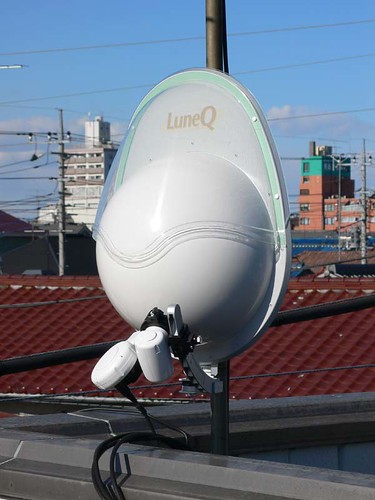
There’s a revolutionary satellite antenna being sold in Japan, based on the Luneberg Lens, capable of receiving signals from multiple satcoms. JSAT’s press release in 2001 announced this breakthrough, and a joint release with Sumitomo Electric introduced it to the marketplace in 2003. This photo journal demonstrates assembly, which looks simple enough.
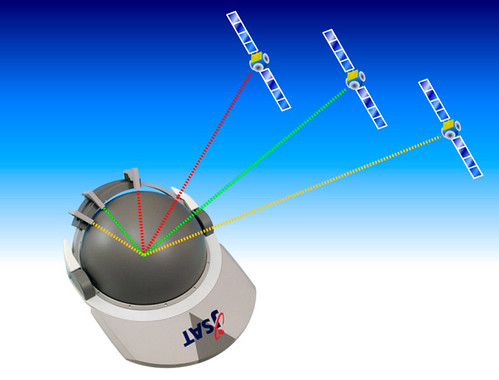

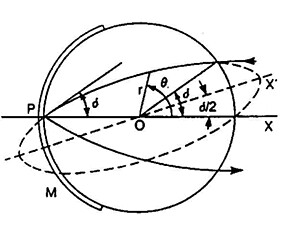
But was it really a “breakthrough?” I think it was – at least from a marketing perspective.  R. K. Luneberg proposed the principle of this lens for electromagnetic waves in 1944, where a sphere made of materials with relative dielectric constants varying in square distribution from 1 at the surface to 2 at the center becomes a dielectric lens with countless foci on its surface. A dielectric constant is a measurement of a material’s capacity to modify electromagnetic waves. This suggests a single lens antenna is capable of receiving and transmitting waves to and from multiple directions simultaneously – without moving the sphere. Brilliant!
 

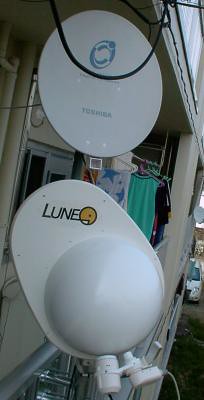
What we have here is a high-gain, low-cost antenna that may have substantial market potential in the U.S and Europe, too.  Presently, antennae based on the Luneberg Lens have been used in mobile military applications, especially on aircraft where a low profile is required. Datron makes and sells a Luneberg Lens Array (LLA). Lun’tech of France is selling one today, and Raven in the U.K. has been talking about one for some time.


Pretty cool how this 60-year-old technology may have an impact in today’s most advanced satellite communications systems. Want to learn more? This comprehensive overview from Stevens Tech in Hoboken is very useful. And if you want to start selling them, the folks at Rozendal Associates can help you make them.

SinoSat2, Optus D1 on the Fritz

Monday, November 20th, 2006

We wrote in September about China’s efforts to improve television coverage for up to 300 million mainland households through the launch of the SinoSat2 communications satellite, which lifted on October 29th.

Now reports are coming in that SinoSat2 is failing less than a month after being launched. IOL reports:

 A Chinese communications and broadcast satellite is failing less than a month into orbit because of malfunctioning solar panels, a China-watching Hong Kong-based group said on Monday.

The SinoSat-2 satellite, launched on October 29 in the southwestern province of Sichuan, is designed to serve live television signals and digital broadband multimedia systems in China, Hong Kong, Macau and Taiwan.

But technicians discovered its main solar panel had failed to unfold as planned on November 7, disabling some antennae from receiving ground instructions, the Hong Kong-based Information Centre for Human Rights and Democracy said.

"Chinese satellite experts are doing their utmost to save it but the chance of success is slim," the group said in a faxed statement, quoting unnamed sources.

One hopes things are going better with China’s seed breeding satellite. 

SinoSat2’s failure was not the only satellite to give the satellite underwriting market "a serious setback this week," as Satellite Finance (subscription required) reports:

 Next came the problems faced by Optus D1…. After the satellite was launched in orbit tests showed that one of the antennas was not functioning properly. The insurance placement was done by ISB.
 
“Insurers were sworn to absolute secrecy on it,” said one source. “The rumour is that they’re looking at a 50% partial loss.” The satellite was insured for a total of US$130m and Optus may thus get US$65m. Whether underwriters will subsequently turn to Orbital Sciences, the satellite’s manufacturer, in an attempt to recoup some of the outlay remains to be seen.


Live HDTV from the ISS

Thursday, November 16th, 2006

This was really cool. Thank you, NASA

Images from the world’s first high definition television (HDTV) broadcast from space flashed across the screen yesterday in Times Square. On Nov. 15, 2006, NASA made history with the first live HDTV broadcasts from space, in cooperation with the Japan Aerospace Exploration Agency, Discovery HD Theater and Japanese broadcast network NHK.

The two HDTV broadcasts featured Expedition 14 Commander Michael Lopez-Alegria on the International Space Station, with Flight Engineer Thomas Reiter serving as camera operator aboard the 220-mile-high laboratory.

"HDTV provides up to six times the resolution of regular analog video," said Rodney Grubbs, NASA principal investigator. "On previous missions, we’ve flown HDTV cameras but had to wait until after the mission to retrieve the tapes, watch the video and share it with the science and engineering community, the media and the public. For the first time ever, this test lets us stream live HDTV from space so the public can experience what its like to be there."

Known as the Space Video Gateway, the system transmits high bandwidth digital television signals to the ground that are not only spectacular, but also valuable to scientists, engineers and managers.

NASA and the Japan Aerospace Exploration Agency, along with both NHK and Discovery, are cooperating in this effort though a Space Act Agreement originally signed in 2002.

Image credit: Discovery Channel

Delta Launch From The Cape

Wednesday, November 15th, 2006

Watch a Delta II launch the GPS Block 2R military navigation satellite on Thursday, 16 November. Live feed from the Kennedy Space Center

Here’s the latest from Spaceflight Now:

WEDNESDAY, NOVEMBER 15, 2006
2230 GMT (5:30 p.m. EST)

Preparations continue for tomorrow’s launch of the Boeing Delta 2 rocket carrying a replacement satellite for the Global Positioning System, but bad weather at Cape Canaveral is threatening to delay the liftoff. Launch will be possible between 2:17 and 2:30 p.m. EST (1917-1930 GMT).

A cold front will be sliding through Central Florida on Thursday, and Air Force forecasters expect the Cape to feel the brunt of the stormy weather between 3 and 11 a.m. A severe weather watch has been issued.

Gradual clearing is predicted later in the day, but rain, lingering thunderstorms and thick clouds still pose a high concern for the mid-afternoon launch. There is a 70 percent chance that conditions will be unacceptable at liftoff time.

Mission managers will meet before dawn to assess the latest weather outlook and determine if it’s safe to retract the mobile service tower from around the rocket at pad 17A. Winds cannot exceed 39 knots for the move, plus officials must be confident of no hazardous weather looming on the horizon that could harm the rocket while it stands exposed on the pad for the final hours of the countdown.

Tower rollback is targeted to occur around 6 a.m. The retraction could be postponed a couple of hours without impacting the launch time.

Air Force officials say their strategy, assuming weather is safe enough to retract the tower, will be pressing forward with the launch opportunity. An early decision to scrub is unlikely unless the launch time forecast gives absolutely no hope of allowable conditions, they said. As of right now, there is that 30 percent chance that the storms will clear in time.

The outlook for Friday is beautiful, forecasters say.


The Mysterious Eye of a Saturnian Storm

Tuesday, November 14th, 2006

NASA’s Cassini orbiter has recorded something never before seen on another planet — "a hurricane-like storm at Saturn’s south pole with a well-developed eye, ringed by towering clouds."


(Click on the image above to play a movie of the storm.)

From the NASA press release:

 The "hurricane" spans a dark area inside a thick, brighter ring of clouds. It is approximately 8,000 kilometers (5,000 miles) across, or two thirds the diameter of Earth.

"It looks like a hurricane, but it doesn’t behave like a hurricane," said Dr. Andrew Ingersoll, a member of Cassini’s imaging team at the California Institute of Technology, Pasadena. "Whatever it is, we’re going to focus on the eye of this storm and find out why it’s there."

A movie taken by Cassini’s camera over a three-hour period reveals winds around Saturn’s south pole blowing clockwise at 550 kilometers (350 miles) per hour. The camera also saw the shadow cast by a ring of towering clouds surrounding the pole, and two spiral arms of clouds extending from the central ring. These ring clouds, 30 to 75 kilometers (20 to 45 miles) above those in the center of the storm, are two to five times taller than the clouds of thunderstorms and hurricanes on Earth.

Eye-wall clouds are a distinguishing feature of hurricanes on Earth. They form where moist air flows inward across the ocean’s surface, rising vertically and releasing a heavy rain around an interior circle of descending air that is the eye of the storm itself. Though it is uncertain whether such moist convection is driving Saturn’s storm, the dark "eye" at the pole, the eye-wall clouds and the spiral arms together indicate a hurricane-like system.

Distinctive eye-wall clouds had not been seen on any planet other than Earth. Even Jupiter’s Great Red Spot, much larger than Saturn’s polar storm, has no eye or eye-wall and is relatively calm at the center.

This giant Saturnian storm is apparently different from hurricanes on Earth because it is locked to the pole and does not drift around. Also, since Saturn is a gaseous planet, the storm forms without an ocean at its base. 

 Click here to view a movie of the storm.

DIY Friday: Death Ray Dogs and Other Potential Uses for your Old Satellite Dish

Friday, November 10th, 2006

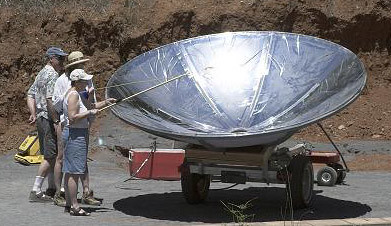
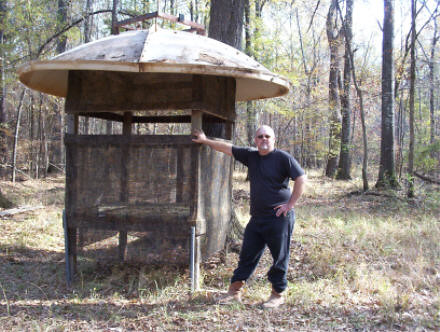
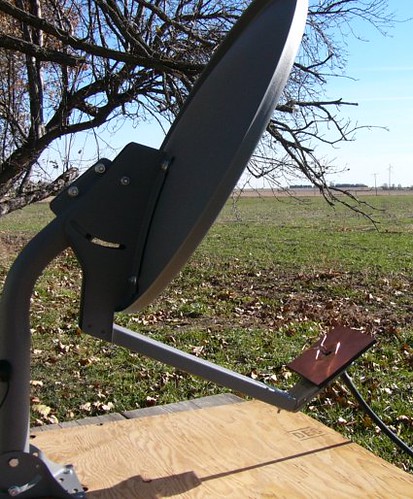
If you’re like most RRS readers you probably have an old satellite dish (or seven) sitting around your place and loathe the idea of parting with perfectly good electronics. This being the case, here are some ideas…

  1. Solar Death Ray Hot Dogs

    It’s probably not the most efficient way to cook a dog, but for a brat in the desert its hard to beat.
  2. Redneck Deer Stand

    Sure, you could just make stand completely out of wood, but, come on, where’s the sport in that. Now if only we could figure out a way to use the ’82 Gremlin on cement blocks on the front lawn…
  3. WiFi Antenna

    Certainly the most useful idea even if its not the most exciting.

Anyone have any other suggestions?


Space-based Narcissism

Thursday, November 9th, 2006

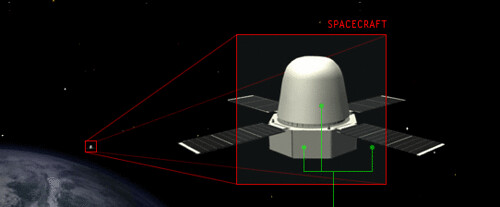
Ok, honestly, what could be cooler than having your name — yes, YOUR name — on a future piece of space junk? Well, I can probably think of a few things (a free donut, a good massage, etc.), but having your name blasted in to space does seem pretty cool.

If you agree, you should check out MIT and Georgia Tech’s Your Name In Space project, which aims to put "America’s most ambitious student spacecraft" up in the sky with the "tax-deductible" support of people looking for their "space in space". The Boson Globe had the story yesterday, but the project website gets a little more specific:

"In 2010, a small unmanned research spacecraft designed by students will launch into Earth’s orbit. The science on board will help pave the way for humankind to explore our solar system. We invite you to participate in this landmark mission by uploading content to be printed on our spacecraft…

Choose a location on the outside of the spacecraft and get pictures of your content photographed in space. Choose a location inside the return vehicle, and after five weeks in orbit we’ll return to you the actual piece of spacecraft hardware which carried your image into orbit."

The best part? Even if you can’t pony up the cold hard cash (a donation as small as $35 gets you a picture of your name or image on the craft before the flight, $250 gets you piece after reentry), you can still send your name up into the heavens. While financial supporters get a photograph of their name/logo/etc. in space or even a piece of the spacecraft following the mission, anyone can provide their name and information and have it encoded on to a DVD that will hitch a ride on the craft during its journey. Sure, it might not be a trip aboard the ISS, but, for now, its the next closest (and far cheaper) alternative.

Arabsat Launches Today

Wednesday, November 8th, 2006
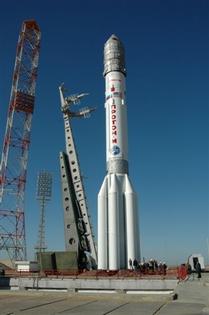
ILS is launching the BADR-4 satellite today from Baikonur at 19:40 GMT. Watch it live or tune your satellite receivers to…
In North America:
IA-6 @ 93 West
C-band, analog/NTSC
Transponder 14, 3980H
In Europe & Asia:
NSS-7 @ 338 East
Ku-band, digital/PAL
Transponder: WHL4/EUH3,Channel-1, 11,098.9H
Symbol Rate: 6.1113 Msps
FEC: 3/4
In Africa & Asia:
BADR-C (formerly Arabsat 2C) @ 26 East
Ku-band, digital/PAL
Transponder: C21, 4,120H
Symbol Rate: 27.5 Msps
FEC: 3/4

We like their blog.


BIG Airplane Lands in Cayenne

Tuesday, November 7th, 2006

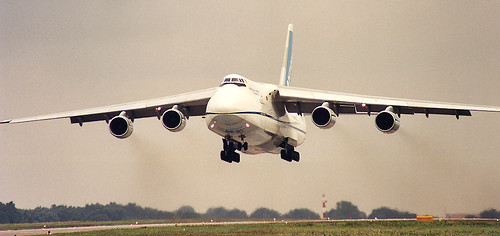
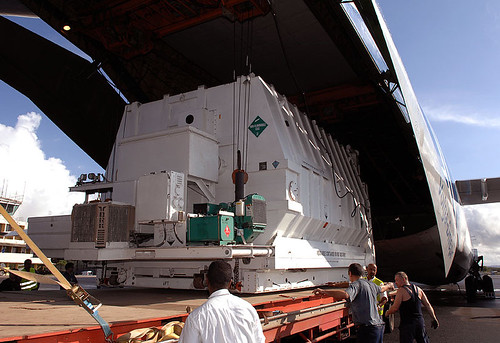
What is THAT? Is it the Big Kahuna landing for Election Day in Florida? No, that’s an Antonov 124 delivering the AMC-18 satellite at Cayenne’s Rochambeau International Airport. The satellite, scheduled for launch in December, is now being transferred to Europe’s Spaceport.

DMSP-17 Launched

Sunday, November 5th, 2006

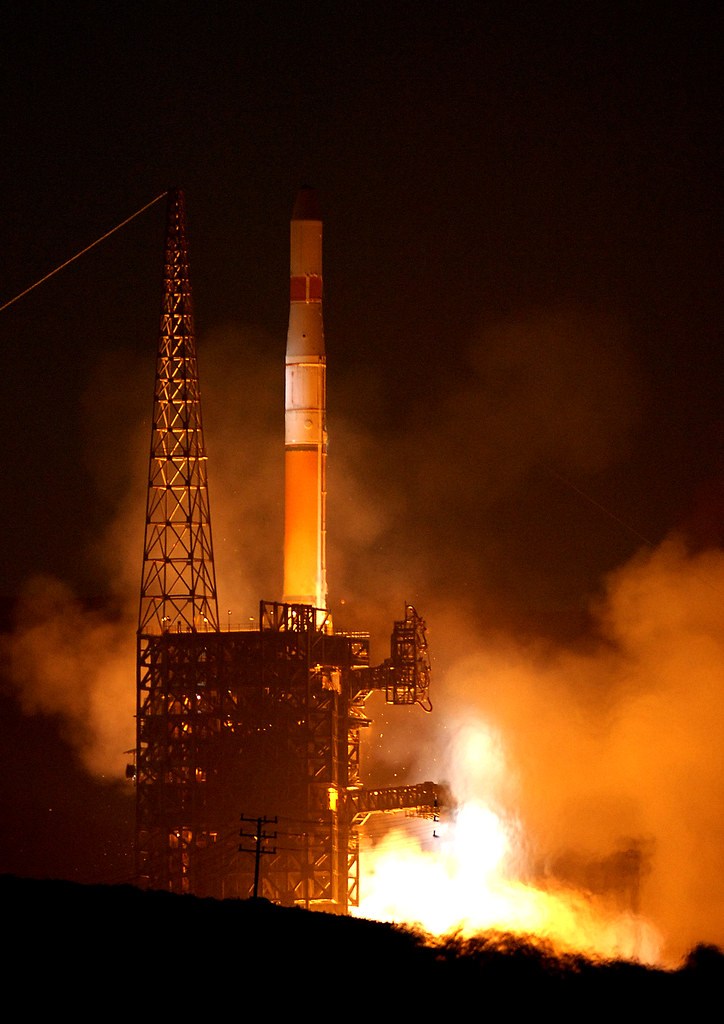
A Delta IV rocket launches at 5:53 a.m. on Nov. 4 from Vandenberg’s Space Launch Complex-6. The rocket carried a Defense Meteorological Satellite Program satellite in to space. The satellite will transition into a polar earth orbit to provide weather forcasts for servicemembers on battlefields around the world. (U.S. Air Force photo/Joe Davila)