Archive for the ‘Satellites’ Category

XM-4 Satellite Sea-Launched

Monday, October 30th, 2006


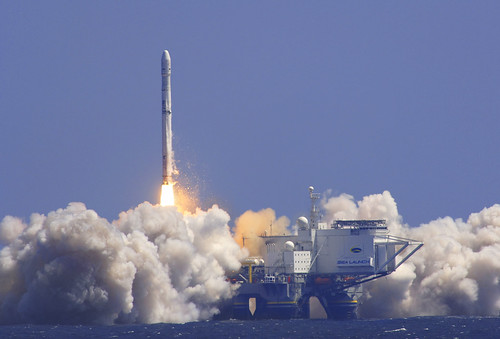
The XM-4 satellite was successfully launched on Monday:

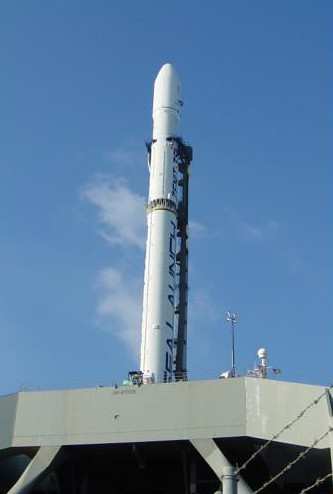
A Zenit-3SL vehicle lifted off at 3:49 pm Pacific Standard Time (23:49 GMT) from the Odyssey Launch Platform, positioned at 154 degrees West Longitude in the equatorial Pacific. All systems performed nominally throughout the flight. The Block DM upper stage inserted the 5,193 kg (11,448 lbs.) spacecraft into geosynchronous transfer orbit, on its way to final orbital position of 115 degrees West Longitude. A ground station at Hartebeesthoek, near Pretoria, South Africa, acquired the first signal from the satellite in orbit.

I think you’ll enjoy the video.

Hubble Decision

Monday, October 30th, 2006


The unusual variable star V838 Monocerotis (V838 Mon) continues to puzzle astronomers. This previously inconspicuous star underwent an outburst early in 2002, during which it temporarily increased in brightness to become 600,000 times more luminous than our Sun. Light from this sudden eruption is illuminating the interstellar dust surrounding the star, producing the most spectacular "light echo" in the history of astronomy.

The image above was recently captured by the Hubble Space Telescope, which is in need of repair, according to this (among others)  CBC report:

NASA officials met Friday to decide whether to risk a space shuttle flight on a mission to repair the Hubble space telescope.

Michael Griffin, the agency administrator, is scheduled to announce Tuesday at Goddard Space Flight Center in Greenbelt, Md., whether the mission will take place.

NASA says a mission to repair the Hubble telescope carries a higher risk.
(NASA/Associated Press) Although the space agency hasn’t said anything officially, University of Wisconsin-Madison astronomer Jay Gallagher, a member of a science team responsible for a camera in the Hubble telescope, says the signs are promising.

The 16-year-old telescope has been repaired four times since its launch in 1990. A fifth repair mission was cancelled after the 2003 space shuttle Columbia tragedy that killed seven astronauts.

NASA officials decided to cancel any future repairs of Hubble, saying it was a matter of shuttle safety. If a spacecraft heading to the telescope encountered a problem, there would be no safety net, since the astronauts would not be able to reach the International Space Station from Hubble’s orbit.

If Tuesday’s announcement gives the go-ahead for the mission, it could prolong Hubble’s ability to capture some of the most spectacular images of the universe well into the next decade. If the repair doesn’t take place, the telescope will deteriorate by 2009 or 2010.

Satellite-Linked Heineken?

Monday, October 30th, 2006

Well, it looks like the party might soon be over for the generations of euro-tripping backpackers who’ve snuck a few bottles of French wine into Germany or bottle of the illicit green stuff from central europe into Ole’ Blighty… shucks!

Our good friends at vnunet are reporting that Heineken Brewery (makers of Dutch delight drunk around the world), in association with IBM, international shipping company Safmarine, Vrije Universiteit Amsterdam (University of Amsterdam), and customs agencies in the US, UK, and the Netherlands, are beginning a program to track cargo container shipments of Heineken beer from Europe to the United States using satellite and cellular technology.

Called the "Beer Living Lab," the main goal of the project is to create a paperless documentation trail using IBM technology to provide real-time visibility of the product and interoperability through wireless sensors linked to its WebSphere platform.

According to IBM project Manager, Steffan Reidy, the results of this research effort could be used to improve customs processes around the world:

"[It’s] the first step in building the ‘Intranet of Trade’, which will help to substantially improve efficiency and security in the global supply chain."

Or, as Vnunet reported:

"Once accepted and implemented widely, paperless trade will support initiatives that will eliminate most inspections on arrival, thus significantly speeding up ocean freight shipments and improving the profit margins for shippers."

While this might mean it might be a little harder to sneak some booze across the border (especially if and when the technology is combined with RFID tagging of shipped spirits), the potential savings that could be passed down to consumers and improved port security probably evens things out a bit.

Want even more information about the Beer Living Lab? Think about taking a brief sojourn to Amsterdam in the next few days… the lab seems to be having a workshop on the technology on Thursday.

XM-4 Ready to Join Rock and Roll Satellites

Thursday, October 26th, 2006


Sea Launch is now preparing for the launch of the XM-4 satellite on 26 October 2006, at 23:49 GMT. Here’s the feed from their webcam:

Live broadcast of the launch will be available in North America via the AMC-3 satellite’s Ku-band payload, transponder 18. The satellite is located at 87 degrees West Longitude. Here are the particulars:
          
Downlink Frequency:   12064  Mhz Vertical
DIGITAL PARAMETERS:      4:2:0      FEC:  3 / 4      Symbol Rate: 6.1113
Audios:    Audio channel 1 / Audio channel 2 = Program Mix ( English)
Standard:    525 NTSC

Transmission test begins at 23:00 GMT, with the live transmission beginning at 23:35. Launch window opens at 23:49 and closes 00:57 on 27 October 2006.

Or you can watch the webcast.

SKY Perfect Merging With JSAT

Wednesday, October 25th, 2006


The Nihon Keizai Shimbun reported that Japanese DTH service SKY Perfect is merging with satellite operator JSAT, which provides carriage for the satellite TV service. The news report prompted this reply from SKY Perfect:

SKY Perfect is currently looking into strengthening its relationship with and possible merger with JSAT, but nothing definite, including the stock transfer ratio, has been decided on at this stage. SKY Perfect will immediately disclose if anything on this matter is decided.

But Reuters goes a little deeper:

Japanese satellite broadcaster Sky Perfect Communications Inc. will acquire satellite communications company JSAT Corp. and create a holding company next spring, the Nihon Keizai business daily reported in its evening edition on Wednesday.

The paper said Sky Perfect will become a holding company, while creating a new entity for its operations. The holding company will bring the new firm and JSAT under its umbrella.

Each JSAT share will likely be swapped for about 4 shares in the holding company, the paper said.

Based on Sky Perfect’s closing share price on Wednesday, the deal would value JSAT at around 93.7 billion yen ($786 million), 7.5 percent below actual market capitalisation.

Shares in Sky Perfect closed down 1.9 percent at 65,700 yen, and JSAT ended down 2.4 percent at 284,000 yen. They underperformed the benchmark Nikkei average’s 0.48 percent fall.

Sky Perfect currently does not own JSAT shares. JSAT, which transmits programming for Sky Perfect’s Sky PerfecTV, holds a 6.9 percent stake in Sky Perfect.

Interesting to note SKY Perfect, the leading satellite TV service in Japan, started up its own IPTV service, OptiCast. For about $25 (3,000 yen), you get 68 channels.  Such a deal.


Cargo for ISS

Tuesday, October 24th, 2006

Via MosNews.com

An unmanned Russian cargo ship carrying 2.76 U.S. tons of supplies, equipment and gifts blasted off Monday en route to the international space station, a space official quoted by AP said.

The Progress M-58 mounted atop a Soyuz-U booster rocket lifted off at 5:41 p.m. from the Baikonur cosmodrome in Kazakhstan and entered orbit about 10 minutes later, Federal Space Agency spokesman Valery Lyndin said.

The ship was scheduled to reach the orbiting station Thursday evening, delivering fresh fruit and vegetables, compact discs and DVDs and other gifts to the station’s current crew — cosmonaut
Mikhail Tyurin, U.S. astronaut Michael Lopez-Alegria and German astronaut Thomas Reiter.

Also included in the shipment, according to Itar-Tass, will be equipment for repairing a Russian-built Elektron oxygen generator, which overheated last month, spreading burnt-rubber smell and leaking potassium hydroxide.

While the incident forced the crew to don masks and gloves in the first emergency ever declared aboard the 8-year-old orbiting outpost, Russian and U.S. space officials downplayed it, saying crew members’ lives were never in any danger.

Soyuz Launches MetOp

Friday, October 20th, 2006

The MetOp satellite was finally launched into polar orbit on 19 October 2006 on a Soyuz rocket:

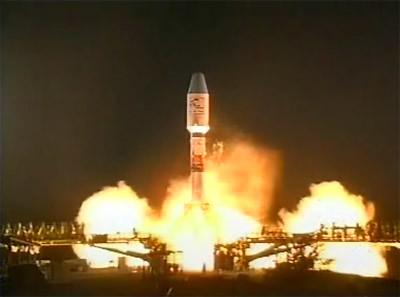
The Soyuz 2-1a, an enhanced version of the Soyuz launcher, lifted off from the Baikonur Cosmodrome in Kazakhstan right on schedule at 10:28 p.m. local time (04:28 p.m. UTC, 06:28 p.m. in Paris). It is the 1,714th launch of a rocket from the Soyuz family.

Starsem and its Russian partners confirmed that the Fregat orbital stage accurately injected Eumetsat’s MetOp-A satellite into its Sun-Synchronous Orbit (SSO). The Fregat upper stage was ignited twice to place MetOp-A into orbit 1 hour, 8 minutes after lift-off.

The MetOp-A satellite will provide more precise details about atmospheric temperature and moisture profiles, invaluable for weather forecasting and climate monitoring. The MetOp program was jointly established by the European Organisation for the Exploitation of Meteorological Satellites (EUMETSAT) and the European Space Agency (ESA). Their main partners in this co-operative venture are the Centre National d’Etudes Spatiales (CNES) in France and the United States National Oceanic and Atmospheric Administration (NOAA).

For this flight, Starsem used the upgraded Soyuz 2-1a, flown with the new ST fairing. The 2-1a configuration features improved navigation accuracy and control capability provided by a digital control system. The 2-1a configuration also enables Starsem to introduce the ST payload fairing with an external diameter of 4.1 meters and a length of 11.4 meters.

This latest successful launch by Soyuz reflects the industrial capabilities of the Samara Space Center (TsSKB-Progress) and the skills of all the operating teams, working under the authority of the Russian Federal Space Agency (Roscosmos).

Starsem is responsible for the international marketing and operation of Soyuz launchers. Its shareholders are Arianespace, EADS, Roscosmos and the Samara Space Center.

Check out the launch highlights.


A Violent Collision of Stars, or a Marriage?

Thursday, October 19th, 2006

That’s the question many are asking when they see this stunning new image of the merging Antennae galaxies taken by the Hubble Space Telescope:


Reuters explains: 

A seemingly violent collision of two galaxies is in fact a fertile marriage that has birthed billions of new stars, and an image released on Tuesday gives astronomers their best view yet.

The new image of the Antennae galaxies allows astronomers working with the orbiting Hubble Space Telescope to distinguish between new stars and the star clusters that form them.

Most of these clusters, created in the collision of the two galaxies, will disperse within 10 million years but about 100 of the largest will grow into "globular clusters" — large groups of stars found in many galaxies, including our own Milky Way.

The Antennae galaxies, 68 million light years from Earth, began to fuse 500 million years ago.

The image serves as a preview for the Milky Way’s likely collision with the nearby Andromeda Galaxy, about 6 billion years from now.

So if you’ve ever gotten the feeling that everything was heading towards a tremendous smash-up — well, you’re right.

You can zoom in on the above image at the HubbleSite


MetOp Launches Today at 2:28 pm EDT

Tuesday, October 17th, 2006


The BBC reports on Europe’s first polar-orbit satellite:

Europe is set to launch its most sophisticated weather and climate satellite to date.

The MetOp spacecraft will be lofted into its 850km-high polar orbit by a Soyuz-Fregat vehicle from Kazakhstan.

The platform should improve forecasting globally, and give scientists detailed data they can use to refine models describing how Earth’s systems work.

Metop has eight instruments to gather a range of data about the planet’s atmospheric and surface conditions….

Metop is a joint project of the European Space Agency (Esa) and Eumetsat, the intergovernmental organisation charged by European member states with operating a series of orbiting weather observatories….

The new platform weighs more than four tonnes and measures almost 18m (60ft) with its solar wing unfurled.

The Eumetsat website will feature a stream broadcasting the launch live. For more information on the satellite, visit the ESA Portal, or click here for a cool animated video explaining the satellite and its mission.

Set Your Watches: New Break Through in Atomic Clocks

Monday, October 16th, 2006

"Most technical systems that employ satellites, including GPS technology, make use of atomic clocks; these technologies can now operate much more accurately," thanks to a recent breakthrough in understanding errors in atomic clock technology, ScienceDaily reports:

Andrei Derevianko, Kyle Beloy, and Ulyana Safronova [of the University of Nevada, Reno] sat down six months ago and began work on a calculation that will help the world keep better time….

Associate physics professor Andrei Derevianko and his team isolated and explained a significant portion of the error in atomic clock output….

In its research, the University team was able to isolate and explain a significant portion of the error in atomic clock output. The portion of error that the team studied has now been cut to one-fiftieth of its original size. The team’s research was based solely on calculations, many of which were conducted on high performance computers…

In 2004, an Italian research team found some convincing evidence that suggested that atomic clocks were less accurate then previously thought. This evidence concerned the scientific community and gave the theory behind atomic clocks renewed international attention….

Atomic clock technology is based on the fact that atoms emit a fixed frequency. Lasers, which also have operating frequencies, can be calibrated so that their frequencies match that of a given atom. Since atomic frequencies are constant, syncing a laser with an atom and counting the laser’s oscillations will always provide a steady measurement of time….

The new findings are also paving the way for all kinds of new scientific experimentation. Extremely accurate measurements are required to make estimations about the behaviors of the universe. The extra time-keeping precision will allow scientists to explore hypotheses about the big-bang theory. The improved technology might even be accurate enough to provide evidence related to the controversial theory that universal constants, as in the amount of charge in an electron, are changing.

So how does one tune in to the more accurate atomic clock? Why, with an atomic clock receiver, of course:

A radio system is available in North America set up and operated by NIST – the National Institute of Standards and Technology, located in Fort Collins, Colorado. NIST operates radio station WWVB, which is the station that transmits the time codes. WWVB has high transmitter power (50,000 watts), a very efficient antenna and an extremely low frequency (60,000 Hz). For comparison, a typical AM radio station broadcasts at a frequency of 1,000,000 Hz. The combination of high power and low frequency gives the radio waves from WWVB a lot of bounce, and this single station can therefore cover the entire continental United States plus much of Canada and Central America. The time codes are sent from WWVB using one of the simplest systems possible, and at a very low data rate of one bit per second. The 60,000 Hz signal is always transmitted, but every second it is significantly reduced in power for a period of 0.2, 0.5 or 0.8 seconds: • 0.2 seconds of reduced power means a binary zero • 0.5 seconds of reduced power is a binary one. • 0.8 seconds of reduced power is a separator. The time code is sent in BCD (Binary Coded Decimal) and indicates minutes, hours, day of the year and year, along with information about daylight savings time and leap years. The time is transmitted using 53 bits and 7 separators, and therefore takes 60 seconds to transmit. A clock or watch can contain an extremely small and relatively simple antenna and receiver to decode the information in the signal and set the clock’s time accurately. All that you have to do is set the time zone, and the atomic clock will display the correct time.