Archive for the ‘Satellites’ Category

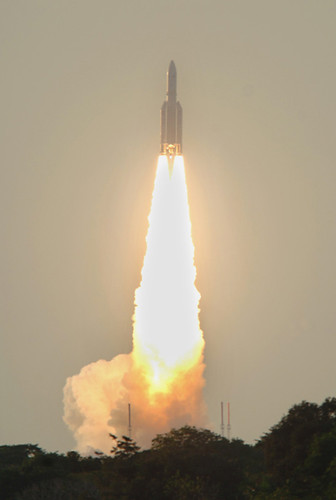
Nice Launch: Ariane 5 ECA

Monday, October 16th, 2006

Mission réussie pour Ariane 5 ECA

Dans la nuit du vendredi 13 au samedi 14 octobre 2006, Arianespace a mis en orbite de transfert géostationnaire le satellite DIRECTV 9S pour l’opérateur américain DIRECTV et le satellite OPTUS D1 pour l’opérateur australien OPTUS. Grâce au plateau ASAP 5, le lancement emportait également le réflecteur expérimental LDREX-2 pour l’agence spatiale japonaise JAXA.

Arianespace placed two satellites into geostationary transfer orbit: DIRECTV 9S for the U.S. operator DIRECTV Inc., and OPTUS D1 for the Australian operator OPTUS. The Ariane 5 ECA launcher was also fitted with the ASAP 5 platform, allowing it to deploy the LDREX-2 experimental reflector for the Japanese space agency JAXA.

Provisional parameters at injection of the cryogenic upper stage (ESC-A) were:
Perigee: 249.4 km for a target of 249.5 km (±3)
Apogee: 35,940 km for a target of 35,946 km (±160)
Inclination: 6.98 º for a target of 7.0 degrees (±0.06º)

DIRECTV 9S was built by Space Systems/Loral in Palo Alto, California, and will be positioned at 101 degrees West. Weighing approximately 5,530 kg at liftoff, DIRECTV 9S is fitted with 52 high-power Ku-band transponders and 2 Ka-band transponders. It will provide direct TV broadcasts using digital compression technology. DIRECTV 9S will give American TV viewers a greater choice of broadcast services, while prefiguring tomorrow’s multibeam satellites for multimedia applications. Design life is about 15 years.

OPTUS D1 was integrated by American manufacturer Orbital Sciences Corporation in Dulles, Virginia, based on a Star-2 platform. OPTUS D1 will weigh about 2,300 kg at launch. Positioned at 160 degrees East, it will provide direct TV broadcasts, Internet links, voice and data services for Australia and New Zealand. Its design life is 15 years.

LDREX-2 (Large-scale Deployable Reflector Experiment 2), launched on behalf of the Japan Aerospace Exploration Agency (JAXA), is a small-sized partial model representing the large deployable antenna to be used on the ETS-8 technology satellite, which will be launched in December 2006.
DIY Friday: Installing C-Band at Home

Friday, October 13th, 2006

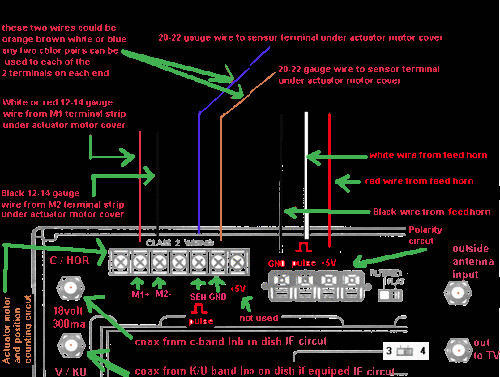
So you’ve made the decision to get a C-Band receiver at home, so you can watch (what else?) NASA TV and other free to air channels from around the globe.

Now, you think, it’s DIY Firday — and how the heck do you hook the thing up to your dish?

HomeCable.com offers a set of standard instructions and diagrams to help you get started. 


There are several places online where you can get C-band receivers and antennas. Sadoun Satellite sales offers the Fortec Star FC6D. Mechtech and RPS Satellite offer several models, as does Global Communications.

What other sources do readers turn to for their antenna and receiver needs? Let us know in the comment threads — or if there are other DIY Friday topics you’d like to see us cover. 

Arianespace to Launch DirecTV Satellite Tomorrow

Thursday, October 12th, 2006

Among those who aren’t suspicious of undertaking major endeavors on Friday the 13th, you can include both Arianespace and DirecTV.

The Ariane 5ECA rocket is scheduled to launch tomorrow afternoon between 4:56 and 5:56 pm, U.S. Eastern time. The launch will take place from the ESA spaceport in Kourou, French Guiana.

The launch will service three customers and deploy three satellites: DirecTV’s 9S, Optus’ Optus D1, and JAXA’s LDREX-2.  

The 9S satellite "will be capable of providing up to 54 transponders for high-quality local and national digital video service broadcast into 27 beams. In an alternate configuration, the satellite will be capable of providing up to 44 transponders broadcast into 30 beams."

Want to know what to expect from the launch, second by second? Check out Spaceflight Now’s cool launch cue card

Dust Devils on Mars

Wednesday, October 11th, 2006

This morning we stumbled across this article in the Columbus Dispatch (written under contract by NASA), and we were reminded again of one of the cooler images to come from our solar system in the last few years.

The image is of a dust devil moving across a Martian plain on a hot spring afternoon a year ago:


The image was caught by NASA’s ‘Spirit’ Mars Rover in April, 2005. 

Both rovers (Spirit and Opportunity) have recently been upgraded with new software that enables them to better understand when a dust devil is moving across the martian surface, and to begin snapping pictures when they sense that movement:

NASA’s Space Technology 6 mission, or ST6, had already proven this "artificial intelligence" software in space. ST6 used it to help an Earth-orbiting satellite take pictures of erupting volcanoes on Earth. So NASA knew the software would help Spirit and Opportunity capture images of dust devils.

ST6 is part of NASA’s New Millennium Program, whose job is to test new technologies in space before putting them on NASA missions of discovery.

Other images and video from Mars can be found on NASA’s Mars Exploration Program website. 

Labrador Internet Connections At Risk

Tuesday, October 10th, 2006

Sailing from England with one vessel, the Matthew, on 20 May 1497, John Cabot (Giovanni Caboto) and a crew of 18 reached what some historians now believe was Labrador on 24 June 1497. He went ashore to take possession of the land, exploring the coast for some time and departing on or about the 20th of July.

Upon his return to England, Cabot was well rewarded (a pension of 20 pounds a year), and a patent was written for a new voyage. In 1498, he sailed for America with 5 ships. One of the ships became distressed and diverted to an Irish port. Nothing was ever heard of the other — or John Cabot — ever since.

Will the same happen to Internet connections in Labrador today? The CBC reports that’s what might happen if Industry Canada’s Community Access Program (CAP) cuts funding. In a town like Black Tickle, where dial-up service became available only recently, people see the need:

The cut may mean the closure of 21 internet sites in Labrador. In many coastal communities, the only efficient way to connect to the internet is via satellite.

Brenda Roberts, principal of St. Peter’s school in the southern Labrador community of Black Tickle, said CAP sites are used broadly. Students use the connection for research, and the school’s administration depends on it.

"Our fee for this internet connection to [the] satellite system is around $220 a month, so basically, if you compare it to a human body, well, we’re going to die of heart failure in January," Roberts said.

Residents in the community rely on satellite-based CAP sites for everyday things, including commerce and filling out government forms.

"We’ve got no bank here now and it’s easier to get a piece of gold nugget here than cash, so being able to bank online is all right," she said.

Who will step in to help? Will it be Canada’s dominant satellite operator, Telesat? Perhaps this is the type of situation where Telesat’s new competitor, Ciel Satellite, saves the day? There are other options, of course: resellers such as Barrett Xplore, who use satellites operated by Intelsat.

Korean Ping-Pong

Tuesday, October 10th, 2006

As the debate rages in the press as to whether Pyongyang’s 60-year obsession came to fruition on Sunday — or, if, as Drudge is reporting, the North Korean blast was a  "dud" — it’s worth taking a moment to ask: how do we come to conclusions about what really happened?

To do so, it’s worth recounting how the United States learned about the blast.  

Our initial warning that the nuclear test was about to take place came not from a high-tech gizmo, but in a phone call from the Chinese:

The White House said Monday the United States received word from China of North Korea’s intent to conduct a nuclear test minutes ahead of the reported event.

According to spokesman Tony Snow, North Korea had called its ally China to advise them on the imminent explosion at about 9 p.m. EST Sunday. China in turn notified the U.S. Embassy in Beijing, which relayed the message to Washington.

Secretary of State Condoleeza Rice received notification about 9:45 p.m. and notified national security adviser Stephen Hadley. Hadley called President George W. Bush at about 9:52 p.m.

South Korean authorities said they felt the seismic tremor from an apparent explosion in North Korea in about the same time frame of Hadley and Bush being notified.

 In addition to indications on the ground in South Korea, there was the on-the-air announcement in North Korea:


Soon thereafter, the USGS and other agencies began to analyze the seismic data to locate the epicenter and identify the magnitude of the tremors that were registered on seismic monitors. In this case, the magnitude was 4.2, and the location was pinned down (though not literally, of course) on the map.

NOAA’s NESDIS satellite likely played a key role in communicating the scientific (non-intelligence) data, and satellite telemetry helped pinpoint the location of the tremor. 

The result? So far, a good deal of doubt on behalf of the West in regards to North Korea’s claims of success:

U.S. officials, speaking on the condition of anonymity, said that seismic readings show that the conventional high explosives used to create a chain reaction in a plutonium-based device went off, but that the blast’s readings were shy of a typical nuclear detonation.
   
"We’re still evaluating the data, and as more data comes in, we hope to develop a clearer picture," said one official familiar with intelligence reports.
   
"There was a seismic event that registered about 4 on the Richter scale, but it still isn’t clear if it was a nuclear test. You can get that kind of seismic reading from high explosives."
   
The underground explosion, which Pyongyang dubbed a historic nuclear test, is thought to have been the equivalent of several hundred tons of TNT, far short of the several thousand tons of TNT, or kilotons, that are signs of a nuclear blast, the official said.

The official said that so far, "it appears there was more fizz than pop."

Without satellites and seismic monitors, however, it would be impossible to say whether it was fizz, pop, or outright propaganda on the part of North Korea.


The Years Fly By

Thursday, October 5th, 2006

MSNBC reports on the most recent Hubble exoplanet discovery:


WASHINGTON – A recently spied planet orbits so close to its star that a new year comes every 10 hours.

Called SWEEPS-10, the planet belongs to a newfound class of zippy exoplanets called ultra-short-period planets that have orbits of less than a day.

The Hubble Space Telescope recently spotted five ultra-short-period planets, all about the size of Jupiter, in a crowded star field near the galactic bulge of our Milky Way galaxy as part of an exoplanet survey called the Sagittarius Window Eclipsing Extrasolar Planet Search, or SWEEPS. A total of 16 planet candidates were found, all with relatively short orbital periods…

"These are the farthest planets detected so far around some of the faintest stars," study leader Kailash Sahu of the Space Telescope Science Institute in Maryland told reporters at a NASA press conference.

Extrapolated to the entire galaxy, the Hubble results suggest the Milky Way contains at least 6 billion Jupiter-sized planets, researchers say.

The findings are detailed in Thursday’s issue of the journal Nature.

More info and images can be found on the HubbleSite.

Checking in On Space Weather

Wednesday, October 4th, 2006

We’re all familiar with standard weather reports: rain in the western U.S., Ohio Valley, a nice high-pressure system over the southeast, with plasmaspheric hiss at higher altitudes.

Wait — plasmaspheric hiss? Space.com explains:

Plasmaspheric hiss consists of extremely low frequency radio waves with frequencies ranging from 100 Hz to several kHz. These waves scatter energetic electrons and divert some of them into the Earthís upper atmosphere, thereby creating the gap in the Van Allen radiation belts.

Fluxes of high-energy, or relativisitic, electrons which occur during space weather events such as coronal mass ejections and sunspot activity, are a risk to humans in space and damage spacecraft. Fluxes in the outer Van Allen radiation belt are particularly erratic and even the gap can be filled with killer electrons during intense solar weather events, such as the Halloween Storm in 2003, Meredith said.

A better understanding of solar weather and the source of plasmaspheric hiss will help scientists improve their forecasts of space conditions and make space travel safer for humans, he said.

"Understanding the source of hiss will help scientists produce the next generation of radiation belt models that will eventually be used for predictive purposes," Meredith told SPACE.com. "This will help humans in space plan their activities to avoid unnecessary exposure to extreme levels of radiation."

For those who are really rocket scientists, understanding the weather in space is critical to maintaining full satellite functionality on a day to day basis.

So where does one get a forecast of the day’s space weather?

Why, from NOAA, of course. 

This site gives a good overview of what a daily space weather forecast looks like, with predictions of solar X-ray flux and links to auroral activity estimates and information on solar protons. A similar page provides predictions of solar wind speeds at earth; a complete list of NOAA’s space weather and data products can be found here.

And here’s a tidbit: Unlike the old joke about wind chill factor, solar wind effects you whether you believe in it or not. And it can make itself known in some amazing ways.

Mach 23 Will Set You Free

Tuesday, October 3rd, 2006

The U.S. Air Force Office of Scientific Research thinks it’s possible, and a company in California wants to prove it: a large electromagnetic ring will be able to launch small satellites into space. Discovery Channel Canada gives us the scoop:

A large circular metal track could accelerate objects to supersonic speed using electromagnets and spit them out into space, says a report from the U.S. air force’s Office of Scientific research.

Tagged as the Launch Ring by its inventing company, Launch Point Technologies, the track would be several kilometers in diameter. Similar to trains that hover on electromagnetic tracks, a sled would hover over the ring and be propelled forward using powerful magnets.

According to the company, a satellite protected by an eggshell-like capsule could sit atop the sled and slowly accelerate over a matter of hours to a supersonic 10 km/sec. Then a small explosion could detach the capsule from the sled and it would hurtle into a side tunnel.

From there, it would shoot up a ramp and through the atmosphere into outer space. Traveling at a 23 times the speed of sound, the capsule would experience forces 2,000 times that of normal gravity on Earth.

A rocket strapped on the capsule would correct the trajectory so that it correctly aligned itself in orbit.

The Goleta California company has received funding to begin a two-year study within several weeks. Boosters of the ring hope to one day use it for thousands of launches a year, at a fraction of today’s cost of putting things in space.

Humans could never withstand the forces exerted during the ring’s launch process. Under existing technological limitations, it could only be used to propel supplies to be used by humans on a long-term mission in outer space, or to put satellites into orbit.

The Air Force also suggests it could be used for military purposes, quickly launching weapons around the world.

For more details, try NewScientist.com.


Thai Business Destabilized, Thai Satellite Deorbited

Tuesday, October 3rd, 2006

Let’s face it: military juntas make businessmen nervous.

Last week’s military coup in Thailand has destabilized the business climate — if only briefly — with many business leaders holding off on planned deals as they assess the situation in Bangkok.

One big example of the law of unintended consequences: GE Capital put its deal with Bank of Ayudhya on hold until the situation clarifies itself.

But what impact has the coup had on satcom in Thailand?

For Shin Satellite Plc, the greatest problem in recent weeks is not change in power in the governement but a sudden loss of power on their Thaicom 3 satellite:

Shin Satellite Plc yesterday immediately de-orbited its glitch-ridden Thaicom 3 broadcasting satellite, following its power loss, which affects its plan to tap the Middle East market.

However, the company’s executive chairman Dumrong Kasemset denied that the de-orbit would affect the company’s projected revenue this year as it has yet to include Thaicom 3 income’s from the Middle East into the calculation.

He added during the teleconference with the presses that the company is also evaluating the deeper financial impact of the de-orbit incidence. He said ShinSat de-orbited Thaicom 3 at approximately 01.37 am, due to the power loss to such extent that it could not provide further service.

t de-orbited Thaicom 3 by moving it beyond its existing orbital slot of 50.5 Degrees East.

Thaicom 3 has had its share of problems, as has Thaicom’s owner, Shincorp. Thailand’s Ministry of Commerce recentely completed its investigations of the sale of Shin Corp to Singapore’s Temasek Holdings.

One thing’s for certain — businessmen, and those of us hoping for a Christmas trip to Phuket, will welcome a return to normalcy.