Archive for the ‘Satellites’ Category

Hand-Held at Sea

Monday, October 2nd, 2006

According to Lloyd’s List (subscription required), Inmarsat is focusing on hand-held satellite communications devices for maritime service:

LEADING satellite communications provider Inmarsat is gearing up for a major entry into the hand-held market after signing off the deal with voice service provider ACeS International.

“This was the final piece in the jigsaw for our services, and we are now ready to make big strides in the mobile voice sector,” said Robert Johnson, director of maritime services for Inmarsat.

The deal will give Inmarsat the means to compete with Iridium, its principal rival in the commodity voice segment.

The London-listed company bought the intellectual property rights of ACeS International last month and expects initial annualised revenues from the collaboration to be in the region of $3m-$5m from capital expenditures of approximately $40-$50m over two years for ground infrastructure and development on the ACeS R190 phone. 

The ACeS press release on the partnership can be found here. The InMarsat/ACeS system relies upon low-bandwidth communications using geosynchronous satellites in the L-band, which is a global allocation. Thus, you can operate in the same frequency anywhere in the world.

Iridium tried (and failed in) the hand-held satcom market in the 1990s, as The Wall Street Journal recently reminded us:

"They were targeting people in deserts and on ships in the middle of oceans, and one of my life lessons is that you can’t get a good business serving the fringe," said George Calhoun, a telecom entrepreneur and professor of technology management at Stevens Institute of Technology in Hoboken, N.J. "I remember thinking at the time that this was a trial balloon and that they weren’t serious."

Well, the creditors to Iridium remain serious; now they’re going after parent company Motorola to recoup their losses.

So who, exactly, needs handheld satcom equipment? The big boats with lots of people (cruise ships, naval vessels) have big dishes for TV — and they can spend the money required for marine-stabilized antennas.

The Inmarsat maritime service is useful, we suppose, if you want to blog while floating on a raft in the middle of the ocean. Or if you’re rowing a boat to the Canary Islands. But the question remains — is there a mass market for handheld sat phones?

What do you think? 

Farm Aid 2006 on Satellite

Friday, September 29th, 2006

 FARM AID® 2006 takes place on Saturday, September 30 at the Tweeter Center at the Waterfront in Camden, New Jersey. The entire event will be broadcast live on XM Satellite Radio starting at 3:30 p.m., EDT (on X Country, XM Channel 12).

The event will feature president and founder Willie Nelson, board members Neil Young, John Mellencamp and Dave Matthews, as well as Jerry Lee Lewis with Roy Head, Los Lonely Boys, Arlo Guthrie, Gov’t Mule, Steve Earle, Allison Moorer, Steel Pulse, Shelby Lynne, Nitty Gritty Dirt Band, Jimmy Sturr & his Orchestra, Pauline Reese and Danielle Evin.

Of course, there’s also a webcast. I like their blog, too. Philly’s Bling blog will be covering it as well.

What’s espcially interesting is how the environmental impact of this year’s concert is being worked. Purchasing Green Tags from the Bonneville Environmental Foundation is offsetting all of the electricity used at the concert, replacing it with sustainable wind energy. Title sponsor Silk Soymilk has also purchased additional Green Tags to offset the energy used for an estimated 25,000 attendees to drive to the venue. Last I checked, tickets were still available.

Their local promotion, Fresh from the Family Farm, a restaurant promotion to benefit Farm Aid, is well worth it (if you live, work or plan to visit the area this weekend).

“Pale Blue Dot”

Thursday, September 28th, 2006

Yesterday’s Astronomy Picture of the Day was particularly beautiful:


From the NASA website:

Explanation: What’s that pale blue dot in this image taken from Saturn? Earth. The robotic Cassini spacecraft looked back toward its old home world earlier this month as it orbited Saturn. Using Saturn itself to block the bright Sun, Cassini imaged a faint dot on the right of the above photograph. That dot is expanded on the image inset, where a slight elongation in the direction of Earth’s Moon is visible. Vast water oceans make Earth’s reflection of sunlight somewhat blue. Earth is home to over six billion humans and over one octillion Prochlorococcus.

Japanese Launch Sun Microscope

Tuesday, September 26th, 2006

On Saturday, the Japanese Aerospace Exploration Agency (JAXA) successfully launched  the M-V Launch Vehicle No. 7 (M-V-7) at 6:36 a.m. Japan Standard Time from the Uchinoura Space Center.

Within an hour, JAXA started receiving signals from the rocket’s satellite payload —  the SOLAR-B, a sun observation "microscrope" nicknamed "Hinode" ("sunrise") by JAXA engineers.

The BBC has more
on the SOLAR-B and its mission of studying solar flares, which "release the equivalent of tens of millions of hydrogen bombs in just a few minutes:"

 The probe will attempt to find out more about the magnetic fields thought to power solar flares, and try to identify the trigger that sets them off.

The ultimate goal for scientists is to use the new insights to make better forecasts of the Sun’s behaviour.

Flares can hurl radiation and super-fast particles in the direction of the Earth, disrupting radio signals, frying satellite electronics, and damaging the health of astronauts….

Solar-B is expected to transform our understanding [of solar flares].

It carries three instruments: a Solar Optical Telescope (SOT), an X-ray Telescope and an Extreme Ultraviolet Imaging Spectrometer.

They will make continuous, simultaneous observations of specific solar features, to observe how changes in the magnetic field at the Sun’s surface can spread through the layers of the solar atmosphere to produce, ultimately, a flare.

"Solar-B acts essentially like a microscope, probing the fine details of what the magnetic field is doing as it builds up to a flare," said mission scientist Professor Louise Harra, from the Mullard Space Science Laboratory, UCL, UK.

"What we don’t know is what triggers a flare; we don’t understand the physics of that phase at all. Solar-B will show us how tangled the field is, and how the field lines collide to produce all that energy."

In October, NASA will contribute to the growing understanding of solar flares when it launches its Stereo mission – twin spacecraft that will make 3D observations of the sun.

Better understanding of solar flares is critical, as John Davis, Solar-B project scientist at Nasa’s Marshall Center, told the BBC.

"The information that Solar-B will provide is significant for understanding and forecasting of solar disturbances, which can interfere with satellite communications, electric power transmission grids, and threaten the safety of astronauts travelling beyond the safety of the Earth’s magnetic field," he said.

(Video of the M-V-7 launch can be found here (in the right hand column).) 

Launch Day Monday — Delta II: Good; SpaceLoft XL1: Almost.

Tuesday, September 26th, 2006
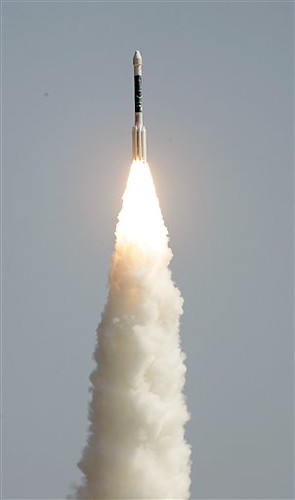
Watched the Delta II launch a GPS payload yesterday, live on HD-Net. Gorgeous launch on a beautiful day at Cape Canaveral Air Force Station in Florida. Seeing it in HDTV does make a difference.

Boeing’s workhouse did its job:

The Delta II rocket carrying the GPS IIR-15 (M) spacecraft lifted off from Space Launch Complex 17A at Cape Canaveral Air Force Station, Fla., at 2:50 p.m. EDT, Sept. 24. Following a nominal 68-minute flight, the rocket deployed the satellite to a transfer orbit.

The Boeing Delta II 7925-9.5 configuration vehicle used for today’s mission featured a Boeing first stage booster powered by a Pratt & Whitney Rocketdyne RS-27A main engine and nine Alliant Techsystems (ATK) solid rocket boosters. An Aerojet AJ10-118K engine powered the storable propellant restartable second stage. A Thiokol Star-48B solid rocket motor propelled the third stage prior to spacecraft deployment. The rocket also flew with a nine-and-a-half-foot-diameter Boeing payload fairing.

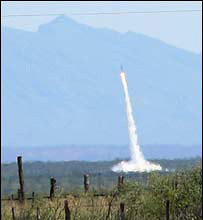
Monday’s other launch event, at Spaceport America in New Mexico, did not do as well. The SpaceLoft XL1 rocket failed at around 40,000 feet, eliciting this gem of a quote from launch logistical coordinator Tracey Larson:

"If it was easy, everyone would be doing it."

Optus Satellite Fueled for Launch in October

Monday, September 25th, 2006

Seems the next Ariane 5 launch is now scheduled for 12 October 2006.

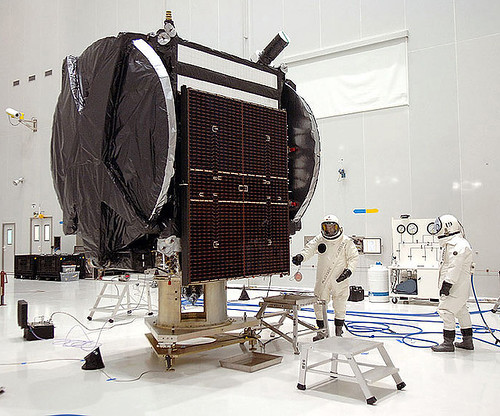
Here’s one of the rocket’s "passengers" being fueled. Evidently, rocket science is still a dangerous business…

TV on Wheels

Monday, September 25th, 2006

We’ve written recently about DIY techniques for getting satellite reception on your RV. But doing it yourself, we readily admit, requires actually doing something yourself, which can be a drag (especially on Mondays!) .

Sometimes, after all, you just want to lean back and have the sort of unbridled fun that the guys in the photo to the right are clearly having.

Luckily for the want-it-now crowd, there are several consumer options already on the market that will bring you (or, more precisely and safely, your passengers) satellite television reception in your minivan or SUV while you barrel down the interstate.

One such system is RaySat’s T5 low-profile in-motion satellite antenna,  which "can work across multiple Ku-Band frequencies (factory option) in either linear or circular polarization (field option) and operate over many geographical regions, multiple satellites and any DTH (dedicated) infrastructure." Another system — the TracVision A7 mobile satellite system — is now being offered by DIRECTV, which also offers a mobile programming option:

Recognizing the growing interest among American motorists who want the same DIRECTV entertainment experience in their cars that they have in their homes, DIRECTV is now delivering to car video screens live local news, weather, traffic, sports and other local entertainment programming.

Local broadcast channels via DIRECTV are now available to mobile customers on the open road within the continental United States to vehicles that have been equipped with a TracVision A7 mobile satellite TV system, launched today by KVH Industries, Inc. DIRECTV will provide mobile customers their local broadcast channels within the designated market areas where it already offers them to home viewers. Local channels availability may vary by market. DIRECTV delivers local programming in 142 markets, representing 94 percent of U.S. television households.

DIRECTV’s TOTAL CHOICE(R) Mobile with local channels package, created exclusively for mobile customers with a low-profile automotive TracVision system, is available for $44.99, and offers more than 185 channels. To receive local channels in their car, DIRECTV customers must purchase a new TracVision A7 satellite TV system, which includes an integrated GPS unit and new 12-volt receiver jointly developed by DIRECTV and KVH.

The mobile local channels offering is part of a larger strategy by DIRECTV to target the more than 20 million U.S. vehicles expected to have in-vehicle passenger video systems by 2011, according to the leading analyst firm Frost & Sullivan.

Delivering uninterrupted satellite reception while an antenna moves at nearly 70 miles per hour is no simple engineering feat, which helps explain why the KVH system is loaded with patents.

It also helps explain why the system will currently set you back about 3,000 clams. (To keep a low wind profile, it looks like a clam, too.)

Just remember, though, that 20 million vehicles are expected to have such a system in place by 2011. So keep your eyes on the road.
 

Rescuing Inflight Broadband

Thursday, September 21st, 2006


According to Shephard Group’s Inflight-Online, Panasonic Avionics wants to offer the same inflight broadband service being shut down by Connexion by Boeing:

JUST when the Inmarsat community was relishing the prospect of an unobstructed run at the passenger broadband market, Panasonic has announced a plan to take up where Connexion by Boeing left off. The IFE giant has no intention of rushing in, though, and will not launch unless it has commitments covering a critical mass of aircraft. 

“We have a complete system designed, developed and ready to go,” strategic marketing director David Bruner told Inflight Online at the WAEA show in Miami Beach last week. “But we’re determined to avoid one of the things that brought Connexion down – lack of an initial fleet big enough to assure acceptable pricing for the airlines.”

Panasonic has set about securing agreements covering a minimum of 500 aircraft in the next 60 days. That schedule is being driven by the need to be ready to serve ex-Connexion airlines within a tolerable time after the discontinuation of that service by the end of the year. “We can’t drag our launch decision on until, say, February,” Bruner said. “There will inevitably be a dark period between the end of Connexion and the start of our service, and we want to keep that as short as possible. We already have 150 aircraft committed and feel confident we’ll make the 500. But if we’re falling badly short in 60 days’ time we will not go.”

Early takers would enjoy significant advantages over airlines that were slower of the mark, Bruner said. “In return for a minimum five-year commitment we’ll reward our launch customers with very preferential service pricing, and they will also get priority access to bandwidth.”

Panasonic’s standard wholesale price to the airlines would represent a comparatively small premium on terrestrial broadband access tariffs, Bruner said. “So far we are seeing little indication that the airlines are planning to mark this up for passengers. It’s a service they want to offer – they don’t currently see it as a revenue-generator.”

The new offering is designed to be as attractive as possible to airlines that are already equipped for Connexion. “Our solution for them is to replace only the modem on the aircraft and leave all the rest of the hardware, including the antenna, in place,” said Bruner. “That will spare them the expense of reversing the Connexion installations and then putting in our definitive equipment suite.”

That includes a compact Ku-band antenna from Californian-based L-3 Datron Advanced Technologies. Another L-3 Communications operation, the Linkabit division, is supplying the modem. Both are already fully developed for US military applications and have been modified for civil use by removing the encryption provision. Working with an existing Ku-band satellite system, the hardware is capable of delivering 12Mbit/sec to the aircraft and 3Mbit/sec in the opposite direction, according to Bruner.

Panasonic has selected a single Ku-band satellite operator to provide transponder capacity and geographical coverage at least equivalent to Connexion’s. “With an initial fleet of 500 aircraft we would anyway pay significantly less for transponders than Connexion,” Bruner pointed out. “But our technical solution will also be more efficient than theirs, allowing us to put more traffic through each transponder and thus reduce our total requirement for satellite capacity.”

Panasonic saw itself as a system designer and integrator and had no intention of incurring the costs associated with being a service provider, Bruner said. The as yet unidentified satellite operator would be responsible for system management, operation and capacity planning, and Panasonic is in talks with a global wireless roaming company for the provision of services such as customer care, billing and retail promotion. 

“We’re intent on learning from what happened to Connexion,” said Bruner. “9/11 lost them their start-up fleet, and after that they were always struggling to catch up. Our onboard equipment is lighter and cheaper, and our approach to buying transponder capacity is altogether more economical. We think these advantages will persuade the airlines and that in a couple of months’ time we’ll be ready to go ahead.”

Should the magic 500 not be achieved, however, Panasonic will continue to look for another way into connectivity. “If Ku-band proves not to make sense after all, then we’ll go down another path,” Bruner concluded.

At least one other passenger communications provider will be watching developments carefully. AeroMobile is currently to committed to L-band operator Inmarsat as the bearer system for its soon to be introduced onboard cellphone offering. But it is also looking to offer email and Internet/VPN access in the longer term, and would be open to integration with the Panasonic Ku-band system in the same way its new GSM/GPRS cellular offering is being integrated with the company’s onboard IFE infrastructure.

“We’re completely agnostic when it comes to air-to-ground data pipes,” commented AeroMobile strategic relationships and marketing director David Coiley. “In the end we could find ourselves working with Inmarsat, Panasonic and even the AirCell terrestrial broadband system in North America.”


Although some still have doubts, Australian airline Qantas is moving forward with their test.

Walkie Talkie via IP

Thursday, September 21st, 2006

We’ve written before about the nexus between IPTV and satellite communications technology, including SES Americom’s IP-PRIME (which recently signed up more than 120 channels through transport agreements with leading television programmers and networks) — but what about IP Radio?

Companies like Barix (whose consumer products can be viewed here) utilize IP radio and satellite technology for IP connections as a backup against studio power outages, as Radio World reports:

Barix AG said Clear Channel Satellite Services is using its products for point-to-multipoint IP connectivity from Englewood, Colo., to Clear Channel radio towers in the southeastern United States….

The system was launched in June in advance of the hurricane season and connects stations in the Gulf region. Stations there “now can remain on the air in the event that studios go dark in extreme weather or other disaster conditions, allowing stations to broadcast important information to local populations in emergency situations,” the supplier stated.

Englewood streams audio to towers sites in preparation for broadcast should studios experience power outages. Barionets at those sites are used to activate and switch the Exstreamer backup audio feed for transmission over the air. The latter devices are controlled from Englewood via the IP connection established over the satellite.

Stations in Texas, Louisiana, Alabama, Mississippi, Florida, Georgia, and the Carolinas are connected; the broadcast group hopes to expand the system to around 900 towers over the next year.

Such systems provide important redundancy to over-the-air broadcasts, but radio (eh, Marconi?) is not just about broadcasting from one to many — it’s about multi-point, multi-way communications, as well.

Which, when you think about it, is exactly the model upon which internet protocol is designed. So why aren’t we seeing more IP Walkie Talkies?

Well, we may soon. Cisco last fall announced technology and a new business unit "focused on integrating two-way radio, cellular, VoIP and other communications methods into an IP backbone:"

 The IP Interoperability and Collaboration System (IPICS) consists of existing Cisco products and new server software that Cisco says will let public safety organizations and companies IP-enable two-way radio voice traffic and integrate disparate radio infrastructures with other public safety or private organizations.

While initially focused on public safety and government users – patching together systems of separate police, fire and governmental organizations, for example – Cisco says the IPICS platform will appeal to a broad range of public and private enterprise customers because the system also is capable of integrating disparate data and video signals with an IP infrastructure.

"[IPICS] is not a communications system in itself; it’s something that enables disparate communication systems out there to work together in an IP format," says Brad Curran, an industry analyst with Frost and Sullivan who tracks government and military communications technology industries.

Cisco Systems president and Chairman  John Chambers recently gave the keynote address (more info here) and a demonstration of IPICS at the Security Standard Conference in Boston:

IPICS focuses on voice interoperability across multiple networks, and provides services for user management, policy creation, and integration of diverse PTT devices. But Chambers said its underlying architecture would enable IPICS to extend beyond voice to provide complete information-based interoperability and collaboration, with the contextual integration of voice, video, and data resources.

The potential for a company as large as Cisco to transform IP Radio and push past the barriers of interoperability should not be underestimated. Indeed, it could be as transformative as radio itself.

Before radio, after all, instant communications across great distances relied upon point-to-point connections via the telegraph. Today’s networks similarly limit communications to those with devices capable of communicating on those networks. True interoperability — a result of the nexus between satcom, IP and radio — could literally change the way we communicate.

But then, as Rocket Scientists (cough, cough), we’ve always been excited by the potential of new technology. 

China to Launch New Communications Satellite in October

Thursday, September 14th, 2006

We wrote last month about the Chinese launch of their seed-breeding satellite.

Now the Chinese hope to breed lots of new channels for millions of people with the launch of its SinoSat 2 satellite at the end of October:

A Chinese Chang Zheng (Long March) 3B carrier rocket is scheduled to launch the SinoSat 2 (a.k.a. Xinnuo 2), satellite… from Launch Complex 2 at the Xichang Satellite Launch Centre. According to Sun Laiyan, administrator of the China National Space Administration, the Xinnuo 2 large-capacity communications satellite, with an anti-jamming system, will provide direct television broadcasting services to the Chinese mainland, as well as Hong Kong, Macao and Taiwan. On Monday, August 4, the satellite left the production facility after receiving its final checks by the Commission of Science, Technology and Industry for National Defence. Xinnuo 2 is based on the Dongfanghong 4 platform and has been designed to work with the ChinaSat 9 satellite in the same orbit, to provide communications services to the Chinese mainland. The ChinaSat 9 satellite is based on the Spacebus 4000 C1 platform and will be positioned at 92.2 degrees east. The Xinnuo 2 satellite, which has taken China six years to develop, is designed to have a lifespan of 15 years, and operated in geosynchronous orbit at 110.5 deg E. China has managed to launch 70 satellites since the 1970’s, of which, currently only 20 are still in service today.

China Daily has additonal information on how the Chinasat 9 and Sinosat 2 satellites will improve television coverage in local areas; the Asia-Pacific Broadcasting Union notes that the new satellite will provide up to 300 million mainland households with "access to cable-quality TV services that have so far been restricted to China’s more urban areas."

The launch of SinoSat 9 comes just in time a new cultural great leap forward in China, as January, 2007 will bring the introduction of a Chinese version of America’s Next Top Model to Chinese television.

(The photo above shows the areas of coverage for the new satellite.)