Archive for the ‘Satellites’ Category

Watching TV at 35,000 feet

Thursday, May 25th, 2006

Last week I was reading an article on the 2nd anniversary of the introduction of broadband Internet service on Lufthansa aircraft

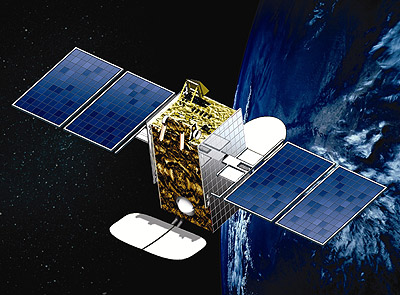
The online, in-flight service — which has proven so popular that Lufthansa is now offering it on nearly 80% of its long-haul flights — is provided by Connexion by Boeing (CbB). The CbB system uses geosynchronous satellites to connect to the Internet, with a Wi-Fi hotspot on the aircraft itself. SES AMERICOM plays a critical role in delivering the airborne internet; Connexion by Boeing utilizes our AMC-23 satellite to provide high-speed access to customers flying over the Pacific Ocean. (AMC-23 was designed and specified in conjunction with CbB to provide Ku-band coverage of major air routes across the Pacific Ocean).

That satellite connection — and SES is proud to play a role in delivering it — is changing the way people travel, and becoming a “must have” amenity for many business travelers. One recent study conducted by Boeing found that:

  • 83 percent of those surveyed said that the availability of the Connexion by Boeing service will have an impact on future travel plans and their choice of airline carrier;
  • 94 percent said they plan to use the service again on a future flight;
  • 78 percent said that the service’s speed met or exceeded their expectations.

As for how people are using the service, the study found:

  • 90 percent of respondents said they accessed their work e-mail, most of whom use a virtual private (corporate) network;
  • 76 percent accessed their personal e-mail;
  • 69 percent said they browsed the Internet;
  • 41 percent engaged their friends and family via instant messaging or live chat applications.

Using IM and email to stay in touch with others while crossing the oceans is a great way to increase business productivity. But as I read the article and study about Lufthansa’s experience with Connexion by Boeing over the last two years, I was reminded of a personal experience I had on Lufthansa flight earlier this spring.

Because I travel so frequently,  and I like to stay connected with “hometown” news, I purchased a Slingbox device. Slingbox enables you to tune in to your TV service at home via the Internet. On this occasion, I was flying on an overnight Lufthansa flight to Luxembourg via Frankfurt, and had gotten online using CbB.

Like most business travelers, I initially got online to check my work email, and I spent some productive time catching up on business matters. But then I had a thought — I wondered if I could use CbB to connect to my Slingbox and to try tuning in the news program — from 35,000 feet. It worked!

“Tuning in at home” while over the North Atlantic was made possible by many technologies — twice by satellite. First, the video signal was carried by an AMERICOM satellite and downlinked by a cable operator in New York. Then, an AMERICOM satellite was used to provide Internet service to the aircraft. In between, there are the new technologies: the Slingbox and CbB. Oh, and of course, there’s the Internet.

That, to me, is what is truly amazing about the combination of satellite technology with the Internet. Productivity is nice, but being able to sit back and relax with your favorite local programming while flying across time zones — that’s the type of future we’ve long imagined. And thanks to satellite technology, that future is here. This really is rocket science.

 

Comet Cancelled?

Thursday, May 25th, 2006

What’s that in the sky? A bird? A plane? Well, no. It’s a comet, but nothing you need to worry about according to Phil over at Bad Astronomy.

Comet

Well, today is the day, once again, that the world won’t end. I’m shocked, shocked, that the comet fragment predicted to hit in the Atlantic causing a seismic event and an ensuing tidal wave hasn’t materialized.

Of course, the day’s not over yet. But I’m pretty sure how this will turn out.

Chris has been blogging the story of whether or not a comet will hit the earth today, and is pretty sure it won’t. He’s updated his post about his Sirus Radio interview on the subject with more than enough links to make an effective case. 

But keep one eye on the sky today just in case, will ya?

NASA on Hurricanes

Wednesday, May 24th, 2006

It’s that time of year. Hurricane season is upon us, and NASA is stepping up its services to better communicate with employees through its intranet. Good thing too, because half of NASA’s offices are smack in the middle of the path Katrina and Rita took to land last year. 

The InsideNASA intranet, built on Vignette’s Next-Generation web Presence platform, help employees at 11 US facilities stay informed about office closures, evacuation procedures and when it’s safe to return to work. Information on the site also will guide employees to make a "safe-arrival call" when they reach their destination.

… There’s also a real-time feed from the Department of Homeland Security (DHS) helps monitor theorist threat advisories. The site has approximately 130 portlets, "a small window of content, such as an animated real-time weather map," Holm said. "We also have an announcement portlet that offers all the latest information at NASA submitted by employees."

… A virtual private network (VPN) provides employees remote access from virtually any device with internet connectivity, such as a Research In Motion (RIM) Blackberry or Palm Treo. NASA employees also can call a hotline to find gas or a hotel when there not able to log into the network, Holm said. "Just for my group, we budgeted about US$300,000 for the project this year," she said. "It includes personnel, management training, operations, content and disaster support, and publishing and information architecture."

Makes sense, since NASA has something of an inside track when it comes to advance info on hurricanes. Metroblogging New Orleans posted that NASA’s satellite study of Rita last summer yielded an interesting discovery about what’s behind the strength of some hurricanes.  

Using a satellite last summer to study hurricane Rita from above, scientists discovered that towering clouds near the storm’s eye were good predictors of future storm strength.

… Specifically, if hot towers are active at least 33 percent of the time during a three-hour period, surface winds have an 82 percent chance of intensifying. Making such measurements on the fly could improve the forecast of a storm’s strength just prior to landfall.

Here’s hoping more accurate forecasts combined with getting information out faster will lead to getting more people out of the path of the next big hurricane.

Waiting for the Bus

Friday, May 19th, 2006

Where’s the bus? Satellite technology (combined with your handheld or PDA) may soon provide the answer to that question, at least in Manhattan. NY1 News reports:

A plan using a satellite tracking system for buses is moving forward.

New York City Transit says a pilot program proposed last year could be in place by November.

Technology will allow for website displays with real-time bus locations and arrival times.

Updates would also be available on electronic message boards.

Riders will even be able to access times on your cell phone or blackberry.


And if you had a ringtone to this classic Replacements song — well, then riding the bus would almost be cool.

Satellite Radio on the Download?

Wednesday, May 17th, 2006

You might have thought, after the demise of Napter and the ensuing deluge of RIAA lawsuits, that satellite radio was a pretty safe bet. After all, you’re not so much downloading music as you are catching it as it falls from the sky. Kinda like collecting rainwater. As consumer, you’d be right. You’re relatively safe, for now. It’s the providers that could be in trouble, as XM radio learned upon getting sued by RIAA.


XM Radio

The recording industry on Tuesday sued XM Satellite Radio Holdings Inc. (Nasdaq:XMSR – news), alleging its Inno device that can store music infringes on copyrights and transforms a passive radio experience into the equivalent of a digital download service like iTunes.

The suit accuses XM Satellite of “massive wholesale infringement,” and seeks $150,000 in damages for every song copied by XM customers using the devices, which went on sale earlier this month. XM, with more than 6.5 million subscribers, said it plays 160,000 different songs every month.

“…Because XM makes available vast catalogues of music in every genre, XM subscribers will have little need ever again to buy legitimate copies of plaintiffs’ sound recordings,” the lawsuit says referring to the hand held “Inno” device.

The suit says that XM has touted its service’s advantages over the iPod and cites XM’s advertising literature that says “It’s not a Pod. It’s the mothership.”

 At $150,000 a pop, you’d better be careful what you beam down from “the mothership.” But, as the guys over at Gizmodo suggest, you might want to get yourself an Inno before they disappear forever. (Though the folks at XM say the lawsuit is just a negotiating tactic.)

In slightly related news, if you’re a Sirius Radio subscriber you’ll can listen to Bad Astrology blogger Phil Plait on Discovery Channel Radio at 9:00pm EST. He’ll be talking about the likelihood of Earth having a run in with a comet sometime next week…

Bridging the “Broadband Gap” with Satellite

Tuesday, May 16th, 2006

This past March, the EU issued a report on the urgent need for broadband connectivity throughout Europe. A new project announced on May 15th is designed to bring high-quality broadband service in less developed areas to address this demand with the HYLAS satellite.


HYLAS satellite


For Giuseppe Viriglio, Director of European Union and Industry Programmes for the European Space Agency, “HYLAS will play an important role in demonstrating the advanced technological capabilities of European space companies which are truly competitive on a global scale. It also makes significant progress in solving the social problem of poor broadband coverage in many parts of Europe and serves as a template for future large scale projects ".


 Responding to the i2010 initiative, the satellite will use Ka-band for broadband data communications and Ku-band for HDTV broadcasting. Considering the report does not include new EU Member States added in 2004 (Czech Republic, Estonia, Hungary, Latvia, Lithuania, Malta, Poland, Slovakia and Slovenia), space-based broadband connectivity will play a key role in less-developed and rural communities around the world.

How appropriate as Wednesday is the first World Information Society Day.

Map of the Known Universe

Tuesday, May 16th, 2006

Astronomers have released the largest-ever atlas of the cosmos — and it’s coming soon to the world wide web.

The Royal Astronomical Society reports:

Traditionally, astronomers have needed to take a "spectrum" of each galaxy to determine [the distance between galaxies], splitting its light into many components to reveal sharp features with which to measure the amount of redshifting. This requires a time-consuming, individual observation of each galaxy.

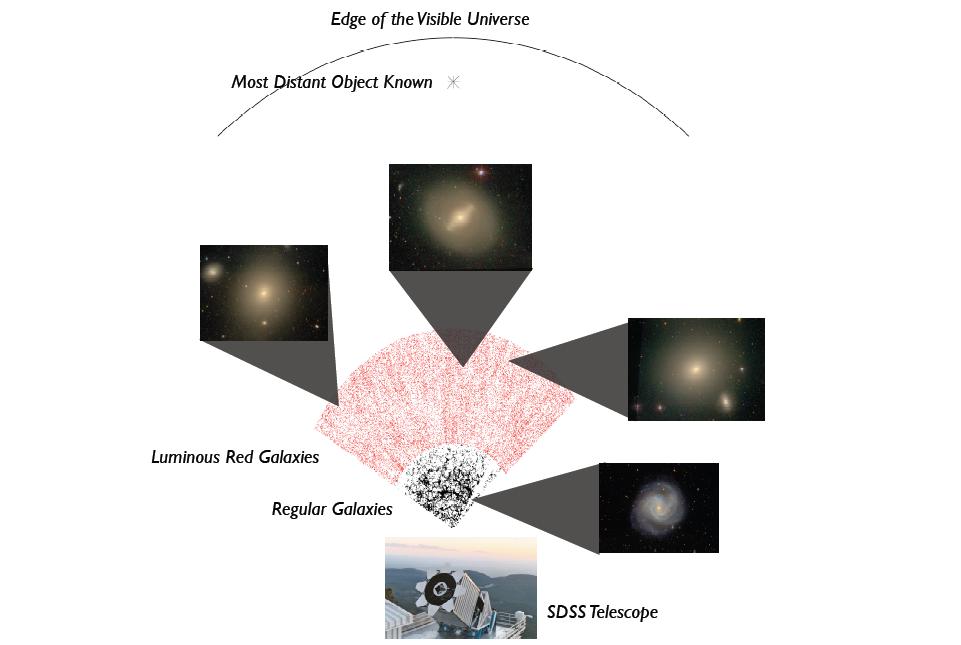
The new cosmic map has been constructed using a novel technique focusing on a special class of galaxy whose intrinsic colour is very well known. For these ‘Luminous Red Galaxies’ researchers can measure the amount of colour distortion, and hence the approximate distance of the galaxy, just by looking at digital images of the sky, without the need to obtain a full spectrum.


What is most striking is that the new study and atlas have revealed that "the ordinary matter our bodies are made of and that we experience in everyday life only accounts for a few percent of the total cosmic budget:"

Our Universe contains billions of galaxies of all shapes and sizes. In recent years astronomers have used increasingly large surveys to map out the positions of these galaxies, stepping their way out into the Cosmos.

The new cosmic map unveiled today is the largest to date — a three-dimensional atlas of over a million galaxies spread over a distance of more than 5 billion light years. The findings confirm that we live in a Universe filled with mysterious dark matter and dark energy.
"We have analyzed the patterns in this map and discovered waves of structure over a billion light years across," said Dr. Chris Blake of the University of British Columbia, principal author of the study. "These waves were generated billions of years ago and have been vastly stretched in size by the expanding Universe."
 
The full findings of the report can be found here.

Slinging into Space

Friday, May 12th, 2006

Are rockets déclassé when it comes to launching stuff into space?

Well, not really. Nothing can quite compare to the countdown to launch and the rumble as the rocket lifts off from the pad.

But in the future, rockets might not be the only way of lifting things into the Clarke Orbit and beyond. 


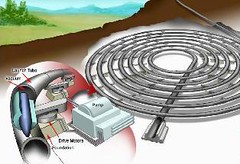
We’ve written before about the space elevator; the picture above depicts another method being explored by scientists and engineers — a giant slingshot:

What if we could throw something so hard, it would wind up in space? At NASA’s behest, Ed Schmidt and Mark Bundy of the Army Research Lab are looking at ways of firing projectiles into orbit.

The notion has a very long pedigree. Back in 1687 when Isaac Newton first came up with the theory of gravity he also introduced the concept of an orbital cannon which could fire a cannonball so fast that it would never come down. The first serious attempt to shoot into space was the High Altitude Research Program (HARP) carried out in the US in the 60’s…. HARP used a modified 16-inch naval gun to loft projectiles to the incredible altitude of 112 miles before being cancelled in 1967.

The ARL study looks at more sophisticated approaches than your basic cannon, including a blast wave accelerator, and electro-magnetic rail gun, and an EM coil gun. But the wildest idea may be the Slingatron: a giant, hypervelocity, rapid-fire slingshot. The machine would spin a projectile faster and faster through a spiral-shaped tube, building up increasing amounts of centripetal force along the way – just like a discus-thrower, spinning himself around before a toss, or like a latter-day King David, winding up his weapon before he whacks Goliath.

Personally, we think slingshots are dangerous– you could poke out your brother’s eye, as Mom used to warn– but cannons look pretty cool:


And engineers for a relaunched HARP project could easily be found in the autumn in Montana, at the Annual World Championship Punkin Chunkin.

Then again, slingin’ a punkin would be pretty cool, too. 


Cellular Love Detector

Tuesday, May 9th, 2006

It’s an idea I’ve had knocking around in my head for a while, or at least since I started writing for this blog. And it may be an idea whose time has come. But given my somewhat limited technological abilities, someone else is gonna have to make it happen.

While pondering the various ways technology might be employed to improve the life of the everyday man or woman on the street, it occurred to me that while exploring the various uses for mobile technologies affairs of the heart were being overlooked. Since scores of people carry mobile phones these days, that allow them to do everything from playing their favorite music via satellite radio to watching their favorite shows, it seems like a no-brainer to use the same technology to track down potential candidates for significant-other status. If I thought of it, surely someone out there with greater technical acumen than me has thought of it and tried to make it a reality. 

Enter the Cellular Love Detector.  It works like this: dial the access number, the number of your latest crush, and talk as you would normally do while the Love Detector does it’s magic and spits out a report. 

Using the Love-Detector Cell Service is as simple as dialing the access number, and your friend’s phone number right after… Once the conversation starts, all you need to do is have a NORMAL conversation. Speak about work, homework, movies or any other thing. …
During the call, our server will monitor the excitement levels and other related parameters your friend is demonstrating, and will calculate the "Love-Level" as detected in the conversation. Once the conversation has ended, the final report will be sent to your cellular phone using SMS or audio message! The final report is not only about the "Love-Level", and includes other parameters, like "Concentration", "Embarrassment" and even "Anticipation".

Sounds like an interesting idea, and one that may be useful to folks who are impaired when it comes to detecting mutual admiration. But I don’t think it goes far enough. 

Look, we already know how easy it is to track someone down using various technologies. We can use GPS to track down lost pets and roving gang members. We can use GPS and cell phones to track down wandering teenagers. And I just read that it’s pretty easy to track anybody who’s carrying a cell phone, whether they make calls or not. 

Most people know that when they make a mobile call—during a 911 emergency, for example—authorities can access phone company technology to pin down their location, sometimes to within a few feet.

A lesser-known fact: Cell phone companies can locate you any time you are in range of a tower and your phone is on. Cell phones are designed to work either with global positioning satellites or through “pings” that allow towers to triangulate and pinpoint signals. Any time your phone “sees” a tower, it pings it.

Here’s a more straightforward explanation

Real-time tracking of cell phones is possible because mobile phones are constantly sending data to cell towers, which allows incoming calls to be routed correctly. The towers record the strength of the signal along with the side of the tower the signal is coming from. This allows the phone’s position to be easily triangulated to within a few hundred yards.

The technology is already within reach of consumers. You can sign up for services like AccuTracking, World Tracker, or ULocate. For that matter you can build your own. So, the genie is out of the bottle and unlikely to go back in. 

Why not put it all together in the service of matchmaking? The Google Earth Blog had the same premonition I did, upon hearing news of at least one dating service letting customers use Google Earth to locate prospective dates.

It can only be a matter of time before other dating services implement a Google Earth interface for showing approximate locations for prospective dates. It would be a smart move in my opinion and not too difficult to implement technically.

Exactly. At least one dating service already uses GPS to alert customers to potential dates in their vicinity, if the prospective date is on the customer’s "hotlist." Another popular online dating service was considering a similar move earlier this year. Even the practice of "toothing" — meeting potential dates via Bluetooth-enabled mobile phones — started as a hoax and blossomed into reality. 

So, I guess my idea isn’t all that far fetched, but would just take things one step further. Here’s how it would work, at least as I imagine it. You register with the service, and fill out a profile indicating your interests, the type of person you’re seeking, etc. You don’t have to do much more than that to start getting matches, except to indicate that you’d like to be "trackable" via your mobile phone.

Then some computer in some warehouse in the middle of nowhere runs through it’s database to find potential matches that are also "trackable." When you’re out and about with your phone, you’d get a message from the service when there’s a good match in your vicinity, with a link to their profile. At that point, you’d be asked to decide whether you want to make contact or not. At the same time, your potential match would see the same message with your profile and the option to make contact.

You and your match would get, say, three contact options. First, chatting via SMS or a chat client. Second, talking via mobile phone (with numbers masked, of course). And finally, if you’ve opted to have your location tracked and chosen to make contact and your match has done the same, you could get one another’s approximate location via GPS, and meet in person.

I haven’t seen anything quite like that available, but if I did and I were single I’d sing up for it. With all that technology at your disposal, who needs Cupid?

U.S., India Team Up for the Moon

Tuesday, May 9th, 2006

"Indian and U.S. space agencies Tuesday signed an agreement to put two U.S.-made scientific instruments on board of Chandrayaan-I, India’s first unmanned moon explorer, in 2008, Indo-Asian News Service reported:

NASA will put one mini synthetic aperture radar (Mini SAR) and moon mineralogy mapper (M3) on board of Chandrayaan-I, according to the agreement.

"The objective of SAR is to detect water in the permanently shadowed areas of lunar polar regions, while M3 will map the minerals on the lunar surface and study its characterization," [Indian Space Research Organization (ISRO) chairperson G. Madhavan] Nair said.

Chandrayaan-I will be launched from the Satish Dhawan Space Centre (SDSC) at Sriharikota in southeast India’s Andhra Pradesh, by an advanced polar satellite launch vehicle (PSLV), into a 240-24,000 km earth orbit and placed subsequently in a 100-km polar orbit around the moon, with its own propulsion system.