Archive for the ‘Satellites’ Category

Scientists Sky-High Over First CloudSat Images

Thursday, June 8th, 2006

Last month we wrote about the launch of the CloudSat and Calipso satellites. Now reports are coming back that the first images from Cloudsat are giving scientists a completely new view of the clouds:

 

"We’re seeing the atmosphere as we’ve never seen it before," says Deborah Vane, CloudSat deputy principal investigator at NASA’s Jet Propulsion Laboratory in Pasadena, California, US. "We’re no longer looking at clouds like images on a flat piece of paper, but instead we’re peering into the clouds and seeing their layered complexity…."

CloudSat’s Cloud Profiling Radar, the first millimetre-wavelength radar, underwent tests in late May and was formally activated on 2 June.

"All major cloud system types were observed, and the radar demonstrated its ability to penetrate through almost all but the heaviest rainfall," says Graeme Stephens, CloudSat principal investigator and atmospheric scientist at Colorado State University, US.

The first image is a cross-section of a warm storm front above the Norwegian Sea taken on 20 May. In the image, red represents highly reflective particles such as raindrops, ice crystals or snowflakes. Blue represents thinner cirrus clouds.

The radar also provided a look at a night snow storm near Antarctica. The long winter nights make traditional remote sensing difficult in the polar regions and CloudSat is the first satellite able to detect snowfall from space.

A third image shows tall thunderstorm clouds over east Africa.

The results are still preliminary, but the mission team aims to release validated science data within nine months.

CloudSat is part of the A-Train, a constellation of five satellites that fly right behind one another, measuring the same swath of Earth.

The picture above is "CloudSat’s first image, of a warm front storm over the Norwegian Sea, was obtained on May 20, 2006. In this horizontal cross-section of clouds, warm air is seen rising over colder air as the satellite travels from right to left. The red colors are indicative of highly reflective particles such as water droplets (or rain) or larger ice crystals (or snow), while the blue indicates thinner clouds (such as cirrus). The flat green/blue lines across the bottom represent the ground signal. The vertical scale on the CloudSat Cloud Profiling Radar image is approximately 30 kilometers (19 miles). The blue line below the Cloud Profiling Radar image indicates that the data were taken over water."

For more information on Cloudsat, visit the NASA CloudSat website.
Jason-2 in Space

Tuesday, June 6th, 2006

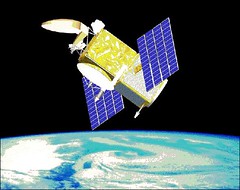
It has nothing to do with Wes Craven and is not nearly as scary as it sounds: new details have been released about the Jason-2 (Joint Altimetry Satellite Oceanography Network) satellite set to be launched from Vandenberg AFB in October 2008. In a demonstration of international cooperation in global warming research, the Japan Aerospace Exploration Agency is working with the French company CNES on the project:

The science objectives of Jason-2/OSTM are to extend the time series of ocean surface topography measurements to: a) obtain a continuous record of observations (with the previous missions), b) to determine the variability of ocean circulation at decadal time scales from combined data record with T/P and Jason, c) improve the measure of the time-averaged ocean circulation, d) improve the measure of global sea-level change, and e) improve open ocean tide models.

The mission objectives call for the provision of the same measurement accuracy of Jason (3.3 cm) with a goal of achieving 2.5 cm, and to maintain the stability of the global mean sea level measurement with a drift less than 1 mm/year over the life of the mission. The overall goal is to better understand the forces behind global changes of climate and to predict seasonal anomalies in weather patterns; this is vital to understand the physics of the ocean.

Jason-2 is scheduled to join Jason-1 in the same orbit with a 10 day repeat observation cycle. Both satellites will pass within minutes of each other over the same ocean surface, thus enabling verification and cross-calibration of the collected data. Together, they will provide a vital contribution to the expanding network of global ocean observations and their application in meteorology, operational oceanography and climate monitoring.


Spacewalk Success

Friday, June 2nd, 2006

Looks like the spacewalk we blogged about yesterday went off without a hitch. Almost.

ISS SpacwalkThe spacewalk took 6 1/2-hours, longer than expected, but nowhere near the record of eight hours and 56 minutes set in 2001.

"OK. We’re going out," Russian commander Pavel Vinogradov said at 6:48 p.m. EDT Thursday as he and U.S. flight engineer Jeff Williams exited the Russian side of the station in their bulky suits while the outpost soared more than 220 miles above Earth.

Vinogradov attached himself to the end of a boom that can extend to 50 feet and Williams maneuvered him to an area on the station where the Russian commander installed a new vent for a broken oxygen-generation system. At one point, the spacewalkers were bathed in a golden glow from a sunset over the Pacific Ocean. After the sun passed, the temperature got chilly.

"My feet are like ice," Williams joked in Russian when asked if he was cold. A Russian flight controller responded, "We need to put brandy into the system instead of water." 

No word on the brandy, but there was a pretty cool droid on board the ISS.

Google Goes Green

Friday, June 2nd, 2006

More interesting uses for Google Maps — the site that brought satellite imagery to your desktop — keep cropping up.

Google Goes GreenGoogle has launched its first mashup–a map-based Web site with information about earth-friendly locations in five of the U.S.’s top travel destinations.

The site, at maps.google.com/green, features information on and video tours of spots in San Francisco, Los Angeles, Las Vegas, New York and Orlando, Fla., as well as tips for "traveling green" during the summer using Google Maps. 

… Listings include the Las Vegas Natural History Museum and the Go Raw Cafe in Las Vegas, the Tree People park and EcoLimo in Los Angeles, the Skyscraper Museum and Central Park in New York, the Forever Florida nature preserve and Horse World Riding Stables in Orlando and, in San Francisco the Red Victorian Bed and Breakfast and the Exploratorium.

But I think my favorite is a non-official mashup called Placeopedia, which matches WikiPedia articles with their locations. You can add a place, or spend click around to various places, which is a great time-waster or way to take a vacation without leaving your desk.

Student Scientists to go to Rocket Launch

Thursday, June 1st, 2006

A couple of fifth grade students are going to see thier first rocket launch, and it’s a happy story of the internet community coming together to help a couple of fifth-graders who may be the next generation of rocket scientists

Here’s your chance to help do just that. Two fifth grade students from Indiana, Cameron Wade and Billy Shannon, both 11 years old, have an experiment that will launch onboard a suborbital NASA rocket. It’s part of a partnership between their school and NASA. The problem is, the grant they have doesn’t cover their own travel to Virginia to see the rocket launch!

They still want to go, of course. The trip will cost $3000, and they’re still $1000 from their goal.

And their experiment sounds pretty interesting. 

Young Rocket ScientistsTheir experiment is already in Virginia, waiting to be loaded onto the rocket. The students placed nuts and bolts screwed together in tiny bottles to see whether the vibrations from the rocket will break them apart.

They also sent up plant seeds, which they will plant this summer along with seeds that haven’t been airborne to see whether there is a difference in growth.

“They’re learning how to follow an experiment through,” Ghaffarian said. “They’re learning how to change the variables and see what happens, and it’s cool because … it makes it much more exciting than if you just buy a couple seeds and plant them.”

The nuts and bolts tie in with a unit the class did on robots and cars. The seeds work with lessons on extreme environments. Everyone in Ghaffarian’s third- through fifth-grade multiage class wrote essays that were judged by the school’s office staff on why they should be chosen for the Virginia field trip.

The good news? In less than a day, the money was raised

I am incredibly pleased and proud to announce that after just a few hours, BABloggers have donated more than $1000 to help the two fifth-graders and their teacher fly to Virginia to see their rocket launch!

… I just talked to Pamela Ghaffarian, the teacher, on the phone, and she was thrilled with how wonderful people have been to send her this money. She told me the two students, Cameron Wade and Billy Shannon, are really excited about the trip. I know they’re happy now, but wait until they actually see the launch! Even though it’s a small rocket, it’ll be really dramatic, and they’ll have the time of their lives.

And it might also inspire them to keep aiming high. Here’s to the science blogging community for coming together so quickly to help these students out!

Using Satellites to Track Human Rights Abuses

Wednesday, May 31st, 2006

We’ve written before about scientists using satellites to track climate change and uncover Mayan ruins. Now scientists and activists are using satellites for another purpose– to spot human rights abuses:

Satellite images captured under a pioneering program of the American Association for the Advancement of Science (AAAS) provide powerful evidence that the government of Zimbabwe has destroyed an entire settlement and relocated thousands of residents as part of a campaign against political opponents.

The images, analyzed by the AAAS staff, show two views of the settlement of Porta Farm, located just west of the Zimbabwean capital of Harare. The first, an archived image from June 2002, shows an intact settlement with more than 850 homes and other buildings; an estimated 6,000 to 10,000 people lived in Porta Farm at the time. The second photo, taken by satellite on 6 April this year, shows that the settlement has been leveled.

The pictures were released Wednesday 31 May as central evidence in a report compiled by the international secretariat of Amnesty International in London and Zimbabwe Lawyers for Human Rights (ZLHR), based in Harare. The report, “Shattered Lives: The Case of Porta Farm,” views the destruction of the settlement and the forced relocation of its residents as emblematic of a broad campaign by the government of President Robert Mugabe to repress political opposition.

(Via Kottke.) 

Nearest Black Hole: Inside Pluto’s Orbit

Wednesday, May 31st, 2006

Reading about a new satellite in New Scientist, set to launch in 2007, that could help us study the 4th dimension by analyzing gamma-ray bursts:

Bursts of high-energy gamma-rays from the deaths of massive stars may reveal whether the universe contains extra dimensions (Illustration: Dana Berry, SkyWorks Digital)

Charles Keeton, a physicist at Rutgers University in New Jersey, U.S.,  and colleague Arlie Petters at Duke University in North Carolina, U.S., have calculated how many of these tiny black holes should exist – and how they might be detected – according to an offshoot of string theory.
 
The theory they use, called the Randall-Sundrum braneworld model, proposes that the 3D universe we live in is floating within a larger universe with an extra spatial dimension.
 
They based their calculations on black holes that each contain only the mass of a small asteroid. Assuming these objects make up 1% of the mass of nearby dark matter – whose existence can only be detected through its gravitational effects on normal matter – the team says there could be several thousand black holes in the solar system. And not only that: "The nearest ones would lie well inside Pluto’s orbit," says Keeton.
 

Even NASA is calling this “extreme physics,” which has a nice ring to it. 

We’ve covered this type of  topic before – we like anything having to do with anti-gravity, anti-matter and the “theory of everything.”

Which Way are We Going? Voyager May Provide Clues

Wednesday, May 31st, 2006

Consider this your mid-week 70s flashback. Science Daily reports that the two Voyager spacecraft are still sending back useful data to NASA scientists nearly 30 years after their launch — and they’re providing clues to better understanding both the heliosphere and the direction of our solar system through local space:

 The heliosphere, generated by the Sun, is sort of the cocoon in which the solar system rides. It has been suspected for several years that it is not spherical but more egg shaped. Voyager 1 recently reached one edge and it is estimated it will pass into interstellar space at about 12.4 billion miles from the Sun. It was recently announced that Voyager 2 has reached its more southerly edge, sooner than expected. It is now believed it will reach interstellar space at about 10.5 billion miles. This reveals that the heliosphere is not a sphere after all, but is more of a comet shape.
According to Cal Tech’s Ed Stone, the former director of NASA’s Jet Propulsion Laboratory and a Voyager chief scientist, the shape of the bubble is determined by what is pressing on the solar system from the outside, meaning the shape and force of interstellar gases. That is one explanation. Another put forth by Walter Cruttenden of the Binary Research Institute is that local gases are fairly uniform and the shape derives from the trajectory of the solar system through local space — possibly in its orbit around a companion star. While this latter explanation is far more speculative, it is not unlikely that local interstellar gases are relatively homogeneous and therefore the shape of the heliosphere may be at least partially due to motion of the solar system.


Amazingly, both Voyager spacecraft are expected to remain active for several more decades. Which is more than can be said for many other artifacts of the 70s. 

Roomba on the Moon?

Tuesday, May 30th, 2006

Saturn’s moon, that is. The first intelligent beings we know of in space (besides us, if we count) may be the ones we make ourselves. If this New York Times article is to be believed, scientists basically want to attach a blimp to a Roomba and send it to one of Saturn’s moons. 

Titan

A future space mission to Titan, Saturn’s intriguing moon enveloped in clouds, might deploy a blimp to float around the thick atmosphere and survey the sand dunes and carved valleys below.

… Until recently, interplanetary robotic explorers have largely been marionettes of mission controllers back on Earth. The controllers sent instructions, and the spacecraft diligently executed them.

But as missions go farther and become more ambitious, long-distance puppetry becomes less and less practical. If dumb spacecraft will not work, the answer is to make them smarter. Artificial intelligence will increasingly give spacecraft the ability to think for themselves.

… HAL, the soulful conversationalist at the helm of the spaceship in "2001: A Space Odyssey," is not on the drawing board. The work so far has been more along the lines of Roomba, the robotic vacuum cleaner, with autonomy to perform certain specific tasks.

Interesting. Just about everybody his brother has hacked a Roomba and/or blogged it. I guess the AI techs at NASA will get their crack at doing the same. 

XM Radio Helix

Friday, May 26th, 2006

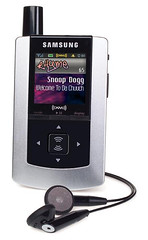
Uh oh. It looks like XM satellite radio is about to have even more legal trouble with RIAA. I blogged a while back about how RIAA filed a lawsuit against XM over the alleged ability of XM’s Inno player to not only play music but also record it.  Well, the news about XM’s new Samsung Helix player may be likely to strengthen the RIAA’s case — it records music too. If you hear a song and right in the middle decide to recort it, the Helix records it, from the beginning. 

Samsung Helix

TO be filed under Best Ideas of the Year: Imagine a tiny music player, smaller than an iPod, that’s also an XM satellite radio receiver. When you hear a song you like — even if it’s halfway over — one press of a button records it from the beginning.

Meet the Samsung Helix (and its twin, the Pioneer Inno): a tiny, well-designed $400 radio that not only lets you enjoy satellite radio in the car, at home or when you’re jogging, but also plays back your own MP3 files and up to 750 songs that you’ve recorded from the satellites.

… Now, not everybody is happy about this feature of the Helix and its Pioneer sibling. XM, which was largely responsible for the design of both players, has been sued by the increasingly busy lawyers of the Recording Industry Association of America. They’re calling the design of these players a tool for copyright infringement.

Or not. It turns out that you can’t do much more with the music you record on the Helix than listen to it on the device. You can’t export it to a computer or another MP3 player. You can’t burn it to a CD, at least not before you download from a pay service like Napster. And since it’s music you already payed to listen to via XM, if you download it you’re actually paying for it twice

So maybe this doesn’t bolster RIAA’s case much. Then again, maybe it’s the price that’s bothering them. They’re asking $150,000 per song in their lawsuit. But to doanload a song you "bookmark" on the Helix is only going to cost you $1.