Archive for the ‘Satellites’ Category

Taepodong Tease

Tuesday, June 20th, 2006

While the U.S. is in the midst of a major naval exercise in the Pacific, near Guam, North Korea has reportedly fueled up a Taepodong missile and is ready to light the fuse.

Among the three U.S. aircraft carrier groups, 30 warships, 280 aircraft and 22,000 soldiers taking part in the naval exercises is the USS John McCain. The exercises, "Valiant Shield 2006," marks the first time a Chinese delegation is observing.

Now is not the best time to test an ICBM over the Pacific. You know Japan is not happy about it and has made it known. They’re still upset about the 1998 missile test.

As reported by the AP:

This is an Orbview-3 satellite image provided by GeoEye showing the Taepodong missile launch complex in North Korea, called Musudan-ri, in May 2006. North Korea referred to its missile program Monday, June 19, 2006 in its official media for the first time since it apparently began preparations for a test launch, as a U.S. official confirmed the North has completed fueling a missile that is poised to fire.


China to the Moon … Again

Tuesday, June 20th, 2006

A couple of months ago, I posted about China’s space program (and NASA’s interest in it).

Well, China’s back in the news with plans for moon exploration. Or, rather, the major news media has caught on to China’s lunar ambitions.


A top official in China’s space program has set 2024 for the country’s first moonwalk, a Hong Kong newspaper reported on Monday, cementing its position as a new space power.

The mission would kick off in earnest next year, the Beijing-backed Wen Wei Po paper said, when China launches an unmanned lunar satellite in March or April to orbit and survey the lunar surface.

"China now basically possesses the technology, materials and the economic strength" to put a man on the moon, the paper quoted the official as saying.

Of course, if you’ve been reading this blog, this is kind of old news. A couple of months old, anyway.

KazSat-1 Satellite Launched

Tuesday, June 20th, 2006

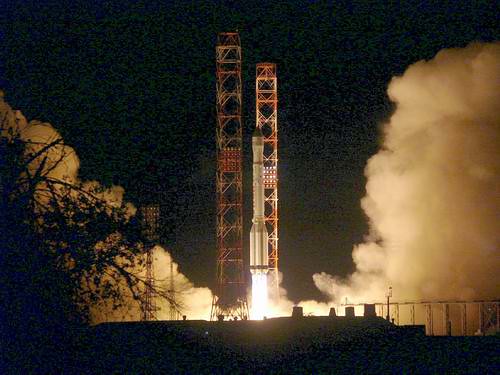
Kazakhstan launched its first communications satellite on 18 June

KazSat-1 Launch

2006 from the Baikonur Cosmodrome. The launch was personally seen by Kazakh president Nursultan Nazarbayev, who invited 18 leaders from media and communications in Russian and Kazakhstan.

The satellite’s advantages will provide for greater communications autonomy and security for the vast Kazakh steppes and new industrial development in the entire region.

The Great Kazoo

Contrary to some rumors among the space cadets, they did not adopt Kazoo from The Flintstones as their mascot.


Spaceports Abound

Friday, June 16th, 2006

Do you know the way to your friendly neighborhood spaceport? Yeah, me neither. If you’re like me you probably had to first ask “what’s a spaceport?”. Well, the commercial space travel industry is heating up and spaceport — where commercial spacecraft launch, I guess — are popping up all over the place. And if you live in Oklahoma, there may be a spaceport coming to your neighborhood.

Oklahoma Spaceport

The Federal Aviation Administration has given its OK for commercial spaceflight operations at Oklahoma’s spaceport, a former military air base that is expected to begin hosting test flights of a new suborbital spacecraft next year.

“We are the planet’s newest gateway to space,” Bill Khourie, executive director of the Oklahoma Space Development Authority, told MSNBC.com after the FAA’s announcement on Tuesday.

The launch site operator license, issued Monday, gives Oklahoma an edge in the nascent space tourism industry — a market also being targeted by California, New Mexico, Florida and even Wisconsin, as well as Singapore and the United Arab Emirates. However, the FAA’s Office of Commercial Space Transportation would have to issue separate licenses to companies wishing to operate from Oklahoma.

With the Oklahoma spaceport scheduled to start an extensive test site schedule in 2007, one already operating in the Mojave, and activity picking up at the New Mexico site, I have jut one question. Is living near a spaceport anything like living near an airport?

Staring into the Sun

Thursday, June 15th, 2006

You’ve heard it since high school. Staring into the sun is bad for your eye. Fortunately, you now have a satellite to do it for you, and even take pictures. I happened across this MetaFilter thread about the TRACE, the Transitional Region and Coronal Explorer, and discovered a treasure trove of photographs shot by the satellite. Kinda like this one.

Solar Flair

TRACEBuilt and launched in April of 1998, on a mission to enable scientists to "study the connections between fine-scale magnetic fields and the associated plasma structures on the Sun in a quantitative way by observing the photosphere" (whatever that means) the satellite isn’t exactly new. But it took its millionth picture of the sun back in October of 1999. So it’s a great source of photographs that make great wallpaper for your desktop your IM profile, as well as movies that just make interesting viewing.

Hawking: We Gotta Get Out of This Place

Wednesday, June 14th, 2006

Blaring in an above-the-fold headline on the Drudge Report yesterday and making its way around the blogosphere today is world-renowned astrophysicist Stephen Hawking’s statement during a press conference that humans must colonize space to survive. The AP reports:

 Humans could have a permanent base on the moon in 20 years and a colony on Mars in the next 40 years, the British scientist told a news conference.

"We won’t find anywhere as nice as Earth unless we go to another star system," added Hawking, who arrived in Hong Kong to a rock star’s welcome Monday. Tickets for his lecture planned for today were sold out.

He added that if humans can avoid killing themselves in the next 100 years, they should have space settlements that can continue without support from Earth.

"It is important for the human race to spread out into space for the survival of the species," Hawking said. "Life on Earth is at the ever-increasing risk of being wiped out by a disaster, such as sudden global warming, nuclear war, a genetically engineered virus or other dangers we have not yet thought of.”

The 64-year-old scientist — author of the global bestseller A Brief History of Time — uses a wheelchair and communicates with the help of a computer because he suffers from a neurological disorder called amyotrophic lateral sclerosis, or ALS.

Hawking said he’s teaming up with his daughter to write a children’s book about the universe, aimed at the same age group as the Harry Potter books.


Cisco Getting Into Satcom

Monday, June 12th, 2006

Israel’s Globes Online reports Gilat’s SkyEdge technology, having met Cisco’s development criteria, will be incorporated into enterprise routers, helping customers with voice, video, data and wireless communications transmission over high speed satellite networks.

Gilat CEO and president Amiram Levinberg said, “Teaming with Cisco in developing and marketing interoperable networking solutions truly differentiates Gilat in the VSAT market and shows our commitment to provide our customers with an edge beyond the latest technology, via its cooperation with market leaders. We believe Cisco’s interest to add satellite communication capability into its enterprise routers is good news for the satellite industry in general as it expands the addressable market for satellite communication technology and services.”

Gilat’s U.S. subsidiary Spacenet is selling Cisco-compatible network modules today. Glad to see their technology is getting traction in the U.S.

I like their fruity video.

Above the Clouds

Monday, June 12th, 2006

More pictures from space. This time it’s NASA using satellites to look inside storm clouds, in order to predict how much water they hold and how much might fall.

CloudSat

The first images from a $217 million satellite project to measure the moisture content of clouds provided breathtaking views of storms on Earth, scientists said.

“For the first time we’re seeing inside the clouds,” said Graeme Stephens, a Colorado State University atmospheric sciences professor and the principal investigator for the CloudSat project. “We can see tropical storms 15 kilometers deep organized on scales of thousands of kilometers across.”

CloudSat, a formation of five satellites launched April 28, was developed by CSU researchers in conjunction with other agencies to determine the moisture content of clouds, in the hope of developing long-term precipitation models.

“We want to know how much water is in the sky so we can see how much water falls,” Stephens said.

The spacecraft are 438 miles above the Earth.

NASA, of course, has the latest photos.

Satellite Broadband Activity

Sunday, June 11th, 2006

NRTC Welcomes New WildBlue Providers HERNDON, Va.

HERNDON, Va., June 9 /PRNewswire/ — Today, WildBlue Communications, Inc. announced agreements with satellite television providers DIRECTV, Inc. and EchoStar Communications Corporation (DISH Network) to distribute WildBlue satellite Internet access.

The National Rural Telecommunications Cooperative (NRTC) welcomes the efforts of these national providers to bring broadband Internet access to rural America.

"Beginning in 2002, NRTC and our members invested in WildBlue because we knew it would be a great service and would meet a critical need," said Bob Phillips, NRTC’s president and CEO, and member of the WildBlue Board of Directors. "NRTC members proved the benefit of the WildBlue business during its first year of operations. It is gratifying to see companies like EchoStar and DIRECTV recognize the value of such a great and needed product."

During much of the first year of WildBlue service availability, NRTC- member electric and telephone rural utilities have been the primary distributors of WildBlue satellite Internet service, bringing access to news, information and entertainment that was previously unavailable to many rural residents, and serve nearly 40,000 of the 60,000 current WildBlue subscribers.

"While WildBlue continues to expand our wholesale distribution network, we recognize the current and long term value of the NRTC membership in our distribution efforts," said Dave Leonard, WildBlue’s CEO. "NRTC has and will continue to play a vital role in the delivery of satellite broadband to rural America. WildBlue remains committed to the success of the NRTC member distribution effort."

"Our members are pioneers who have historically recognized the importance of bringing much-needed telecommunications solutions to rural America," continued Phillips. "They see a need and fill it early. Our members were instrumental in launching and distributing DIRECTV satellite television service, and for the last year they have filled an equally important role as the primary distributors of WildBlue. NRTC members are known and trusted service providers in their communities and will continue to fill this valued role by providing their core utility services as well as important diversified services such as WildBlue."

About NRTC

NRTC leads and supports more than 1,300 member organizations by delivering telecommunications solutions to strengthen member business, promote economic development, and improve the quality of life in rural America. The rural utilities that make up NRTC offer services to more than 30 million rural households in the United States. For more information, visit http://www.nrtc.coop.
National Rural Telecommunications Cooperative

Web site: http://www.nrtc.coop/

Sirius to Add Fourth, Geostationary Satellite

Friday, June 9th, 2006

Is Sirius looking to expand its product offerings? That’s the question that lingers between the lines in yesterday’s news reports that Sirius has agreed to a $260 million contract with Space Systems/Loral to launch a fourth satellite:

 Loral Space & Communications Ltd.’s (LORL) Space Systems/Loral unit, which built Sirius’s three existing in-orbit satellites and a fourth back-up satellite in storage, is constructing the new satellite – the FM-5. It is slated for completion in the fourth quarter of 2008. Once completed, the satellite will be launched on a Proton rocket under an existing contract with International Launch Service.

Sirius said the new satellite will help enhance overall coverage, particularly for stationary applications at home or in the office. Unlike the company’s current satellites, which travel in a figure-eight pattern above and below the equator that is known as an "elliptical geosynchronous orbit," the FM-5 will stay in a fixed position above the earth – a "geostationary orbit." Sirius said having a satellite in the different orbit will complement existing coverage. Rival XM Satellite Radio Inc. (XMSR) has all of its satellites in geostationary orbits.

With this new satellite, Sirius and XM will have the same number of satellites. XM is currently building a fourth satellite that is expected to launch in the second half of the year. It also has a spare under construction that is scheduled to be completed by the end of 2007.

A good explanation of how Sirius’ current satellite system works can be found here. Bell Labs did some work for Sirius (see here), and the question on analysts’ minds is whether the new geosynchronous satellite signals (no pun intended) an intention by Sirius to move into the market of providing video as well as radio to cars and buses. 

Time will tell.