Archive for 2006

Student Scientists to go to Rocket Launch

Thursday, June 1st, 2006

A couple of fifth grade students are going to see thier first rocket launch, and it’s a happy story of the internet community coming together to help a couple of fifth-graders who may be the next generation of rocket scientists

Here’s your chance to help do just that. Two fifth grade students from Indiana, Cameron Wade and Billy Shannon, both 11 years old, have an experiment that will launch onboard a suborbital NASA rocket. It’s part of a partnership between their school and NASA. The problem is, the grant they have doesn’t cover their own travel to Virginia to see the rocket launch!

They still want to go, of course. The trip will cost $3000, and they’re still $1000 from their goal.

And their experiment sounds pretty interesting. 

Young Rocket ScientistsTheir experiment is already in Virginia, waiting to be loaded onto the rocket. The students placed nuts and bolts screwed together in tiny bottles to see whether the vibrations from the rocket will break them apart.

They also sent up plant seeds, which they will plant this summer along with seeds that haven’t been airborne to see whether there is a difference in growth.

“They’re learning how to follow an experiment through,” Ghaffarian said. “They’re learning how to change the variables and see what happens, and it’s cool because … it makes it much more exciting than if you just buy a couple seeds and plant them.”

The nuts and bolts tie in with a unit the class did on robots and cars. The seeds work with lessons on extreme environments. Everyone in Ghaffarian’s third- through fifth-grade multiage class wrote essays that were judged by the school’s office staff on why they should be chosen for the Virginia field trip.

The good news? In less than a day, the money was raised

I am incredibly pleased and proud to announce that after just a few hours, BABloggers have donated more than $1000 to help the two fifth-graders and their teacher fly to Virginia to see their rocket launch!

… I just talked to Pamela Ghaffarian, the teacher, on the phone, and she was thrilled with how wonderful people have been to send her this money. She told me the two students, Cameron Wade and Billy Shannon, are really excited about the trip. I know they’re happy now, but wait until they actually see the launch! Even though it’s a small rocket, it’ll be really dramatic, and they’ll have the time of their lives.

And it might also inspire them to keep aiming high. Here’s to the science blogging community for coming together so quickly to help these students out!

Spacewalk On, Caddy Off

Thursday, June 1st, 2006

I wrote earlier about the amount of debris in outerspace. Well, there’s one bit of debris that we won’t be adding to what’s already up there. 

Thursday’s 5 1/2-hour spacewalk by the Russian and U.S. occupants of the International Space Station will not include the previously announced attempt to hit a radio transmitting golf ball into Earth orbit, The New York Times reported Wednesday. 

The publicity stunt involved the payment of an undisclosed amount of money to Russia from a Canadian golf company. Russian officials did not explain the reason for the postponement.

In place of the golf shot, the astronauts will replace a malfunctioning camera on the U.S. side of the ISS. 

The spacewalk, sans golf clubs, is on for 6:40pm.

Via Marsblog.  

Using Satellites to Track Human Rights Abuses

Wednesday, May 31st, 2006

We’ve written before about scientists using satellites to track climate change and uncover Mayan ruins. Now scientists and activists are using satellites for another purpose– to spot human rights abuses:

Satellite images captured under a pioneering program of the American Association for the Advancement of Science (AAAS) provide powerful evidence that the government of Zimbabwe has destroyed an entire settlement and relocated thousands of residents as part of a campaign against political opponents.

The images, analyzed by the AAAS staff, show two views of the settlement of Porta Farm, located just west of the Zimbabwean capital of Harare. The first, an archived image from June 2002, shows an intact settlement with more than 850 homes and other buildings; an estimated 6,000 to 10,000 people lived in Porta Farm at the time. The second photo, taken by satellite on 6 April this year, shows that the settlement has been leveled.

The pictures were released Wednesday 31 May as central evidence in a report compiled by the international secretariat of Amnesty International in London and Zimbabwe Lawyers for Human Rights (ZLHR), based in Harare. The report, “Shattered Lives: The Case of Porta Farm,” views the destruction of the settlement and the forced relocation of its residents as emblematic of a broad campaign by the government of President Robert Mugabe to repress political opposition.

(Via Kottke.) 

Nearest Black Hole: Inside Pluto’s Orbit

Wednesday, May 31st, 2006

Reading about a new satellite in New Scientist, set to launch in 2007, that could help us study the 4th dimension by analyzing gamma-ray bursts:

Bursts of high-energy gamma-rays from the deaths of massive stars may reveal whether the universe contains extra dimensions (Illustration: Dana Berry, SkyWorks Digital)

Charles Keeton, a physicist at Rutgers University in New Jersey, U.S.,  and colleague Arlie Petters at Duke University in North Carolina, U.S., have calculated how many of these tiny black holes should exist – and how they might be detected – according to an offshoot of string theory.
 
The theory they use, called the Randall-Sundrum braneworld model, proposes that the 3D universe we live in is floating within a larger universe with an extra spatial dimension.
 
They based their calculations on black holes that each contain only the mass of a small asteroid. Assuming these objects make up 1% of the mass of nearby dark matter – whose existence can only be detected through its gravitational effects on normal matter – the team says there could be several thousand black holes in the solar system. And not only that: "The nearest ones would lie well inside Pluto’s orbit," says Keeton.
 

Even NASA is calling this “extreme physics,” which has a nice ring to it. 

We’ve covered this type of  topic before – we like anything having to do with anti-gravity, anti-matter and the “theory of everything.”

Which Way are We Going? Voyager May Provide Clues

Wednesday, May 31st, 2006

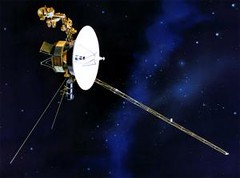
Consider this your mid-week 70s flashback. Science Daily reports that the two Voyager spacecraft are still sending back useful data to NASA scientists nearly 30 years after their launch — and they’re providing clues to better understanding both the heliosphere and the direction of our solar system through local space:

 The heliosphere, generated by the Sun, is sort of the cocoon in which the solar system rides. It has been suspected for several years that it is not spherical but more egg shaped. Voyager 1 recently reached one edge and it is estimated it will pass into interstellar space at about 12.4 billion miles from the Sun. It was recently announced that Voyager 2 has reached its more southerly edge, sooner than expected. It is now believed it will reach interstellar space at about 10.5 billion miles. This reveals that the heliosphere is not a sphere after all, but is more of a comet shape.

According to Cal Tech’s Ed Stone, the former director of NASA’s Jet Propulsion Laboratory and a Voyager chief scientist, the shape of the bubble is determined by what is pressing on the solar system from the outside, meaning the shape and force of interstellar gases. That is one explanation. Another put forth by Walter Cruttenden of the Binary Research Institute is that local gases are fairly uniform and the shape derives from the trajectory of the solar system through local space — possibly in its orbit around a companion star. While this latter explanation is far more speculative, it is not unlikely that local interstellar gases are relatively homogeneous and therefore the shape of the heliosphere may be at least partially due to motion of the solar system.


Amazingly, both Voyager spacecraft are expected to remain active for several more decades. Which is more than can be said for many other artifacts of the 70s. 

Roomba on the Moon?

Tuesday, May 30th, 2006

Saturn’s moon, that is. The first intelligent beings we know of in space (besides us, if we count) may be the ones we make ourselves. If this New York Times article is to be believed, scientists basically want to attach a blimp to a Roomba and send it to one of Saturn’s moons. 

Titan

A future space mission to Titan, Saturn’s intriguing moon enveloped in clouds, might deploy a blimp to float around the thick atmosphere and survey the sand dunes and carved valleys below.

… Until recently, interplanetary robotic explorers have largely been marionettes of mission controllers back on Earth. The controllers sent instructions, and the spacecraft diligently executed them.

But as missions go farther and become more ambitious, long-distance puppetry becomes less and less practical. If dumb spacecraft will not work, the answer is to make them smarter. Artificial intelligence will increasingly give spacecraft the ability to think for themselves.

… HAL, the soulful conversationalist at the helm of the spaceship in "2001: A Space Odyssey," is not on the drawing board. The work so far has been more along the lines of Roomba, the robotic vacuum cleaner, with autonomy to perform certain specific tasks.

Interesting. Just about everybody his brother has hacked a Roomba and/or blogged it. I guess the AI techs at NASA will get their crack at doing the same. 

Commercials on Your Cell?

Tuesday, May 30th, 2006

You had to know it was coming. As soon as your favorite television shows and events became available on your mobile phone, commercials couldn’t be too far behind.  This time, however, watching advertisements might pay off if you’re paying attention. 

Virgin Mobile USA plans to announce a way that people can talk for no money at all. They will, however, have to pay with a chunk of their attention.

The program, called SugarMama, lets people earn one minute of talking time by watching 30-second commercials on a computer or receiving text messages on their phones, then answering questions to prove they were, in fact, paying attention. 

Granted, we’re just talking text messages here, but how soon before full-fledged TV-style ads start coming to you via your mobile phone?

It’ll be interesting to see how well this pans out. Industry analysts suggest that anyone who’s "too cheap to buy a minute" probably can’t afford an Xbox (one of the products to be advertised), but Virgin says that the program will put a youth market that’s already inundated with advertisements "in control" of what they see and how they respond. 

The only problem I see is the unanswered question of just when and how often these advertisements arrive? it’s one thing to be interrupted by a phone call. It’s another to be interrupted by an advertisement?

Homemade Mobile

Friday, May 26th, 2006

Here’s one I’ve been saving for a DIY Friday. I didn’t believe it at first, but apparently there are people out there making their own mobile phones. And of course, in the age of the internet, they’ve inevitably found one another. 

Matt Hamrick hates standard-issue mobile phones almost as much as he loves tinkering with them to make them better.

The software security expert reckons he’s spent around $3,000 over the past two years trying to get his calendar and e-mail to sync between his Apple computer and his phone.

"The phones aren’t getting any better," he says. "I’ve been looking for a phone that would meet my requirements for 10 years now."

That quest gained new momentum this month when the Silicon Valley Homebrew Mobile Phone Club, a group Hamrick co-founded, attracted about 40 people to its first meeting.

The fledgling organization owes its name and inspiration to the famous Homebrew Computer Club of the 1970s, which many historians now credit with innovations that paved the way for the personal computing revolution. Members hope something equally climactic will arise from their new association.

Hamrick’s even written a manifesto of sorts for his movement, and there’s at least one more out there like it. I’m impressed with anyone who takes on the task of building their own mobile phone. After all, like most people (according to one of the manifestos), I’m still figuring out how to use the one I bought. 

In a recent phone conversation with a friend, I needed a phone number of a mutual acquaintance. My friend had the number in his mobile phone, but it took several minutes for me to convince him that he could review numbers stored there without hanging up. The sad part of this is that upon discussing the incident with friends who are responsible for the software in some phones, they laughed at what they viewed as "stupid user behavior." Tsk. tsk. If your phone software is so good, why do most of your customers persist in erroneous beliefs about it’s function?

Good question. I’m a bit further along than the guy who didn’t know he could view numbers without hanging up his phone, but I’m a little iffy on whether I can record numbers without hanging up phone. And I’ve never tried to synch it with anything either, though I’m sure I could. And I know it’s got voice dialing capabilities, but I haven’t figured out how to use that either. 

If these guys are modeled on the Homebrew Computer Club, maybe they’ll do for mobile phones what that group did for desktop innovation. And maybe I’ll use a few more functions on my phone.

XM Radio Helix

Friday, May 26th, 2006

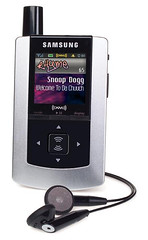
Uh oh. It looks like XM satellite radio is about to have even more legal trouble with RIAA. I blogged a while back about how RIAA filed a lawsuit against XM over the alleged ability of XM’s Inno player to not only play music but also record it.  Well, the news about XM’s new Samsung Helix player may be likely to strengthen the RIAA’s case — it records music too. If you hear a song and right in the middle decide to recort it, the Helix records it, from the beginning. 

Samsung Helix

TO be filed under Best Ideas of the Year: Imagine a tiny music player, smaller than an iPod, that’s also an XM satellite radio receiver. When you hear a song you like — even if it’s halfway over — one press of a button records it from the beginning.

Meet the Samsung Helix (and its twin, the Pioneer Inno): a tiny, well-designed $400 radio that not only lets you enjoy satellite radio in the car, at home or when you’re jogging, but also plays back your own MP3 files and up to 750 songs that you’ve recorded from the satellites.

… Now, not everybody is happy about this feature of the Helix and its Pioneer sibling. XM, which was largely responsible for the design of both players, has been sued by the increasingly busy lawyers of the Recording Industry Association of America. They’re calling the design of these players a tool for copyright infringement.

Or not. It turns out that you can’t do much more with the music you record on the Helix than listen to it on the device. You can’t export it to a computer or another MP3 player. You can’t burn it to a CD, at least not before you download from a pay service like Napster. And since it’s music you already payed to listen to via XM, if you download it you’re actually paying for it twice

So maybe this doesn’t bolster RIAA’s case much. Then again, maybe it’s the price that’s bothering them. They’re asking $150,000 per song in their lawsuit. But to doanload a song you "bookmark" on the Helix is only going to cost you $1.

Watching TV at 35,000 feet

Thursday, May 25th, 2006

Last week I was reading an article on the 2nd anniversary of the introduction of broadband Internet service on Lufthansa aircraft

The online, in-flight service — which has proven so popular that Lufthansa is now offering it on nearly 80% of its long-haul flights — is provided by Connexion by Boeing (CbB). The CbB system uses geosynchronous satellites to connect to the Internet, with a Wi-Fi hotspot on the aircraft itself. SES AMERICOM plays a critical role in delivering the airborne internet; Connexion by Boeing utilizes our AMC-23 satellite to provide high-speed access to customers flying over the Pacific Ocean. (AMC-23 was designed and specified in conjunction with CbB to provide Ku-band coverage of major air routes across the Pacific Ocean).

That satellite connection — and SES is proud to play a role in delivering it — is changing the way people travel, and becoming a “must have” amenity for many business travelers. One recent study conducted by Boeing found that:

  • 83 percent of those surveyed said that the availability of the Connexion by Boeing service will have an impact on future travel plans and their choice of airline carrier;
  • 94 percent said they plan to use the service again on a future flight;
  • 78 percent said that the service’s speed met or exceeded their expectations.

As for how people are using the service, the study found:

  • 90 percent of respondents said they accessed their work e-mail, most of whom use a virtual private (corporate) network;
  • 76 percent accessed their personal e-mail;
  • 69 percent said they browsed the Internet;
  • 41 percent engaged their friends and family via instant messaging or live chat applications.

Using IM and email to stay in touch with others while crossing the oceans is a great way to increase business productivity. But as I read the article and study about Lufthansa’s experience with Connexion by Boeing over the last two years, I was reminded of a personal experience I had on Lufthansa flight earlier this spring.

Because I travel so frequently,  and I like to stay connected with “hometown” news, I purchased a Slingbox device. Slingbox enables you to tune in to your TV service at home via the Internet. On this occasion, I was flying on an overnight Lufthansa flight to Luxembourg via Frankfurt, and had gotten online using CbB.

Like most business travelers, I initially got online to check my work email, and I spent some productive time catching up on business matters. But then I had a thought — I wondered if I could use CbB to connect to my Slingbox and to try tuning in the news program — from 35,000 feet. It worked!

“Tuning in at home” while over the North Atlantic was made possible by many technologies — twice by satellite. First, the video signal was carried by an AMERICOM satellite and downlinked by a cable operator in New York. Then, an AMERICOM satellite was used to provide Internet service to the aircraft. In between, there are the new technologies: the Slingbox and CbB. Oh, and of course, there’s the Internet.

That, to me, is what is truly amazing about the combination of satellite technology with the Internet. Productivity is nice, but being able to sit back and relax with your favorite local programming while flying across time zones — that’s the type of future we’ve long imagined. And thanks to satellite technology, that future is here. This really is rocket science.