Sirius to Add Fourth, Geostationary Satellite
Friday, June 9th, 2006Is Sirius looking to expand its product offerings? That’s the question that lingers between the lines in yesterday’s news reports that Sirius has agreed to a $260 million contract with Space Systems/Loral to launch a fourth satellite:
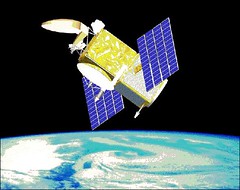
Loral Space & Communications Ltd.’s (LORL) Space Systems/Loral unit, which built Sirius’s three existing in-orbit satellites and a fourth back-up satellite in storage, is constructing the new satellite – the FM-5. It is slated for completion in the fourth quarter of 2008. Once completed, the satellite will be launched on a Proton rocket under an existing contract with International Launch Service.
Sirius said the new satellite will help enhance overall coverage, particularly for stationary applications at home or in the office. Unlike the company’s current satellites, which travel in a figure-eight pattern above and below the equator that is known as an "elliptical geosynchronous orbit," the FM-5 will stay in a fixed position above the earth – a "geostationary orbit." Sirius said having a satellite in the different orbit will complement existing coverage. Rival XM Satellite Radio Inc. (XMSR) has all of its satellites in geostationary orbits.
With this new satellite, Sirius and XM will have the same number of satellites. XM is currently building a fourth satellite that is expected to launch in the second half of the year. It also has a spare under construction that is scheduled to be completed by the end of 2007.
A good explanation of how Sirius’ current satellite system works can be found here. Bell Labs did some work for Sirius (see here), and the question on analysts’ minds is whether the new geosynchronous satellite signals (no pun intended) an intention by Sirius to move into the market of providing video as well as radio to cars and buses.
Time will tell.

 The science objectives of Jason-2/OSTM are to extend the time series of ocean surface topography measurements to: a) obtain a continuous record of observations (with the previous missions), b) to determine the variability of ocean circulation at decadal time scales from combined data record with T/P and Jason, c) improve the measure of the time-averaged ocean circulation, d) improve the measure of global sea-level change, and e) improve open ocean tide models.
 However, the storms’ outer bands are expected to pass close to one another and it’s anybody’s guess what will happen when they do.