Archive for 2006

Staring into the Sun

Thursday, June 15th, 2006

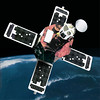
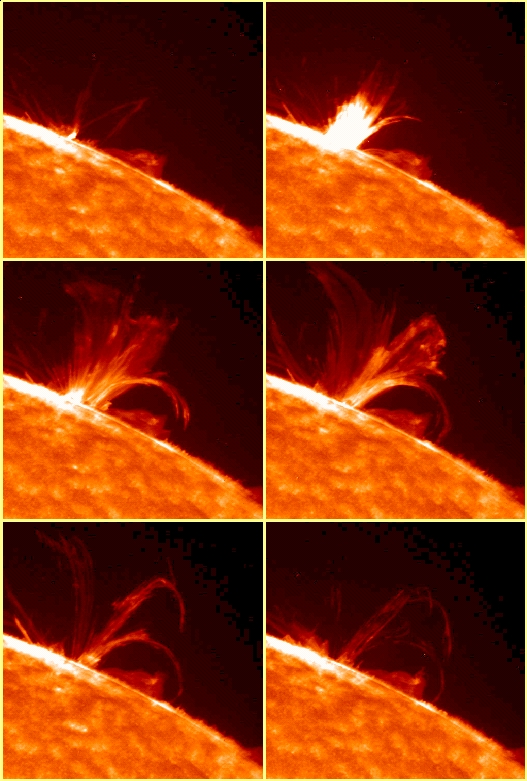
You’ve heard it since high school. Staring into the sun is bad for your eye. Fortunately, you now have a satellite to do it for you, and even take pictures. I happened across this MetaFilter thread about the TRACE, the Transitional Region and Coronal Explorer, and discovered a treasure trove of photographs shot by the satellite. Kinda like this one.

Solar Flair

TRACEBuilt and launched in April of 1998, on a mission to enable scientists to "study the connections between fine-scale magnetic fields and the associated plasma structures on the Sun in a quantitative way by observing the photosphere" (whatever that means) the satellite isn’t exactly new. But it took its millionth picture of the sun back in October of 1999. So it’s a great source of photographs that make great wallpaper for your desktop your IM profile, as well as movies that just make interesting viewing.

Hawking: We Gotta Get Out of This Place

Wednesday, June 14th, 2006

Blaring in an above-the-fold headline on the Drudge Report yesterday and making its way around the blogosphere today is world-renowned astrophysicist Stephen Hawking’s statement during a press conference that humans must colonize space to survive. The AP reports:

 Humans could have a permanent base on the moon in 20 years and a colony on Mars in the next 40 years, the British scientist told a news conference.

"We won’t find anywhere as nice as Earth unless we go to another star system," added Hawking, who arrived in Hong Kong to a rock star’s welcome Monday. Tickets for his lecture planned for today were sold out.

He added that if humans can avoid killing themselves in the next 100 years, they should have space settlements that can continue without support from Earth.

"It is important for the human race to spread out into space for the survival of the species," Hawking said. "Life on Earth is at the ever-increasing risk of being wiped out by a disaster, such as sudden global warming, nuclear war, a genetically engineered virus or other dangers we have not yet thought of.”

The 64-year-old scientist — author of the global bestseller A Brief History of Time — uses a wheelchair and communicates with the help of a computer because he suffers from a neurological disorder called amyotrophic lateral sclerosis, or ALS.

Hawking said he’s teaming up with his daughter to write a children’s book about the universe, aimed at the same age group as the Harry Potter books.


Teleport Falls on Troubled Times

Wednesday, June 14th, 2006

Times are tough for Staten Island’s famous high-tech Teleport, according to the Staten Island Advance.

Billed as one of the region’s most secure communications centers for businesses, the 100-acre corporate campus has faced scepticism– and recurring difficulty attracting tenants– since it first opened in the 1980s. A New York Times article from 1988 reports:

The root of the problem is that office development is the secondary focus of the Teleport, a joint venture of Merrill Lynch, the Port Authority of New York and New Jersey, the City of New York and the Western Union Corporation.

The project’s centerpiece is an 11-acre field dotted by 14 satellite dishes. A concrete parapet 50 feet high surrounds the field to reduce electronic interference, and fiber-optic cables beam the satellite transmissions to companies throughout the New York metropolitan region.

But companies have been slow to sign on. The Teleport, in the northwest corner of Staten Island, about eight miles southwest of the ferry to Manhattan, has suffered from a stigma of being too far off the track. Although modest bus service exists, the Teleport is essentially a suburban project designed around the automobile.

For top executives of Manhattan companies with employees who rely on mass transit, the automobile orientation has killed the Teleport as a potential site for computer or back-office operations.

10 years later, during the dot-com boom, the Teleport was at the height of its success and occupancy rate– in large part because of the secure satellite and landline communication facilities it offered. The future looked bright for the "Teleport" model:

The Teleport Communications Group…  built a satellite "infield" in the park that connected to a master control center. The center operates a fiber-optic network connecting all the new buildings in the teleport park and extends into Manhattan and Brooklyn. Primarily, the infrastructure allows companies to operate their mainframe data centers or have secure sites for servers and vital network equipment.

The Port Authority began to promote the unique characteristics of the world’s very first teleport to businesses that required access to broadband communications. It’s $70 million gamble has paid off and continues to deliver dividends. Today there are five fully leased buildings at the Staten Island site with rent above market rates. More than 2,100 people are employed in new jobs at the teleport, in industries including computer operations, communications, security, building services, back office functions and telecommunications.

The New York City teleport model is being followed in cities worldwide. In fact, experts say there may be as many as 200 of these new ports in existence by the year 2005.

But now, according to the Staten Island Advance, the Teleport looks less like the future than it does a ghost town:

Industry experts and developers say the troubling numbers here are skewed by the Port Authority-managed Teleport in Bloomfield, which recently lost its signature satellite dishes and where two buildings are completely empty. The worker population has dropped from a high of more than 3,000 in the late 1990s to 1,000 today.

New investments are being made to keep the Teleport’s high-tech infrastructure up to date. But will that be enough to lure companies back out to Staten Island?

Only time will tell. 
 

Electronic Paper… Will it keep my desk neater?

Tuesday, June 13th, 2006

New technology changes the way we do business every day.  Take a technology like e-paper (below), add an internet connection (wi-fi of course) and some writing recognition software and you have a computer that fits in a file folder. Or at a minimum you could read that 100-page contract without going blind using your Blackberry. –mfc

post below from http://blog.scifi.com/tech/

Epson develops new super-thin, flexible e-paper

Related Entries:  Future Tech : Portable Entertainment : Tech Briefs


epson_epaper_w.jpgEpson has developed new 7.1-inch piece of electronic paper that’s bendable and has a very respectable resolution of 1,536 x 2,048 pixels. Electronic paper is a thin material that acts as an electronic display, allowing for text and graphics to be displayed just like a screen, but with the image remaining when it’s powered off. Similar technology will be used in Sony’s oft-delayed portable Reader, and as the technology develops, more and more uses for it will undoubtedly be discovered. Epson’s new paper is less than half a millimeter thick and it’s also flexible, both said to be firsts for e-paper displays.
Rest in Space

Tuesday, June 13th, 2006

Humans have long imagined the stars as the place where loved ones reside after their deaths. Now the spiritual metaphor can become reality, thanks to a Japanese firm’s plans to give people a boost to heaven:

A venture business here is offering people the chance to get closer to space by launching a personal satellite business allowing customers to send ashes or photos of loved ones up into orbit for as long as 30 years.

The service is being provided by Yokohama-based firm Astro Research. The satellites are cube-shaped, measuring 25 cm to a side, inside which the memorabilia can be stored.

The satellites will be launched into space from overseas, and will orbit the earth at an altitude of between 600 and 800 kilometers for about 30 years. For several years customers will able to confirm their positions by radio….

But there is a catch — the price tag of the service is 100 million yen. For most people, that will make the cost of sending their memories into outer space astronomical. 

Sort of brings a whole new meaning to the notion that the deceased are looking down on you, now doesn’t it? 


Cisco Getting Into Satcom

Monday, June 12th, 2006

Israel’s Globes Online reports Gilat’s SkyEdge technology, having met Cisco’s development criteria, will be incorporated into enterprise routers, helping customers with voice, video, data and wireless communications transmission over high speed satellite networks.

Gilat CEO and president Amiram Levinberg said, “Teaming with Cisco in developing and marketing interoperable networking solutions truly differentiates Gilat in the VSAT market and shows our commitment to provide our customers with an edge beyond the latest technology, via its cooperation with market leaders. We believe Cisco’s interest to add satellite communication capability into its enterprise routers is good news for the satellite industry in general as it expands the addressable market for satellite communication technology and services.”

Gilat’s U.S. subsidiary Spacenet is selling Cisco-compatible network modules today. Glad to see their technology is getting traction in the U.S.

I like their fruity video.

Above the Clouds

Monday, June 12th, 2006

More pictures from space. This time it’s NASA using satellites to look inside storm clouds, in order to predict how much water they hold and how much might fall.

CloudSat

The first images from a $217 million satellite project to measure the moisture content of clouds provided breathtaking views of storms on Earth, scientists said.

“For the first time we’re seeing inside the clouds,” said Graeme Stephens, a Colorado State University atmospheric sciences professor and the principal investigator for the CloudSat project. “We can see tropical storms 15 kilometers deep organized on scales of thousands of kilometers across.”

CloudSat, a formation of five satellites launched April 28, was developed by CSU researchers in conjunction with other agencies to determine the moisture content of clouds, in the hope of developing long-term precipitation models.

“We want to know how much water is in the sky so we can see how much water falls,” Stephens said.

The spacecraft are 438 miles above the Earth.

NASA, of course, has the latest photos.

CGI Meteor Strike

Monday, June 12th, 2006

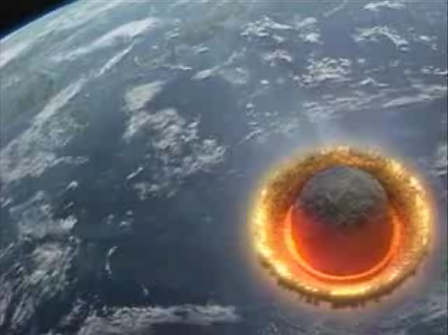
I posted earlier about Phil’s prediction that the earth probably wouldn’t have a date with a comet last month. And it looks like he was right. There is, however, a YouTube video showing what it might have looked like had Phil been right.

Meteor Strike 2

Okay, it’s probably not exactly like it would have been (the meteor in the CGI video looks much bigger than I think the theoretical comet would have been), but the video is still worth a look.

Being mono-lingual, I can’t tell what the announcer is saying. Can anyone translate? And how accurate is this video anyway?

Via TechEBLog.

Satellite Broadband Activity

Sunday, June 11th, 2006

NRTC Welcomes New WildBlue Providers HERNDON, Va.

HERNDON, Va., June 9 /PRNewswire/ — Today, WildBlue Communications, Inc. announced agreements with satellite television providers DIRECTV, Inc. and EchoStar Communications Corporation (DISH Network) to distribute WildBlue satellite Internet access.

The National Rural Telecommunications Cooperative (NRTC) welcomes the efforts of these national providers to bring broadband Internet access to rural America.

"Beginning in 2002, NRTC and our members invested in WildBlue because we knew it would be a great service and would meet a critical need," said Bob Phillips, NRTC’s president and CEO, and member of the WildBlue Board of Directors. "NRTC members proved the benefit of the WildBlue business during its first year of operations. It is gratifying to see companies like EchoStar and DIRECTV recognize the value of such a great and needed product."

During much of the first year of WildBlue service availability, NRTC- member electric and telephone rural utilities have been the primary distributors of WildBlue satellite Internet service, bringing access to news, information and entertainment that was previously unavailable to many rural residents, and serve nearly 40,000 of the 60,000 current WildBlue subscribers.

"While WildBlue continues to expand our wholesale distribution network, we recognize the current and long term value of the NRTC membership in our distribution efforts," said Dave Leonard, WildBlue’s CEO. "NRTC has and will continue to play a vital role in the delivery of satellite broadband to rural America. WildBlue remains committed to the success of the NRTC member distribution effort."

"Our members are pioneers who have historically recognized the importance of bringing much-needed telecommunications solutions to rural America," continued Phillips. "They see a need and fill it early. Our members were instrumental in launching and distributing DIRECTV satellite television service, and for the last year they have filled an equally important role as the primary distributors of WildBlue. NRTC members are known and trusted service providers in their communities and will continue to fill this valued role by providing their core utility services as well as important diversified services such as WildBlue."

About NRTC

NRTC leads and supports more than 1,300 member organizations by delivering telecommunications solutions to strengthen member business, promote economic development, and improve the quality of life in rural America. The rural utilities that make up NRTC offer services to more than 30 million rural households in the United States. For more information, visit http://www.nrtc.coop.
National Rural Telecommunications Cooperative

Web site: http://www.nrtc.coop/

AppleBerry Mashup

Friday, June 9th, 2006


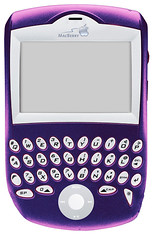
So what would an AppleBerry look like?

I’m not sure, but I decided to take a stab at designing one after reading Sebadoh’s post about the rumored collaboration between Apple and RIM, the makers of the Blackberry.

Click on the to the left to see a "full-size" version of the mashup. 

And if you you want to take a stab at designing the next "AppleBerry", send us a link or a file at [email protected] and we’ll post it here.