Archive for 2006

Bots on the Brain

Wednesday, June 21st, 2006

More robot-related news.

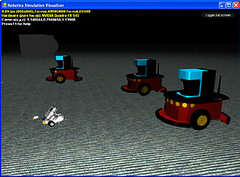
CNet has a gallery of screenshots from Microsoft’s just-announced Robotics Studio.

Robotics Studio

Meanwhile, Wired has write-up on RoboGames, which ends with a quote that sums up the point of getting kids to build robots and bang them into each other.

For [Dan] Albert, as with many of the roboticists who spoke to Wired News, events like RoboGames are about getting kids interested in science and technology. “You start kids out with entertainment, and they gravitate toward engineering as they want more control over their world,” he says.

Finally, though not specifically bot-related, Retrospectacle has an interesting post up about brain-machine interfaces. (Hint: think brain-powered space flight.)

Taepodong Tease

Tuesday, June 20th, 2006

While the U.S. is in the midst of a major naval exercise in the Pacific, near Guam, North Korea has reportedly fueled up a Taepodong missile and is ready to light the fuse.

Among the three U.S. aircraft carrier groups, 30 warships, 280 aircraft and 22,000 soldiers taking part in the naval exercises is the USS John McCain. The exercises, "Valiant Shield 2006," marks the first time a Chinese delegation is observing.

Now is not the best time to test an ICBM over the Pacific. You know Japan is not happy about it and has made it known. They’re still upset about the 1998 missile test.

As reported by the AP:

This is an Orbview-3 satellite image provided by GeoEye showing the Taepodong missile launch complex in North Korea, called Musudan-ri, in May 2006. North Korea referred to its missile program Monday, June 19, 2006 in its official media for the first time since it apparently began preparations for a test launch, as a U.S. official confirmed the North has completed fueling a missile that is poised to fire.


Microsoft Does the Robot

Tuesday, June 20th, 2006

Speculations, theories and predictions abound in the wake of Bill Gates’ announcement that he’s quitting his day job in a couple of years. Among the ideas being bandied about the blogosphere, the predicted end of software is the second most interesting.

Here’s the dilemma for Microsoft. It knows that the Webtop is coming. It knows that desktop applications and Web applications are going to become more and more indistinguishable. And it is making a play for that future with Windows Live and Office Live. But as an organization, it’s heart is just not in it. And why should it be?

Why? Well, I don’t know, but it’s a great lead-in to the first most interesting hint on Microsoft’s direction in a post-Gates world: robots.

Microsoft will announce today that it is launching a new effort to dominate the robot world. They will offer a software platform that could provide a foundation operating environment for robots.

Their motivation for the efforts,according to an announcement letter from Tandy Trower, General Manager, Microsoft Robotics Group,is, "We think robotics is poised to take off rapidly, and there are solid indications that this is true! With component hardware costs coming down and computational capabilities increasing, the robotics industry appears to have the right conditions to really grow quickly."

OK. So Microsoft isn’t building robots (yet?), but launching an effort to help people build robots is an interesting direction, and maybe a feasible one since there isn’t a "webtop" application for that. (Is there?)

Check out the Robot Gossip link for more info on what Microsoft’s up to (like funding a Center for Innovative Robotics at Carnegie Mellon) and specs on Robotics Studio.

China to the Moon … Again

Tuesday, June 20th, 2006

A couple of months ago, I posted about China’s space program (and NASA’s interest in it).

Well, China’s back in the news with plans for moon exploration. Or, rather, the major news media has caught on to China’s lunar ambitions.


A top official in China’s space program has set 2024 for the country’s first moonwalk, a Hong Kong newspaper reported on Monday, cementing its position as a new space power.

The mission would kick off in earnest next year, the Beijing-backed Wen Wei Po paper said, when China launches an unmanned lunar satellite in March or April to orbit and survey the lunar surface.

"China now basically possesses the technology, materials and the economic strength" to put a man on the moon, the paper quoted the official as saying.

Of course, if you’ve been reading this blog, this is kind of old news. A couple of months old, anyway.

KazSat-1 Satellite Launched

Tuesday, June 20th, 2006

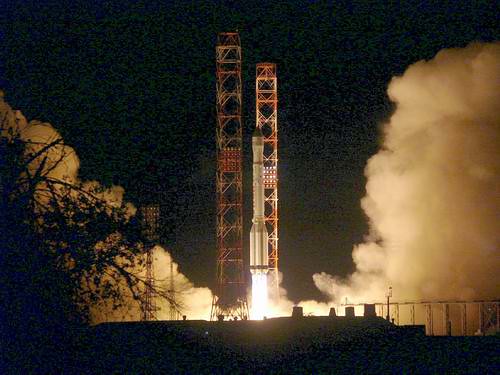
Kazakhstan launched its first communications satellite on 18 June

KazSat-1 Launch

2006 from the Baikonur Cosmodrome. The launch was personally seen by Kazakh president Nursultan Nazarbayev, who invited 18 leaders from media and communications in Russian and Kazakhstan.

The satellite’s advantages will provide for greater communications autonomy and security for the vast Kazakh steppes and new industrial development in the entire region.

The Great Kazoo

Contrary to some rumors among the space cadets, they did not adopt Kazoo from The Flintstones as their mascot.


Video Shows Meteoroid Hitting the Moon

Monday, June 19th, 2006

"There’s a new crater on the Moon. It’s about 14 meters wide, 3 meters deep and precisely one month, [sixteen] days old," NASA reports:

NASA astronomers watched it form: "On May 2, 2006, a meteoroid hit the Moon’s Sea of Clouds (Mare Nubium) with 17 billion joules of kinetic energy—that’s about the same as 4 tons of TNT," says Bill Cooke, the head of NASA’s Meteoroid Environment Office in Huntsville, AL. "The impact created a bright fireball which we video-recorded using a 10-inch telescope."

Lunar impacts have been seen before–"stuff hits the Moon all the time," notes Cooke–but this is the best-ever recording of an explosion in progress.


"The video plays in 7x slow motion; otherwise the explosion would be nearly invisible to the human eye. "The duration of the fireball was only four-tenths of a second," says Cooke.

Space Tourism Roundup

Monday, June 19th, 2006

Expanding on NooBee’s post (below) about the Oklahoma Spaceport, several pieces of news from last week are of interest to those closely following the growth of space tourism and its infrastructure.

"The Civil Aviation Authority of Singapore (CCAS) is laying the groundwork here for the rules to govern flights out of Spaceport Singapore, a planned $115 million (SGD $191 million) project to offer suborbital spaceflights and a host of other experiences to adventure-seeking tourists," Space.com reports: 

Slated to open in 2009, Spaceport Singapore is the brainchild of a consortium of investors and the Virginia-based adventure tourism firm Space Adventures, which announced the project – alongside plans for a United Arab Emirates spaceport and a fleet of suborbital Explorer spacecraft– earlier this year.

Space Adventures and its chief competitor, Virgin Galactic have disputed claims that they are in a "new space race" for tourist dollars. Nonetheless its difficult for observers to refrain from comparing their progress on both spacecraft and spaceports.

Or at least, it’s hard for us to refrain, and we read with interest news reports last week that the state of New Mexico has chosen a Los Angeles firm to design and engineer the new spaceport in the Land of Enchantment. 

Virgin Galactic also revealed design details of its SpaceShipTwo craft last week. Observers wonder
if changes to the craft’s rocket fuel and apogee indicate the possibility of Virgin Galactic pursuing point-to-point suborbital travel.

Finally, the company that bills itself as "the SouthWest Airlines of outer space" reports that one of its customers, Seattle-based ZG Aerospace, is offering to send business cards into space this summer for $50 each.

Who said space tourism wouldn’t be available to the masses? 

Spaceports Abound

Friday, June 16th, 2006

Do you know the way to your friendly neighborhood spaceport? Yeah, me neither. If you’re like me you probably had to first ask “what’s a spaceport?”. Well, the commercial space travel industry is heating up and spaceport — where commercial spacecraft launch, I guess — are popping up all over the place. And if you live in Oklahoma, there may be a spaceport coming to your neighborhood.

Oklahoma Spaceport

The Federal Aviation Administration has given its OK for commercial spaceflight operations at Oklahoma’s spaceport, a former military air base that is expected to begin hosting test flights of a new suborbital spacecraft next year.

“We are the planet’s newest gateway to space,” Bill Khourie, executive director of the Oklahoma Space Development Authority, told MSNBC.com after the FAA’s announcement on Tuesday.

The launch site operator license, issued Monday, gives Oklahoma an edge in the nascent space tourism industry — a market also being targeted by California, New Mexico, Florida and even Wisconsin, as well as Singapore and the United Arab Emirates. However, the FAA’s Office of Commercial Space Transportation would have to issue separate licenses to companies wishing to operate from Oklahoma.

With the Oklahoma spaceport scheduled to start an extensive test site schedule in 2007, one already operating in the Mojave, and activity picking up at the New Mexico site, I have jut one question. Is living near a spaceport anything like living near an airport?

DIY WiFi

Friday, June 16th, 2006

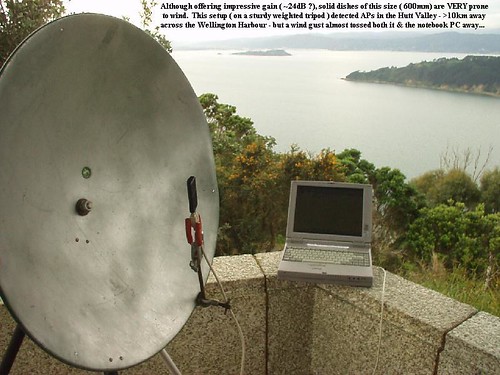
Here’s a few interesting bits about how to build your own antenna, for a DIY Friday. The first one, from Geekcorps Mali, is all about how to build your own antenna with a plastic bottle, using a design based on waveguide theory. Another offers even more detailed instructions. But I was still trying to figure out what one might use these antennae for (and what waveguide theory is) when I stumbled upon some well illustrated instructions on how to build "the poor man’s wifi."


I’m not sure I’ll ever try these instructions, but I had fun looking at the pictures of various wifi access devices made from little more than a USB adaptor and some Chinese cookware. 

Chaperone via Cellphone

Thursday, June 15th, 2006

Back in April, I blogged about Sprint’s GPS tracking package aimed at parents who want to keep better track of the cellphone-totting kids. Well, it’s a trend that seems to be catching on. Verizon just rolled out its own “chaperone” service.

Verizon on Monday introduced a new service aimed at parents who wish to keep track of where their children are through their cell phones. Additionally, the service will give children a way to easily contact their parents.

The “Chaperone” service would be provided in conjunction with the kid-friendly LG Migo, a cell phone designed for easy operation by even the youngest users. The system uses GPS capabilities built into the phone in order to track a child’s position.

The parent would be able to see where the phone is located from a map on the Verizon Web site. Additionally, parents can download a cell phone-based application that would perform similar functions, Verizon said.

… Another feature, called Child Zone, provides a service for parents where they would be alerted when the Migo phone leaves a predetermined area. The service would send a text message to the parent’s Verizon phone.

Linux News has screenshots of the locator screen for the Sprint plan, which give some idea of what parents on Verizon’s plan might see when logging on to make sure little Johnny or Susie comes straight home from soccer practice. It also quotes an industry analyst as suggesting that companies offer such services will need to set “realistic expectations for their customers.

LG Migo Phone

I still find myself wondering what other uses folks might find for this technology, like keeping tabs on straying spouses, etc. That the service requires use of Verizon’s LG Migo phone, which adults are unlikely to use, might reduce that threat. Of course, it would be easy enough to slip the phone into the purse, briefcase, car, etc., of the suspected spouse (or anyone else, for that matter) and keep track of their comings and goings while undetected. But, then again, there are already services that track anyone who has a cellphone, so perhaps that segment of the GPS market is already being served.