Archive for 2006

Verizon Airfone Grounded

Thursday, June 29th, 2006

Earlier this month, I blogged about JetBlue getting into the in-flight internet/phone business. Now, before the month is quite over, it looks like Verizon is getting out of the in-flight phone business.

Verizon Airfone will exit the in-flight phone business by the end of the year, a company spokesman confirmed Friday.

Airfone’s parent company, Verizon Communications, plans to focus its efforts more on its core business, said Jim Pilcher, a spokesman for Verizon Airfone.

Verizon was initially the favorite to win the FCC auction for the 800MHz spectrum for supplying broadband and phone services in-flight, but dropped out of the running early, which lead to the AirCell — a subsidiary of JetBlue — getting the license to use the spectrum.

Robot Roach Patrol

Wednesday, June 28th, 2006

Forget Raid. Forget Orkin. When you’re facing an infestation of pests, in this case roaches, your best bet might be a robot. This isn’t a new story, from what I can tell, but it’s popped back up in the last couple of days. And it’s an interesting one. Given that you can now have a robot keeping your house clean, why not have one keeping it roach-free?

In a breakthrough for the battle against mankind’s most diehard enemy – the cockroach – European scientists have hoodwinked a group of them into congregating in a place where they can be stamped on easily.

The kick in the mandibles comes from a Belgian-led team who spent three years developing a mini robot that can convince cockroaches to creep out of dark holes and gather in light places. The InsBot looks more like a pencil sharpener than a household pest, but it smells like a cockroach. Most importantly, the InsBot can pass for a Periplaneta Americana (American cockroach).

OK. Maybe you should keep the insecticide handy, since this model apparently just herds the roaches together for easier spraying/stamping. Still, as Technovelgy points out, it has interesting implications for creating more innovative forms of artificial intelligence. Technovelgy also has an interesting post up about a roach-controlled robot. And for good measure, here’s a link to the project itself.

UFO Threatens Space Station

Tuesday, June 27th, 2006

How’s that for a hyperbolic headline? It’s rooted in fact:

MOSCOW – An unknown floating object close to the International Space Station ISS has concerned ground control, according to reports from the US Space Agency NASA on Tuesday.

The object is approximately 2.8 kilometres away from the International Space Station, said the Russian flight control centre in Moscow, citing a NASA source.

The situation… does not yet require a dodge manoeuvre…..

“The object has no number in the list of space debris,” Kireyev said, according to reports from the Russian Itar-Tass agency.

“It is however probably an old piece of space exploration equipment.”

If the object gets any closer to the ISS, astronauts Jeff Williams and Pavel Vinogradov would have to take the precaution of moving to the rescue space shuttle Soyuz TM.

A dodge manoeuvre could cause difficulties for the docking of the US space ship “Discovery”, due to be launched on July 1.

Perhaps the astronauts should practice on this game.

Laptop Go Boom!

Tuesday, June 27th, 2006

We can’t vouch for the veracity of this, but it amused us to no end:

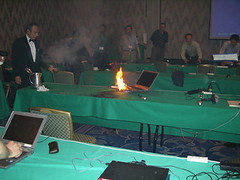
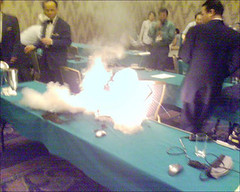
 AN INQUIRER READER attending a conference in Japan was sat just feet away from a laptop computer that suddenly exploded into flames, in what could have been a deadly accident.

Gaston, our astonished reader reports: "The damn thing was on fire and produced several explosions for more than five minutes"….

"It is only a matter of time until such an incident breaks out on a plane," he suggests.

Our witness managed to catch all the action in these amazing pictures.

"Fire extinguishers leave a mess on your suit and belongings; pack your stuff (if you can) and leave, leave, leave!" he advises.

We don’t have any further details of the model of the computer in question. In light of the evidence, however, we’d suggest you avoid actually using a laptop on your lap. 


The after-photo:


New Satellite Service By 2012?

Monday, June 26th, 2006

The FCC has proposed allowing new satellite service in the 17 and 24 gigahertz band spectrum — a proposal which, if passed, could add new competition to satellite radio and other emerging broadcast industries, Billboard Radio Monitor reports:

 In an email exchange with Billboard Radio Monitor, one high-level engineering source wrote that “the ‘Ka-Band’ frequencies (18 GHZ to 40 GHZ) usually suffer from extreme susceptibility to rain-out and fog failure conditions. On the plus side, the satellite antennas (up in orbit) can send more spot-area signals to different parts of the [continental U.S.], potentially creating individual market coverage signals, which can’t effectively be done at 2.3 GHZ.”

Radio Monitor sources and industry observers estimate that the shortest possible timetable for a new satellite service to make its way through the FCC, onto the launch pad and into space would be five or six years.

The FCC’s Notice of Proposed Rule Making (NPRM) for establishing a new satellite service was originally going to be part of the commission’s Open Meeting agenda but it was deleted at the last minute. Instead, the FCC’s commissioners handled the vote later in the day, with all five commissioners approving the NPRM.

An FCC press release about the Notice says the service “holds the potential of bringing a new generation of innovative satellite services to American consumers—providing a mix of video, audio, data and multimedia services to residential and business subscribers.”


Nix and Hyrda

Monday, June 26th, 2006

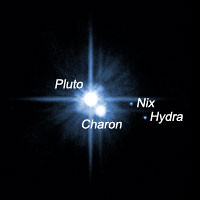
In other Hubble news (see the post below), a pair of small moons orbiting Pluto, first photgraphed by the Hubble Telescope in 2005, now have official names: Nix and Hyrdra.

"Nix and Hydra are roughly 5,000 times fainter than Pluto and are about two to three times farther from Pluto than its large moon, Charon, which was discovered in 1978," according to the official Hubble website.

Hubble’s ACS Camera Offline

Monday, June 26th, 2006

The Hubble Space Telescope’s Advanced Camera for Surveys (ACS) has been offline since June 19, Space.com reports:

ngineers have yet to figure out what caused the Advanced Camera for Surveys (ACS) to go into "safe mode," essentially a sleep state that prevents normal operations. But the outlook is bright.

"We’re very optimistic" that the camera will be fixed, said Ed Ruitberg, associate program manager for Hubble at NASA’s Goddard Space Flight Center.

Ruitberg told SPACE.com that some potential causes have been ruled out and that the problem is likely with a low-voltage power supply interface, something between the batteries and a camera component. If that’s the case, then redundant electronics can be relied on to bypass the problem area.

"We’re still investigating the problem and working on all sorts of contingencies," said Max Mutchler at the Space Telescope Science Institute (STScI) in Baltimore, where Hubble’s science operations are run. "We’re hoping for the best but preparing for other contingencies."

Space Daily also reports on Hubble’s troubles. 

We’ll keep you updated on the efforts to "wake up" the camera….

Mitex Launches Successfully

Friday, June 23rd, 2006

UPI files the report:

The Delta II rocket launched Wednesday at Cape Canaveral carried a pair of small satellites for the U.S. Defense Advanced Research Projects Agency (DARPA) Micro-Satellite Technology Experiment. The program looks into new spacecraft technologies that could be applied to future military space projects.

Boeing and its crew of subcontractors reported Thursday that the Delta II in its 7925-9.5 configuration performed flawlessly with the payload deploying some 30 minutes after launch in geostationary orbit more than 22,000 miles above the equator….

The rocket was equipped with nine GEM-40 solid-fuel booster rockets that augmented liftoff thrust to 850,000 pounds to which another 450,000 pounds was added three minutes downrange.


Mitex Launch Today

Thursday, June 22nd, 2006

The New Scientist reports:
The US military is preparing to launch two technology demonstration satellites on Wednesday, collectively known as the Micro-satellite Technology Experiment (Mitex).

The craft will launch aboard a Delta II rocket from Cape Canaveral Air Force Station, Florida, US. The launch window lasts from 1734 to 2134 EDT (2134 to 0134 GMT on 22 June).

The micro-satellites will test a range of technologies for the Defense Advanced Research Projects Agency (DARPA), the US Air Force and the US Navy. These include avionics, advanced communications, fuels that spontaneously ignite on contact, solar cells and new software. No further details of the technologies are available.

DARPA is interested in investigating the capabilities of small satellites, says DARPA spokesperson Jan Walker. One particular focus of the mission is reducing the mass of equipment by using lightweight materials….

he technologies could have been tested with a single satellite, but because the demonstrator mission has few back-up systems and little pre-flight testing, DARPA decided to split the payload in two to maximise their chances of success.

It’s not just small satellites being tested:

The mission will also be the first flight test of an experimental rocket upper stage for the US Naval Research Laboratory. The upper stage will lift the satellites on the final leg of their journey into geosynchronous orbit.

Some of stage’s new features include: lightweight titanium propellant tanks with internal propellant management devices; novel attitude control thrusters; and solar cells with three semi-conducting layers to more efficiently convert sunlight into electricity.

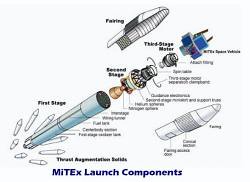
 A larger version of the Mitex launch components diagram can be found here.
 

GeoEye Awarded Airport Mapping Project

Thursday, June 22nd, 2006

There’s little doubt that satellite technology has transformed aviation. From the widespread use of GPS technology to the in-flight weather updates provided to pilots through services like XM Satellite Weather, satellite-delivered content and information has greatly increased the situational awareness of pilots and, in turn, made aviation safer.

Yet any gadget is only as useful as the underlying information, which is why the National Geospatial-Intelligence Agency (NGA) Stereo Airfield Collection program has awarded Dulles-based GeoEye a $3.7 million contract to image 365 airfields and produce Airport Mapping Databases (AMDB) over a 12-month period:

GeoEye is now the world’s largest developer of airport geospatial information support, terrain and obstacle databases with several hundred airfields mapped to date. Matt O’Connell, GeoEye’s president and chief executive officer said, "We are a leader in providing airport geospatial solutions to key customers like the NGA and the USAF at the best price and with the best performance in the industry."

An Airport Mapping Database is a geospatial database that contains significant features of an airport such as runways, taxiways, buildings, obstacles and terrain surrounding an airfield. This information supports the safe movement of aircraft and helicopters on runways and taxiways. These products can also be used to support training, mission or contingency planning and visual simulations for ordinary operations or crisis situations. GeoEye is uniquely positioned to fulfill this contract for North American and international airfields by virtue of its IKONOS satellite’s ability to generate a three-dimensional image from stereo data collected during a single orbital pass. The result is a three-dimensional map-accurate image of an airport that can be quickly and cost effectively acquired.