Archive for 2006

Happy Birthday, Mr. Tesla

Monday, July 10th, 2006

Tesla

If you’re reading this, chances are you’re doing so on a computer or laptop that’s plugged into an electrical outlet (or in the case of the latter, running on energy stored in its battery), so you should take a moment to thank the guy some say made it all possible. Nikola Tesla, born (according to A Blog Around the Clock) on this date, 150 years ago.

I have to admit that, although I knew Tesla’s name, I couldn’t claim to know much about his involvement with much of what I (and lots of others, I’m sure) take for granted about modern life. I haven’t often given much thought to who’s being the reality that I wake up in the morning in an air-conditioned house, turn on the lights, retrieve breakfast from the fridge and consume it while either sitting in front of the television or the computer.

Yet all of that’s possible due to alternating current; something Tesla contributed to developing. I had to do a bit of googling to find this PBS site devoted to Tesla, to learn that in fact the AC motor was among his inventions and that he’d patented some 20 different types of AC motors. And that’s not to even mention the radio and remote control. (Channel surfers of the world, we now know whom to thank.)

There’s a bit of irony in remembering Tesla’s birthday, as Archy points out. Tesla is credited with bringing electricity to the United States, of which he became a naturalized citizen. Yet, today many of the villages around his hometown have no electricity. But the occasion of his 150th birthday is bringing people together in Tesla’s homeland, and thus his memory may yet get the lights turned on again.

Monday Morning Videos

Monday, July 10th, 2006

Here’s a couple of videos to get your Monday started with a bang. Via Mars Blog, here’s a NASA video of the STS-121 solid rocket booster separating from the space shuttle. (Can’t view the video? Check out the Flickr photoset of the view from earth.)

Also, a little late for the 4th of July but fun to watch nonetheless, here’s a YouTube video of 30,000 bottle rockets launched in 2 minutes.

The Mystery at the Center of the Heart

Friday, July 7th, 2006

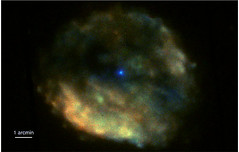
An amazing photo showing the aftermath of a 2,000-year-old star explosion reveals something never seen before: astronomers believe the blue dot at the center may be a neutron star, less than 20 kilometers wide. Space.com reports:

Embedded in the heart of a supernova remnant 10,000 light-years away is a stellar object the likes of which astronomers have never seen before in our galaxy.

At first glance, the object looks like a densely packed stellar corpse known as a neutron star surrounded by a bubble of ejected stellar material, exactly what would be expected in the wake of a supernova explosion.

However, a closer 24.5-hour examination with the European Space Agency’s XMM Newton X-ray satellite reveals that the energetic X-ray emissions of the blue, point-like object cycles every 6.7 hours—tens of thousands of times longer than expected for a freshly created neutron star.

It is behavior that’s more commonly seen in neutron stars that have been around for several million years, researchers say.

The mystery is fully explored in the July 7 issue of the journal Science


How to Deliver Goods to the International Space Station

Friday, July 7th, 2006

After performing a backflip to allow crewmembers of the International Space Station to inspect its belly (and to provide cool images for space fans everywhere), Discovery docked with the ISS yesterday.

The big item on the mission agenda today? Moving supplies

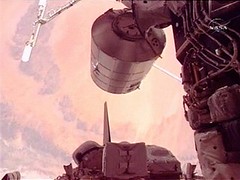
The astronauts moved a huge cargo container, nicknamed Leonardo, onto the space station by robotic arm. Among the goodies awaiting the space station crew were a new stationary bicycle for exercise, an oxygen generator that will eventually allow the space station to support six inhabitants, a machine that cools the station’s cabin air and a lab freezer for scientific samples…

For the first time in three years, the international space station had three crew members. European Space Agency astronaut Thomas Reiter joined Pavel Vingogradov and Jeff Williams, who marked their 100th day at the space station Friday.

The shuttle isn’t the only means of delivering supplies to the ISS, of course. Earlier this week, the European Space Agency announced the successful completion of acoustic testing on "Jules Verne," the first Automated Transfer Vehicle: 

The ATV, an unmanned vehicle that will deliver supplies to the International Space Station (ISS), will be put into orbit by the European Ariane-5 launcher. Acoustic testing is vital to ensure the ATV can withstand the vibrations caused by the extreme noise levels generated during launch.


Discovery’s Launch — From Any Angle

Thursday, July 6th, 2006

MSNBC has a cool interactive web page that allows you to watch Discovery’s July 4th from multiple camera angles. Click here to check it out.

Satellites Aid Voluntary High-Seas Trawling Ban

Thursday, July 6th, 2006

Here’s an interesting story out of the Indian Ocean:

In a global first, four major fishing companies announced today a voluntary halt on trawling in eleven benthic-protected areas in the southern Indian Ocean. This will protect and conserve the benthic and associated fish fauna and related biodiversity in one of the largest marine protected area enclosures ever.

By setting aside an area almost equal to Australia’s Great Barrier Reef National Park, these businesses are sending a clear signal that they want to keep fish on people’s plates for generations to come…

Using the scientific knowledge gathered over a decade of activity in the Indian Ocean and in consultation with staff of the Fisheries Department of the United Nations Food and Agriculture Organization (FAO), SIODFA have delimited 309 000 km2 of ocean floor in eleven separate benthic protected areas — a total zone with an area approximately the size of Norway — where their vessels will no longer fish. To verify compliance with these self-imposed restrictions, the companies will track their vessels’ locations and activities via a special satellite monitoring system.

We’ve written before about how scientists are using satellites to study ecosystems, land and water usage and climate change– but to the best of our knowledge, this is the first time we’ve heard of satellites being used for enforcement of voluntary conservation measures.

 
Do you know of any other examples? If so, please post them in the comment threads and we’ll highlight them here.

Bezos Goes Orbital

Wednesday, July 5th, 2006

There’s a new player in the tourism-fueled race for space.

As we mentioned back in FebruaryAmazon founder Jeff Bezos has been fueling Blue Origin’s New Shepard Reusable Launch system, according to Space.com.

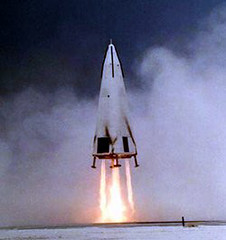
[The] Blue Origin rocket concept is patterned after the DC-XA that was operated by NASA and the Department of Defense under the Reusable Launch Vehicle program. The flight vehicle was tested at White Sands during the summer of 1996, and demonstrated a 26-hour turnaround between its second and third flights, a first for any rocket. 

Evidence that Blue Origin is moving forward with the project came when the company filed a draft Environmental Assessment with the FAA for the company’s launch site north of Van Horn, Texas:

The more than 200-page draft EA is a necessary step required by the FAA/AST for Blue Origin to get the needed permits and/or licenses to fly their rocket hardware.

Blue Origin proposes to launch its reusable launch vehicles (RLVs) on suborbital, ballistic trajectories to altitudes in excess of 325,000 feet (99,060 meters) from a privately-owned space launch site in Culberson County, Texas.

As outlined in the EA, the Blue Origin launch site would be approximately 25 miles (40.2 kilometers) north of Van Horn, Texas. It lies within a larger, privately-owned property known as the Corn Ranch. Access to the proposed launch site is from Texas Highway 54, which is approximately five miles (8 kilometers) west of the proposed project’s center of operations.

Also on the group’s to do list at the site is putting in place a vehicle processing facility, a launch complex and vehicle landing and recovery area, as well as an astronaut training facility, and other minor support amenities…

"The strategy is to build the New Shepard suborbital vehicle incrementally, starting with low-altitude tests, progressing to higher-altitude testing, and culminating with commercial flights. Early testing would use prototype vehicles that are smaller and/or less capable than the proposed final design," according to the Space.com report. 

Weekend Roundup

Wednesday, July 5th, 2006

We hope everyone enjoyed the long holiday weekend.

The big non-event of the weekend was the expected near-miss between 2004 XP14 and Earth on Monday:

A large asteroid hurtled harmlessly past the Earth early Monday at a distance of about 269,000 miles – slightly farther away than the moon.

Residents with telescopes in the United States and Canada had the best view of 2004 XP14, which appeared as a streaking dot in the northern sky.

Astronomers tracking the space rock’s path since its discovery in 2004 had determined that it would pose no risk to Earth during the encounter nor in the next 100 years. Judging by its brightness, 2004 XP14 was estimated to be a quarter-mile to a half-mile wide.

An asteroid that size, if it smashed into Earth, would probably cause regional destruction. Scientists have said it would take a mile-wide or larger asteroid to cause widespread devastation that could threaten civilization. 

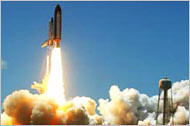
The big event that finally happened– on July 4th, no less–  was the successful launch of space shuttle Discovery yesterday:

The liftoff, right on schedule at 2:38 p.m., was the start of a 13-day flight that is the first in a year for the diminished shuttle fleet as NASA continues its efforts to resume more frequent human spaceflight.

The Discovery is to rendezvous on Thursday with the International Space Station, where it is carrying equipment, supplies and a fresh astronaut for the station’s crew.

But this is also considered the second and final test flight for the shuttle fleet since the loss of the Columbia and its seven astronauts in 2003, and the Discovery’s ascent was scrutinized for the kind of liftoff debris that caused that disaster.

At 2 minutes 53 seconds into the flight, an onboard camera showed numerous pieces of debris appearing to fall away from the external fuel tank. They fluttered away and did not appear to strike the shuttle, carrying a crew of seven.

N. Wayne Hale Jr., NASA’s shuttle program chief, said the pieces had fallen "after the time we are concerned about," after the air becomes so thin that debris usually floats harmlessly away.

A piece of debris that broke off later in the ascent did appear to strike the midbody of the orbiter, NASA officials said. But they added that it probably did not do any damage.

In all, officials said, insulating foam broke away from five spots on the external fuel tank and a solid rocket booster, some with several pieces of foam.

We’ll be bringing you updates of the space shuttle’s 13-day mission over the next two weeks. 


Your Phone, Your Brain & Your Nose

Friday, June 30th, 2006

There have been some pretty interesting stories circulating about mobile phones this week, and now seems like a good time to encapsulate them all in one place (especially considering the one that landed in my inbox this morning). 

You’ve probably heard about the alleged connection between mobile phones and brain cancer (And who can forget the Canadian University that banned wifi because of health concerns?) Well, the FDA says there’s no clear connection between (pun intended?) the two, but new research from Italy suggests that your cellphone may be stimulating a part of your brain

Cellphone OKDr. Paolo Rossini of Fatebenefratelli hospital in Milan and colleagues used Transcranial Magnetic Stimulation or TMS to check brain function while people used these phones.

They had 15 young male volunteers use a GSM 900 cell phone for 45 minutes. In 12 of the 15, the cells in the motor cortex adjacent to the cell phone showed excitability during phone use but returned to normal within an hour.

The cortex is the outside layer of the brain and the motor cortex is known as the "excitable area" because magnetic stimulation has been shown to cause a muscle twitch.

The science blogger over at Retrospectacle mentions a Japanese study that yielded similar results, and notes that the motor cortex is affected (and temporarily at that, according to both studies) but not the sensory cortex where the visual, auditory, and olfactory (site, sound, and smell) regions of the brain reside. 

That might be true, but according to another set of researchers chatting on your cellphone while driving (even with hands-free accessories) makes you just as impaired as a drunk driver.  And just as dangerous too.

The researchers used a driving simulation device for their study, published in the summer 2006 issue of Human Factors: The Journal of the Human Factors and Ergonomics Society.

They studied 40 volunteers who used a driving simulator four times — while undistracted, using a handheld cell phone, using a hands-free cell phone and while intoxicated to a 0.08 percent blood-alcohol level — the average legal level of impairment in the United States — after drinking vodka and orange juice.

Three study participants rear-ended the simulated car in front of them. All were talking on cellphones and none was drunk, the researchers said.

Motorists who talked on either handheld or hands-free cell phones drove slightly more slowly, were 9 percent slower to hit the brakes, and varied their speed more than undistracted drivers.

Drivers with an 0.08 percent blood-alcohol level drove a bit more slowly than both undistracted drivers and telephone users, yet more aggressively.

And if your cellphone isn’t distracting enough when you’re driving, imagine how much more distracting it might be if there were smells coming from your cellphone. I kid you not. Trendhunter led me to this article about some researchers working to turn your cellphone into a smellphone

Engineers have already developed a system that can record smells of various fruits, such as apples, oranges, melons and bananas, on to a system of 15 microchips in a handheld device.

Each microchip is an electronic ‘nose’, containing a chemical sensor which can pick up different traces in the odour.

The Japanese inventors of the system say these sensors can come up with thousands of different combinations.

The proportions of each odour are carefully noted by the microchips and when the ‘recording’ is played back they recreate them from 96 manmade chemicals. 

I can’t help wondering if the scientists involved in this project have really thought this through. There may be an actual use for this, but I can also think of some good reasons not to put the capability of recording and transmitting odors via cellphone into the hands of at least some people. Can’t you?

Oh, Say Can You See

Thursday, June 29th, 2006

The 4th of July in the U.S. is almost always celebrated with a fireworks display, ideally with proper supervision by responsible adults.  Here’s a display up in the sky that’s definitely overseen by responsible rocket scientists, captured via telescope in Betzdorf, Luxembourg.

We recently got word a new satellite has come into service at ASTRA. Launched in April, the ASTRA 1KR satellite underwent a rigorous in-orbit testing before arriving on-station at 19.2° East, which it shares with several other satellites. Ever wonder what that looks like? We’ve got the video.

If you’re an amateur astronomist, you can try this at home. If the skies are dark enough and you have a telescope, you can spot some of the satellites in the Clarke Orbit, a.k.a. the geostationary ring, 36,000 kilometers (23,600 miles) above the Earth.

Most geostationary satellites are really geosynchronous. For radio and television broadcasting, this is essential. With mean motions between 0.9 to 1.1 revolutions per day, these satellites drift across a 45-square-kilometer “box” before corrections are made by spacecraft controllers on the ground via on-board thrusters. Anomalies in the Earth’s gravitational field causes this “drift,” as atmospheric drag is irrelevent at this altitude. The Moon’s gravitational pull provides an out-of-plane force as well, gradually increasing the orbital inclination towards that of the Moon around the Earth (which itself varies between 18 and 29 degrees).

So the satellite’s track tends to resemble a figure-eight track. In the ASTRA 1KR video, we get to see a small portion of this eventual figure-eight. Allowed to go on unchecked, a satellite’s orbit becomes more inclined. Some satellites are purposefully directed towards an inclined orbit, thus providing better coverage of the polar regions. Antarctic research stations rely on these satellites for communications.

Unlike objects in low Earth orbit, geostationary satellites are visible throughout every night of the year, entering the Earth’s shadow for up to 70 minutes per day. During the same period the satellite tends to brighten over several days, twice a year (equinox, +/- one week), when the satellites’ orientation toward the Sun causes “flares,” the most spectacular of which comprise the Iridium system (check this site for predictions). Two line elements can be obtained for nearly all these satellites via Dr. T.S. Kelso’s site.