Archive for 2006

Happy Anniversary

Tuesday, April 11th, 2006

Apollo 13

apollo13

It was yesterday. Did you remember? I didn’t until until Transterrestrial Musings reminded me, but I usually don’t remember anniversaries. At least this time I don’t have to buy flowers on my way home, but a movie night may be in order. 

Of Space Phlebotomy and Chipped Teeth

Tuesday, April 11th, 2006

Here’s something I hadn’t thought about. (And I’m willing to bet few people have.) Ever consider how many things us earthbound folks take for granted, but would require some additional thought in space?

Sure. Astronauts have to eat and sleep in space, along with all the other things they normally do on earth, but without the benefit of gravity.  According to New Scientist Space, simple procedures like getting blood samples are a little more complicated when human health emergencies arise in space. 

Space Needle

Taking blood from arteries can be crucial in diagnosing problems in health emergencies – but doing so in the microgravity of space is tricky and potentially dangerous.

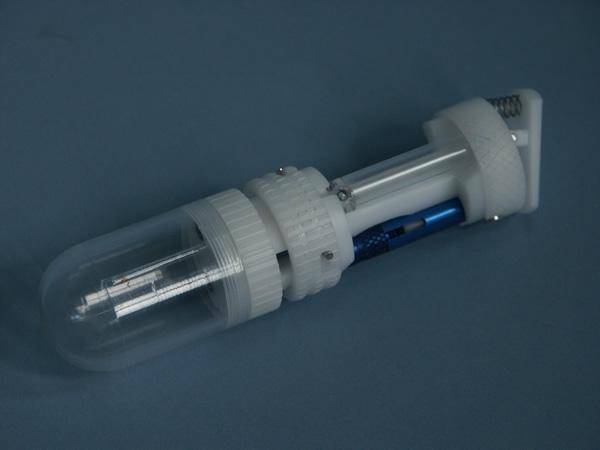
Now researchers have come up with a potential solution – a thumb-sized gadget that collects a sample from the earlobe.

Blood is easiest to collect from veins, but this blood is on its way back to the heart and has been de-oxygenated and altered in the body’s tissues. This means it is not as useful for monitoring serious health problems as blood coming fresh from the heart in arteries.

"But the technique to collect blood from the artery is complicated and needs a lot of training," says Thais Russomano, at the Microgravity Laboratory of PUCRS University in Brazil. "It can also be painful and blood clots or infection can result. So it can be a bit dangerous to perform that in space."

So Russomano and her colleagues created the device to collect samples of "arterialised blood" from the earlobe. This serves as an accurate substitute for arterial blood. The system clips onto a subject’s earlobe and contains both a small cutting blade and a collection chamber, to ensure no blood can spill and contaminate the spacecraft. The device is operated with a twist and is said to be virtually painless.

Kinda gives the term "space needle" a whole new meaning doesn’t it? 

Maybe you should take it with a grain of salt, as New Scientist Space also reports that they were duped some art students who claimed to have invented a "cell phone tooth" by implanting a vibrating radio receiver in a human tooth.  So were a a few others, including Time magazine and Wired, the latter of which just exposed the fraud

Then again, maybe no one should be embarrassed by this. After all one person’s idea of a joke is often turns into someone else’s idea of "crazy enough to work." Scoble recently posted about a guy who implanted an RFID chip into his hand and posted a video about it.  (It’s been done before, of course.) And if you believe The Register, Belgian scientists have embedded RFID chips into — wait for it — human teeth. 

So, hoax or no, the "cellphone tooth" isn’t all that far fetched. And if it comes to pass, those who were duped before can claim "we always new it was possible" and claim the cutting edge.

To Mars and Back – In One Day

Tuesday, April 11th, 2006

Ever hear that something is “physically impossible?”  It carries a lot more weight coming from physicists. How do you respond? Can the speed of light be exceeded?
 
According to an annual award presented by the American Institute of Aeronautics and Astronautics, the fanciful dreams of interstellar travel using a real “hyperdrive” might indeed be possible. Based largely on the work of the late Burkhard Heim, a theoretical physicist whose advanced theories still baffle most physicists today, we could be on the verge of a propulsion revolution:

 
This paper is the third one in a series of publications, describing a novel and revolutionary space propulsion technique, based on a unified field theory in a quantized, higher-dimensional space, developed by the late Burkhard Heim and the first author, termed Heim quantum theory (HQT) in the following. It is interesting to note that this theory shares a similar physical picture, namely a quantized spacetime, with the recently published loop quantum theory (LQT) by L. Smolin, A. Ashtektar, C. Rovelli, M. Bojowald et al. [11, 24-28]. LQT, if proved correct, would stand for a major revision of current physics, while HQT would cause a revolution in the technology of propulsion.

 
The paper, “Guidelines for a Space Propulsion Device Based on Heim’s Quantum Theory,” goes into considerable detail. What got physicists buzzing in January was a piece in New Scientist, overwhelming all who are familiar with Heim’s work with hundreds of questions and unprecedented attention.
 
It’s this type of game-changing new science that NASA was looking for. The story was picked up by The Scotsman, interviewing some who worked on the AIAA submission:
 

Prof Hauser, a physicist at the Applied Sciences University in Salzgitter, Germany, and a former chief of aerodynamics at the European Space Agency, cautioned it was based on a highly controversial theory that would require a significant change in the current understanding of the laws of physics. "It would be amazing. I have been working on propulsion systems for quite a while and it would be the most amazing thing. The benefits would be almost unlimited," he said.


Some people look at Heim’s work like it came from another planet. Maybe it did.

Propelling through multidimensional hyperspace might afford the possibility of exploring the closest earth-like exoplanet, discovered a couple of years ago, orbiting mu Arae, a sun-like star. The planet is 14 times the mass of earth and is a mere 50 light years away.

Punch the hyperdrive and we can get there in less than 11 years.


Mars, In Color

Monday, April 10th, 2006

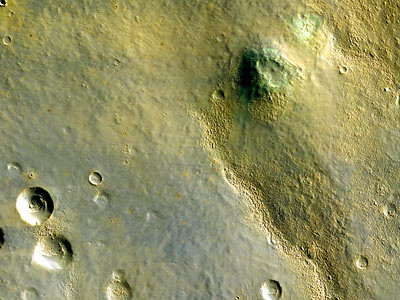
Friday saw the release of the first color image from NASA’s Mars Reconnaissance Orbiter.

ABC News reports:

The crisp test images released Friday revealed pocked craters, carved gullies and wind-formed dunes in Mars’ southern hemisphere. The diverse geologic features show the importance of water, wind and meteor impacts in shaping the Martian surface, scientists said.


The orbiter, the most advanced spacecraft ever sent to another planet, reached Mars on March 10 and slipped into an elliptical orbit. Over the next six months, it will dip into the upper atmosphere to shrink its orbit, lowering itself to 158 miles above the surface.

Last month, the orbiter beamed back the first view of Mars from an altitude of 1,547 miles. Those first test images were meant to calibrate the high-resolution camera aboard the spacecraft. The latest images were taken at the same time, but scientists spent several weeks processing them.

The Reconnaissance Orbiter will begin collecting data in November, and scientists expect the resolution of those images to be nine times higher.

The image is in infrared color– so the colors seen in this post are not what would be seen by the human eye.

 For additional information on the above image, click here.


Boeing Orbital Express Passes Major Milestones

Friday, April 7th, 2006

SpaceDaily reports:

 The Boeing Orbital Express system, a Defense Advanced Research Projects Agency (DARPA) program aimed at demonstrating fully autonomous on-orbit satellite servicing, last month completed two major test milestones.

The program completed its Baseline Integrated System Test (BIST) of the Autonomous Space Transport Robotic Operations (ASTRO) spacecraft and a series of electromagnetic interference and compatibility tests to verify component operation in the spacecraft’s actual electromagnetic environment….

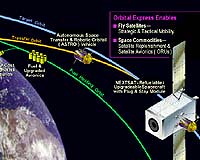
 The Orbital Express System consists of two satellites: Boeing’s ASTRO servicing spacecraft and NextSat, a prototypical, modular next-generation serviceable client satellite developed by Ball Aerospace.

The Orbital Express launch is scheduled for October, when the system will demonstrate for the first time: fully autonomous rendezvous out to 7 km with a capability that could support rendezvous at separation distances up to 1,000 km; soft capture and sub-meter range autonomous station-keeping; on-orbit refueling and component replacement as well as other robotic operations. Upon a successful demonstration, Orbital Express will provide the foundation for developing an operational system that can provide routine on-orbit servicing of existing and future space assets.

The full article can be found here

No Joke: The Ring Around Uranus is Blue

Thursday, April 6th, 2006

U.C. Berkeley astronomy professor Imke de Pater tells Red Orbit:

The newly discovered outer ring of Uranus is bright blue, for the same reason the Earth’s sky is blue — it is made up of tiny particles, astronomers said on Thursday.

It is "strikingly similar" to Saturn’s outer ring, which astronomers last month confirmed was probably generated by one of the planet’s moons, Enceladus.

Like Saturn’s ring, the Uranus ring also has a small moon in it, called Mab. But Mab is too small and too cold to be spewing a geyser of ice that contributes to the ring as Enceladus is now believed to be doing.

"The outer ring of Saturn is blue and has Enceladus right smack at its brightest spot, and Uranus is strikingly similar, with its blue ring right on top of Mab’s orbit," said Imke de Pater, a professor of astronomy at the University of California Berkeley, who helped lead the study.

"I think there is no chance that the blue ring is caused by geyser activity," added de Pater, whose report is published in Friday’s issue of the journal Science.

Originally named after King George III of England, Uranus is the 4th largest planet by mass. Found some animation and images of interest, courtesy of the SETI Institute.

NASA Goes to China?

Thursday, April 6th, 2006

The China story is getting more interesting. I only found out a couple of days ago that China has a space program, and some pretty ambitious plans to go along with it. At the time I wasn’t sure how serious the news was as far as the U.S. space program is concerned. Now I find out, via The Write Stuff again, that apparently it’s serious enough that NASA may send someone to China to check things out.

Chinese space officials have invited NASA Administrator Michael Griffin to visit their country in the fall, possibly as early as September.   

During an informal visit to NASA headquarters in Washington, April 3, Luo Ge, vice administrator of the China National Space Administration, met with Michael F. O’Brien, NASA associate administrator for external relations, to discuss a potential trip by Griffin to meet with Chinese space officials and visit their facilities, possibly as early as September.

“I made a joke with Mr. O’Brien that if we need to get married some day, we have to meet; otherwise we cannot get married,” Luo said in an interview here following his morning keynote speech April 5 at the 22nd National Space Symposium. Luo described the visit with O’Brien as “only a drop in” with two purposes:” to see an old friend” and to discuss Griffin visiting China.

Marriage proposals aside, that’s rather interesting news. Granted, it’s only an invitation, I haven’t heard whether it’s been accepted. But Lou did speak earlier about China’s willingness for space collaboration, and given Tom DeLay’s rather dire warning about the "space race" with China, it might be smart for NASA to at least give the Chinese program the once over; especially considering who else could be entering the "space race." 

If Matt Tompkins over at DefenseTech.Org is right when he says "Don’t Freak" over reports that China is set to overtake the U.S. in technology development, NASA may find it has nothing to worry about.  And with China concerns about its U.S. debt holdings, and  news that Iran is entering the space race too, some kind of U.S. – China partnership could be advantageous for both.

Mind you, I’m just a newbie who’s trying to sort all this stuff out. And I wouldn’t’ mind a little help.

Closing the Digital Gap: A Laptop for Every Child

Thursday, April 6th, 2006

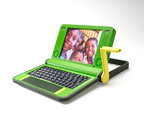
It’s been just over a year since Nicholas Negroponte announced at the World Economic Forum in Davos, Switzerland the goal of developing a $100 laptop not for the marketplace, but to be distributed to schools globally to provide "children around the world with new opportunities to explore, experiment, and express themselves."

What does the initiative have to do with satellites or rocket science? Indirectly, everything. Such initiatives excite interest in technology in general– and the opportunities for education and discovery provided to so many children by the $100 laptop will play a critical role in bringing a creative and educated individuals to the next generation’s workplace, regardless of industry.

But for today, we’ve filed this under "cool stuff," because the technology itself is cool:

The proposed $100 machine will be a Linux-based, with a dual-mode display—both a full-color, transmissive DVD mode, and a second display option that is black and white reflective and sunlight-readable at 3× the resolution. The laptop will have a 500MHz processor and 128MB of DRAM, with 500MB of Flash memory; it will not have a hard disk, but it will have four USB ports. The laptops will have wireless broadband that, among other things, allows them to work as a mesh network; each laptop will be able to talk to its nearest neighbors, creating an ad hoc, local area network. The laptops will use innovative power (including wind-up)

A wind-up option would be great on my own PC, which always seems to die on long flights just when I’ve decided to turn away from Minesweeper and try to get some work done.

We’ll be tracking the latest news on the $100 Laptop project as news becomes available, because the potential is huge for the technology to "trickle up" to consumer laptops and for the project itself to unlock creativity in millions of children around the world.

 (Be sure to check out additional design concepts here.)

Space Symposium Kicks Off in Colorado

Wednesday, April 5th, 2006

The 22nd National Space Symposium opened its doors in Colorado Springs, Colorado yesterday.

The Symposium, sponsored by the Space Foundation, is an annual space industry conference that brings members of the global space industry and the military together.

Space.com reports:

“In terms of intellectual content, this Symposium is clearly our most exploration-focused and most commercial-entrepreneurial focused ever, said Elliot Pulham, President and Chief Executive Officer of The Space Foundation… 

Local station KKTV looks at what’s of interest to the general public:

This year’s show features a robot who can dance and entertain named "Sprockit." It also features NASA’s Crew Exploration Vehicle, or C.E.V. NASA says the C.E.V. will replace the shuttle and sit four to six people.

The C.E.V. is a refined version of the old Apollo vehicle. They say it’s safer than a shuttle and more economical. 

 More stories can be found here. You can also check out photos from the symposium and even check out the live webcam of the exhibit hall (in the left hand column).

 Organizers expect more than 7,500 people to attend the symposium, which runs through tomorrow at the Broadmoor Hotel.


China’s Sputnik?

Tuesday, April 4th, 2006

It’s gonna get crowded up there. In space, I mean. On the moon in particular. And the key to it all may be soon-to-be-former Congressman Tom DeLay. I thought it was down to the U.S. and Sweden in the latest lap of the "space race."  But it looks like there’s one more player entering the arena. I checked my RSS reader this afternoon, and found out via NASA Watch that China has plans for space exploration to the moon and beyond.

A top Chinese space official on Monday described China’s ambitious exploration plans, including robotic Moon missions starting next year.

Beyond Moon missions, including a flight to collect and return lunar samples to Earth in 2017, the Chinese space agency plans to develop a nonpolluting launch vehicle that can lift 55,000 pounds (25,000 kg) into orbit by 2010, said Luo Ge, a vice administrator at the Chinese National Space Administration.

"Space is a high-risk investment," Luo said through a translator at the Center for Strategic and International Studies, a Washington think tank. "China as a developing country is limited and constrained by its funding for more ambitious programs."

But Luo says China has an edge because of the progress of its space program, the country’s "openness" — citing its work with countries like Russia, Nigeria, and Brazil — and because the U.S. has grown more closed since the 1990s. The Write Stuff, space blog of the Orlando Sentinel’, points to a story that repeats Luo’s claims and notes the successes of China’s space program, including a manned spaceflight last October. 

But is there anything to China’s claims? And How does Tom DeLay figure into all of this? 

Jeff of Space Politics reminds us that none other than Tom Delay warned just a week ago that the U.S. is in a "space race" with China, and even called China’s space program "a 21st century Sputnik moment"

I’m not sure I buy that comparison, as it sounds like a bit of hyperbole to me. After all, Luo even noted that China’s $500 space budget is barely bus fare compared to NASA’s $16.6 billion. But then again NASA is losing a powerful backer in Tom Delay, and having to pinch pennies for the moon mission even as scientists are clamoring for more

Plus Jeff also speculates that, since he called for a special oversight hearing on NASA’s human space space program during a congressional hearing last week, the Chinese space program might be one reason for DeLay’s 2-month "delay" in actually leaving office. Maybe ensuring NASA stays well head of China’s"sputnik" will be DeLay’s swan song.

I suppose Jeff could be right. After all, just last week I thought Sweden was America’s biggest competitor in space. They don’t call me NooBee (i.e. "newbie) for nothin’, folks.