Archive for 2006

UAE Man to be First Tourist in Space?

Tuesday, April 4th, 2006

USA Today reports that the space tourism race is on– and one of the first tourists is ready for his journey:

 Adnan al-Maimani insists he isn’t looking to be a pioneer — he just dreams of looking down on Earth. So the 40-year-old entrepreneur is paying more than $100,000 to go on the first flight traveling to the edge of space from a Mideast nation.

The flight, which will travel about 62 miles toward space and give its passengers up to five minutes of weightlessness, is part of an American company’s plan to establish a spaceport in the northern tip of the United Arab Emirates.

Virginia-based Space Adventures — the only company to have successfully sent private citizens into space — won’t say when the flight will take place, only that it will be within a few years….

The journey has to wait until Space Adventures carries out plans it announced in February to build a commercial spaceport in Ras Al-Khaimah, the most northern of seven emirates making up the United Arab Emirates….

Space Adventures, whose advisers include Apollo 11 moonwalker Buzz Aldrin and several shuttle astronauts, says 200 people have already made reservations for future suborbital spaceflights, although the program is still in a developing stage.

Space Adventures has a partnership with the Russian Federal Space Agency and previously sent American businessman Dennis Tito, scientist Gregory Olsen and South African Mark Shuttleworth on Russian rockets to the international space station. Each paid $20 million.

As we’ve reported before, Space Adventures is locked in a race with Virgin Galactic to bring the next wave of  of tourists, if not quite to the stars, then above the stratosphere. But as any tourist anywhere knows, getting there is easy. It’s finding decent lodging that’s the hard part.

 Virgin Galactic’s Richard Branson is thinking that through, according to Hotels Magazine (link to story not available):

SIR Richard Branson is taking a giant leap for mankind by drawing up plans to build the worlds first space hotels, his space flight company Virgin Galactic has told The Business.

Alex Tai, its operations director, who will pilot Virgins first commercial space flight in 2008, has held talks with US hotel entrepreneur Robert Bigelow about the project, Virgin Galactics president Will Whitehorn confirmed.Bigelow Aerospace is developing inflatable pods it believes could receive the first space travellers by the end of the decade. Branson, Virgin Galactics chairman, revealed the space hotel discussions in Dubai last week.

Branson said: We are talking to people who are developing hotels for space. We are also talking to people who are developing launch craft to get hotels into space. People know that we can turn something that might seem a bit bizarre into a commercial reality. Personally, I think theres a demand for space hotels.
Calling from the Sea

Monday, April 3rd, 2006

Imagine this problem:

 You’re on-board a ferry cruising across the North Sea between Newcastle and Amsterdam and you realize that you have to call home. Or someone back home has to call you. But you’re hundreds of kilometers from the nearest cellular operator’s service area. So what do you do? What can they do back home?

One alternative is to see if the ferry is equipped with a satellite telephone, but these services tend to be expensive and do not solve the problem of being accessible via your own cell phone number. Increasingly, therefore, a Base Transceiver Station (BTS) has become a permanent fixture on cruise ships and ferries. A BTS, connected to a cellular operator’s land-based Base Station Controller (BSC) over a satellite link, enables passengers to use their regular GSM telephones while at sea, but, given the expense of leasing satellite bandwidth, this alternative cannot serve a large number of simultaneous users either. So how can ship operators ensure that every passenger who wants or needs GSM service coverage will be able to afford it?

Maritime Communications Partner AS (MCP), a Norwegian-based provider of onboard cell phone connectivity to cruise ships and ferries that provides global coverage through leading suppliers of maritime satellite services, has come up with an ideal solution.

 MCP is based in Grimstad, Norway– the port of the poets. "It’s the place to be/ when you must make a call/ at sea," as our own in-house poet (we got him cheap, from a temp service) tells us.

The key technology used by MCP are GSM A-bis optimization gateways designed by RAD Data Communications. The gateways reduce costs by saving on satellite bandwidth.

But you don’t have to be on a Danish-owned cruiseship on the North Sea (where MCP has deployed the product) to enjoy the benefits of the new technology. Skywave Communications Solutions resells the Globalstar Maritime Satellite Phone System for use on private boats.

Robot Video

Saturday, April 1st, 2006

For your Saturday viewing pleasure, here’s a video from the Robot-One 9 competition in Tokyo. Check out the related videos for more!

A Hard Knock Life for Satellites

Friday, March 31st, 2006

I’m probably giving away my age when I say this, but I remember when our television had a "rabbit ear" antenna, and adjusting the picture just meant moving the "ears" around. Later we had an antenna on the roof. Adjusting the picture meant someone had to climb a ladder to the roof, while someone else yelled out of a window until the picture was clear. Then there was cable. If we lost the signal, we called the cable company and waited.

Now we have satellite TV, and we rarely lose a the signal — except for occasionally during a storm, when it flickers on and off briefly before returning. If we have snow, it can interrupt the signal if it piles up on the dish, but that just means a quick trip to the back yard to brush it off. The dish in the back yard, however, is just a receiver; pointing at at a satellite so high up that a ladder on the roof doesn’t begin to do the trick. So, what happens if a satellite gets bonked by an asteroid or other random space junk?

Well, you lose the signal, which is what happened to a lot of Russians this week when a telecom satellite failed after a "sudden impact" shut down its thermal control, causing it to end up in space disposal orbit.  (Yeah. I didn’t know what that meant either. Apparently there’s a whole part of space where satellites go to die. Who knew?)  New Zealand had an outage too, due to loss of pointing control.  (Another hard knock?) A European satellite got bonked in 1993 when the earth passed through a trail of comet dust. 

So, what to do? Some people are trying to predict problems, and others are working on better materials. (What can withstand getting smacked by an asteroid?) And some are focusing on better monitoring and forecasting of sunspots and space weather (space weather?), which apparently can also cause problems for satellites. 

I can’t say how it all works. I just hope it keeps working. I don’t want to miss any of my favorite shows, and I don’t want to have to climb any higher than the roof.

Playing a Small Part in Understanding Small Things

Friday, March 31st, 2006

The Cern Courier reports on a grassroots project that utilizes the power of the web– and the unused computing power of personal PCs– to help analyze the interstellar dust particles brought back by the Stardust space capsule in early January:

Finding the tiny interstellar dust particles in the Stardust Interstellar Dust Collector will be extremely difficult. The impacts created by interstellar dust can only be found using a high-magnification microscope with a field of view smaller than a grain of salt….. Stardust@home enables public volunteers to help in this task, which is done more accurately by humans than by any pattern recognition software. After a web-based training session, passing a test and registering, volunteers download a virtual microscope (VM). The VM automatically connects to the Stardust@home server and downloads stacks of images created by an automated microscope at the Cosmic Dust Lab at the Johnson Space Center. Each field can then be searched for interstellar dust impacts by focusing up and down with a focus control. The first images for scanning should become available in April and the project should be completed by October.

For more information on on Stardust@home, click here.

Brazil Joins Astronaut Club

Thursday, March 30th, 2006

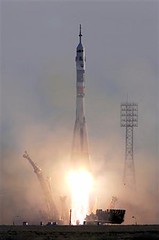
"Brazil’s first astronaut blasted off from earth on a cloudless day on Thursday with a Russia-U.S. crew bound for the orbiting International Space Station," Reuters reports:
Marcos Pontes, a 43-year-old Brazilian Air Force pilot, was hunched inside the spacecraft with Russian cosmonaut Pavel Vinogradov and U.S. astronaut Jeffrey Williams, both of whom were starting a six-month rotation in space….

Pontes, who packed a Brazilian soccer team shirt, returns to earth in 10 days with the outgoing crew, American Bill McArthur and Russian Valery Tokarev.

The Russian Soyuz rocket took off at 0230 GMT (3:30 a.m. British time) from the Baikonur cosmodrome, on a piece of Kazakh steppe rented by Russia from its ex-Soviet neighbour. It is scheduled to dock in two days’ time.

Soon after launch the first stage of the rocket fell away and tumbled back to earth, still glowing orange, while the Soyuz sped higher and higher into space.

"It’s beautiful, absolutely beautiful," said Michael Baker, a NASA international space station programme manager.

Russian spacecraft bear the responsibility for shipping crew and supplies to the station after NASA grounded its shuttle fleet in July when it failed to fix a technical problem that killed seven astronauts in 2003.

Soyuz rockets have proved safer than the shuttle despite their 1960s heritage.


iPod-from-Space Mystery Unfolds?

Wednesday, March 29th, 2006

After getting some comments from our readers on the iPod-from-Space post, concerning the accuracy of the dates in the Terrabyte screenshot, we dropped an email to TerraServers to see if we could get any further answers. Here’s what they sent us:

You can’t get the whole planet shot all in one day, so it is made up of various collection dates in 1999. When you have a large date range over a big mosaic like this, the company that took it will often just give the month or year taken. In cases like this, to specify a date, we use the first of the month or first of the year. So, all of the 1/1/1999 pictures would be made up of shots taken during 1999 or possibly some in 1998 or 2000. They’d probably go with the year with the majority. This 15m satellite mosaic covers most or all of the earth’s surface and is the last full collection that we know of. That’s partly because one of the Landsat satellites failed or crashed a couple of years back. It is the main baseline imagery that us and the rest of the major imagery sites use to show basic coverage worldwide. That’s why you’ll see the same picture between us because it’s all coming from the same original imagery.

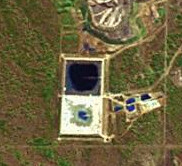
I was able to pick off the coordinates from the image at full size on Flickr and get to it on our site. My best guess from looking at the area just north of it is that it’s part of a strip mining operation. The “screen” of the iPod might be a big holding pond or quarry pond

 Anywhere from 1998 to 2000, huh? Strip mine? Quarry pond? Sounds feasible, given the original post, but still doesn’t nail down an absolute date. So perhaps it still remains a mystery.

iPod From Space Falls to Earth

Tuesday, March 28th, 2006

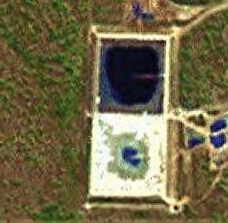
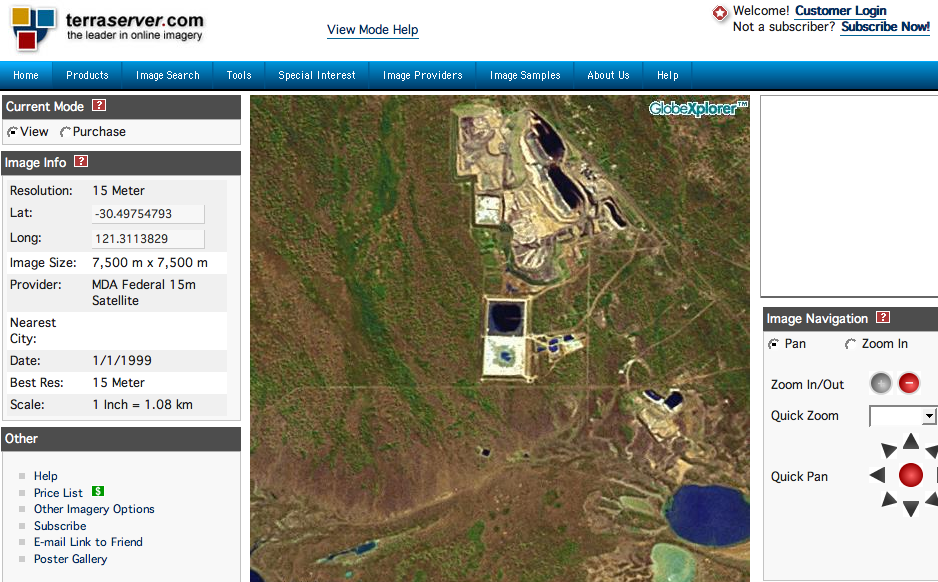
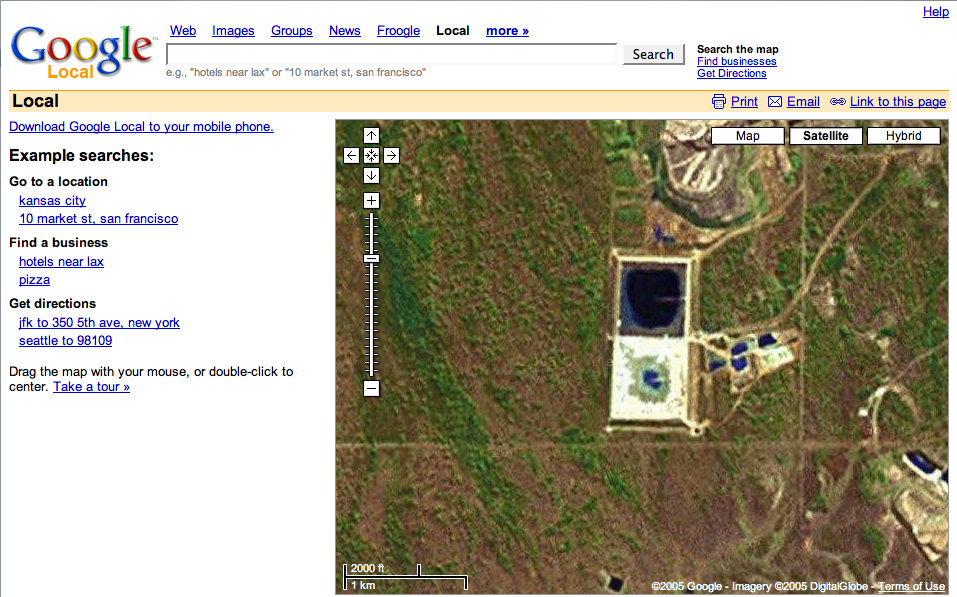
It was fun while it lasted, huh? We saw the Gizmodo post yesterday, about the iPod advertisement that’s viewable from space, and filed it away for future reference. Turns out that, after rocketing around the blogosphere, it’s probably not what it looks like. Some intrepid bloggers noted that the Terrabyte satellite image for that location on January 1, 1999 — before the iPod launched — looks the same  as it does Google Earth today.

We’ve got both images. Care to guess which is which?


It gets better. The Terabyte server’s been rather busy, so when we got a chance we grabbed a screenshot of the whole page. (Note the date.)


terrabyte1999

And we grabbed a shot of Google Earth as well. 


googleearth

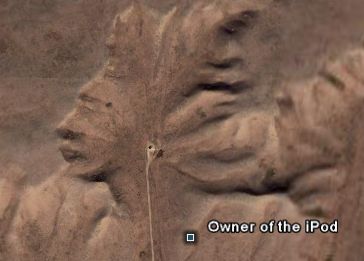
And fun would it bit of snark? The author of the the original post suggests he knows the identity of the legendary space-iPod’s owner.

It is just me? Do things not always look like what they are when seen from space? Or is am I seeing ancient Egyptian royalty here? 

So, is there anything else that looks like an iPod from space? How many can you find?

NASA & Sweden in Moonbase Race?

Monday, March 27th, 2006

The history book on the shelf,
Is always repeating itself…

Abba – “Waterloo” 

We’ve already been to the moon (unless you believe that the whole thing was done on a movie lot), but it looks like we’re going to stay a while the next time we go back. There just one question. Who’s gonna get there first? I experienced a little brain tickle this morning when I saw the news item that NASA is quietly planning a moonbase

For the first time since 1972, the United States is planning to fly to the moon, but instead of a quick, Apollo-like visit, astronauts intend to build a permanent base and live there while they prepare what may be the most ambitious undertaking in history — putting human beings on Mars.

It sounded vaguely familiar, and not because the presdient announced a plan to return to the moon a couple of years ago. I felt that brain tickle because I remembered hearing just a week or so ago that someone else was planning to do the same thing.

A quick search through my bookmarks, and I had the answer. In the race to colonize the moon, NASA has at least one competitor: Sweden.

The proof comes in the form of the innocent-looking SMART-Centre which, according to various reports, has assembled a consortium of more than 50 partners – including Japan’s Shimizu Corporation, US NASA contractor Orbitech and the UK’s Cranfield University – to turn the centre’s Dr. Niklas Järvstråt’s dreams of extraterrestrial conquest into reality.
 You won’t find much about a moonbase at the SMART-Center homepage. For that you’ll have to dig into their projects for the vision statement.

We have already taken the one small step for mankind and landed on the moon. We have seen it, we have conquered it, we have explored it – but our presence has not been sustained. For the benefit of mankind, the survival of our natural resources on Earth and for the proliferation of space exploration, it is now time for the next logical step – an international lunar colony. A colony where men, women and children can live without the need of a continuous supply of materials and technology from Earth; a self-supporting colony where the great circle of life can be sustained in its entirety by lunar raw materials and where all life-sustaining products will be manufactured in situ.

The Swedes have some other big plans in mind beyond moon — including exploring Mars, asteroids, other solar systems, etc., and trying their hand at world peace — but will it be more than they can handle? Then again, as the article linked above notes, NASA has its hands full with emptying its already-tapped-out pocketbook for space shuttle repairs, with a 2020 back-to-the-moon deadline looming over it. The Swedes have a deadline for lunar construction and immigration to happen sometime between 2018 and 2024.

So, it’s not a question of if human beings will return to the moon, but a matter of when and under which flag. Anyone care to lay bets?

New Falcon 1 Rocket Destroyed on Maiden Voyage

Monday, March 27th, 2006

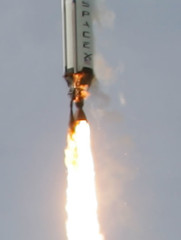
An engine fire destroyed Space-X’s Falcon 1 rocket on its maiden voyage today, according to reports.

Close up of Falcon 1 Engine Fire The International Reporter has early details:

The US vehicle, developed by the Space Exploration Technologies Corp, was destroyed soon after take-off from the Marshall Islands in the Pacific Ocean. The vision of Elon Musk, co-founder of the electronic payment system PayPal, the Falcon was designed to cut the cost of current satellite launches.

An onboard camera appeared to show the rocket rolling out of control shortly before the video signal was lost….

The rocket was attempting to carry a 19.5kg satellite to a low-Earth orbit of 450km. The satellite, FalconSat-2, was built by US Air Force Academy cadets to investigate the phenomenon known as "space weather".

Elon Musk has additional details on the Space-X blog

The good news is that all vehicle systems, including the main engine, thrust vector control, structures, avionics, software, guidance algorithm, etc. were picture perfect.  Falcon’s trajectory was within 0.2 degrees of nominal during powered flight. 


However, at T+25s, a fuel leak of currently unknown origin caused a fire around the top of the main engine that cut into the first stage helium pneumatic system.  On high resolution imagery, the fire is clearly visible within seconds after liftoff.  Once the pneumatic pressure decayed below a critical value, the spring return safety function of the pre-valves forced them closed, shutting down the main engine at T+29s. 
 

It does not appear as though the first stage insulation played a negative role, nor are any other vehicle anomalies apparent from either the telemetry or imaging.  Falcon was executing perfectly on all fronts until fire impaired the first stage pneumatic system.
 

Our plan at this point is to analyze data and debris to be certain that the above preliminary analysis is correct and then isolate and address all possible causes for the fuel leak.  In addition, we will do another ground up systems review of the entire vehicle to flush out any other potential issues.
 
The company says it is too soon to determine when the next flight will take place.