Archive for 2006

Making MobTV Work

Friday, March 24th, 2006

I’ve decided to try my hand at coining a new phrase: mobTV. I figure if mobile blogging can become "moblogging", then mobile television can become "mobTV." Besides, as I’m learning more about it and writing more about it I’m going to need a more efficient way to refer to it if I want to keep up, given the way its spreading and the number of terms I have to learn. 

Since my last post on the mobTV taking off in Korea, it looks like mobTV is coming to China next, if Radioscope has its way.  And on a pretty cool looking phone, if you ask me.

Samsung MobTV PhoneRadioscape has won contracts to supply five more Digital Multimedia Broadcast (DMB) and Enhanced Packet Mode (EPM) transmission systems for mobile TV operators in China, bringing the total to nine in the past few months.

 The company says the contracts are the fruits of at least two years of courting Chinese authorities about its DAB-based mobile TV technology and helping them evaluate the most appropriate technologies for the service, and choosing between DMB, DVB-H and DMB-T.

From there it gets interesting. Qualcomm announced last year that it was bringing mobTV to the states via a  technology called MediaFLO, which Verzion also adopted late last year. For the curious, Mobile Content News has video of MediaFLO in action. (Found via Engadget, and I believe that’s Shrek on the small screen.)  The question is, can it work? The experts aren’t  exactly in agreement. Depending on who you ask, MediaFLO and another technology called DVB-H are doomed because EV-DO already gets the job done and new networks are too expensive to build and support, or DVB-H will be the de facto standard once spectrum allocation problems are solved.

Got all that? Good, because I’m about to add some French to the mix. Alcatel just announced that it’s overcome the spectrum allocation issue by using a satellite frequency.

With the help of satellites, Alcatel aims to overcome a key hurdle in rolling out broadcast television services over mobile phones: the lack of available spectrum. 

The French telecommunications-equipment manufacturer proposes using the widely available S-Band frequency reserved for satellites to transmit broadcast signals both terrestrially and via satellite to mobile phones based on the DVB-H (digital video broadcasting – handheld) standard, instead of the UHF band. 

… The Alcatel proposal calls for equipping base stations with S-Band repeaters and, in addition, using satellites capable of transmitting in the S-Band to deliver content to 3G (third-generation) phones enabled with DVB-H technology in three different ways: base-station streaming, base-station broadcasting and satellite broadcasting.

The article also does a good job of explaining the drawbacks of the three delivery systems. Streaming offers unlimited channels and great indoor coverage, but only for a limited number of users on a network. Broadcast matches it on indoor coverage, and supports unlimited users, but only 27 channels. Satellite matches them on channels and user support, but falls short on indoor coverage. Alcatel claims the answer is an "intelligent content-management system" that seamlessly chooses the right delivery system. 

Leave it to the French to come up with an elegant solution. I just hope it works well enough to eventually get picked up in the U.S. It would be great to catch up on Desperate Housewives reruns on the subway, and get all the way up the street to my office without losing the signal.

No More Dial-Up to the Outer Planets

Thursday, March 23rd, 2006

It may be surprising to many people, but when NASA scientists receive data back from distant probes, their experience is akin to downloading "Bohemian Rhapsody" (or, pick your own epic-length song) on 56K. Which is to say, there’s a lot of waiting involved. But that could change:

 Researchers at the Massachusetts Institute for Technology have developed a tiny light detector that could one day boost interplanetary communications to broadband speeds.

Images from Mars, like this computerized one of a canyon, are transmitted at a data rate of 128,000 bits per second.

The work could permit the transmission of color video between astronauts and satellites and scientists on Earth across interplanetary distances, something that is not practical with current technologies.

The new light detector improves detection efficiency to 57% at a wavelength of 1,550 nanometers — the same wavelength used by optical fibers on Earth to carry broadband signals to homes and offices. Currently, light detectors only absorb about 20% of the light they receive.

"It can take hours with the existing wireless radio frequency technology to get useful scientific information back from Mars to Earth," said study team member Karl Berggren from the Massachusetts Institute of Technology. "But an optical link can do that thousands of times faster."

The work is detailed in the Jan. 23 issue of the journal Optics Express


Hunting for Stars, Through the Light

Wednesday, March 22nd, 2006

This is a great effort:

Join thousands of other students, families, and educators by participating in GLOBE at Night – an international event designed to observe and record the visible stars as a means of measuring light pollution in a given location. Participation is open to anyone – anywhere in the world – who can get outside and look skyward during the week of March 22-29, 2006! There is no cost to participate in GLOBE at Night. Help us reach our goal of 5000 observations from around the world!

 The National Optical Astronomy Observatory, which is sponsoring the event, also has a cool online tool that allows you to witness the changes in the night sky that result from light pollution.

For more information, download the GLOBE Family Activity Packet PDF (in English and Spanish) or subscribe to the GLOBE email list. 

Robots on the Road

Monday, March 20th, 2006

Here’s another post about people building the darndest things. On March 28th, thanks to the folks at Darpanet, you’ll be able to watch a dozen driverless vehicles — created by people ranging from entreprenuers to students and hobbyists — attempt to successfully navigate 130 miles of Mojave desert terrain on NOVA’s The Great Robot Race. NOVA’s companion site features background on the dozen teams competing for the $2 million prize, as well as videos of their vehicles, and a preview of the upcoming show. 

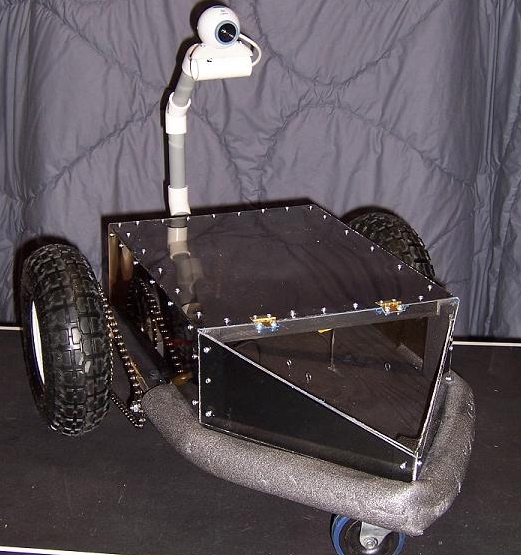
Sounds impressive, and you can bet that with $2 million at stake a lot of time and resources went into building these prototypes. However, my favorite robot vehicle of the day won’t qualify for the competition. It’s a wi-fi rover I found via Make  magazine, built at a cost of $103 by a high school student who won second place in a local science fair with his creation.


He’s got plans to add GPS, and other neat gadgets. After building a robot on just over $100, I wonder what this kid could do with even a fraction of the Great Robot Race prize money.

The (Private) Race for Space

Monday, March 20th, 2006

We’ve written before about the incipient space tourism industry; yesterday the AP released a story that summarizes the gathering momentum of what was, not too long ago, a "sleepy industry":

Two years after the first privately financed space flight jump-started a sleepy industry, more than a dozen companies are developing rocket planes to ferry ordinary rich people out of the atmosphere.

Several private companies will begin building their prototype vehicles this summer with plans to test fly them as early as next year. If all goes well, the first tourist could hitch a galactic joy ride late next year or 2008 – pending approval by federal regulators….

"This time, it’s personal. This space race is about getting ‘us’ into space," said space historian Andrew Chaikin.

For now, commercial space travel remains an exclusive club.

Over the past few years, three tourists have paid a reported $20 million each to ride aboard a Russian rocket to the orbiting international space station.

Instead of days in space, the commercial spaceships under development will only reach suborbital space, a region about 60 miles up that is generally considered the beginning of the rest of the universe. Since the private spaceships lack the speed to go into orbit around Earth, the flights are essentially up and down experiences – lasting about two hours with up to five minutes of weightlessness.

The article includes a summary of the major contenders in the space-tourism arena:

The biggest name is Virgin Galactic, a space tourism firm founded by British billionaire tycoon Richard Branson. Branson has partnered with Burt Rutan, whose SpaceShipOne in 2004 became the first private manned craft to reach space, to build a fleet of suborbital commercial spaceships called SpaceShipTwo….

_Oklahoma-based Rocketplane Kistler is one of Virgin Galactic’s biggest competitors. Rocketplane Kistler, whose main investor is American businessman George French, hopes to start test flights next January and fly commercially by next summer. French owns several businesses including a space education company in Wisconsin….

_Space Adventures, a Virginia-based space travel agency best known for brokering three tourists to the international space station, is the latest entrant.

Last month, Space Adventures announced a partnership with members of the Ansari family – the major funders of the $10 million X Prize won by SpaceShipOne – to develop Russian-designed suborbital rockets that would launch from a proposed spaceport in the United Arab Emirates by 2008.

You can check out Rocketplane here and Virgin Galactic here.

Maps in Greater Detail

Monday, March 20th, 2006

Wired has a good article out today on how the next-generation of commercial imaging satellites is going to change, er, the way we view the world– or at least the details of our view:

Critics of overhead imagery services like Google Earth and Microsoft Virtual Earth generally fall into two categories: government agencies who say the services show too much, and users who lament they can’t see more.

As the next generation of commercial imaging satellites moves closer to launch, the first camp may be out of luck.

Forthcoming features such as enhanced zoom capabilities, higher-resolution views and faster updates of stock imagery will reveal far more detail of Earth’s surface than anything visible on a computer screen today. While satellite imagery won’t be real-time, or capable of distinguishing individuals, it will be good enough to pinpoint ground-level details too blurry to identify using today’s technology.

"We’re just starting," said Matthew M. O’Connell, CEO of GeoEye (formerly Orbimage), which plans to launch a satellite in early 2007 that can show images of objects as small as 1.3 feet across. "At that resolution, we can literally count the manhole covers in Manhattan."

Just a few years ago, the idea of zooming in from a PC screen to any point on Earth would have seemed like the stuff of fantasy. Now that it’s reality, satellite and aerial mapping applications are drawing millions of addicted users. Hardly a week goes by without news of some strange or scandalous finding: Last week amateur astronomer Emilio González of Spain used Google Earth to find what might be a previously unknown impact crater in Chad.


Read the whole story here


Podcast Numbers Overtake Radio Stations

Monday, March 20th, 2006

Although the reach of radio remains infinitely larger, a major milestone in the distribution of new media content was hit when the number of podasts exceeded the number of radio stations recently. SiliconRepublic:

There are now more podcasts than there are radio stations worldwide, matching a prediction made on an Irish blog site last year….

Podcasts cover a range of areas; the most popular is science, followed by religion, audio blogs, technology and talk radio. Other common categories include news, arts, movies and TV, sport, health, travel and food….

“[Podcasts] not equal in size or money or importance but it’s about choice,” Greene added, suggesting that the alternative listening choice now available to the public via podcasting would mean the end for what he calls “wallpaper radio”. Unlike many mainstream radio stations which take their playlists from a narrow selection of music formats, podcasts are designed to appeal to niche audiences.

Want to find out if you own the most expensive house in your neighborhood?

Friday, March 17th, 2006

Better yet how about getting information for houses in your neighborhood or any neighborhood? Get a bird’s eye view of house or neighborhood.

Go to http://www.zillow.com to find out more.

EchoStar, DirecTV Possible Partners

Thursday, March 16th, 2006

Joyzelle Davis reports in the Rocky Mountain News:

EchoStar Communications’ Chief Executive Charlie Ergen gave the strongest indication yet that the satellite-television provider would team with larger rival DirecTV to establish a broadband service.

DirecTV, whose controlling shareholder is Rupert Murdoch’s News Corp., is working on technology that could allow it to offer services including phone and wireless high-speed Internet to homes and mobile devices. That would give satellite-TV providers a way to counter cable companies’ bundle of video, high-speed Internet and phone service….

A partnership would allow EchoStar to split the "excessive" costs of building the network and help craft standards for the industry, Ergen said…

If such a partnership were to occur, it would mark the first strategic alliance between the companies that sought to merge four years ago.

 Read more about the plan here.

TV: To-Go vs. Terrestrial

Wednesday, March 15th, 2006

Imagine for minute that you want to watch, say, the Super Bowl or some other big television event. But it’s only available on your phone.  That’s right. None of the "terrestrial" networks are carrying it. Hard to imagine?  It happened in South Korea

Cable TV and other media that are considered as "non-mainstream" are threatening the realm of conventional terrestrial TV.

The latest case was a challenge made by a one-year-old sports channel Xports, which is buying up broadcasting rights for matches of the South Korean national team.

On Wednesday night, Xports exclusively aired the national team’s match with Syria. It was the first time a national team match was not shown on the three terrestrial TV channels _ KBS, SBS and MBC. Adding insult to injury was the fact that the Korea-Syria match was also viewed on versatile mobile phones with satellite DMB functions, another emerging medium of entertainment.

Satellite TV on a cell phone? Evidently, it’s spread so widely in other parts of the world that it’s starting to rival traditional — "terrestrial" — TV. Well, it’s here. And though you may not find it’s your only option for some television events, it’s set to offer more options. It’s expanding into Europe and other countries, through companies like Pantech and Samsung. It’s also coming to Canada and Latin America. Now, I find out that my wireless carrier launched its own video service a week ago, along with two new phones to go with it. 

Boy, am I behind. I haven’t even gotten a video iPod yet.  Now my phone is outdated, and have to choose which new phone to get; never mind deciding what to watch once I get it.