Archive for 2006

Google Goes to Mars

Monday, March 13th, 2006

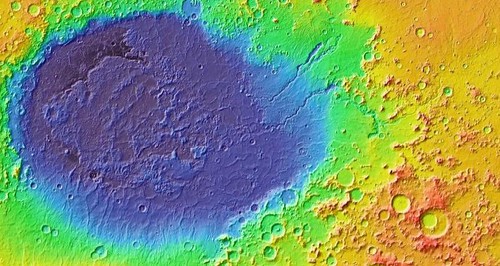
Having already been to the the moon, Google goes to Mars and takes us there with Google Mars.

 Google Mars

Besides looking at the pretty pictures via the elevation map, you can check out the "visible" and "infrared" views, as well as the mountains, ridges, plains and  craters of the red planet, as tagged by Google. And clicking on the stories link will lead you to some background information on various sites, like the Bacolor Crater.  

Via Warping it up!

Technorati Profile

Wanna Buy a Space Shuttle?

Monday, March 13th, 2006

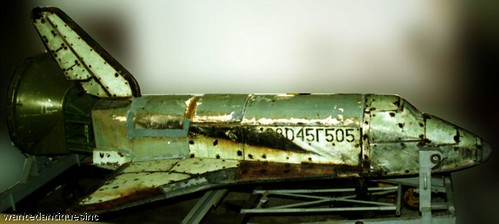
Well, you’re too late and about $98,000 short if — like most of us — you don’t happen to have that kind of change lying around. But if you had it to spare and had happened across a particular Ebay posting over the weekend, you could have bought a Soviet Space Shuttle

 Soviet Shuttle

OK, OK. So it’s not an actual space shuttle. It’s a 1/8 model that was used in various flight tests for the Soviet’s Buran space shuttle.

 The BOR-5 is a 1400 kg exact 1/8 scale model of the Soviet space shuttle Buran. The BOR-5 is 15’6" Long (17′ w/trailer) X 9’10" Wide (wingtip to wingtip) X 5’10" Tall (8’10" Tall on trailer). It was used to validate the aero-dynamic characteristics of the Buran at hypersonic speeds, between 1983 and 1988. The BOR-5 was launched on probably five sub-orbital trajectories from Kapustin Yar, in the direction of Lake Balkhash, using SL-8 (Cosmos) rockets (Russian designation: K65M-RB5). BOR is the abbreviation for Bezpilotnyy Orbitalnyy Raketoplan (Unmanned Orbital Rocketplane).

BOR-5 flights tested (amoung other things) carbon-based and quartz fiber heat-shield material paving the way for the Buran Shuttle. Russian sources are contradictory as to the number of BOR-5 flights. An except from one report reads: " … At an approximate altitude of 110-120 km height, the Cosmos booster pitched down, driving at full thrust for several minutes, accelerated the model to Mach 18.5 at 45 degrees, before separation. The craft landed using a parachute landing system after a flight of 2000 km.

 But those are just details, really. How cool would it be to start conversations with, "So, you know, I own a space shuttle"? If you happen to have $25,000 to spare between now and April you still have shot at an original NASA space shuttle prototype. Sure it’s only .008 scale, but it’s still a space shuttle, right? Anyway, if that’s too big of a hit to the wallet, you can always bid on about a ton of other space memorabilia.

Via Gizmodo and Random Good Stuff.

Mars Probe Set for Arrival

Friday, March 10th, 2006

"The tension is mounting for scientists and engineers of NASA’s Mars Reconnaissance Orbiter (MRO) mission as their spacecraft heads toward a red planet rendezvous today," Space.com reports:

 MRO is expected to enter Mars orbit after a 27-minute maneuver around the planet’s southern hemisphere, completing a seven-month trek. That burn is set to begin at 4:25 p.m. EST (2125 GMT) this afternoon, with MRO swinging back into communications range by 5:16 p.m. EST (2216 GMT).

NASA will broadcast MRO’s Mars approach and orbital arrival live on NASA TV beginning at 3:30 p.m. EST today. You can watch it here

Technorati Tags:  Science, Space, technology, Cool Stuff, NASA, Planetary

Life’s Distant Outpost?

Friday, March 10th, 2006

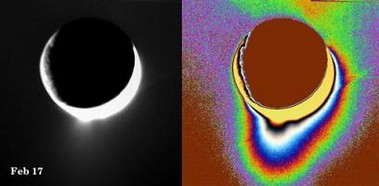
"One of Saturn’s moons, Enceladus, is spewing out a giant plume of water vapor that is probably feeding one of the planet’s rings, scientists said on Thursday," Reuters reports, indicating the potential for biological life on the tiny moon.

NASA made the announcement yesterday, and it quickly became headline news around the world:

The findings, published in the journal Science, suggest that tiny Enceladus could have a liquid ocean under its icy surface which in theory could sustain primitive life, similar to Jupiter’s moon Europa. The plume was spotted by Cassini, a joint U.S.-European spacecraft that is visiting Saturn….

Several moons have been found to have evidence of liquid water and the chemical elements needed to make life, including Europa. But scientists are far more intrigued by the plume itself, a gigantic geyser of water vapor and tiny ice particles.

"It’s basically this giant plume of gas coming out of the south pole of Enceladus," Candy Hansen of NASA’S Jet Propulsion Laboratory in California said in a telephone interview.

"The plume is half the size of the moon. It’s huge," said Hansen, a planetary scientist. "Water is being spewed out of this moon. It solves some real mysteries that we have been struggling with over the years."

Indirect observations had shown the moon, discovered in 1789 by William Herschel, was rich in oxygen and hydrogen. But whether this was because of water was not clear.

Both water vapor and water particles were observed, as well as a smattering of other compounds such as methane and carbon dioxide, the international team of scientists report in a series of papers in Science.

It is possible the plume comes directly from ice, but more likely there is a liquid source, they said. It would have to be under the moon’s surface, which is covered with ice.

"If a wet domain exists at the bottom of Enceladus’ icy crust, like a miniature Europan ocean, Cassini may help to confirm it," Jeffrey Kargel of the University of Arizona at Tucson wrote in a commentary. "Might it be a habitat? Cassini cannot answer this question," Kargel added.

"Any life that existed could not be luxuriant and would have to deal with low temperatures, feeble metabolic energy, and perhaps a severe chemical environment. Nevertheless, we cannot discount the possibility that Enceladus might be life’s distant outpost."

Technorati Tags:  

Science, Space, technology, Cool Stuff, PHYSICS, News, NASA, Planetary
Rocket Launch Tonight

Thursday, March 9th, 2006

Arianespace is launching two satellites: HOT BIRD 7A and SPAINSAT. I plan to watch it live — on Saturday night.
 
Launch window opens 22:05 GMT  on 11 March 2006 (7:05 p.m. local time in Kourou, French Guiana; 5:05 p.m. in Washington, D.C.). Webcast begins 20 minutes prior.

Kourou is known as Europe’s Spaceport. First settled by the French in 1604, French Guiana was the site of notorious penal settlements (see Devil’s Island) until 1951.

GPS for Lost Pets

Tuesday, March 7th, 2006

Here’s a use for satellites I hadn’t thought of, but wish I had. No matter where you live, chances are you’ve seen "lost pet" signs stapled to telephone poles, stapled to streetlights, or tacked to grocery store bulletin boards. I always wondered if those signs really helped people find pets who’ve been struck with wanderlust. My guess is that it’s probably hit-or-miss. Via Gizmodo comes news of Global Pet Finder, which uses GPS and 2-way wireless technology to help customers find their lost pets. Their customer testimonials don’t mention any lost pets that have been found, but some owners have gotten pet location alerts via SMS, so my guess it that it’s probably more effective than posting signs all over town.

People Build the Darndest Things

Tuesday, March 7th, 2006

As someone who finds it challenging to put together my three-year-old son’s toys, I’m rather in awe people who can build stuff — from a simple birdhouse to space-bound rockets and satellites. Lately, I’ve noticed people of all ages taking dreams and ideas from mere ideas on paper to reality. In particular, I’m rather in awe of some Philladelphia high school students who built a hybrid car that runs on soybeans.

 
A car that can go from zero to 60 in four seconds and get more than 50 miles to the gallon would be enough to pique any driver’s interest. So who do we have to thank for it. Ford? GM? Toyota? No — just Victor, David, Cheeseborough, Bruce, and Kosi, five kids from the auto shop program at West Philadelphia High School

The five kids, along with a handful of schoolmates, built the soybean-fueled car as an after-school project. It took them more than a year — rummaging for parts, configuring wires and learning as they went. As teacher Simon Hauger notes, these kids weren’t exactly the cream of the academic crop.

“We have a number of high school dropouts,” he says. “We have a number that have been removed for disciplinary reasons and they end up with us.”

…”If you give kids that have been stereotyped as not being able to do anything an opportunity to do something great, they’ll step up,” he says.

The high school inventors have more than earned their “Fab Five” moniker, but they’re not the only ones building some pretty amazing things. Just in the past week, Make Magazine has featured an update on a Rube Goldberg contest at Purdue University, and a Mexican grandfather who builds his own rockets. I f you’re inclined to try your own hand at this, you can check their post on making water rockets, or visit Dirk’s Rocket Dungeon and check out some old rocket plans for reference.

As for me, I’ll stick to putting together my kid’s toys.  That’s challenge enough for me.

Blackstar System Shelved?

Tuesday, March 7th, 2006

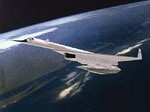
Aviation Week and Space Technology reports on the recently-shelved Blackstar system, a two-stage-to-orbit system designed to place a small military spaceplane in orbit:


This two-vehicle "Blackstar" carrier/orbiter system may have been declared operational during the 1990s.

A large "mothership," closely resembling the U.S. Air Force’s historic XB-70 supersonic bomber, carries the orbital component conformally under its fuselage, accelerating to supersonic speeds at high altitude before dropping the spaceplane. The orbiter’s engines fire and boost the vehicle into space. If mission requirements dictate, the spaceplane can either reach low Earth orbit or remain suborbital.

The manned orbiter’s primary military advantage would be surprise overflight. There would be no forewarning of its presence, prior to the first orbit, allowing ground targets to be imaged before they could be hidden. In contrast, satellite orbits are predictable enough that activities having intelligence value can be scheduled to avoid overflights.

Exactly what missions the Blackstar system may have been designed for and built to accomplish are as yet unconfirmed, but U.S. Air Force Space Command (AFSPC) officers and contractors have been toying with similar spaceplane-operational concepts for years. Besides reconnaissance, they call for inserting small satellites into orbit, and either retrieving or servicing other spacecraft. Conceivably, such a vehicle could serve as an anti-satellite or space-to-ground weapons-delivery platform, as well.


Read the full story here

Satellites Track Climate Change

Thursday, March 2nd, 2006

Back in March of 2002, twin satellites launched called GRACE (short for Gravity Recovery and Climate Experiment) were launched by NASA to make detailed measurements of Earth’s gravity field and to the Earth’s natural systems.
Today, MSNBC reports that new data from the satellites reveal that global warming is causing ice loss in Antartica: 


 Joining the growing list of places on this planet that are melting, Antarctica is losing about 36 cubic miles (150 cubic kilometers) of ice every year, scientists reported Thursday.

For comparison, Los Angeles consumes roughly 1 cubic mile of fresh water a year.

The south polar region holds 90 percent of Earth’s ice and 70 percent of the total fresh water on the planet, so any significant pace of melting there is important and could contribute to an already rising sea….

"This is the first study to indicate the total mass balance of the Antarctic ice sheet is in significant decline," said Isabella Velicogna of the University of Colorado at Boulder.

More information on GRACE can be found here


Further Scenes from a Universe

Wednesday, March 1st, 2006

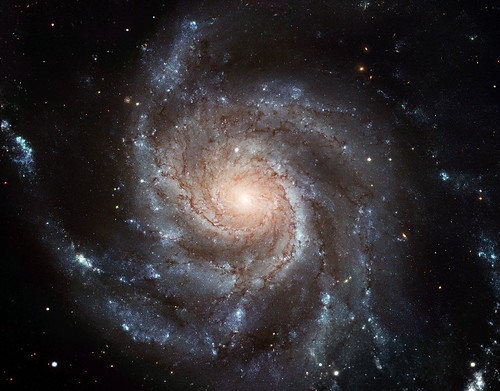
Pinwheel

This time it’s the Hubble telescope, bringing you the Messier 101 spiral galaxy (a/k/a the Pinwheel Galaxy) head-on, in just 51 exposures and coming in at a mere 16,000 by 12,000 pixels