Send In The Rocket Scientist
 

Watched the U.S. presidential debate last night and neither could explain their position on this $700 billion bailout/rescue. Seems their economic talking points haven’t changed much in six months (Main Street, middle class, tax the rich). We need Madison Avenue to start selling these leading candidates.

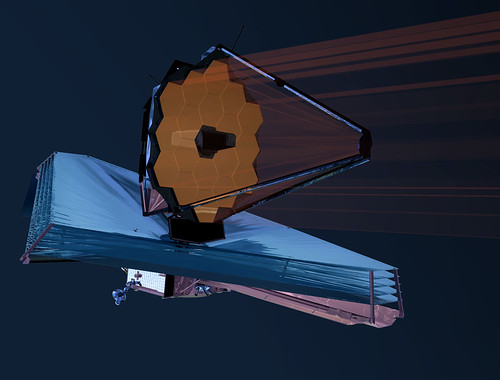
Now we’ve got an interesting angle, as far as we’re concerned and way to go, NPR! They called it before we did in today’s Morning Edition piece on Neel Kashkari, the new Interim Assistant-secretary for Financial Stability: "Ex-Rocket Scientist To Oversee Financial Bailout." He worked on NASA’s Jame Webb Space Telescope at TRW. Click here to listen:

Back in the 1990s, Tom Dautel worked on a team led by Kashkari to design a solar car called the Photon Torpedo at the University of Illinois. He says Kashkari worked like a slave, often even on projects he wasn’t directly overseeing.

"He meant business. He wanted to get the job done. He was very focused, and it doesn’t surprise me he ended up where he is," Dautel says.

Poorni Bid says Kashkari’s intensity made the man she and other classmates called Rocket Scientist seem wise and competent beyond his years.

"He stood out in just his focus and just his intensity," she says. "And you’d think everyone in MBA school would be like that, but there was a different quality about him."
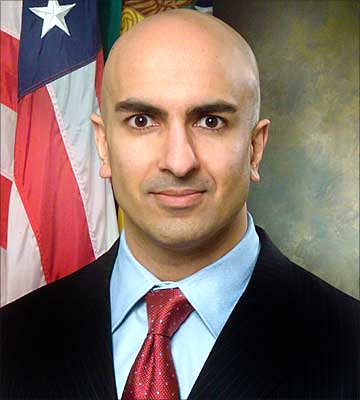


The Independent (U.K.) gives us some background:

Before he became one of the "masters of the universe", as the ambitious bankers of Wall Street are known, Mr Kashkari was headed towards becoming a master of the cosmos, doing important work for Nasa’s space program. Banking is not in his blood. Science is. His father, Chapman, is a retired professor of engineering, and his mother Sheila is a pathologist. It was to science that the young Neel Kashkari originally hewed, taking a bachelor’s and a master’s in engineering at the University of Illinois at Urbana-Champaign, his home state’s flagship public university. His first major career was as a research and development investigator at a company called TRW in Redondo Beach, California, which had an illustrious history as a contractor to Nasa, creating several of its deep space satellites. At TRW, Mr Kashkari helped develop technology for new space science missions such as the James Webb Space Telescope, which is due for launch in 2013 as a successor to the ageing Hubble telescope and which will go searching for light from the first stars formed after the Big Bang.

The sheer complexity of this situation will take a rocket scientist to fix, but it’s already affecting the presidential race:

Within the poll numbers, Obama appears to have been helped by a number of factors. For one, voters generally tend to say they believe Democrats are better at handling the economy than Republicans, and that appears to have happened here. A new Hotline poll shows that over the last week the percentage of respondents who feel McCain is better prepared than Obama to handle the economy fell five percentage points, from 43 to 38 percent.

McCain’s personal performance, from his attempt to cancel the initial presidential debate to his silence in presidential meetings on the bailout, did not gain him new votes, at least in the short term. A USA Today/Gallup poll taken before the bailout failed to pass the House on Monday showed that 53 percent of respondents judged his actions unfavorably.



India, to the Moon!

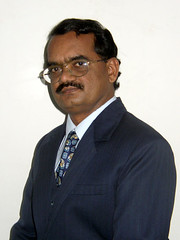
Who is this man?


He’s the man who’ll give India the moon, otherwise known as Mylswamy Annadurai, the recipient of the Hariom Ashram pretit Vikram Sarabhai Research Award for his outstanding Contributions to Systems Analysis and Space systems management(2004), and the recipient of a citation from ISRO for his contribution to the INSAT systems Mission management(2003) and Team Excellence award for his contribution to Indian Space Program (2007):

On the shoulders of the soft-spoken M Annadurai rests a mission that will make history for the Indian Space Research Organisation (ISRO) and for India. The man, who has worked on a dozen ISRO missions, is now the project director of the most ambitious of missions of ISRO till date. Annadurai… is now preparing to send India’s first mission to the moon, Chandrayaan I.

The spacecraft, which will carry 11 payloads, of which five are from India and six from the US, Europe and Bulgaria, will be launched onboard the Polar Satellite Launch Vehicle C11 (PSLV), with improved strap-on motors. On D-day (as of now, October 22), the PSLV’s lift-off will take India into the league of nations that have had a date with the moon, remotely. This could be just the warming up before an Indian lands on the moon.

Here’s a good illustration of the Chandrayaan I mission. Integration with the launch rocket has begun at Sriharikota Range (SHAR), and the launch is scheduled for the 22nd of this month:


At SHAR, the lunar probe will undergo a further series of electrical and mechanical checks, including those of its solar panels. It has already undergone preliminary thermal and vibration tests at the ISRO Satellite Centre (ISAC) in Bangalore.

The upgraded version of the launch rocket PSLV-C11 will have a lift-off weight of 316 tonnes, and will be used to inject the 1,304-kg mass Chandrayaan-I into a 240 x 24,000 km orbit. Subsequently, the spacecraft’s own propulsion system will be used to position it in a 100-km polar orbit around the moon.

We’ll have more about the liftoff as the 22nd approaches.

Space Tug

Currently, when satellites malfunction, they become (very expensive) space junk. A geosynchronous satellite orbits at 36,000 km (22,300 miles), which puts it outside the range for any type of service or repair. But researchers at Queen’s University in Kingston, Ontario are hoping to change that.

“These are mechanical systems, which means that eventually they will fail,” notes Electrical and Computer Engineering professor Michael Greenspan, who leads the Queen’s project. But because they are many thousands of kilometres away, the satellites are beyond the reach of an expensive, manned spaced flight, while Earth-based telerobotic repair isn’t possible in real time."

Dr. Greenspan’s solution to this problem is the development of tracking software that will enable an Autonomous Space Servicing Vehicle (ASSV) to grasp the ailing satellite from its orbit and draw it into the repair vehicle’s bay. Once there, remote control from the ground station can be used for the repair, he explains. “The repair itself doesn’t have to be done in real time, since everything is in a fixed position and a human can interact with it telerobotically to do whatever is required.”

The main challenge in this process is computer vision. The robotic system must be able to recognize and track the satellite, even in the harsh illumination conditions of space. Here’s a video demonstration of the technology that helps accurately measure the surface geometry of the satellite. It’s a light-based radar called LIDAR:


Funding for the Queen’s University research is provided by NSERC. NSERC is a federal agency whose vision is to help make Canada a country of discoverers and innovators for the benefit of all Canadians. The agency supports some 25,000 university students and postdoctoral fellows in their advanced studies and promotes discovery by funding more than 11,000 university professors every year.


Loral tried to sell NASA on a space tug last December:

Instead of using a Russian Progress supply spacecraft to retrieve a separately launched pressurized cargo vehicle and guide it back to the space station for unloading, the Space System/Loral-team would use the company’s proven 1300-series satellite bus as a refuelable space tug that would remain in orbit for as long as 10 years.

And then, of course, there’s the Jules Verne cargo ship, which we’ve blogged about before.

Virgin Says “No”

A "no" from Virgin means "NO," dutifully reported by Peter de Selding:

Virgin Galactic Rejects Million-Dollar Offer to Film Sex Video

By Peter B. de Selding
Space News Staff Writer

GLASGOW, Scotland — The private company planning to take wealthy tourists to the edge of the atmosphere starting in late 2009 or early 2010 has refused a million-dollar proposal to film a sex video while the participants are floating gravity free, the company’s president said.

Will Whitehorn, president of Virgin Galactic, said the offer, from an unidentified party, "was $1 million, up front, for a sex-in-space movie. That was money we had to refuse, I’m afraid."

Whitehorn disclosed the rejected transaction here Sept. 30 during the International Astronautical Congress. He said Virgin Galactic, part of Richard Branson’s Virgin Group, is planning to begin flights of the WhiteKnightTwo aircraft in late 2009 or early 2010 from Sierra County, N.M.

Remember, selling begins with the word "no." Let’s see what other offers pop up.

Commute got you down? Introducing the DIY Segway

Boring commute and a weekend to spend in the shop? Try your hand at building your own self-balancing Segway.

Or, if you aren’t exactly Dean Kamen, try this slightly scaled down version built, along with a couple LEGO motors, on the open-source Arduino platform. Using relatively simple programming techniques, a huge community of enthusiasts, and a generous selection of tutorials and info, this little guy—dubbed “Arduway”—is one of the community’s newest creations.

Feeling ambitious? Check out these projects from the guys at MIT and the University of Minnesota.

MIT set out to build their Segway clone for less than $1,000 and to weigh around 50 lbs. They ended up with a finished product that is functionally identical to a genuine Segway and even includes cupholders!

The Segway folks are even billing the real thing, which comes in around $5,000, as the green alternative to fuel-powered automobiles (segway.com/nogas), citing the fractional cost of ownership and maintenance compared to cars.

Finally, if your DIY juices are really flowing, channel visions of Marty McFly as you take a look at Minnesota’s Segskate project—described simply as, “like Segway but it is a skateboard.” The video speaks for itself.

Inadequate Gravel Road Training


Transporting a missile/rocket booster by semi. As the driver of that tractor, you’d think you’d be very well trained. You can never have too much training, as we read North Dakota’s Bismarck Tribune:

Cost to recover rocket booster: $5.6 million

By JAMES MacPHERSON
Associated Press Writer

The military says it cost $5.6 million to recover an overturned truck carrying an unarmed missile booster rocket in northwestern North Dakota.

The Air Force blamed "driver and safety observer error" for the July 31 incident. The truck carrying the booster for the unarmed Minuteman III intercontinental ballistic missile tipped over on a gravel road while being transported from the Minot Air Force Base to a launch facility 70 miles southwest. Two airmen were in the truck, which was accompanied by a security convoy.

"There were no injuries and the accident posed no danger to the public," the Air Force said in a statement.

The rocket booster and truck remained at the side of the road until Aug. 10, while investigators assessed the crash site.

Air Force spokeswoman Maj. Laurie A. Arellano said the recovery cost of $5.6 million included damage to the truck and its cargo.

"Inadequate gravel road training programs and the inability of 91st Missile Wing engineering personnel to accurately determine the safe load-bearing width of gravel roads along designated routes also contributed to the accident," the Air Force statement said.

The Air Force said the booster rocket is 66 feet long and weighs 75,000 pounds while the vehicle, trailer and rocket booster weighed more than 70 tons.

"While preparing to make a left turn, the driver and safety observer maneuvered the loaded tractor-trailer beyond the right edge of the reinforced gravel roadway and shoulder," the Air Force statement said.

"Basically, the procedure for large trucks is that they’re supposed to drive in the middle of the gravel road," Arellano said.

Arellano did not know Thursday if any airmen had been sanctioned.

They should have hired one of the drivers who race up Pike’s Peak in trucks. Take a look at this video clip:


Smile For The Satellite

Chelyabinsk is one happy town. They’ve come a long way from being "the most contaminated spot on the planet."

Here’s an interesting story from Slashdot:

Citizens of the Russian town Chelyabinsk calculated when the satellite, QuickBird, which takes images for Google Earth and Google Maps, would cross above their city and used people to make a giant smiley face. A rock concert on the main square attracted many people and everyone got a yellow cape. It looks like someone at Google was quicker than usual to put up the new data. Maybe Google likes the idea of an entire town working hard to get its 15 minutes of fame. The article has a screenshot of Google Maps and images taken directly at the event."

They did pretty good:


This isn’t the first time that Google Earth or Google Maps has captured something interesting from space. Longtime readers of Really Rocket Science will recall the Ipod that fell to Earth, which we wrote about way back in March of 2006:


But there’s more to be seen than "Ipods" and smiley faces in the world of Google Earth. GoogleSightSeeing.com — whose tag line is "Why Bother Seeing the World for Real?" has a great series of blog posts on cool sights that you can see right from your computer desk. Be sure to check out this map of global points of interest.

Here’s a clip on Chelyabinsk:


Airborne Broadband Bacchanal


About a week after Labor Day, ARINC introduced new Caribbean coverage for SKYLink, an in-flight broadband service for business jets:

The new Caribbean coverage area means users of the SKYLink network will be able to fly from Europe to North America, across the Caribbean, and on to Central and South America, without losing access to important e-mail or Internet applications. To encourage customers to take part in the coverage tests, ARINC Direct suspended roaming charges in the new region through July 21, 2008. Customer feedback was used to adjust satellite coverage and to map signal strength across the region.

The new coverage includes the Bahamas, Jamaica, Cuba, Haiti, the Dominican Republic, Puerto Rico, the Lesser Antilles, Trinidad-Tobago; Belize, Guatemala, Honduras, El Salvador, Nicaragua, Costa Rica, Panama, Colombia, Ecuador, northern Peru, northern Bolivia, Venezuela, Guyana, and part of Surinam.

eXchange with service by SKYLink is the only communications system for business jets offering true broadband Internet speeds—as high as 3.5 Mbps to the aircraft. Customers have access to e-mail, corporate intranet (VPN), the Web, flat-rate Voice over IP (VoIP) global telephone service, and videoconferencing. eXchange also provides e-mail and data capability for personal Wi-Fi enabled smartphones in the cabin.


Really cool how Rockwell-Collins integrates it all:

Business travelers will experience real-time, two-way broadband connectivity with secure access to e-mail services, Internet browsing, access to Virtual Private Networks (VPN), and options for Voice over IP (VoIP) telephone service and videoconferencing. eXchange also enables data connectivity to select Wi-Fi enabled smartphones, such as RIM’s Blackberry models 8320 and 8820, providing travelers with access to e-mail and other smartphone data services.

Thanks to the AMC-21 satellite’s dedicated Caribbean Ku-band beam — and new mobile platform — local satcom Internet companies like Caribbetech and mobile services like KVH have new opportunities to pursue.

Satellite Internet Making Inroads on the Backroads

It’s hard to believe for some of us who think of dial-up internet as a thing of the past, but up to 10 million Americans who live in our nation’s most remote places still don’t have the option of DSL or cable internet.

But dial up won’t suffice in today’s age of YouTube and World of Warcraft, so what to do?

The answer is satellite broadband Internet. 

We’ve written in the past about several of the players in the market, such as Wild Blue, HughesNet, and Spacenet’s Starband.  But today we want to focus on SkyWay USA, which touts itself as "rural America’s low-cost satellite provider."


For just $49 in equipment costs (after a rebate) and a monthly basic subscription of $29.95, you can be up and running with SkyWay USA in a matter of days. Installation is so easy, according to this press release (caution if you’re still on dial-up: opens in PDF) that Skyway claims they’ve even had a 69 year old grandmother install the system.

So how does it work?

Skyways use a hybrid or combination model, using your phone line for sending commands (upload) and satellite for content (download).

For capacity, they use Echostar Fixed Satellite Services — at least according to MarketWatch. (On their own website, SkyWay says it is partnering with SES Americom.)

FSS is the division of EchoStar that uses DISH Network’s excess capacity. Dean Olmstead,  who was behind the AMERICOM2Home concept, notes that SkyWay USA will be using both the Ku- and Ka-band capacity of Echostar FSS.  

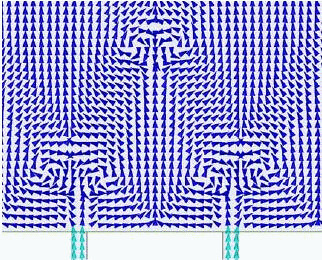
Reverse Electromagnetic Waves


Fascinating story, first posted to PhysOrg.com (and since garnering quite a few Diggs) Well, leave it to Doug Lung to draw some interesting conclusions:

What if you could design a satellite dish or microwave antenna with the feed horn behind the reflector instead of in front of it? That may be possible, thanks to research by Cesar Monzon, a senior scientist at Enig Associates presented in the paper Anomalous Power Flow and ‘Ghost’ Sources published in Physical Review Letters (payment required to view the full paper).

The abstract describes the effect this way:

"It is demonstrated that EM radiation from complex sources can result in real power in restricted regions of space flowing back towards the sources, thereby mimicking ‘ghost’ sources. This counterintuitive mechanism of radiation does not rely on backward waves, as ordinary waves carry the power. Ways to harness the effect by making it directional are presented, together with selected applications, of which deception is a prime example due to the nature of the phenomenon."

It goes on to say that this concept could be to such areas as mechanics, acoustics and others with technology that is already available.

The article In radiation ‘ventriloquism,’ electromagnetic waves travel backwards on Physorg.com describes how the waves are generated and listed some of the possible applications. Obviously hiding transmitters and radar emitters is desirable in military environments.

Physorg.com quotes Monzon describing how the technology could be used with dish antennas: "On the case of satellite antenna feeds, the theory indicates it may be possible to build these behind the main reflector dish, which will offer a clear field of view without blocking or the disadvantages derived from feed offsetting. The same principle applies to both transmit and receive antennas."

I recall a paper from the mid-80s published in the Ukrainian Physics Journal (by O.S. Ilenko of the Kyivskii Politekhnicheskii Institut). The abstract, translated from the original Russian:

The diffusion of cylindrical electromagnetic waves and electromagnetic energy oscillations in the near field of a radiator is analyzed based on the physical principles of Huygens (1935). It is shown that the surface of a moving electromagnetic wave which conforms to the Huygens principle will be either spherical or planar in free space. Deviations from the planar or spherical forms can lead to the development of reverse electromagnetic waves. The geometry of the wave surfaces is illustrated.