Global Mobile Satcom
 

Inmarsat CEO Andrew Sukawaty said it best:

The Inmarsat-4s are the world’s most sophisticated commercial network for mobile voice and data services, and the successful launch of the third I-4 allows us to complete the global coverage for our broadband services. Once the third I-4 is operational, Inmarsat will have the only fully-funded next-generation network for mobile satellite services.

Very cool mission: complete global coverage from 3 satellites, for land, air or sea.  Oh, and so many spot beams:

Each I-4 can generate 19 wide beams and more than 200 narrow spot beams. These can quickly be reconfigured and focused anywhere on Earth to provide extra capacity where needed.
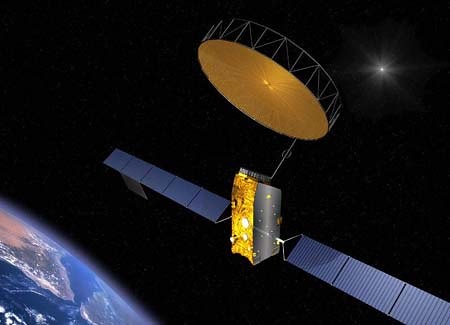


A spacecraft this powerful is a biggie:

Each satellite can digitally form more than 200 spot beams. More power and spectrum can be allocated to certain beams to cope with the fluctuations in traffic. An on-board digital signal processor routes the signals to the different beams, acting like a switchboard in the sky: any signal uplink can be routed to any mobile downlink beam and vice versa.

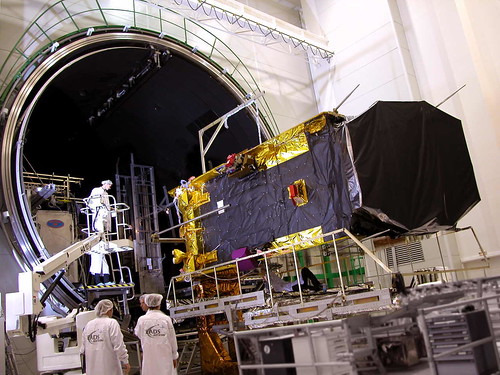
All three satellites are identical and interchangeable – their coverage is programmable and can be reconfigured in orbit. They are based on the E3000 version of Astrium’s outstandly successful Eurostar satellite platform series, and equipped with electric propulsion system. Their 45m-long solar array generates 14 kW of electrical power at beginning of life and the spacecraft weighs approximately 5,950 kg at launch. The main body is 7 metres high and the unfurlable antenna reflector has a diameter of about 10 metres.
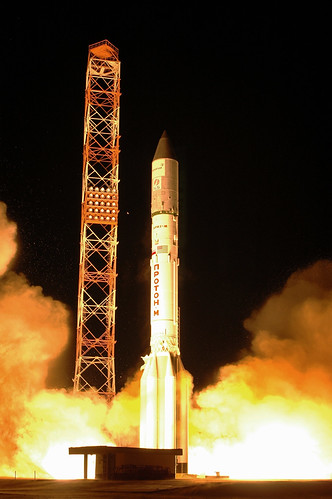
Here’s the launch video:


Putting the Little Guy in Space

We’re written a good deal about space tourism in the past, and about the burgeoning private spaceflight industry.

Most notable in the field, of course, is Spaceship Two project headed by designer Burt Rutan and backed by entrepreneur Richard Branson.

But what about the little guy, toiling away in his metaphorical garage in the hope of becoming the Steve Jobs of private space travel?


By day, Morris Jarvis works as an instrumentation and control engineer for Intel Corp.’s newest factory, Fab 32.
 
By night and on the weekends, he is Arizona’s version of the "Astronaut Farmer," building a vehicle he hopes to launch into space someday.
 
Jarvis and his 10 partners have built a prototype of a craft that would take everyday people on suborbital flights for a fee. He named the craft Hermes, a Greek god of land travel…

 Jarvis is about three years into the latest prototype, a gleaming white craft that resembles a boxy version of the space shuttle and seats four passengers. He works on it in his shop at his east Mesa home.

The problem is that Jarvis needs money to get a workable model off the ground.
 
He estimates he needs about $100,000 to do glide testing. He then would need $1.5 million to launch the craft with a helium balloon, the cheaper of two methods he is considering.
 
Launching the craft with a rocket would take about $5.4 million, he estimates.
 
Jarvis’ business plan is aimed more at the regular tourist than the wealthy, at least relatively speaking. He hopes space travelers will pay $25,000 — or about the price of a new car — for a trip powered by a helium balloon and $100,000 for a ride powered by a rocket.

That compares to Virgin Galactic, which has already collected $25 million in deposits from would-be space travelers at $200,000 per flight.

 
But lest you think that Hermes is too much of a garage space project, we should note that Jarvis’ employer, Intel, is building the chip set for the spacecraft. 
 
(Incidentally, Hermes was also the name of a proposed mini-shuttle designed by the French Centre national d’études spatiales (CNES) and the ESA to compete with the space shuttle back in the late 70s and early 80s, according to Wikipedia.)
 
The race to get normal people into space is, of course, part of a larger, renewed space race all around the globe
 
It’s an exciting time to be a rocket scientist. 
 

Iran Launches First Satellite

The space race got a little more crowded yesterday.

Iran launched its first satellite, using a domestically produced rocket. The launch of the Safir (Ambassador) rocket was shrouded in mystery…surprising, I know.

Few details were available about the rocket or its payload…Western experts say Iran rarely provides enough details for them to determine the extent of its technological advances, but that much Iranian technology consists of modifications of equipment supplied by China, North Korea and others.

And how are Iran’s neighbors responding? Israel, for one, says it’s unconcerned.

The launch comes on the birthday weekend of Hazrat Mahdi, the 12th Imam. Shiites believe his return will signal the end of days.

DIY Friday: HDTV Antenna

Question: What can you make with 2 forks, an old lamp, and a shoelace?

Answer: A sweet HDTV Antenna!

One of our most popular DIY Friday projects was this post on how to build your own HDTV antenna.

And, this week we’re bringin’ it back with some new tricks.

The $10 lamp version above is a great option. Or you can try the Gray-Hoverman Antenna, which has gotten some great reviews:

"Boy, this antenna is hot. I finally got it pointed right. After I did a search for channels, I got 23 digital channels, and this is from about 30-40 miles, over mountains…This antenna is a vast, and I mean REALLY VAST improvement over anything I have used." – DogT


This Broadcast Brought to You By….

This is prime time for political junkies. In less than two weeks, the Democratic National Convention kicks off in Denver; one week later, the Republicans hold their party convention in Minneapolis.


But convention broadcasting isn’t what it used to be. Times were, you could watch nearly every night on the Big Three networks; it was a late-summer ritual in presidential election years.

That’s no longer the case, which is why this political junkie is thankful for satellite television.

The Democrats have announced this week that you can find them on the Dish Network

Dish Network will bring live satellite video feeds into the convention hall from off-site locations across the country. The satellite provider will also offer uninterrupted, unedited live satellite convention coverage to its 13.8 million subscribers across country, available on Channel 211.

In addition, Dish Network’s video feed will be broadcast in HD on television monitors throughout convention venues and will be made available via satellite to television stations for downlink across the country and around the world.

“When we set out to make this convention more inclusive and accessible than ever before, we wanted to do more than get our message out—we wanted to bring the voices of American people into the process, and Dish Network will help us to do just that,” said Brook Colangelo, Director of Technology for the Democratic National Convention Committee, in a prepared statement. “Whether from inside the Convention hall, at watch parties in communities across the country, or from the comfort of their living room, Dish Network’s  technology and services will enhance the Convention experience for everyone who’s tuning in.”

What about the Republicans?


Thus far, they’ve only announced that Google will be their "Official Innovation Provider." We’re not sure what that means, exactly, but we’ve got high hopes that a satellite broadcast provider will be announced for the GOP in the coming weeks. 

Tasting The Ice Plumes of Enceladus


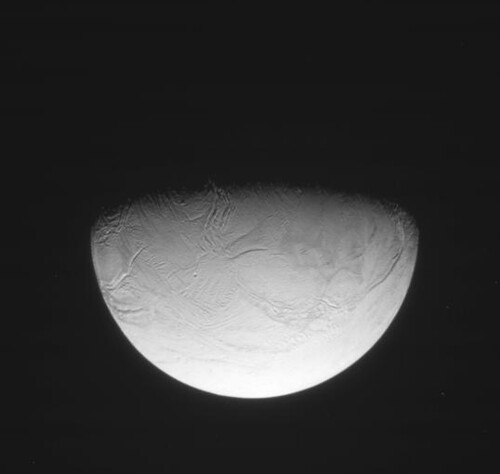
Planetary scientist Carolyn Porco is very happy this week, judging from her blog post on recent Cassini-Huygens images:

Well, folks, the images are down … at last!! …  and I can’t print here what I first said upon seeing them.  What a dazzling success!  There doesn’t even appear to be any smear.   Paul Helfenstein (imaging team associate who planned the images), you genius … here’s one big hug from me, man!  We here at CICLOPS are all giddy, even moved to tears.


The ice plumes of the Saturn moon were first seen last October. Here’s an animated rendering:


This week’s mission is noteworthy, as they’ve practically brushed by the surface:

During closest approach, Cassini successfully passed only 50 kilometers (30 miles) from the surface of the tiny moon.

Cassini’s signal was picked up by the Deep Space Network station in Canberra, Australia, and relayed to the Cassini mission control at NASA’s Jet Propulsion Laboratory in Pasadena, Calif.

"We are happy to report that Cassini’s begun sending data home," said Julie Webster, Cassini team chief at JPL. "The downlink will continue through the night and into tomorrow morning."

Closest approach occurred at approximately 3:21 p.m. PDT, while Cassini was traveling at a swift 17.7 kilometers per second (40,000 miles per hour) relative to Enceladus.
 
During the flyby, Cassini focused its cameras and other remote sensing instruments on Enceladus with an emphasis on the moon’s south pole where parallel stripes or fissures dubbed "tiger stripes" line the region. That area is of particular interest because geysers of water-ice and vapor jet out of the fissures and supply material to Saturn’s E-ring. Scientists hope to learn more about the fissures and whether liquid water is indeed the engine powering the geysers.  

You’ll enjoy this video:


AMC-21 Launch Updates

This Thursday, August 14, 2008, an Ariane 5 rocket is scheduled to lift the SES Americom AMC-21 communications satellite into orbit from the European Spaceport in Kourou, French Guiana.

The satellite will operate from the 125 degrees West orbital position after it is launched by Arianespace.

From the press release

Thales Alenia Space served as the prime contractor and communications payload supplier of the Star-2 spacecraft that was designed, built, integrated and tested by Orbital Sciences Corporation (NYSE: ORB). 

AMC-21 was designed and built for advanced telecommunications, mobile applications and TV broadcasting with coverage of the 50 U.S. states, as well as Southern Canada, Mexico, Central America and the Caribbean.  Featuring 24 active 36 MHz transponders, the 2500 kg spacecraft has a 15-year design life.

The launch window for AMC-21 is from 5:44 p.m. to 6:35 p.m., local time in Kourou, French Guiana (4:44 p.m. to 5:35 p.m. in New York; or 8:44 p.m. to 9:35 p.m. GMT; or 10:44 p.m. to 11:35 p.m. in Paris; or 5:44 a.m. to 6:35 a.m. in Tokyo, etc.). You’ll also be able to watch the launch on the web here

Going along for the ride with AMC-21 will be the Superbird-7 satellite for Space Communications Corporation of Japan. 

Thursday’s launch is just one of many for the satcom industry over the coming months, though the Orbital spacecraft set to launch on August 21st has been delayed, as Measat-3 is being sent back to the United States for repairs, which is a true bummer for the 25 kids who were getting set to watch the launch.

We’ll bring you updates on the launches as they happen. 

Olympics Pirates

On Friday, after hearing about the awesome opening ceremony for the Olympics, I immediately went to NBC.com in search of the video. No dice. They weren’t airing it on TV until later that night, so they hadn’t posted it online yet.

Naturally, I turned to YouTube. Jackpot. 5 stars. Posted 8 minutes before. But wait! It was already taken down.

This is the scenario that NBC is hoping will play out throughout the Olympics, but will they succeed in pulling all the pirated content off the web? They’re certainly trying:

The piracy measures NBC is taking include digital watermarking to “tag” the coverage. An NBC spokesman said the network and its broadcast partners are tagging all the video that NBC originates from the Olympics.

That can help track offenders, said Russell Zack, VP of product management at Anystream, one of the vendors handling online and television technology for NBC’s Olympics effort.

“That acts as a forensic stamp you can track back to the last place it came from and it’ll give you hints as to what system it came from,” he said…NBC also has charged a handful of employees with scouring the Web every day to look for pirated videos from the Olympics. When those videos are found, the network will send a take-down notice to the site, NBC said.

They’re hoping they can channel online Olympics enthusiasts to their own impressive range of on-demand coverage. They’ve paired up with Anystream to deliver content across platforms, and their 3,600 hours of coverage over the course of the games will surpass the combined total of every other summer Olympics ever televised in the United States. We’ve blogged about NBC’s coverage before.

And it’s not just the American’s who are fighting pirated content. Chinese websites are also joining the fight.

DIY Friday: Make Your Own Video Game

I’m starting to get a bit bored with the range of games available for Wii. So, I figured I’d take my entertainment into my own hands. It is DIY Friday, after all.

This kit gives you pretty much everything you need to start programming. This one is kind of a DIY for Dummies. You don’t need to know any code to get started, and they have tons of tutorials to help you out.

If old-school arcades are more your style, you can buy all the parts you need here.

Hanny’s Voorwerp

This is a great story.

Imagine you’re spending some time on the Galaxy Zoo website —  "the project that harnesses the power of the internet and your brain," as the slogan goes "to classify a million galaxies" — and in the image of a remote galaxy that literally no one has ever looked at you find something: different. Something that doesn’t match the classification guidelines given to volunteers on the website.


What would you do?

You’d probably put up a post in the Galaxy Zoo forums asking other users for help identifying the object, correct? And maybe email the webmaster?

That’s exactly what Dutch schoolteacher Hanny Van Arkel did when she discovered a green blob in an image that she was classifying on the Galaxy Zoo website. What happened next is incredible.

The BBC explains

A new class of cosmic object has been found by a Dutch schoolteacher, through a project which allows the public to take part in astronomy research online.

Hanny Van Arkel, 25, came across the strange gaseous blob while using the Galaxy Zoo website to help classify galaxies in telescope images.

Astronomers subsequently confirmed that the object was one-of-a-kind.

The work has been submitted to the journal Monthly Notices of the Royal Astronomical Society.

The object quickly became known as "Hanny’s Voorwerp" – Voorwerp being the Dutch word for "object".

Researchers think this green blob got its energy from light emitted by a quasar (a powerful radiation source powered by a supermassive black hole) that has since gone dim.

They think the quasar was hosted in a nearby spiral galaxy called IC 2497. It was so bright that, if the quasar was still active, it would be visible from Earth with binoculars.

However, because of the distance between the galaxy and the Voorwerp, light from the quasar would have taken tens of thousands of years to reach the gaseous blob…

Dr Lintott said the object was the only one of its type known to astronomers, though other Voorwerpen could still be awaiting identification.

He added that the object had been catalogued before, but its significance had only been recognised when it was brought to the attention of Galaxy Zoo team members by Ms Van Arkel.

During the last year, 50 million classifications of galaxies have been submitted on one million objects at galaxyzoo.org by more than 150,000 amateur astronomers from all over the world.

The next stage of the project will ask volunteers for more detailed classifications, making it easier to identify more unusual objects such as Hanny’s Voorwerp, according to the BBC report.