China Launches Zhongxing-9
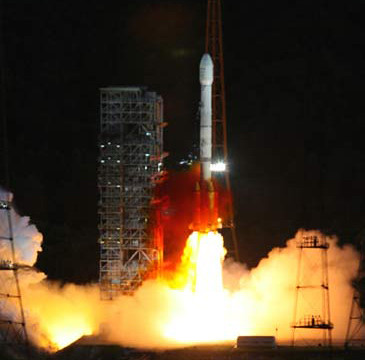
China announced today the launch of its new communications satellite, Zhongxing-9, from the Xichang Satellite Launch Center in the southwestern Sichuan Province.

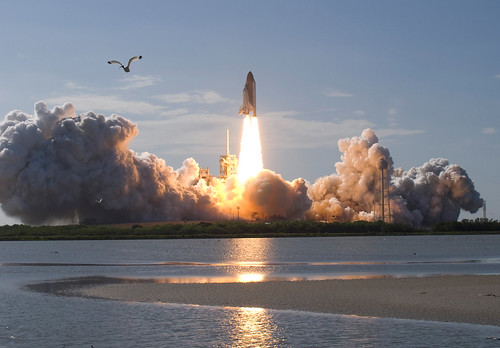
The bird went up at 8:15 p.m. Beijing Time on Monday:

The satellite was shot into space aboard the Long March-3B rocket carrier. It was the 107th launch mission for the Long March series of carrier rockets….

The China Great Wall Industrial Corporation (CGWIC), the contractor of the satellite launch, signed the launch service contract with China Satcom in November 2005.

As the only company engaged in international commercial satellite launching services, CGWIC has launched 34 foreign satellites for 28 services.

Zhongxing-9 was built by France-based Thales Alenia Space for China Satcom, which plans to use it for live television broadcasts of the Beijing Olympic Games in August.

The launch of  Zhongxing-9 may help rural residents of China get a clearer picture of the Olympics, but other networks are getting increasingly worried about just what they’ll be able to broadcast to the rest of the world:

 Television networks that will broadcast the Beijing Olympics to billions around the world are squaring off with local organizers over stringent security that threatens coverage of the games in two months.

Differences over a wide range of issues — from limits on live coverage in Tiananmen Square to allegations that freight shipments of TV broadcasting equipment are being held up in Chinese ports — surfaced in a contentious meeting late last month between Beijing organizers and high-ranking International Olympic Committee officials and TV executives — including those from NBC.

In response to the complaints from broadcasters, Sun Weijia, head of media operations for the Beijing organizers, asked them to put it in writing, only to draw protests about mounting paperwork.

The CBC has more about TV execs’ mounting worries:

In a meeting with Chinese officials held in Beijing on May 29, nine media organizations that have paid for the rights to broadcast the Olympics were told there’s unlikely to be live coverage from Tiananmen Square or the Forbidden City.

This is a change from two months ago when International Olympic Committee officials in Beijing said China had agreed to allow live coverage.

Broadcasters have been denied permits to record aerial views of the two sites for media coverage of the Games, which begin Aug. 8.

"For us to potentially not be able to do live reports from Tiananmen — the most iconic place in China — is a disgrace," said Scott Moore, executive director of Canada’s CBC Sports. "I’ve been told that to do business in China, you have to have patience. We don’t have time to have patience. The Games have begun for us already."

It should be interesting to see how the Olympic broadcasting — which sounds like an event in and of itself — will play out.

One thing is for certain: it doesn’t matter how good your satcom broadcasting capability if you can’t get the shot you want to broadcast in the first place.

 

Boatloads of iPhones


Hundreds of shipping containers have been arriving from China to ports all over this planet, presumably packed with new iPhones

Don’t miss your boat: Apple’s announcing a new iPhone on Monday, 9 June 2008 at 17:00 GMT — tape your "go away" signs to your doors and follow it on Engadget, which reported firmware details last night:

    • Infineon PMB6952 / S-GOLD3 six-band UMTS / HSDPA transceiver (as we’d heard)
    • Murata LMRX3JCA-479 tri-band amplifier (we’re assuming for the 3G)
    • Sony SP9T antenna switch for GSM / UMTS dual mode
    • ARM 1176JZF-S – Main CPU (same as in 1st gen iPhone)
    • Skyworks 77427 chip – UMTS / HSDPA tx 1900MHz, rx 2100MHz
    • Skyworks 77414 chip – UMTS / HSDPA 1900MHz Skyworks 77413 chip – UMTS / HSDPA 850MHz
    • Internal build model number: n82ap (1st gen iPhone was model m68ap)
    • UMTS Power Saving option – on or off
    • Hooks for Global Locate Library (GLL), software that handles A-GPS related commands for the host processor


Otherwise, we have no shortage of rumors. Check Engadget, Gizmodo and FierceWireless. There are sure to be some surprises, and I’m hoping for live TV reception via A-VSB. Getting DVB-H, DVB-T or DVB-SH may be a stretch, but maybe next year.

I’ll be watching/following the Apple WWDC any way I can. MacWorld reports this is one of the most important in years:

“This is a hugely significant WWDC for Apple because they are bringing out a new platform,” said Michael Gartenberg, vice president and research director at research firm JupiterResearch. “This is the coming out party for the iPhone.”


DIY Friday: Flux Capacitor

You’ve seen Back to the Future and the De Lorean time machine, but what is a flux capacitor?

It’s the Y-shaped flashing light device (powered by 1.21 jigowatts) that turns a sports car into a time machine. How does/did it work? “Doc” couldn’t even explain it:

It is not described in the films exactly how the flux capacitor worked beyond that of a typical plot device or a typical deus ex machina device, though Doc mentioned at one point that the stainless steel body of the DeLorean has a direct and influential effect on the “flux dispersal”, though he was interrupted before he could finish the explanation. The flux capacitor required 1.21 gigawatts of electricity to operate.

You can make your very own Flux Capacitor (but, PLEASE, do not toss it in your car, cross your fingers, and go 88 mph in a parking lot). Instructables has the instructions. Not a lot of electronics experience is needed, and most of the equipment is available at your local hardware store and Radio Shack. The Flux is housed in an ordinary fuse box.

Too complicated? You can buy one here for $250. A small price to pay for time travel capabilities. And this (more-expensive) dealer will even provide a time-travel, money back guarantee (read closely):

This item may be expensive, but can you place a price on time travel? NOTE: Special return policy: If you are not 100% satisfied, you may return this product for a full refund, in no LESS than 30 days before you purchase it!

Once you have have your Flux, get started on the rest of the De Lorean time machine:

Holy Tripoli

Earlier this year, the USS Erie successfully shot down an errant satellite in a real-world mission.

And, later today, the ship and its sea-based missle defense system will get a chance to prove itself again:

The test, off Kauai, is the latest test of the military’s sea-based missile defenses, called the Aegis ballistic missile defense program.

The military will fire a Scud-like missile, which has a range of a few hundred miles, from a decommissioned amphibious assault ship, the USS Tripoli.

USS Lake Erie, a Pearl Harbor-based Navy cruiser, will fire two interceptor missiles at the target with the intention of shooting it down in its final seconds of flight.

If all goes well, the intercept should occur within the Earth’s atmosphere, or within 100 miles of the Earth’s surface.

The Aegis system accomplished a similar task once before: two years ago, the Lake Erie shot down a missile fired from the Pacific Missile Range Facility on Kauai in its final stage of flight.

In February, the ship successfully shot down a U.S. spy satellite in the Aegis’ system’s first real-world mission.

The satellite had lost power and become uncontrollable, creating worries it would break up and spread debris over several hundred miles if it fell to earth.

The Hawaii-based, Star Bulletin has more details.

The Navy said yesterday that on Tuesday the mission, named Stellar Scorpion, was blessed at the Barking Sands missile facility by "Uncle Tom" Takahashi, who named the Lake Erie’s two interceptor missiles "the crashing sound of the ocean" and "the ear of the earth," respectively.

Being a decommissioned helicopter-carrier, the USS Tripoli (photo above) seems like a pretty odd choice to be involved in this exercise. The "Semper Princeps" (Always First), as they call it, has been around since 1964, and decommissioned (but strangely still very active) since 1995:

She was decommissioned in 1995 and as of 2004, she was on loan to the Army, but remained laid up at Mare Island Naval Shipyard. In December 2006, the ship was towed to Pearl Harbor, Hawaii, where it now has a high-tech role as a launch platform with the nation’s developing ballistic missile defense program. Three times the ship was towed some 100 miles off shore and used to launch small ballistic missiles, which are then intercepted by Terminal High Altitude Area Defense Missiles, test-fired from the Pacific Missile Range Facility. The last test in the series was performed October 26, when the ship fired a "scud-like" missile, which was successfully intercepted. The ship will be towed back to the San Francisco Bay Area for the winter. Kaua’i lacks a suitable land-based launch site, and the costs of building one would far exceed the approximately $600,000 per year it costs to use the old warship, so the vessel will return to Pearl Harbor for a second series of tests in late spring 2008.


Alaskan Business


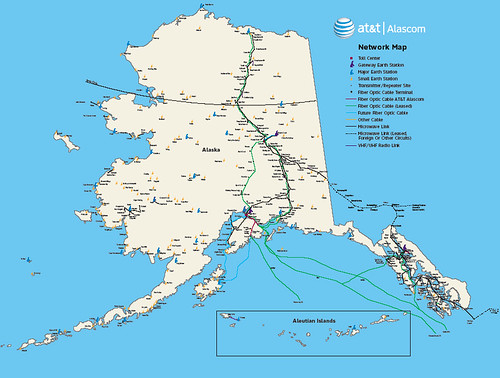
Out in the bush, you need an airplane to get around effectively. You can get by with a snowmoble in the winter, but how much can you cover in a day? Alaska is a big state, spanning 663,267 square miles (that’s 367 million acres, cowboy). Since the early 1970s, Alaska’s telephone system has been using satellite, primary using AT&T Alascom’s Aurora satellites (currently Aurora III; co-named AMC-8). Pretty extensive network, highlighted by the Alyeska Pipeline:


When Galaxy 18 launched in May, we didn’t think they’d be cutting over some of the services from the Galaxy 10R spacecraft so quickly.  End-of-life for G10R was originally projected to be 2015, but after a XIPS problem, it was cut short. One of the big customers on that bird, GCI, moved nine transponders of traffic yesterday:

GCI announced today that it successfully transitioned all of its rural telecommunication services last night to the Galaxy 18 satellite. This satellite will provide long-distance, Internet, distance education and telehealth services throughout rural Alaska for the next 14 years.

“The success of last night means rural Alaskans will stay connected to the most advanced network in Alaska,” said Ron Duncan, GCI president and CEO. “It also provides major businesses in Alaska and carriers in the lower 48 states the ability to directly touch customers virtually anywhere in Alaska.”

GCI owns nine transponders on Galaxy 18 and will take possession of a tenth transponder in approximately two weeks. GCI will lease the transponder capacity from Intelsat. However, GCI will be required to account for this arrangement as a capital lease. This will result in a capital lease obligation, and corresponding long-term asset, in the approximate amount of $98 million.

Hmm. At that price, it seems to work out to approximately $58,000 per month per transponder, and that ain’t a bad price. I suppose if the oil keeps pumping, there will always be money to pay for satcom services. Keep us rocket scientists busy for years.

Here’s where the oil ends up, in Valdez:


XH-150 Returns to Seattle

Longtime readers here at Really Rocket Science know that we’re always impressed with next generation technology.

Today, this press release from AFS Trinity Power Corporation caught our eye: 

 Two XH-150 prototypes are returning this week to the Seattle area after being unveiled at the North American International Auto Show in Detroit and then traveling to cities across the U.S. to demonstrate the car to carmakers, government officials and the driving public, including a ride-and-drive demonstration on Earth Day for members of Congress in the Nation’s Capital.

Road tests of the XH-150 at Michelin’s Laurens Proving Grounds in South Carolina prior to the Detroit unveiling demonstrated extreme fuel economy without sacrificing performance. Test reports indicated the XH-150 traveled 41.9 miles without burning an once of fuel in a mixed urban/highway driving cycle, achieved all-electric highway speed of 87 MPH, accelerated faster to 60 MPH than comparable gasoline-only models (11.6 seconds) and, in full hybrid mode, delivered zero to 60 in just 6.9 seconds.  Along with dramatically reducing vehicle emissions, the XH-150 is expected to significantly reduce the cost of operating a car. It uses only one dollar of off-peak electricity to provide enough power for the average driver’s 40 miles of daily driving and can achieve 150 miles per gallon during a typical 340 mile week. No other hybrid or plug-in hybrid of which AFS Trinity is aware has demonstrated the ability to achieve such fuel economy, range,  highway speed and acceleration.

The Governor of Washington, along with local and state officials, will be tooling near South Lake Union in Seattle today to celebrate the homecoming of the incredible vehicle.


So what’s it like? Check out these videos and these images for more on just how normal the future actually looks.

Toys in Space


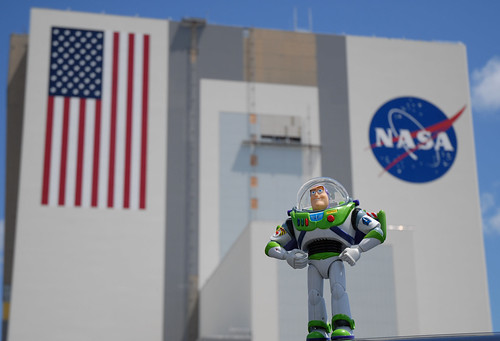
With the launch of STS-124, a great site for kids from NASA, featuring Buzz Lightyear, is up. And Buzz Lightyear’s in space, too:

Seven astronauts who will fly into orbit aboard space shuttle Discovery will have comfortable seats for the climb into space. An eighth space ranger won’t have a seat at all. In fact, he will be packed tight inside a box and won’t even get to enjoy the ride up.

But it’s nothing veteran spaceman Buzz Lightyear can’t overcome.

The good news is that he’ll have some sports shows to listen to, along with a host of jerseys that have been to the Champs Elysees in Paris for the Tour de France and to the Super Bowl.

More accustomed to soaring among the galaxies on fold-out wings and a backpack rocket, Lightyear will take to space on Discovery’s STS-124 mission stowed inside a locker in Discovery’s crew compartment. The 12-inch-tall action figure is flying as part of a partnership between NASA and Disney Parks to encourage students to pursue studies in science, technology and mathematics, one of NASA’s main educational goals.

Disney’s Youth Educational Series and NASA have developed an online program known as the Space Ranger Education Series. It includes fun educational games for students, as well as materials for educators to download and integrate into their classroom curriculum.

And the interview with Buzz Aldrin is priceless.

Blogging at 300 KM/H

No, the title of this post isn’t a reference to the velocity of our Kerouacian prose — it’s what you could be doing if you took a train between Paris, Brussels, Amsterdam and Cologne:


 The first commercial application of the European Space Agency (ESA) “Broadband on Trains” initiative officially launched May 14 on six high-speed Thalys trains… Passengers on the trains equipped with “Thalysnet” have continuous Internet connectivity while traveling at 300 km/h via a satellite 36,000 km above the trains.

The satellite link uses a low profile tracking antenna on the train to provide a two-way connection to the Ku-band satellite system and a hub station connected to the Internet backbone. Terrestrial wireless is used to maintain a connection when the train is traveling through tunnels. The total bandwidth from the satellite shared among users on the train is 2 Mbps down and 512 Kbps up. Bandwidth across all trains in the fleet is allocated on demand according to the usage level.

The tracking antenna truly is low-profile. If a train passes you at high speed, you’d be hard pressed to see the little nub whizzing by you:


The ESA initiative to bring broadband to trains started nearly two and a half years ago; as of May of this year, Thalysnet is officially and commercially available to train passengers

Thalysnet… was developed by a consortium lead by Nokia Siemens Networks, which combines satellite communications with conventional wireless data technologies to provide a continuous Internet connection on board trains travelling across national borders at 300 km/h. One of the companies in the consortium is the UK-based 21Net, which carried out a pilot project in 2005 under the European Space Agency’s Broadband to Trains initiative.

21Net worked with leading railway operators such as RENFE (Spain) and SNCF (France), along with Thalys, to develop a solution combining bi-directional satellite communications with terrestrial wireless technologies.

With soaring gas prices leading to an increase in public transport usage here in the US, could an American equivalent of Thalysnet be far behind? 

DIY Friday: Solar Hot Water

First it was soaring gas prices, then the cost of food – now it appears that the price of natural gas will surge fast.

The consequence? The cost of heating your home will be a lot more expensive next winter (especially if you’re in Wisconsin). What to do?

Well, if you’re in Iceland, just dig a hole. An amazing 90% of homes are heated with geothermal energy. Of course, with my luck, I picked this unheated, sod-roofed backpackers hostel/shack (highly-recommended, btw) on my recent stay in Iceland. Chilly nights.

But, if you’re still States-side, the geothermal option probably won’t work. So beyond simple conservation, let’s start by finding a simple and energy-free way to heat our water – the sun!

Way back in 1984, Mother Earth News brought us the plans for building an integral passive solar water heater (IPSWH):

For the do-it-yourselfer searching for an inexpensive, easy-to-build solar water-heating system, the integral passive solar water heater (IPSWH, pronounced ipswah ) is a dream come true. All you need to get going on this down-to-earth water warmer is a discarded electric water heater tank rescued from the local dump, a homemade plywood box to house it in, a can of flat black paint, a sheet or two of used window glass or clear plastic, a few common plumbing fittings and some pipe and insulation. Combine all that with some spare hours of satisfying sawing, hammering and wrench-turning, and you’ll have an ongoing supply of hot water provided virtually free from that friendly furnace in the sky.

The article gives a good how-to on the building process, and a fairly exhaustive explanation on the different types of active and passive solar water heaters. And just three months ago came Mother Earth’s modern update. Among the findings: the solar water heater payoff could be dramatic, especially considering rising energy costs:

Solar water-heating systems have minimal—sometimes zero—operating costs, and maintenance costs only about $2 per month. When all costs for purchase, installation, maintenance and operation are taken into account, a solar water heater usually pulls even with an electric heater after just eight and a half years, and equals a gas heater in about 15 years. From then on, through the expected 40-year life of the solar system, you’ve got FREE hot water.

When you’re ready to roll-up your sleeves, Instructables has the how-to pictures and directions. Build it Solar posts some other plans, including a pretty wild idea to use the energy from composting to heat water. And this enviro-solution is just a damn good excuse to throw a party (instructions are available here).

But, despite all the fun ideas, this is one of the few DIY projects that I encourage you to get some help. If you really want to save some money, reduce your CO2 output, and keep the system cooking for 40+ years, I’d skip the bottles and buy a system.

Have a great weekend!


Voice of The Great Gazoo

We’ll miss Harvey Korman, the actor/comedian who passed away recently. He was the voice of The Great Gazoo on The Flintstones.


We blogged about the character before, although we got the name wrong (oops).