The ITAR Controversy

As reported in the Wall Street Journal and Aviation Week, among other major publications, China is importing “ITAR-free” satellites and other space technologies from a European company, thereby evading U.S. export controls that are intended to safeguard our national security. China is also developing its Long March 5 rocket that will be capable not only of delivering people to the moon, but also landing nuclear payloads anywhere in the United States.

That’s from a Senate Hearing (webcast) earlier this month. For those unfamiliar, ITAR (International Traffic in Arms Regulations) is a set of regulations that prohibit Americans or American companies from sharing or selling information or materials pertaining to defense and military related technologies. There is a balance to be found here: since lots of American technology is adapted from military technology, it can be difficult to sell non-militay products internationally (like satellite launch vehicles) and to collaborate with International partners on products that include proprietary military technology. Wikipedia does a nice job describing the controversy:

There is an open debate between the Department of State and the industries and academia regulated by ITAR concerning how harmful the regulatory restrictions are for U.S. businesses and higher education institutions. The Department of State insists that ITAR has limited effect and provides a security benefit to the nation that these sectors must bear. Every year the Department of State can cite multiple arrests of ITAR violators by U.S. Immigration and Customs Enforcement agents. However, many companies and institutions within the affected areas argue that ITAR is stifling U.S. trade and science. Companies argue that ITAR is a significant trade barrier that acts as a substantial negative subsidy, weakening U.S. industries’ ability to compete [4]. U.S. companies point to announcements in Europe by EADS and Alcatel promoting their “ITAR-free” satellites and defense items.[5] Higher education institutions argue that ITAR prevents the best international students from studying and contributing in the U.S. and prevents cooperation on international scientific projects.

Currently, officials at the Department of State dismiss the burden on industry and educational institutions as minor compared to the security provided by ITAR. They also view the announcements of “ITAR-free” items as anecdotal and not systemic.

Now that we’ve got the background, back to the Senate hearing: China is importing “ITAR-free” space technology from European countries. It’s a perfect example of the controversy: the U.S., worried about national security implications, limits technology sharing/selling to China. But, when Europe fills the gap, it just cuts at traditional U.S. superiority in the space/satellite technology market. Just this Tuesday, with the Berlin Air Show as the backdrop, OHB presented the European Space Agency with a plan (subscription-only) to develop ITAR-free spacecraft:

BERLIN — European governments have agreed that a new commercial telecommunications satellite design they are financing will permit customers to order a version without U.S.-built parts covered by the now-infamous U.S. technology export regime known as ITAR, government and industry officials said here May 27.

Officials said that while the first Small GEO platform, being tailored for Spanish satellite-fleet operator Hispasat, will feature U.S. parts, future versions that are not subject to ITAR, or U.S. International Traffic in Arms Regulations, will be available upon customer request. ITAR rules treat satellites and many of their components as weapons for export-control purposes and allow the U.S. State Department to veto those who can purchase the satellite, and where it can be launched from.

“Customers will be able to choose which version they want, although the ITAR-free version will be a little bit more expensive,” said Manfred Fuchs, founder and president of OHB System of Bremen, Germany, which is prime contractor for the Small GEO program.

Led by Germany and Spain, nine European Space Agency (ESA) governments — France notably is absent — are contributing 190 million euros ($299 million) to design the Small GEO and develop the first model. Hispasat is the first customer and has agreed to spend more than 50 million euros of its own to pay for the satellite’s launch and insurance. The first Small GEO model, called Hispasat AG1, will be fitted with a Ku- and Ka-band telecommunications payload and is scheduled for launch in 2012. OHB and Hispasat signed a preliminary contract for the satellite May 27 here at the Berlin air show, ILA 2008. A final construction contract is expected to follow in September.

Industry and government officials said OHB presented ESA with a list of components and technologies that would be needed for the Small GEO platform and asked which were available in Europe. All major subsystems will be built by European contractors. But several individual components will be purchased in the United States.

“It was more a matter of cost and time than anything else,” a European industry official involved in the selection said. “This is a new satellite design and we already have enough challenges without adding the complication of making it ITAR-free from the outset.”

European governments have agreed that a new commercial telecommunications satellite design they are financing will permit customers to order a version without U.S.-built parts covered by the now-infamous U.S. technology export regime known as ITAR, government and industry officials said here May 27.

Officials said that while the first Small GEO platform, being tailored for Spanish satellite-fleet operator Hispasat, will feature U.S. parts, future versions that are not subject to ITAR, or U.S. International Traffic in Arms Regulations, will be available upon customer request. ITAR rules treat satellites and many of their components as weapons for export-control purposes and allow the U.S. State Department to veto those who can purchase the satellite, and where it can be launched from.

“Customers will be able to choose which version they want, although the ITAR-free version will be a little bit more expensive,” said Manfred Fuchs, founder and president of OHB System of Bremen, Germany, which is prime contractor for the Small GEO program.
Chinese Interference

If you’ve been in the satcom business for a while, you remember Loral’s problems with selling satellite technology to China about 10 years ago. The story made the front page of the New York Times 10 years ago:

The documents paint a fascinating portrait of the intense struggles surrounding Mr. Clinton last February as he weighed whether to allow the satellite launching and ignore the pleas of prosecutors and the probable outrage from some in Congress.

A top State Department official had warned White House staff members that the satellite company, Loral Space and Communications, engaged in ”unlawful” and ”criminal” activity by providing valuable help to the Chinese rocket program.

And the chairman of the company, Bernard L. Schwartz, combed a White House dinner on Feb. 5, looking for Samuel R. Berger, the national security adviser, to plead for a decision on the satellite launching, a decision worth tens of millions of dollars to the company.

As it all played out, with the company arguing it needed an immediate decision, the senior White House staff were concluding that the President’s broader strategy of engaging China should not be endangered by blocking the launching.


The impact of that scandal was far-reaching and still affects how satellite technology is exported — or not.  The spacecraft in question, Chinasat 8, was never delivered. What ever became of it? Space Systems/Loral sold it to Bermuda-based ProtoStar, modified it and just shipped it to Kourou for launch next month:

"Space Systems/Loral has been able to deliver a satellite customized to our requirements in a timely and professional manner," said Philip Father, chief executive officer of ProtoStar. "We have worked closely with SS/L throughout this project and are very impressed with the passion and commitment of all the engineers and technicians who have been involved."

The satellite, which was designed to meet the needs of both emerging and existing direct-to-home (DTH) operators in the Asian market as well as other broadband communication needs in the region, was completed for ProtoStar less than 17 months after the contract was signed. It is the first in a fleet of multiple satellites ProtoStar plans to launch that will enable its in-country partners to offer advanced satellite television services and powerful two-way broadband Internet access.
 
"ProtoStar I is the third satellite that SS/L has shipped for launch this year," said John Celli, president and chief operating officer of Space Systems/Loral. "It is rewarding to see the tangible evidence of our ability to deliver within commercial schedule constraints and to help our customers meet business plan requirements."

Space Systems/Loral was able to deliver the satellite in just over a year because the project involved modifications to an existing satellite, which ProtoStar purchased from its previous owner. SS/L then tailored the spacecraft to meet the defined power and footprint/coverage requirements of ProtoStar’s customers.

Now we read of the Protostar-1 satellite is not fully coordinated in Asia, causing quite a bit of friction, via Satellite Finance (subscription):

Confusion has broken out in the Asian satellite industry as Protostar-1 nears its launch at the end of June. Other Asian operators have expressed fears that Protostar-1 has not been properly configured to avoid interfering with the signals of other satellites close to its orbital slot at 98.5° East.

Speaking to SatelliteFinance, Peter Jackson, CEO of AsiaSat, said: "The Ku band is an issue, but it’s the C-Band on the Protostar satellite that’s going to be the real problem, it is going to interfere with a number of satellites. I know that the Chinese national operator has a problem because they are only a half a degree away with Chinasat 22, and Thuraya has a problem because they have a satellite right at 98.5°. New Skies will have issues as well."

Protostar is understood to be launching the satellite to the orbital slot belonging to Singapore. The Chinese Radio Regulatory Department has written to the Infocomm Development Authority in Singapore to express its concerns.

Jackson said that AsiaSat has had contact with Protostar over the issue, but that they have not been able to come to any definitive understanding on the matter. "When AsiaSat 4 launched we had to make changes to accommodate Thaicom, it’s just the way it works," he said. "I’d be very surprised if Singapore allows them launch as it stands. I know that if it were Hong Kong that was in the same position it would definitely not allow it."

Protostar could not be reached for comment on the issue. Protostar-1 is an SS/L built satellite with 16 Ku band transponders and 36 C-Band transponders, and its primary purpose is to provide capacity for DTH platforms in Asia.

This should be interesting. The co-passenger for next month’s launch is expected to be BADR-6 for Arabsat.

Unfurling a Big Antenna in Space

The ICO G1, launched last month, is referred to as the "world’s largest" by manufacturer Space Systems/Loral:

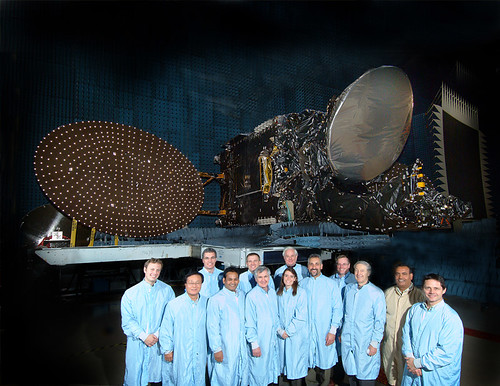
ICO G1 is a Loral-designed spacecraft that incorporates a 12-meter antenna reflector designed and built by Harris Corporation. The reflector utilizes a gold-plated mesh reflective surface and a unique new Harris design that allows a very large antenna reflector to stow safely and easily on the Loral 1300 satellite platform. The reflector size enables the increased performance typically required for mobile interactive media services.

ICO G1 is the largest commercial satellite launched to date, weighing nearly 15,000 pounds at liftoff, and measuring more than 27 feet high and over 100 feet wide, following solar array deployment.

Here’s the animation simulating deployment:


DIY…uhh…Tuesday: Laptop Data Recovery

I woke up this morning in a panic – WHAT DID I FORGET TO DO? DIY-Friday, of course. I started the beer-drinking, BBQ, and pool parties a few hours too early on Friday. My apologies to the readers who were lost without a project this weekend, but, to be honest, who’s going to DIY on Memorial Day weekend?

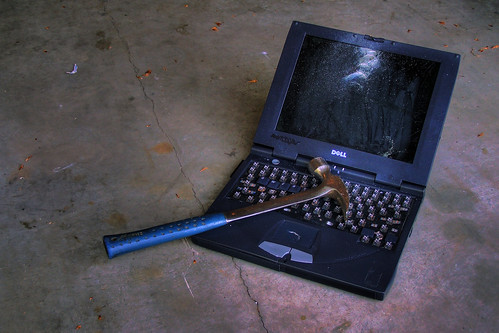
So, for a very business-like DIY post, fit for a Tuesday, let’s explore laptop-data recovery:

WikiHow offers us two main methods:

Method 1

1. Purchase a “Laptop Hard Drive Adaptor Kit” to allow you to plug your laptop hard drive into a standard PC (2.5 TO 3.5 inch IDE HDD).
2. Find a functioning standard PC that can read the file system that was on the laptop. One would need Windows 2k/XP or a Linux distribution to read an NTFS/FAT file system, whereas only a Linux distribution can read the EXT3 file system.
3. Open up the case and add the laptop drive with adaptor kit as a secondary HDD. Be sure that you have set this drive to either Cable Select, or Slave, depending on the configuration of the system, and the available IDE ports.
4. Copy the data you need from the laptop drive to the main drive of the PC, or consider using removable storage for small files.

Method 2

1. Purchase or cannibalize a 2.5″ USB 2.0 or Firewire drive enclosure.
2. Find a functioning standard PC with an open USB port (or firewire port, as applicable) that can read the file system that was on the laptop. One would need Windows 2k/XP or a Linux distribution to read an NTFS/FAT file system, whereas only a Linux distribution can read the EXT3 file system.
3. Plug it in, wait for the tones (and/or mount it if that is necessary in this system)
4. Copy the data you need from the laptop drive to the main drive of the PC, or consider using removable storage for small files.

Method 1 is probably the more straightforward process. You can buy an adaptor kit for about five bucks on Ebay.

Now, if your situation is really, really bad—and not only is your OS install screwed up, but you actually deleted a partition with data on it—do not despair. If the FBI can recover “deleted data,” so should you. A commenter in this forum, offers a good solution: Stellar Phoenix Recovery Software. There are other good software options out there too.

What about a bum harddrive motor? This is pretty cool:

Phoenix: Day Two on Mars

The big news of the holiday weekend was, of course, the successful landing of the Phoenix Mars Lander at 7:53 pm Eastern time on Sunday — a landing which we previewed two weeks ago.


There was only one minor snag reported in the challenging landing: the protective sheath around the trench-digging robotic arm failed to unwrap all the way after touchdown. The sheath now covers the arm’s elbow joint, but NASA describes that as merely an "inconvenience."

The excitement behind the successful landing was evident. Maybe it was because of the slow holiday weekend, but the landing was big news in the mainstream media — not just among space buffs– with the Drudge Report parking a headline most of the day on Sunday and Monday that asked if Phoenix would find evidence of life on Mars as it explored the planet’s arctic plain.  

Since the trench-digging arm that Phoenix will use to collect the soil samples that might contain traces of organic compounds won’t be extended until possibly tomorrow, the answer to the Drudge Report’s questions is clearly "not yet."

But already, Phoenix has sent back some amazing pictures and videos of the Red Planet’s polar region:

  • The Mars Reconnaissance Orbiter snapped this dramatic photo of the Phoenix Lander suspended beneath its parachute as it descended to Mars on Sunday. (For an explanation of how the Orbiter snapped the photo, watch this video.)
  • Here’s a good video from inside the Jet Propulsion Laboratory as Phoenix touched down, showing the excitement and anxiety inside mission control.
  • Check out this photo of where Phoenix landed (in the Vastitas Borealis region) as well as this animation showing an orbital view sweeping upward from Olympus Mons, the tallest volcano in the solar system, to the flat terrain where Phoenix touched down.
  • A bevy of raw images from the Red Planet (in black and white) are available here.
  • How do the images and video come back to earth? NASA explains.
  • More videos and animations of Phoenix are available here.

All in all, NASA has outdone itself in providing information to the public over the web for the Phoenix mission — and done an incredible job of packing that information in a compelling way.

The next press briefing on the mission is set for 1 pm Eastern today. Also check out the Phoenix Landing blog for more updates.

Loving Pay TV

The results are in for the American Customer Satisfaction Index for cable and satellite television providers (link):

Customer satisfaction among subscribers to cable and satellite television improved three percent to a score of 64 in the first quarter of 2008, according to the American Customer Satisfaction Index.

But, at the same time, Comcast, Charter, and Dish Network are losing ground in the satisfaction of their customers. Comcast is down four percent to 54, an all-time low for the largest cable provider in the country.

Rapid growth may have contributed to difficulties in operations as Comcast continues to add cable subscribers, often through acquisitions of companies in smaller markets, says Professor Claes Fornell, director of the National Quality Research Center at the University of Michigan.

Satellite TV provider Dish Network is down three percent to 65 and Charter is down two percent to 54, sharing the lowest score in the industry with Comcast.

The reason for the industry’s overall uptick is the large improvement among smaller cable TV providers such as Cablevision and RCN, Fornell says.

The category of "all other" cable TV companies is up five percent to lead the industry with an all-time high of 69, well ahead of the large competitors.

DirecTV is, once again, the king:

For the eighth consecutive year, DIRECTV has topped the American Customer Satisfaction Index (ACSI) in the Pay TV category.

DIRECTV is American satellite television service provider, serving more than 17 million customers. It has played a major role in the industry-wide switch to high definition (HD) programming, and currently offers 95 HD channels nationally.

The American Customer Satisfaction Index (ACSI) is an economic indicator that measures the satisfaction of U.S. consumers. It is produced by the National Quality Research Center (NQRC) at the University of Michigan in Ann Arbor, Michigan. The ACSI generally interviews about 80,000 Americans annually and asks about their satisfaction with the goods and services they have consumed.

DIRECTV posted an index score of 68 at the ACSI against the overall cable and satellite industry score of 64. Customers surveyed by the ACSI in the first quarter of 2008 were also asked about such issues such as perceived quality and value, and their expectations prior to making a purchase. The ACSI also measures customer loyalty and retention.

Comcast – not so much, unfortunately:

Customer satisfaction ratings for Comcast Corp. fell this year to an all-time low and rank at the bottom of cable and satellite TV providers, according to a survey released on Tuesday.

No Room for Voom

A few months ago, I switched from Dish Network to Cablevision so I could watch MSG-HD. I’ve been a Ranger fan forever. Since Dish didn’t offer MSG-HD, that made up my mind. Cablevision owns Rainbow Media, which owns Voom, and offered all 15 Voom HD channels,  just as Dish did at the time.


Today I heard Dish dropped all the Voom HD channels from their line-up. I was just considering going back to Dish, which means I won’t be watching Voom’s Kung Fu channel, where some of my paesanos and I enjoyed watching the Zatoichi movies from Japan.

Why? Politics, money and bandwidth, according to Phillip Swann:

1. Politics
TBS is owned by Turner Broadcasting, which also owns TNT, CNN, the Cartoon Network and Turner Classic Movies. These are highly rated, basic-cable networks — and a must-carry for any TV operator. Turner knows this so when it negotiates a carriage deal with a TV provider, it usually can mandate that it carry the company’s entire programming suite. That gives TBS HD a tremendous edge over Voom.

And this is not to harp on Turner and TBS. NBC Universal, which owns NBC, CNBC, Universal HD, MSNBC, etc., uses the same leverage to get carriage for its entire programming lineup.

At this time, Voom is relatively unknown and, consequently, does not generate as much interest in the TV audience. It’s easier for a TV provider to say yes to Turner and no to Voom.

2. Money
Because Voom is a small unit, the company must sell all 15 channels as a programming block, rather than offering each niche channel individually. This requires a TV provider to pay more in carriage fees if it wants to add Voom’s suite to its lineup. So it’s easier — and cheaper — for the TV provider to simply go with the established channels from companies such as Turner and NBC.

3. Bandwidth
While cable and satellite operators are rapidly expanding their high-def capacities, many still lack the system space to add 15 HD channels all at once. Even if Voom was owned by a powerhouse such as Turner, it would have difficulty getting 15 channels on the air at the same time.


Good Morning, Sea Launch


That’s the live view from the Odyssey platform’s web cam. The Zenit-3SL rocket will launch Galaxy 18 for Intelsat. Two-hour launch window opens at 09:43 GMT).

Watch the live Webcast here. 

Or downlink the live broadcast yourself.

Volcanoes

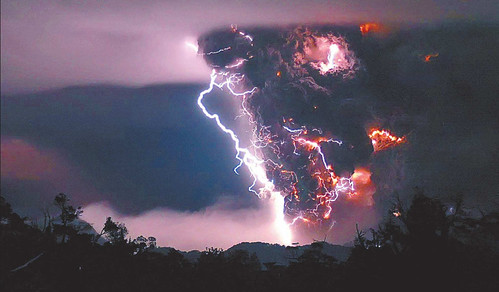
Earlier this month a volcanic eruption in Chile wowed the world, and produced one of the most magnificent natural images ever.

The eruption actually came from a volcanic caldera, Chaitén. The eruption forced the evacuation of nearby towns, merged two massive craters, and increased the possibility of even more activity. You can watch video (in Spanish) of the disaster here.

But beyond YouTube recaps of eruptions, you can discover images of the volcanoes, active and dormant, around the world. The Italian Government has publicly accessible webcams of volcanoes. And this site has mapped, photographed, and documented every volcano in the world (including Chaitén). Pretty amazing.

Satellites are keeping tabs too. This site has satellite images of some of the world’s largest volcanoes, including some very close to home.

But, of course, Volcanoes are not limited to Earth. Jupiter has some of the our galaxy’s more active volcanic activity:

Before the Voyager probes visited Jupiter, if you had described Io to a literary critic it would have been declared overwrought science fiction. Jupiter’s strange moon is literally bursting with volcanoes. Dozens of active vents pepper the landscape with volcanic rings the size of California. The volcanoes themselves are the hottest spots in the solar system with temperatures exceeding 1800 K (1527 C) about 1/3 the temperature of the surface of the Sun. The plumes which rise as much as 500 kilometers into space are so large they can be seen from Earth by the Hubble Space Telescope. Confounding common sense, these high-rising ejecta seem to be made up of, not blisteringly hot lava, but frozen sulfur dioxide. For a world dominated by fiery volcanoes, it’s curious that Io is also very, very cold. The ground just around the volcanic vents is literally sizzling, but most of Io’s surface is 150 degrees or more below 0 C.

What powers the tremendous volcanic activity? Tides! But the tides on Io are not like ocean tides we’re familiar with on Earth. The gravitational fields of Jupiter and its large moons Europa and Ganymede cause tidal bulges in the solid crust of Io that are as high as 100 meters (330 feet). As Io orbits the giant planet, the bulge moves, flexes the crust, and heats Io’s interior like a paper clip bent rapidly back and forth. Infrared observations have shown that the thermal energy released by Io’s hot spots is on the order of 125 trillion watts which is about 2.5 W/m2. By contrast the moon’s outward heat flow is 0.02 W/m2 and the Earth’s average heat flow is 0.06 W/m2.

A year ago, NASA’s New Horizons probe captured a number of amazing images, showing massive plumes of ash, believed to be a result of Volcanic activity.

Yves Rossy: Fusion Man

"I feel fantastically happy." 

That’s what Yves Rossy said after his flight. We remember Jet ManSpiegel Online writes he set a new personal flight record:

…he jumped out of a plane above the Swiss town of Bex and took flight using a jetpack he created.

The five-minute flight was the first public demonstration of Rossy’s one-of-a-kind device, which took him five years to create.

The inventor brings years of more conventional experience to his death-defying feats. He is a former Swiss military pilot and has been a co-pilot and captain for Switzerland’s two national airlines, Swissair and Swiss.

Dressed in a white flight suit, wearing a white helmet and strapped to his black device, Rossy was dropped from an airplane 2,348 meters above the Earth. He first unfolded the rigid, eight-foot wings strapped to his back, then fired up four tiny jet engines originally intended to power model aircraft.

A helicopter flew nearby to document his five minutes of glory, and an airplane followed to measure his speed. Rossy reached speeds of 300 kilometers per hour (186 miles per hour).

"The flight was excellent," Rossy told reporters gathered at the airfield where he touched down. Rossy wears a heavy, heat-resistant flying suit, similar to those worn by race car drivers and firefighters, to protect himself from the jet engines’ exhaust.

The report from the Today Show:


Here’s a cool video edit: