Voom With A View

Remember the Voom Satellite Service? It was an all-HDTV service intended to compete for viewers with DirecTV, Dish Network and local cable systems. Owned by Cablevision and the Dolan family, they built and launched the Rainbow 1 satellite in 2003. I remember the launch had a rocketcam and they produced the video in HD, of course. Here’s the launch clip (action begins around 1:30):


Unfortunately, the service shut down in 2005 and all subscribers were transitioned to Dish Network, who bought the satellite, which is now a.k.a. EchoStar 12. Fortunately for those looking for HD content, they’re still broadcasting the 15 Voom HD channels — many with original content — to Dish and Cablevision subscribers. Neither DirecTV nor Verizon FiOS offer those channels. I just upgraded my service to HD and I dig those Voom channels, in all its 1080i glory, 24×7 and commercial-free. There’s content for kids, like Flipper from the 60s and UFO from the 70s, a cartoon channel called Animania and for those crazy kids, Rush HD — featuring extreme and action sports. The program they put together on downhill skiing was very well done:


THE THIN LINE: Life on the Edge – HD Trailer from VOOM HD on Vimeop>

Seeing how HDTV is really catching on in the marketplace. Now that the Super Bowl is over, expected prices to drop:

Missed a great deal on an HDTV this past week? Don’t sweat it. Analysts over at Pacific Media Associates say we can expect a 15.6% drop on flat panel display prices this year. According to the research company, last year they saw a 14.7 percent price drop on HDTVs, which increased sales by 41 percent. If their estimates are correct, over 113 million displays were sold worldwide instead of the 80 million units they had predicted.

If you think about it, the idea was ahead of its time. Demand for HD content will continue to increase, and Voom offers good, differentiated content — designed for and originated in HD.

And Voom sees growth outside the U.S., too. An international Voom HD channel is available in Northern Europe on Thor 2 (1° West, transponder 15, 11434V, SR 25000, FEC 2/3) and Southeast Asia on Measat 3 (91.5° East, 3752V, SR 13330, FEC 2/3) — both in MPEG-4, and HD, naturally.

Cyber Security and the Next President


Photo: The world’s largest BSoD, outside the Port Authority Bus Terminal in New York.

Who will be the next President? With voters casting ballots in 43 nominating contests in 24 states right now, we should have a clearer understanding — though most probably not a definitive one — of who the nominees for each party will likely be later this evening.

(Voters in New York might be late getting to the polls today, on account of the Giants parade taking place as we write this.) 

Regardless of who ultimately wins in November, among the many issues the next president will have to contend with is creating a strategy for securing cyberspace. But they don’t have to contend with the issue alone, because the Center for Strategic and International Studies has established a Commission on Cyber Security for the 44th Presidency:

The Commission will examine existing plans and strategies to assess what a new administration should continue, what it should change, and what new policies should be adopted or new authorities sought from Congress [in pursuit of cyber security].  Issues for consideration will include infrastructure protection, software assurance, federal agency cyber security, and information security initiatives in both the public and private sectors.  As part of its work, the Commission will review how the Federal government organizes its cybersecurity efforts and make recommendations for improvement.  It will examine existing legal authorities for cyber security and identify where new authorities (including incentives) are necessary.

The Commission will be a bipartisan group composed of twenty to twenty-five experts drawn from the cyber security policy community and from the private sector.  It will be co-chaired by leaders from Congress and the private sector.  The work of the Commissioners will be reinforced by a private sector advisory group composed of representatives from companies and associations, and by the ex officio participation of relevant federal officials…

 The final product would be a well-supported package of recommendations for improving cyber security that could help to guide both a legislative agenda and Presidential policy documents….

CSIS is a nonpartisan, nonprofit research center organization headquartered in Washington, D.C. with more than 200 staff and a large network of affiliated experts.  Its focus is on security in a changing global environment. 

The CSIS isn’t alone in thinking ahead about cyber security, of course. DoD IT, cybersecurity, SPACECOM, STRATCOM, DISA — everybody’s trying to prevent an "electronic Pearl Harbor."  

Cybersecurity is becoming a critical issue for the private sector, too. Verizon just hired a former Army guy to lead their cyber security effort.

What will Verizon’s new cybersecurity guru look into first? How about the submarine cable disruptions in the Mediterranean Sea and Persion Gulf? If you’re keeping score at home, there have been two disruptions in each cable — near Marseilles, France, and Alexandria, Egypt; near Dubai and another near Qatar–  all within a week of each other. Ships’ anchors caused three of the incidents and power trouble caused the fourth, as we blogged recently

Given all the recent trouble undersea, it’s no wonder the U.S. government prefers using satcom over fiber, even for their radios in the field


Iran Launches Sounding Rocket from New Space Center

In preparation for the lifting of its first nationally-built satellite, the Omid, Iran has launched a Kavoshgar1 "sounding rocket" into space. The launch also marks the inauguration of Iran’s first domestic satellite complex:

 The suborbital research rocket took off at Iran’s space launch base, which is specifically built for sending Iranian rockets into outer space from inside the country.

A sounding rocket is an instrument-carrying rocket designed to take measurements and perform scientific experiments during its suborbital flight.

Kavoshgar1 was launched as a preliminary step towards sending the ‘Omid Satellite’ into orbit. Omid is the first advanced scientific research satellite exclusively designed and made by Iranian scientists.

The Omid (which is Persian for "hope") Iran will be the first of five satellites that Iran plans to launch into orbit by 2010. Iran "joined the international space-faring community" in February 2007 after successfully testing its first sounding rocket.

The AP reports that "some Western experts also have raised the possibility that Iran’s space program may be a cover to more fully develop its military ballistic missiles, a prospect many find troubling at a time when the U.S. and others worry Tehran is trying to develop nuclear weapons." 

In other satellite news from the Middle East, Israel Aerospace Industries announced over the weekend that its TecSAR satellite, launched last month, had beamed down its first images of Earth and was in "perfect" working condition. We blogged about TecSAR’s launch here.

DIY Friday: LED Pegboard

We’re all about holidays here at ReallyRocketScience. Yesterday, we commemorated the Explorer 1 launch 50 years ago. Today, we celebrate the DIY-Friday from one year ago – LED light shirts. The beauty of LED’s is that they never burn out. My cheesy shirt is still functioning perfect for the occasional ugly sweater theme party.

Now LED’s are hitting Saks Fifth Avenue – on the store’s facade, not the clothes racks:

This Christmas, Royal Philips Electronics (PHG) is vividly displaying its dominance in the lighting market. It supplied the 50 giant illuminated snowflakes that festoon the front of the flagship Saks Fifth Avenue (SKS) store in New York. The flakes are aglow with light-emitting diodes, or LEDs–semiconductor devices that produce bright beams of light using a fraction as much electricity as incandescent bulbs. The 40,000-plus LEDs in the display sip about the same amount of power as three toaster ovens.

Philips also will provide the lights for the New Year’s Eve Times Square Ball in New York. Instead of 600 incandescent and halogen bulbs, the ball will be fitted with more than 9,500 LEDs, which burn twice as brightly and can create a palette of 16 million colors. Depending on their hue, they’ll be up to 98% more energy-efficient than the bulbs they replace.

The demonstration is a symbolic blow to its main LED rival – GE:

Philips’ latest LED installations give the company much-coveted green bragging rights. Lighting accounts for about one-fifth of all electricity used, in part because, with traditional incandescent bulbs, most of the energy is wasted in heat. LEDs burn cooler and last much longer. So the company that leads in this area can claim to be helping planet earth.

General Electric (GE), Philips’ biggest rival in lighting, has spent millions to bolster its own environmental credentials in a high-profile campaign whose slogan is "ecomagination." But it hasn’t matched the billions of dollars Philips has spent on LEDs and other energy-efficient lighting systems. This year alone, Philips has paid $4.2 billion to acquire five companies in the lighting sector, including the Nov. 26 purchase of Genlyte (GLYT) in Louisville, the No.2 U.S. maker of lighting fixtures. As a result, Philips has vaulted past GE as the leading supplier of lights and fixtures in the all-important U.S. market.

Over the next ten years, as much of the world makes the transition to LED lights, Philips’ lead over GE is expected to grow. "A building contractor can go to Philips and get everything he wants," says Janardan Menon, a financial analyst at Dresdner Kleinwort in London. The same, he argues, is not true for GE.

It won’t be long before LED’s cross-over from Fifth Avenue to the home. Get started by buying some LED candles.

Or, better yet, take up our DIY-challenge: construct "Peggy," a light emitting pegboard kit:

Our light-emitting pegboard display, affectionately known as "Peggy," provides a quick, easy, powerful and efficient way to drive a lot of LEDs– up to 625– in a big matrix covering almost a square foot of area. You can make an LED sign for your window, a geeky valentine for your sweetie, one bad-ass birthday card, or freak the holy bejesus out of Boston. Your call. It’s a versatile, high-brightness display. How you configure it and what you do with it is up to you.

The display can run off batteries (3 ‘D’ cells) or an optional ac adapter, and is designed to drive as many green/blue/white/violet LEDs as you care to solder into the holes, all with excellent brightness. The board can accommodate LEDs in several common sizes: 3mm, 5 mm (standard T-1 3/4 size), and 10 mm. A photosensor is provided that can automatically turn off the display in bright daylight or incandescent light.

Instructions are available here. The good news is you have two weeks to construct your Valentine’s Day surprise creation. Or build a LED-shirt, version 2 – I’m sure he/she will love the gesture. I told you we liked holidays here at ReallyRocketScience.

SatelliteWiki.com Launches


Photo Caption: A model of Explorer 1, held by JPL’s Director William Pickering, scientist James Van Allen and rocket pioneer Wernher von Braun (from left to right). The team was gathered at a news conference at the National Academy of Sciences in Washington, D.C., to announce the satellite’s successful launch. America’s first satellite, Explorer 1 had launched a few hours before, on Jan. 31, 1958.

It may not be on par with the launch of Explorer 1, but  SES Americom is proud to announce the launch of satellitewiki.com today:

Using the same style and software used to power Wikipedia, satellitewiki.com, satellitewiki.com lets visitors explore the history of man-made satellites, definitions of satellite terms and learn about how satellites impact a wide range of industries from oil and gas to television….

From the first U.S. satellite’s bleep in 1958 to modern satellites with their own neighborhoods, users exploring the wiki can find interesting facts, download imagery and discover how satellites work. With input from other users and readers, information can be updated, changed and added, as well.

Want to know the difference between ‘carrier frequency’ and “geostationary transfer orbit”? Or when the best time to look up in the night sky to see a satellite passing over your neighborhood? Log on at  satellitewiki.com.

Although SES AMERICOM has funded the creation of satellitewiki.com, the site is open to the public to add and edit content in true wiki fashion. SES AMERICOM invites all players in the satellite industry to visit satellitewiki.com and add their content so that the website can grow into an important resource for anyone interested in the satellite industry. SES AMERICOM and U.S. satellite historical timeline

As BusinessWeek reported last spring, many corporate wikis are going viral. Both Nokia and investment bank Dresdner Kleinwort, for example, have successfully used wikis to collaborate on solving specific product-design problems and as alternatives to e-mail and collaborative software.

Wikis are also becoming interfaces for B-to-B marketing. IBM is exploring opening up its wikis to explain new products to potential customers,  while Hewlett-Packard has used wikis as a focal point for their "The Computer is Personal Again" marketing campaign:

 In the first two weeks after the campaign broke in late August, more than 220,000 visitors clicked through to a microsite for small and midsize businesses, and the HP Community wiki recorded more than 1,400 visitors. Other Web-based printing activities are being added, and the marketing campaign will continue to evolve, based on the feedback HP receives from customers via the wiki.

The current initiative isn’t just an advertising tactic but a marketing strategy designed to reinforce the brand’s relevance in a changing world.

In marketing, how many people wikis reach may be less important than who is reached. As Ross Mayfield puts it, "It’s no longer about impressions you make but who you impress."

But wikis, once they hit a critical mass, can be just plain fun. Equotes, for example, has some good quotes from all sorts of luminaries, including Neil Armstrong. There’s a SpaceWiki for astronomy buffs. And feel free to add your own insights and knowledge of the satcom industry at our new satellitewiki.com.

Or, you can start your own free wiki here

Mediterranean Submarine Cable Cut


Wow, big fiber cut yesterday, about a year after the one near Taiwan. If you’re in the Middle East, you know: Internet service is disrupted in Egypt, the Gulf Region and to India, too:

Egypt’s Telecommunications Ministry said a communications cable in the Mediterranean was cut, disrupting 70 percent of the country’s Internet network.

The ministry said in a statement it was not known how the cable was cut but that services would probably take several days to return to normal.

India reported serious disruptions to its services and one Indian Internet service provider linked the problem to the Egyptian outage.

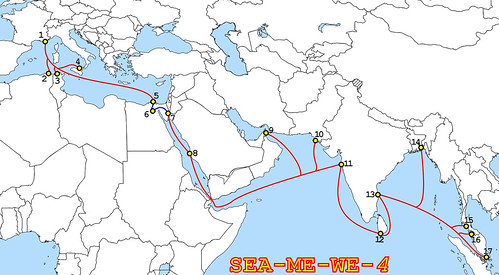
Seems the cut was somewhere between Palermo, Sicily, and Alexandria, Egypt. That sounds like the South East Asia-Middle East-West Europe 4 (SEA-ME-WE 4) cable, which has 17 landing points connected:

    1. Marseilles, France
    2. Annaba, Algeria
    3. Bizerte, Tunisia
    4. Palermo, Italy
    5. Alexandria, Egypt
    6. Cairo, Egypt (overland)
    7. Suez, Egypt (overland/return to submarine)
    8. Jeddah, Saudi Arabia
    9. Fujairah, United Arab Emirates
    10. Karachi, Pakistan
    11. Mumbai, India
    12. Colombo, Sri Lanka
    13. Chennai, India
    14. Cox’s Bazar, Bangladesh
    15. Satun, Thailand
    16. Melaka/Malacca, Malaysia
    17. Tuas, Singapore

Our friends at SES NEW SKIES probably had their phones ringing off the hook yesterday. Best remedy for fiber cuts is a satcom backup. That’s the "secret sauce" in a well-run network.


Let India Launch Your Spacecraft

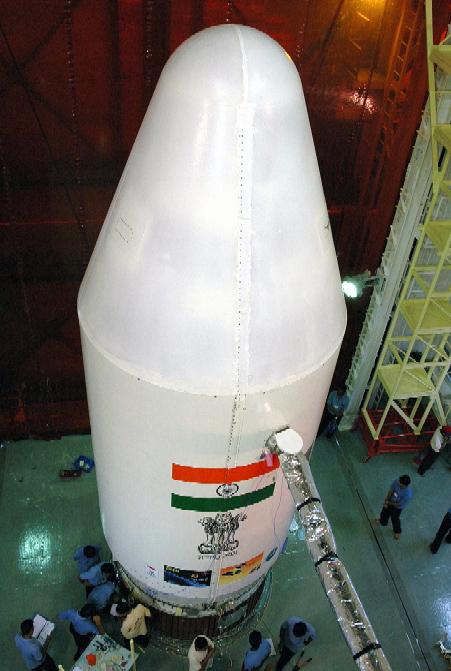
Last week’s launch of an Israeli observation satellite, and an Italian one last April, has put the Indian Space Research Organization’s (ISRO) capabilities on display for the world to see. Developing a commercial launch operation is a huge undertaking and now Antrix, the commercial/marketing arm of the ISRO, is ready to compete in the launch business:

Antrix hopes to bag around three commercial launch contracts for PSLV in 2009.

To be a major player in the launch market, Antrix is also planning a slew of measures. These include a three-stage PSLV to ferry 500 kg satellites for low earth orbit, a new 229-tonne ‘core alone’ configuration that can carry 1,100 kg satellites into SSO, and a vehicle to carry 1,900 kg satellites in SSO by increasing the fuel in stage two and improving the thrust power.

‘We can also look at the potential of our other rocket, Geosynchronous Launch Vehicle (GSLV), only in its Mark III version,’ Murthi said.

According to Frontline, the folks at Antrix are very proud of their accomplishment and happy to share some details surrounding the TecSAR mission (and some pricing info):

At the press conference itself, the emphasis was on how it was “a red-letter day” and “a landmark” event for Antrix because the successful orbiting of Tecsar signified the second full-fledged commercial launch by Antrix. The first one was on April 23, 2007, when a core-alone configuration of PSLV, without its customary six strap-on motors that surround the first stage, put an Italian astronomy satellite called Agile into orbit. Madhavan Nair said, “We won the contract [for launching Tecsar] against stiff competition from many other players. The orbit we achieved will be the envy of any person in the launch service. It recognises the launch capability of ISRO on par with other leading players in the world.”

K.R. Sridhara Murthi, Managing Director, Antrix, said that for putting Tecsar into its difficult orbit, they had “charged quite a lot above” the international rate of $15,000 to $20,000 a kg. During launches in January, April and September 2007, from Sriharikota, and also during the International Astronautical Congress in Hyderabad in September 2007, ISRO top brass had dodged questions on whether ISRO was planning to launch any Israeli satellite. As per the original plan, the core-alone PSLV that was to launch Tecsar in September 2007 had been assembled, and the satellite had reached SHAR from Israel and undergone tests. But the launch was postponed. So ISRO dismantled the vehicle and the Israelis bottled up the satellite.

In the first week of December 2007, newspapers and television channels went to town saying that ISRO had “abandoned” the launch of Tecsar under pressure from the United States, which did not want ISRO to get a slice of the launch market. Informed ISRO officials, however, said there was pressure from the Gulf countries on India to call off the launch of the Israeli satellite, and so the Ministry of External Affairs wanted ISRO to bide its time.

Madhavan Nair denied any such pressure from the Gulf countries. The lift-off was to take place in September 2007, but certain “technical issues” [with the satellite] forced the postponement of the launch, then the monsoon intervened. The launch took place in January after the monsoon, he said. According to the ISRO Chairman, Israel did not want any publicity until the launch was successful.

Nova Suprise for Astronomers on Mauna Kea


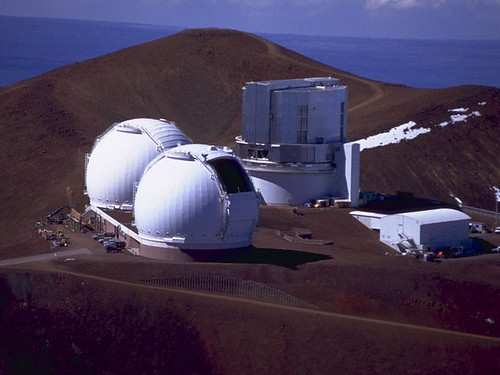
The Keck Interferometer — two linked observatories in Hawaii (above, with Pu’u Poliahu in the background), located on the highest point in the Pacific — give astronomers a new view of novae:

First results from a new NASA-funded scientific instrument at the W. M. Keck Observatory at Mauna Kea, Hawaii, are helping scientists overturn long-standing assumptions about powerful explosions called novae and have produced specific information about one nearby nova.

This sophisticated new system, called the Keck Interferometer, combines the observing power of the two 10-meter (33 feet) Keck telescopes into a single mega-telescope. Using the interferometer’s "nulling" mode, data were taken by the Keck Interferometer team on a nearby nova called RS Ophiuchi.

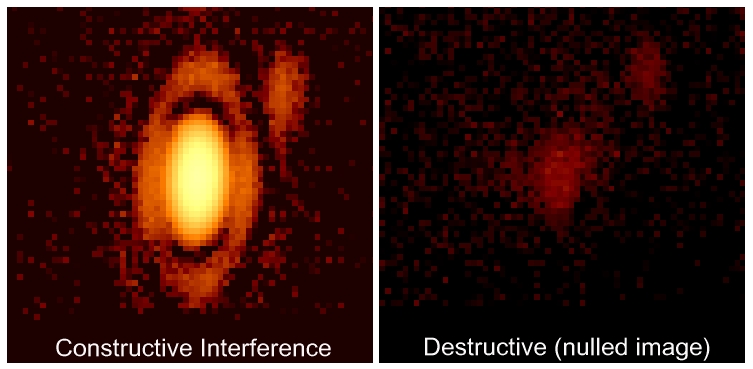
In "nulling" mode, the Keck Interferometer suppresses the blinding light of a star so researchers can study the surrounding environment. The instrument helps them observe very faint objects near bright sources and produces 10 times more resolving power than a single Keck telescope working alone. It is the only instrument of its kind in operation.

The nulling mode was developed to search for dust regions around nearby stars, where planets might be forming, but the bright starlight poses a great challenge. "Because a star is so much brighter than the dust, something has to block the light, which is what the nuller does," said Rachel L. Akeson, Keck Interferometer project scientist at the California Institute of Technology’s Michelson Science Center. "This technique turns out to be useful for lots of other kinds of objects, including this one, where dust is near a star that just went nova."

These nova data were taken by a team led by Wes Traub of NASA’s Jet Propulsion Laboratory, Pasadena, Calif., and the data analysis and unified model for the nova were produced by a team led by Richard Barry and William Danchi of the Goddard Space Flight Center, Greenbelt, Md.

The star in the constellation Ophiuchus went nova at the perfect time for the team, on Feb. 12, 2006. "We were extremely lucky, because we had astronomers in place at two mountain-top interferometers, Keck in Hawaii and Infrared Optical Telescope Array in Arizona. Within minutes of hearing about the discovery of the nova, we alerted both teams to start observing it that night," said Traub, a senior research scientist at JPL.

The nova system, known as RS Oph consists of a white dwarf and a red giant. The red giant is gradually shedding its massive gaseous outer layers, and the white dwarf is sweeping up much of this wind, growing in mass over time. As the matter builds up on the white dwarf’s surface, it eventually reaches a critical temperature that ignites a thermonuclear explosion that causes the system to brighten 600-fold. RS Oph was previously observed blowing its stack in 1898, 1933, 1958, 1967 and 1985, so astronomers were eagerly anticipating the 2006 eruption.

About three-and-a-half days after the nova was detected, the group observed the explosion with the Keck nuller. They set the instrument to cancel the nova’s light, allowing them to see the much fainter surrounding material, and then the extremely bright blast zone.

The instrument’s versatility was key to a surprising discovery. The nuller saw no dust in the bright zone, presumably because the nova’s blast wave vaporized dust particles. But farther from the white dwarf, at distances starting around 20 times the Earth-sun distance, the nuller recorded the spectral chemical signature of silicate dust. The blast wave had not yet reached this zone, so the dust must have pre-dated the explosion.

"This flies in the face of what we expected. Astronomers had previously thought that nova explosions actually create dust," said Richard Barry of Goddard, lead author of the paper on the observations that will appear in the Astrophysical Journal. The team thinks the dust is created as the white dwarf plows through the red giant’s wind, creating a pinwheel pattern of higher-density regions that is reminiscent of galaxy spiral arms. Inside these arms, atoms become cool enough and dense enough to allow atoms to stick together to form dust particles. The nova’s blast wave has since destroyed RS Oph’s pinwheel pattern, but it should re-form over the next few years, and future observations by NASA’s Spitzer Space Telescope could see it. Barry is also coauthor of a paper based on Spitzer observations of RS Oph.

Most studies of RS Oph have relied on spectroscopic models, which have not been able to distinguish various nova components with as much detail as the interferometer. The Keck nuller measured one component of the RS Oph system to an accuracy of just 4 milliarcseconds, or about the size of a basketball seen 7,500 miles away.

Credit Crisis Threatening Intelsat Deal?

The current credit crisis isn’t just hitting the housing market. Last June, BC Partners agreed to buy satellite operator Intelsat. Now, BC Partners is requesting an "unusual" exception, asking "existing lenders to finance the purchase instead of selling a new financing in the open market." The current credit conditions make it very difficult to sell loans.

If Credit Suisse’s proposal is accepted, it would be relieved of the task of refinancing the bank loans for Intelsat and PanAmSat. New financing would still be required to finance the purchase, but the amount needed would be much smaller than the $5.1 billion commitment, as lenders would have agreed to roll the existing credit agreement into the new company.

The terms of Credit Suisse’s proposal are unusual in that the bank is asking lenders to loosen the definition of a "change of control" clause in the existing credit agreement. Usually, this clause will trigger a repayment of bank debt, but under the current proposal, a change of control would not be triggered.

For some background on Intelsat:

Intelsat, a global satellite network set up in 1965 by the national telecom operators of several Western countries, is being sold by a group of four buyout funds. Apax Partners, Permira, Apollo Management and Madison Dearborn Partners bought the company for about $3.1 billion in 2004. They added PanAmSat, a rival operator, for $3.2 billion in 2005.

Intelsat, based in Washington, operates 51 satellites used by cable companies, broadcast networks and governments for distributing video programming. It leases capacity to television companies rather than providing content itself.

The company has about 35 per cent global market share and last year reported $1.7 billion in revenues and adjusted earnings of $1.3 billion. Just under half its business is in North America, with 15 per cent of profits driven by Europe and 17 per cent from the Middle East and Africa.

Despite the credit conditions and the uncertainty surrounding the Intelsat transaction , BC Partners remains upbeat:

BC Partners, the international private equity group have today said they are anticipating returns in excess of 20% on the group’s sub-prime linked investment portfolio, despite the ongoing unrest in the global credit marketplace, according to a top executive today.

Stefan Zuschke of the group’s German operation said that the group was still looking forward to returns of as much as a fifth from its portfolio, despite the collapse of the sub-prime sector which left many banks and investment firms heavily out of pocket and forced to take severe writedowns against their balance sheets.

Whilst it was said that the credit crunch made for difficult times for investment firms, given increasing reluctance from banks to put up the cash for acquisitions and buy-outs at the same rate as before, he added that 2008 would see a return to the previous levels of spending and somewhere in the region of the same level of market confidence and optimism.

Nouveau Nom: Eutelesat


Note: You’re going to have to read through to the end to understand how the picture above relates to the headline of this post. 

Two weeks ago we wrote about Eutelsat and Viasat teaming up to deliver broadband via satellite to the U.S. and Canadian markets. Telesat is playing a key role in that project:

 ViaSat has executed a contract with Space Systems/Loral, a subsidiary of Loral Space & Communications, to build ViaSat-1, which is expected to be the world’s highest capacity broadband satellite…..

ViaSat-1, with a launch planned for early 2011, involves a collaborative effort with top satellite broadband leaders in the market including Loral, Telesat, and Eutelsat. Loral is investing in the Canadian coverage portion of the satellite in anticipation of Telesat using this capacity for the provision of broadband services throughout Canada. The satellite is planned for the Telesat 115 West longitude orbital slot as part of the agreement. Telesat will provide telemetry, tracking & control (TT&C) operations for the satellite.

Now comes news that Eutelsat and Telesat could merge, if one reads the tea leaves correctly in this interview with Telesat CEO Dan Goldberg in Satellite Today (subscription required):

Some industry observers have proposed a linkup between Telesat and Eutelsat, the third largest communications satellite operator.

“Telesat and Eutelsat are complementary businesses that would fit together well, but I would say that Eutelsat has a lot of growth opportunities that they are pursuing,” he said. “I watch what they are doing with great interest, including their Ka-band activities and their S-band plans. They have a lot of opportunities they are focused on. We have a lot of opportunities that we are focused on. I would say while there are lots of good theoretical combinations that might exist out there, all of us are focused on the here and now and growing our businesses, and if there is value to be created for shareholders and we can all effectively serve our customers by considering some consolidation opportunities in the future, I’m sure everyone will be pragmatic about that going forward.”

Will it happen? Who can say? As Goldberg points out, however, 2008 is likely to be a breakout year for satellite broadband, and such rapidly growing markets tend to transform the market players.

In other Telesat news, "Lockheed Martin has announced that it will be farming out $175-million-worth of work to Ontario companies in connection with the federal government’s purchase of its Super Hercules aircraft….

"Telesat Canada would be one of the Ontario companies set to benefit from the commitments to the region, with Lockheed Martin using Telesat’s WAAS GCCS Signals in Space services," according to the Ottawa Business Journal (and thus explaining the picture above).

UPDATE (1/29/2008, 11:45am): While we were talking about Canada, I should have mentioned that, well, Canada’s space program is in total crisis:

Imagine getting news that the space operations of Lockheed Martin and Boeing, including the shuttle and military space programs, had been sold to a corporation based in Europe. Imagine further that this startling news is followed the next day by the announcement that the administrator of NASA has suddenly resigned after just a few months on the job.

The scenario is playing out for our neighbor to the North: Canada’s largest space contractor, MacDonald, Dettwiler and Associates Ltd., announced it was selling all of its space operations to Alliant Techsystems Inc. (ATK) of Edina, Minnesota, for $1.3 billion; and the president of the Canadian Space Agency (and the former CEO of Telesat), Laurier Boisvert, resigned after just nine months on the job. Ouch.