Uncontrolled Re-entry by Spy Satellite

Apparently, a spy satellite is no longer in control and could crash to earth very soon. Today’s New York Times has some detail:

Specialists who follow spy satellite operations suspect it is an experimental imagery satellite built by Lockheed Martin and launched from Vandenberg Air Force Base in California in December 2006 aboard a Delta II rocket. Shortly after the satellite reached orbit, ground controllers lost the ability to control it and were never able to regain communication.

Of course, somebody has to think of the worst. This report from Canadian TV picks up on the hydrazine threat:

Gordon Johndroe, a spokesman for the U.S. National Security Council, said appropriate government agencies are monitoring the situation.

"Numerous satellites over the years have come out of orbit and fallen harmlessly," he said. "We are looking at potential options to mitigate any possible damage this satellite may cause."

It’s unknown whether the U.S. may attempt to destroy the spy satellite before it re-enters the atmosphere.

"It’s not all that easy," said Atwood. "You’re not going to shoot it down, you’re just going to explode it into a million pieces that are ultimately going to fall on the Earth."

An anonymous government source told AP that the satellite contains a rocket fuel called hydrazine, which is a toxic chemical and can be harmful to anyone exposed to it.


One of the news "sources" cited a launch out of Vandenburgh AFB on a Delta II rocket. Probably the NROL-21, a classified NRO spacecraft. Judging from its orbit (353 km x 380 km, 58.5°), it’s probably an experimental radar, according to Gunther:

NROL 21 is the cover-name for one-off classified satellite. Although nothing is known about the mission, the orbit hints for an experimental radar reconnaisance satellite.

A few weeks after launch reports emerged, that grond stations were unable to communicate with an expensive experimental U.S. spy satellite launched last year by the U.S. National Reconnaissance Office (NRO). Efforts were said to be continuing to reestablish communication with the classified satellite, which cost hundreds of millions of dollars, but "the prognosis is not great at this point," said the defense official, who asked not to be identified.The official said the problems were substantial and involved multiple systems, adding that U.S. officials were working to reestablish contact with the satellite because of the importance of the new technology it was meant to test and demonstrate. An other source said the satellite had been described to him as "a comprehensive failure."

In August 2007 the satellite has been declared a complete loss and will be allowed to decay from orbit.

I doubt the re-entry will be as pretty as the launch was…
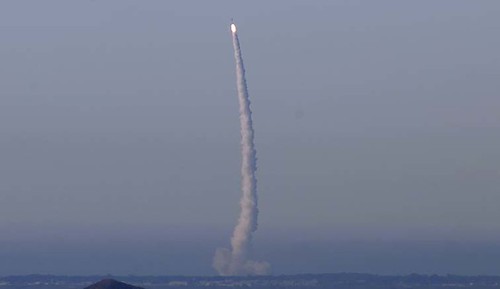
It certainly will not have an on-board camera like the launch did (fast forward to 2:35 — that’s when the action begins):

 

The Sky is Failling!!!….well, part of it anyways….

AP report

Disabled spy satellite threatens Earth

By EILEEN SULLIVAN, Associated Press Writer

WASHINGTON – A large U.S. spy satellite has lost power and could hit the Earth in late February or March, government officials said Saturday. 

The satellite, which no longer can be controlled, could contain hazardous materials, and it is unknown where on the planet it might come down, they said. The officials spoke on condition of anonymity because the information is classified as secret.

"Appropriate government agencies are monitoring the situation," said Gordon Johndroe, a spokesman for the National Security Council, when asked about the situation after it was disclosed by other officials. "Numerous satellites over the years have come out of orbit and fallen harmlessly. We are looking at potential options to mitigate any possible damage this satellite may cause."

He would not comment on whether it is possible for the satellite to be perhaps shot down by a missile. He said it would be inappropriate to discuss any specifics at this time.

A senior government official said that lawmakers and other nations are being kept apprised of the situation.

Such an uncontrolled re-entry could risk exposure of U.S. secrets, said John Pike, a defense and intelligence expert. Spy satellites typically are disposed of through a controlled re-entry into the ocean so that no one else can access the spacecraft, he said.

Pike also said it’s not likely the threat from the satellite could be eliminated by shooting it down with a missile, because that would create debris that would then re-enter the atmosphere and burn up or hit the ground.

Pike, director of the defense research group GlobalSecurity.org, estimated that the spacecraft weighs about 20,000 pounds and is the size of a small bus. He said the satellite would create 10 times less debris than the Columbia space shuttle crash in 2003.

As for possible hazardous material in the spacecraft, Pike said it might contain beryllium, a light metal with a high melting point that is used in the defense and aerospace industries. Breathing beryllium can lead to chronic, incurable respiratory problems.

Jeffrey Richelson, a senior fellow with the National Security Archive, said the spacecraft likely is a photo reconnaissance satellite. Such eyes in the sky are used to gather visual information from space about adversarial governments and terror groups, including construction at suspected nuclear sites or militant training camps. The satellites also can be used to survey damage from hurricanes, fires and other natural disasters.

The largest uncontrolled re-entry by a NASA spacecraft was Skylab, the 78-ton abandoned space station that fell from orbit in 1979. Its debris dropped harmlessly into the Indian Ocean and across a remote section of western Australia.

In 2000, NASA engineers successfully directed a safe de-orbit of the 17-ton Compton Gamma Ray Observatory, using rockets aboard the satellite to bring it down in a remote part of the Pacific Ocean.

In 2002, officials believe debris from a 7,000-pound science satellite smacked into the Earth’s atmosphere and rained down over the Persian Gulf, a few thousand miles from where they first predicted it would plummet.

DIY Friday: Home Theater PC

Everyone is talking about the iPod – music, web browser, email, and phone all in one device. What else would you need? But when I get home from a long day of rocket science, I wanna lay on my couch and watch a 32 inch plasma, not stare at a 3 inch cell-phone.

That said, we don’t have to resign ourselves to the past. Consider a Home Theater PC system. The benefits are numerous: storage scalability, superior DVD playback, and easy content cataloging.

Microsoft is getting into the game. Vista’s Windows Media Center lets you view slide shows set to music, browse music by cover art (blatantly copied from Apple), and, with a TV tuner, utilize Microsoft’s tivo-like features (rewind live tv and schedule recordings).

But to capably take advantage of all of these features (including HD), you’re going to need a pretty powerful PC. You’re probably going to want 2 gb of RAM and a ton of hard drive space (400G gets you about 88 hours of HD recording). For a reasonably priced and very effective system, check out the Gigabyte H971 entertainment PC.

If you’re an anti-Microsoft/establishment snob or are just wary of new Microsoft OS’s (I’m still stubbornly using 2000 on one of my ThinkPads), go Linux. This barebones Linux system includes a DVD image with opensource TV tuner software. You’ll need to install a processor, memory, hard drive, and MythTV, personal video recorder software. Its magical:

Without breaking a sweat, MythTV meets our specifications for a HTPC. Using a TV tuner card, MythTV can pause and rewind live television, schedule recordings, and excise commercials during playback. If you intend to record multiple shows at once or watch another channel while something is recording in the background, you’ll need a second TV tuner card – which MythTV will handily support. You’ll get picture-in-picture that way, too.

If your video card has an output compatible with your TV (S-Video is the best bet), it’s also fairly easy to get TV-out working on Linux these days. That applies to all the software discussed here, not just MythTV.

Much of MythTV’s functionality is provided by plugins. Most of the modules discussed here are "official" add-ons and will be included with MythTV by default, depending upon who packaged your installation.

Enjoy!

SpaceShip Two Unveiled

We’ve long been fans of space tourism generally and Virgin Galactic specifically — in large part because of a longstanding admiration for the design skills of Burt Rutan.

Now, we can ooh and ahh at the symmetry of Virgin Galactic’s SpaceShip Two and its launch vehicle, WhiteKnightTwo; designs for both were unveiled yesterday.


MSNBC provides the details: 

[Yesterday’s unveiling] was the most detailed look yet at the craft that will carry on the legacy of SpaceShipOne, the first commercially developed spaceship and winner of the $10 million Ansari X Prize in 2004.

The biggest twist is that the WhiteKnightTwo plane has spread out and sprouted another passenger cabin on its 140-foot-long wing. The two cabins and four Pratt & Whitney jet engines straddle a central mount for the rocket plane, which will be carried to an altitude of 50,000 feet and dropped. Then SpaceShipTwo will light up its hybrid rocket engine for the final push to the edge of outer space, reaching an altitude of at least 68 miles (110 kilometers).

The twin cabins are basically carbon copies of the SpaceShipTwo cabin, so riding on WhiteKnightTwo will give passengers a taste of what the big blast to space will be like. While commercial astronauts are taking their trip to see the curving earth below the black sky of space, the passengers on WhiteKnightTwo will experience a lower-altitude version of the experience – including a bit of zero-G.

Why two cabins on the mothership?

Burt Rutan, the craft’s designer and head of California-based Scaled Composites, imagined a scenario in which a husband riding in the mothership watches his wife take off in the spaceship, sitting only 25 feet away.

"You’ll say, ‘Honey, have a nice flight,’" Rutan told scores of journalists and dignitaries at the American Museum of Natural History. "While she is enjoying black sky and weightlessness, you, in the launch airplane, will be doing parabolas and floating about the cabin."

So what’s it like?

SpaceShipTwo is designed to carry six passengers and two pilots into space, with enough headroom to allow for free floating. It’s about twice as large as SpaceShipOne, with 18-inch-wide windows and reclining seats for fare-paying fliers.

More than 100 people are already in line for spaceflights, at a cost of $200,000 per person, and Rutan expects there to be thousands more: He said the innovations incorporated into SpaceShipTwo will make human spaceflight "at least as safe as the airliners of the late ’20s."

Hmm. "At least as safe as the airliners of the ’20s" doesn’t really inspire the highest degree of confidence. Maybe they should come up with a better comparison. 


Virgin Galactic is aiming to begin passenger flights in 2010.

Bigfoot Found on Mars

One of the Mars rovers’ images from a few years ago shows what looks like Bigfoot or Sasquatch, according to the Mars Life blog.

Here’s the video clip from the Telegraph (U.K.):

See for yourself by downloading the original image from NASA’s JPL site — then try finding it. Fun for the whole family.

The Bigfoot Field Researchers Organization will be looking into this one, as will the folks of Willow Creek, California: the Bigfoot Capital of the World.

Intrigue in India: Iran Interfered with Israeli Satellite Launch

On a cloudy day when the mist hung heavily in the air, India’s Polar Satellite Launch Vehicle, PSLV-C10, successfully put the Israeli satellite Tecsar into orbit. It was a textbook launch with the “core-alone” configuration of the PSLV lifting off on time from the first launch pad at Sriharikota at 9.15 a.m. on Monday and injecting Tecsar into its precise orbit 19 minutes and 45 seconds after the lift-off. Tecsar, weighing 300 kg, is a remote-sensing satellite that can take pictures of the earth 365 days of the year, 24 hours of the day, through rain, clouds, day and night. It has a one-metre resolution. It was earlier known as Polaris.

Top Indian Space Research Organization (ISRO) engineers called this one "one of the very best launches" of the PSLV and "an excellent performance with a perfect injection of the satellite into orbit." But the road to launch wasn’t so smooth. Iran gave sabatoge a shot:

The successful launch on Monday of an advanced Israeli satellite was delayed in recent months by Iranian sabotage, The Jerusalem Post has learned from Western sources.

The TecSar satellite – developed and manufactured by Israel Aerospace Industries (IAI) – was supposed to be launched in September, on the heels of the June launch of the Ofek-7 spy satellite.

Its deployment will dramatically increase Israel’s intelligence-gathering capabilities regarding the Islamic Republic’s nuclear program, since the satellite can transmit images in all weather conditions, a capability that Israel’s existing satellites lacked.

According to assessments recently received, Iran learned of the TecSar’s planned deployment from the media and has since applied heavy pressure through Indian opposition parties – particularly the Muslim and Communist political factions – to prevent the launch.

Teheran’s attempts to sabotage the operation may demonstrate concerns over Israel’s advancing intelligence capabilities. "The Iranians are scared of the potential this new satellite will bring Israel," a Western defense official had said earlier. "They are doing everything they can to prevent its launch."

IAI, the Israeli manufacturer of TECSAR, has more information on the aircraft here (and in the YouTube video, below). And, the ISRO engineers shouldn’t party too long – they’ve got a busy launch schedule this year.

Bharti Time for Gilat and IBM


After a rough 2007 — in which they lost $335,000 on nearly $40 million in revenues,  compared to a 2006 profit of just over $250,000 — Israel’s Gilat Satellite Networks Ltd. is entering 2008 with some good news:

Israel’s Gilat Satellite Networks Ltd. announced Monday that it will supply India’s Bharti Airtel with a broadband satellite network comprising more than 13,000 small two-way ground stations.

The new network, using Gilat’s SkyEdge technology, will be used by Bharti Airtel to offer information and communication services to the local citizens of India’s Gujarat State.

The agreement "will enable remote citizens in the state of Gujarat to benefit from information and e-governance services," Erez Antebi, CEO of Gilat Network Systems, said in a statement.

Gilat offers VSATs or very small aperture terminal, a two-way satellite ground station with a dish antenna, in India.

SkyEdge is a satellite communications system that delivers high-quality voice, broadband data and video services over a powerful unified system. 

No word yet on the value of the contract, but it’s probably just a taste of the satellite broadband opportunities that are rapidly emerging in India. Compare it, for example, to the deal Bharti signed with IBM, which includes direct-to-home satellite services and IPTV:

In a bid to boost its triple play platform, Bharti Airtel has awarded a $150-million contract to IBM to provide IT solutions and services to support broadcasting services such as DTH and IPTV.

Bharti had already outsourced its IT requirement for the telecom business and the new deal is aimed at providing a one-stop experience spanning mobile, PC and television. 

A direct-to-home satellite TV service in India is, of course, the satcom motherloade. People have been trying to launch that kind of service for years. Back in 1999, News Corp’s ISkyB attempted it in partnership with Hughes; Star TV India was another service from News Corp, which is now a collection of premium content for India.  


DIY Friday: FTA Satellite

No, politicos, we’re not talking about a "free trade agreement." This is rocket scientist shorthand for "free-to-air" satellite – free, unencrypted satellite television broadcasts.

Downlinkers looking for specialized content are the common customers – especially ex-pats looking for hometown TV.

There is nothing ticky or illegal here. Just buy a dish and receiver (or satellite pc card), look up a station, find its signal, and enjoy free-to-air’ing. You will also want an antenna motor if you wish to receive channels from more than one satellite.

More information is available here and here. Details on each satellite, including a list of all free HDTV channels, are available here.

Unplugging Propaganda

In today’s media-saturated world, even extremists have PR campaigns.

Because winning hearts and minds requires reaching as many eyes and ears as possible, it’s little wonder that satellite operators sometimes find themselves inadvertently in the midst of the battle against militant extremists.

The latest incident involves Thaicom and Hezbollah

Satellite operator Thaicom has terminated broadcasts by a Lebanese television channel, al-Manar TV, after learning it was backed by the Shiite militant group Hezbollah. Shin Satellite, which owns Thaicom, pulled the plug on al-Manar TV on Monday.

The satellite had been broadcasting test transmissions for the station.

The abrupt cancellation followed a report by the Israel-based Intelligence and Terrorism Information Center (ITIC) a few weeks ago that a Thai communications satellite, Thaicom, was transmitting al-Manar, to a vast audience.

Thaicom broadcasts to most countries in Asia as well as to Australia, Africa and central Europe.

US counter-terrorism specialist Andrew Cochran said ITIC reported that al-Manar raised funds for Hezbollah through advertisements broadcast on the network and an accompanying website that requested donations for the terrorist organisation.

Al-Manar has also provided support to Palestinian terrorist organisations, including the Palestinian Islamic Jihad (PIJ) and al-Aqsa Martyrs Brigade. It was known to have transferred tens of thousands of dollars for a PIJ-controlled charity, he said.

The report from the Intelligence and Terrorism Information Center in Israel details the sequence of events that led Thaicom to being alerted to the issue and canceling the broadcast. The report can be read here. Wired also reports on the incident.

This isn’t the first time that Al-Manar has crept its way onto western satellites. Way back in August of 2006, we blogged about how one guy on Staten Island built an HDTV uplink in his back yard to distribute Al-Manar via satellite. And last year, Intelsat had its own embarrassing situation in Sri Lanka.

With the proliferation of satellite channels and capacity, we’re likely to see such incidents continue into the future.

AT&T’s Satellite Radio System

What happens to all that extra capacity if and once Sirius and XM merge? Mobile TV, perhaps? Judging from the initial success of vestigal sideband tests, they’d need something different.

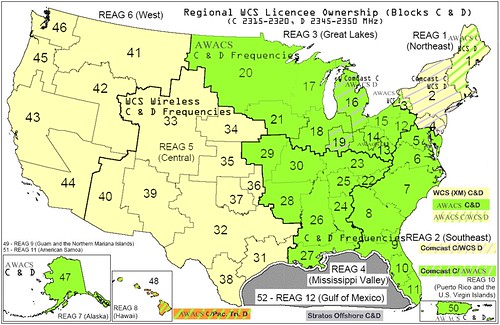
I seem to recall AT&T owning Wireless Communications Services (WCS) spectrum that was in two 15MHz blocks at 2.3GHz with satellite radio (XM and Sirius) in and around those blocks. There was concern that once new WCS came around, there would be interference with satellite radio services — especially C and D channels of this WCS spectrum. But if you grab some of the spectrum that become available after a merger, then one could essentially coordinate the frequencies nicely.

So what do we see AT&T file with the patent office last week? Two applications for a satellite radio system with feedback. Nice catch by Satellite Radio TechWorld:

Through various mergers, AT&T has acquired enough spectrum that could possibly make satellite radio practical. Plus, technology has developed that would make spot beams more practical. There are only a few players left. It wouldn’t take but a few players to come together for nationwide service. Most of the WCS license holders are planning to use WiMax, but it is not practical under the current regulations. They are trying to change the rules in order to make it practical and the same time the FCC is trying to determine the final rules for satellite radio repeaters. If rules are not adapted that would make WiMax practical, then satellite radio might be the next best practical use of the spectrum.

And the timing? Ingenious:

It is interesting to note that this application was filed after XM and Sirius announced the merger (September 24, 2007). Applications can be kept away from the public for up to 18 months, if we recall correctly. This was less than four months ago. They wanted this to be public. However, this is not new. It is based on an application filed in September 2003 and recently became patent on September 25, 2007. No doubt it is enough to give XM and Sirius pause for consideration. 

Here are the two applications (in PDF):

Digital Radio Feedback Apparatuses, System, and Methods

Digital Radio Feedback Systems