More Satcom Internet in Europe

Last week, we wrote about ViaSat and Eutelsat teaming up to offer new broadband capacity via Ka-band, and the impact the joint effort may have on internet satellite offerings in the United States and Canada.

But the growing satellite broadband market isn’t limited to North America, of course. In Europe, SES Astra’s ASTRA2Connect (which we blogged about last August) utilizes the commercially mature Ku-band technology to deliver broadband across the continent:

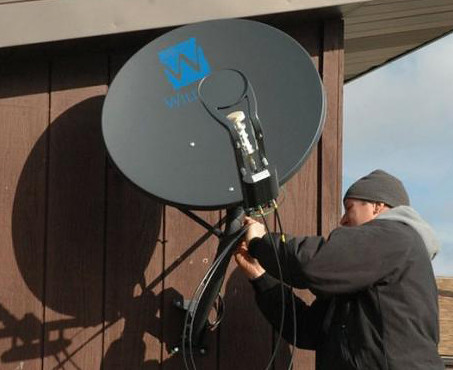
The home equipment is so easy to install that you can even do it yourself. A complete kit of accessories comes with the package including:

  • A satellite antenna (typically 75-80cm)
  • A transmitter/receiver (LNB), which sits on the front of the dish
  • A satellite modem, which is connected via an Ethernet cable to your PC

ASTRA2Connect is sold through resellers.  Just last month, SES Astra signed deals with Euro Marketing Group (to offer ASTRA2Connect in Poland through such brands as SkySatPlus) and with Zug, Switzerland-based telecoms provider Yato, who will distribute the service in Germany.

And today, the news is out that ASTRA2Connect is available in France and Italy as well:

Nine months after the product launch in April 2007, SES Astra now has distribution agreements in seven European countries, the satellite operator said.

Future revenue secured by these contracts amounts to 165 mln eur with more than 200,000 consumer terminals to be installed within three to five years, it said.

SES Astra had already signed contracts for Astra2Connect in Germany, Austria, Switzerland, Ireland and Poland. Additional contracts in several other European countries are under negotiation, the group said.

In France, the product will be distributed to consumers under the brand Viveole by communications service provider Auvea Ingenierie.

In Italy, Astra2Connect will be marketed to consumers by the broadband service provider Digitaria, an affiliate of the network and satellite service providers Netdish and Eurosatellite, SES SA said.

At last count, the ASTRA satellite system reaches 109 million homes in Europe and North Africa, broadcasting nearly 1,900 TV and radio channels in analogue and digital formats.

Satellite Split

Today’s SkyREPORT revisits EchoStar’s split. The division will result in two companies: DISH Networks (DISH), which provides direct-to-home satellite service, and EchoStar (SATS) which does…well…pretty much everything else – designs set-top boxes, provides fixed satellite services, and develops Sling Media technology.

The satellite service provides capacity on nine owned and leased in-orbit satellites, and includes a network of seven full-service digital broadcast centers and leased fiber PoPs in 150 cities. Here at SES, we’re looking forward to launching a new satellite for EchoStar.

How’s this split faring on Wall Street?

In a note released last week, William Kidd of Wedbush Morgan lowered his price target on DISH shares (stock that represents the new DISH Network DBS split) from $48 to $37. The move was made given that DISH shares solely represent the pay-TV assets.

While the bulk of the adjustment represents the split, Kidd also said $2 of the change is the result of the company’s recent decision not to raise prices for subscribers this year.

The two stocks are slightly down so far this year. (But what stock isn’t these days?).

The move allows EchoStar to sell its products externally:

Last week, Ergen said that the company is aggressively planning to sell products — from Sling Media-enabled modems to set-tops — to Dish Network’s video rivals, namely cable operators and phone companies.

Ergen and Blake Krikorian, co-founder and chairman of Sling Media, both described the efforts of the spinoff company, EchoStar Holding, to seek buyers for its products beyond the Dish direct-broadcast satellite service.

“As a set-top manufacturer, EchoStar will certainly try to build products and sell them to the cable industry,” Ergen said at a CES press conference.

And this gives the company a way to "better highlight the value of some of its lesser-known technology assets." That publicity definitely hit last week’s CES 2008 convention:

It’s HD DVR, the TR-50, won CNET’s "best in show" for home video:

If you think everybody has cable or satellite, you couldn’t be more wrong. In fact, if you live in an area that’s well-served by digital broadcasters, now’s a better time than ever to get your TV over the air (or "OTA," as the cool kids say): yeah, you get only a handful of channels, but they’re in crystal-clear digital quality–DVD quality at "worst," uncompressed high-definition at best. The problem–as we’re reminded by many an e-mailer–is that there just isn’t a good DVR solution for the rabbit-ears crowd, especially if you prefer high-def. (You can opt for a TiVo HD, but you’d still have to pay a monthly fee for their programming guide.) But that may finally be changing, thanks to the EchoStar TR-50. For all intents and purposes, the TR-50 takes many of the features found on Dish Networks’ excellent satellite DVRs (such as the ViP622 and 722) and brings them to antenna-based TV viewers.

And, after months of delays and questions, the company announced a SlingPlayer mobile version for the Blackberry:

This past week at CES, Sling Media demonstrated its SlingPlayer Mobile on a BlackBerry Pearl at the technology expo; up until now, SlingPlayer Mobile and BlackBerry haven’t played nice together. Sling Media hasn’t given a firm date on when the new player will be available, but states that it’ll be introduced "later this year" for $29.99.

DIY Friday: Weather Satellite Station

Sick of weather.com’s pop-up ads?

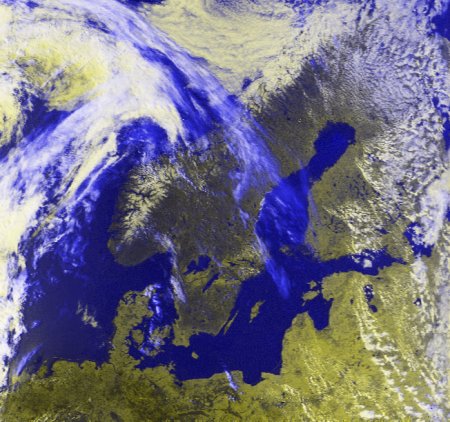
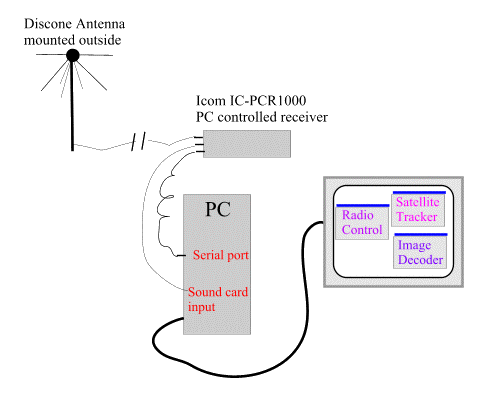
Setting-up a weather satellite station is remarkably simple: Connect a discone antenna ($50-100) to a PC-controlled receiver (HobbySpace used a ICOM – PCR1000 – now a 1500). The receiver includes software to receive the audio signal. You will need software to decode the audio to obtain the weather image. HobbySpace used WXSat (freeware). More advanced station designs are available here.

You can use WinOrbit to track when and where a polar satellite will pass. By the way, these polar satellites work a little different than your typical weather satellites that show weather patterns moving across the country on your local news:

The NOAA polar satellites orbit at 850km and pass within view of all areas on earth at least twice day. The satellite carries a number of instruments including cameras for both visible and Infrared light.

The cameras scan back and forth at right angles to the ground path, like a broom sweeping side-to-side as you walk forward, taking picture strips that cover an area 3000km wide. The satellite thus makes a continuous picture as if it was a tape reeling out from an endless roll.

The image, however, is not recorded on the satellite. Each image strip is immediately broadcast to the ground at a frequency just above 137MHz. The satellite will be in range for up to 12min as the satellite passes from horizon to horizon.

The broadcast uses the APT (Automatic Picture Transmission) analog format for the imagery. (A digital format – High Resolution Picture Transmission (HRPT ) signal is also transmitted but it is more difficult to receive and decode and we did not try to receive it in this project.)

Want the whole shebang? Build an ethernet weather station to collect temperature and air pressure readings, then feed the data through its very own web server.

And, if you’re looking for a location for your new venture, consider my old stomping grounds – southern Wisconsin. Among the bizarre events in the past few weeks: first Severe Thunderstorm Warning in 14 years during the month of January; numerous rivers exceeding flood stage…in JANUARY; and record high January temperatures throughout the area. Crazy. We’ll save the global warming debate for a different day. Let me just say I’m glad I did my cross-country skiing in December and not January.


Eutelsat, Viasat Team up to Offer Broadband Capacity

It’s incredible to reflect — and appropriate in these early days of a new year — on how rapidly broadband access has grown in the last four years. Back in 2004, some of us were still contending with dial up at home, while on the road, an 802.11b connection was a rare luxury.

Now, of course, WiFi is ubiquitous, but for true road warriors, seeking out a Starbucks is no longer  an acceptable way to maintain productivity. Aircards or satellite broadband are the way to go.

And for those in the rural and ex-urban hinterlands, satellite broadband is increasingly edging out DSL and Cable as the way to get connected. As we’ve blogged before, WildBlue has been so successful in signing up ex-urbanites that they’ve had to turn away business.


But more capacity is on the way. Eutelsat and ViaSat are working together in developing the Ka-band for Internet access services: 

ViaSat and Eutelsat are cooperating around ViaSat’s Ka-band SurfBeam networking system and a common wholesale business model to offer service through ISPs, telecommunication companies, and direct-to-home television providers, the US company said.

Eutelsat announced separately that it has selected EADS Astrium to deliver its first satellite operating exclusively in Ka-band frequencies.

ViaSat, too, is getting its own satellite — a first for them — to be built by Loral and operated by Telesat:

The new spacecraft is scheduled to launch in 2011 and is expected to provide more than 15 years of service life. It employs SS/L’s space-proven 1300 platform and high-capacity Ka-band spot beam technology to ultimately service more broadband users at faster data rates than any previous satellite.

The orbital location, 115 degrees West, is one Telesat has had for a while. (It was not one of the new licenses issued last June.)

Meanwhile, Telesat’s Canadian competitor broke ground on its satellite control center last month:

The Ciel Satellite Group announced today that it has selected SED Systems, a division of Calian Ltd, to expand SED’s satellite control center facilities in Saskatoon in preparation for the initiation of tracking, telemetry and control (TT&C) operations for Ciel-2, a satellite that is planned for operation by the first quarter of 2009….

SED Systems has been in operation since 1965. Headquartered in Saskatoon, Saskatchewan, the company is ideally located, in terms of look-angle to Ciel-2’s 129 degree West orbital position. In March 2008, ground will be broken to install the monitoring antenna, while the entire facility renovation and upgrade is expected to be complete by the end of summer 2008. A team of dedicated satellite controllers will be trained and in position, ready to operate Ciel-2 well before its planned fourth quarter 2008 launch and in-orbit testing.

It should be noted that ViaSat’s further adoption of its DOCSIS-based Surfbeam platform, which is used by WildBlue in the U.S., could lead to ViaSat helping WildBlue with additional capacity in the future.

For a local perspective on Viasat’s new venture, check out this article from the San Diego Union-Tribune

Without a doubt, the satellite broadband business continues to boom.

Race for Mobile TV Platform Entering Final Lap

We’ve written before about mobile TV, and about Samsung’s video chipset for mobile TV technology. Now, the race is on to determine which mobile digital television technology will become the standard — with PC Magazine calling the competition a war.

"The battle between Blu-ray and HD DVD may be settling down at last, but in the mobile TV arena another competition is just getting under way," reports the Ecommerce Times:

 Two different mobile digital television technologies will enter testing this year, each backed by a different set of vendors. In one camp, there’s the A-VSB platform developed by Samsung Electronics Latest News about Samsung and Rohde & Schwarz; in the other, it’s the MPH (Mobile-Pedestrian-Handheld) platform, jointly developed by LG Electronics Latest News about LG Electronics and Harris.

Both have performed well in preliminary technical trials conducted by members of the Open Mobile Video Coalition industry alliance, the group said. Ultimately, however, only one will be chosen by the Advanced Television Systems Committee standards-setting body as the official U.S. standard for mobile digital TV, Gerry Kaufhold, principal analyst with In-Stat, told TechNewsWorld.

LG just unveiled its Mobile Pedestrian Handheld (MPH) in Las Vegas:

Woo Paik, LGE president and chief technology officer, said that since the development of the digital broadcast system began, broadcasters have sought a system with the capability of delivering programming to mobile viewers.

LG, which holds the patents to the 8-VSB modulation scheme used in the ATSC television broadcast system, developed MPH to provide broadcast quality video receivable by devices moving at speeds of up to 140 miles per hour. The system will also be capable of working with the current ATSC DTV broadcast standard, LG said.

Here’s Mahalo Daily’s Veronica Belmont at LG’s booth at CES:


Samsung’s technology, meanwhile, is heading for national trials:

The trial will use SES Americom’s IP PRIME facility in Vernon Valley, N.J., and satellite capacity to beam national signals to A-VSB transmitters in local markets, which will also be inserting local content into an A-VSB "in-band" stream that will broadcast within stations’ existing digital spectrum.

Rohde & Schwarz and Samsung are supplying the local transmission technology, Nokia Siemens is providing back-end service management and MobiTV will handle the service’s interactive features. SES Americom will provide overall integration of the project.

Here’s Samsung’s demo from last year’s NAB:


Finally, there are rumors that Apple might announce mobile TV next week at MacWorld. We’ll see on Tuesday.


Solar Cycle 24


A new cycle of solar activity, officially "Solar Cycle 24," is upon us according to a NOAA press release:

A new 11-year cycle of heightened solar activity, bringing with it increased risks for power grids, critical military, civilian and airline communications, GPS signals and even cell phones and ATM transactions, showed signs it was on its way late yesterday when the cycle’s first sunspot appeared in the sun’s Northern Hemisphere, NOAA scientists said.

“This sunspot is like the first robin of spring,” said solar physicist Douglas Biesecker of NOAA’s Space Weather Prediction Center. “In this case, it’s an early omen of solar storms that will gradually increase over the next few years.”

A sunspot is an area of highly organized magnetic activity on the surface of the sun. The new 11-year cycle, called Solar Cycle 24, is expected to build gradually, with the number of sunspots and solar storms reaching a maximum by 2011 or 2012, though devastating storms can occur at any time.

During a solar storm, highly charged material ejected from the sun may head toward Earth, where it can bring down power grids, disrupt critical communications, and threaten astronauts with harmful radiation. Storms can also knock out commercial communications satellites and swamp Global Positioning System signals. Routine activities such as talking on a cell phone or getting money from an ATM machine could suddenly halt over a large part of the globe.

The discussion on Slashdot ranged from light polarity to global warming to AIDS research, which may or may not be entertaining, depending on your point of view.

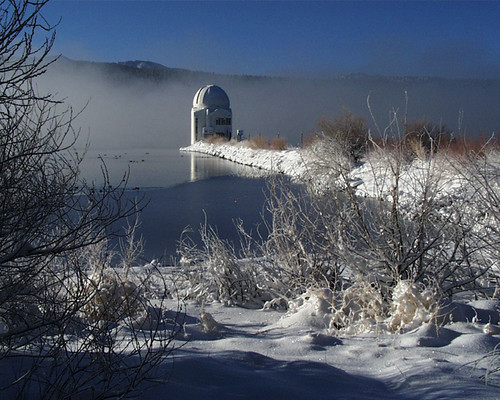
You can bet the Big Bear Solar Observatory will be watching this intently. It may be in California, but it’s run by the New Jersey Institute of Technology (NJIT).

Having your ATM machines go cold suddenly is probably because that location depends on a VSAT terminal to process transactions, which uses a geosynchronous communications satellite to connect to the banking system. If that VSAT network uses an AMERICOM satellite, hopefully it won’t be a problem (disclosure: AMERICOM underwrites this blog). The satellites that AMERICOM operates are designed to withstand the effects of extreme solar events, categories S5 and G5, and with more than the predicted number of events of all levels over the life of each satellite as part of the design. Electronic components that are known to degrade in the presence of solar radiation have been "oversized" to degrade acceptably and operate nominally during the expected radiation exposure associated with soloar storms. In addition, shielding is utilized to reduce the exposure of electronic components to the effects of solar radiation and geomagnetic storms.

As always, check SpaceWeather for the latest developments.


DIY Friday: Tuning Your Newtonian Reflector

The tuning of a telescope is actually called "collimation," and Sky and Telescope shows you how:

To get your telescope well collimated, here is what you need to accomplish:

Step 1: Center the secondary mirror on the axis of the focuser drawtube.

Step 2: Aim the eyepiece at the center of the primary mirror.

Step 3: Center your primary mirror’s sweet spot in the eyepiece’s field of view.

In most cases, only the last of these three steps will need to be repeated regularly; the first two are more or less set-and-forget operations. Now let’s get to the nuts and bolts of actually collimating your reflector


It’s a rather simple telescope and could build one yourself for about $150

Sirius Subscribers

The suspense around the Sirius-XM merger continues, but I like their growth for 2007. Up 38%, according to Business Week:

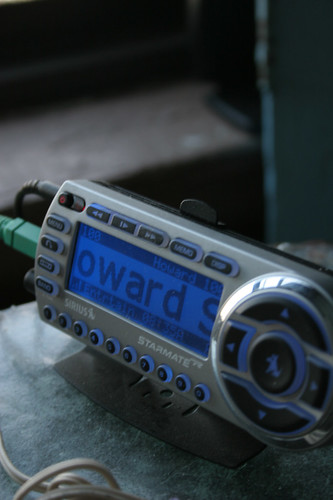
Sirius Satellite Radio Inc. said Thursday it ended 2007 with 8.3 million subscribers, up 38 percent from a year earlier.

The company added about 2.3 million net subscribers during the year.

In October, Sirius had said it expected to have 8 million subscribers by year-end.

Chief Executive Mel Karmazin said, "Our gross subscriber additions in 2007 were the highest in the history of satellite radio."

"Based upon preliminary financial data, we expect to report significantly greater positive free cash flow in the fourth quarter of 2007 than the company reported in the fourth quarter of 2006," Karmazin added.

Sirius is awaiting federal approval of its plan to acquire competitor XM Satellite Radio Holdings Inc. XM signed an agreement in February outlining a sale to Sirius in a $13.6 billion deal that has drawn close regulatory scrutiny. Terms call for Sirius to pay 4.6 shares for each XM share.

Sirius also reported on churn rates, or the percentage of subscribers who end service in a given month. Its full-year monthly subscriber self-pay churn rate was 1.6 percent and overall churn was 2.2 percent, consistent with the low end of its guidance.

In October, Sirius said its net loss for the third quarter narrowed to $120.1 million, or 8 cents a share, from $162.9 million, or 12 cents, a year earlier. Revenue was $241.8 million, up from $167.1 million.

Sirius shares rose 10 cents, or 3.3 percent, to close at $3.15 Thursday.

South Pole South Paw

We recently blogged about a new satcom connection in Antarctica and a terrific new map of "the coldest continent," so we were somewhat amused to read about the "drunken brawl" around Christmas at the Amundsen-Scott South Pole Station:

"There was an altercation between two people … there’s no indication of the cause or of the background between the two folks," said US National Science Foundation spokesman Peter West.

Dr Karl Erb, head of the US Antarctic programme, said the man had been sacked.

"The assailant has been removed from Antarctica and his contract terminated by his employer. Such behaviour has no place whatsoever in the US Antarctic programme."

Mr West said the injured person had been flown to the larger McMurdo Station – near New Zealand’s Scott Base – for treatment.

Medical staff at McMurdo assessed the man’s injury to be more serious than they could treat, and he was flown to Christchurch – accompanied by a flight nurse and paramedic – on board a US Air Force Hercules. Dozens of workers at McMurdo had to work on their day off to help the evacuation.

Mr West said the incremental cost of the medivac was approximately US$85,000 ($110,000) including fuel costs and reimbursement for flight hours.

"The additional costs were incurred because the medivac was required during a period of normally reduced flight activity – specifically the Christmas holiday.

"The injured party is, to my knowledge, still in Christchurch and is recuperating after being treated."

A Christchurch Hospital spokeswoman said a man was admitted on Christmas Day, and was discharged on Boxing Day.

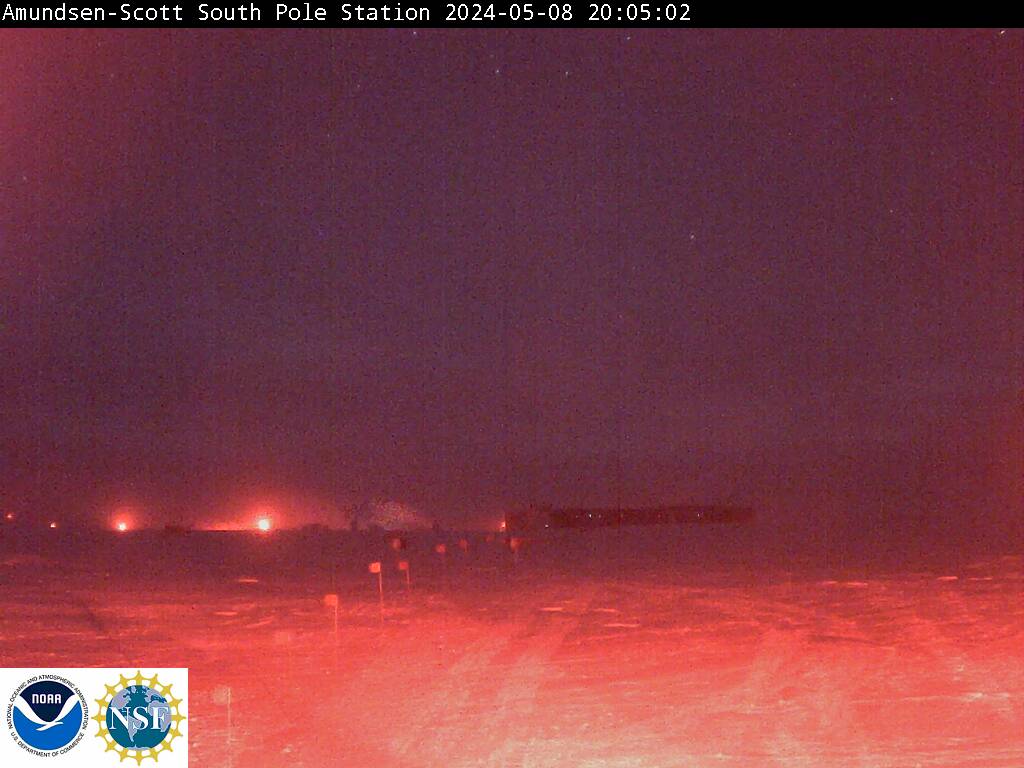
It’s summer there now, as seen on this NOAA webcam:

Wow, US$85,000 to rescue the guy with the busted jaw. Both were apparently employees of Raytheon Polar Services, the IT contractor. I remember reading about the IT guy in a Computerworld interview last month, who has his own blog. In the interview, he talks about one of his more outrageous experiences, the 300 Club:

We have this tradition called the 300 Club. When the temperature drops below -100 we hike the sauna up to 200 degrees and stay in there as long as we can stand it. Then we run outside, naked, around the geographic pole and back inside so we get that total 300-degree change in temperature. That happens every year and it’s absolutely amazing. Just the feel of that cold on your skin is like nothing else. People always wonder if you can feel the difference between 60 below and 100 below and the answer is absolutely.
 

Check out his photo gallery for this and other scenes from the South Pole. Pretty interesting story, too. They use three inclined orbit satellite for communications, available for only a few hours each day. Geosynchrounous satellites are positioned over the equator, so an antenna at the either of the poles can’t really "see" them as they are beyond the horizon.

Your Sirius Radio, however, will work at the North Pole. Their elliptical orbit is focused on North America and is sometimes referred to as a "tundra orbit."

Distance Learning in India

Reading The Hindu today, we see Edusat making major progress:

A major initiative towards providing satellite-based tele-education facilities to engineering colleges in the country was launched on Tuesday by the Indian Space Research Organisation (ISRO) in association with Indian Institute of Technology (IIT), Bombay.

This EDUSAT network would provide satellite-based tele-education facilities to students and teachers of the engineering colleges across the country, an ISRO release said.

The teaching end had been set up at IIT, Bombay by ISRO which will provide satellite bandwidth and install ground equipment at various recipient institutes across the country, while the IIT would arrange for delivering full-fledged courses on various engineering topics through its faculty on this network, it said.

A Memorandum of Understanding in this regard was signed between ISRO and IIT, Bombay in November 2007. To begin with, 13 full-fledged courses had been scheduled on this channel. About 50 colleges including IITs, several National Institutes of Technology (NITs), VJTI Mumbai, Samrat Ashok Technology, Salem, and Delhi College of Engineering, which already have the compatible ground terminal equipment, will start receiving these programmes from tomorrow.

New institutes who wish to join this programme would be provided ground equipment soon.

In the EDUSAT Network, ISRO has set up more than 45 broadcast and interactive networks covering 20 states, including North-Eastern ones and islands of the country.

More than 30,000 classrooms had been provided connectivity through the EDUSAT and the number was still growing steadily, ISRO said. EDUSAT spacecraft was launched on September 20, 2004.

Visvesvaraya Technological University is another one where distance learning via satellite is an important part of the educational mix. 

We’ve seen instances of outages in certain conditions with Edusat, so let’s hope it’s minimized now. Here’s the launch video from 2004: