GSM Satellite Backhaul

Remote regions and developing nations are seeing a massive expansion in their GSM networks. Nigeria, for example, has only 1.25 million landline phones, but more than 30 million mobile subscribers. This presents a number of challenges: foremost, how do you expand a network to remote places that lack the infrastructure for conventional GSM networks?

The solution: satellites, of course! In Papua New Guinea, SES NEW SKIES signed a contract with the national telecom company, Telikom Papua New Guinea, to provide GSM backhaul services using its NSS-5 spacecraft. Details from Cellular-News:
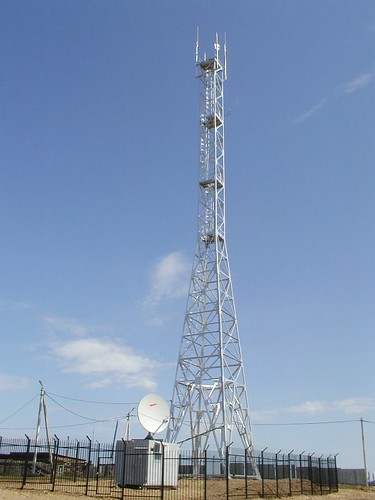
The NSS-5 satellite capacity will allow Telikom PNG to expand its GSM services into new regions and provide telephone services over mountainous terrain by providing GSM backhaul between a large number of sites around the country back to the capital Port Moresby.

States Scott Sprague, Senior Vice President Global Sales of SES NEW SKIES: "The ubiquitous coverage of the NSS-5 satellite allows Telikom Papua New Guinea to significantly increase its GSM service area across the rugged geography of Papua New Guinea. SES NEW SKIES is proud to assist the country’s premier telecommunications provider to offer vital communications services to widespread, mainly rural populations and across terrains that make it difficult to develop even basic transportation infrastructures."

Remote deployment is only one use of satellite backhaul services. As satellite modem manufacturer Radyne expains, two other uses could prove critical: temporary installations during disaster recovery (when the broadband infrastructure has been damaged) and when a rapid deployment is required.

Communications technology giant Cisco hasn’t ignored this developing industry (abbreviations in description have been expanded):

At the cell site, GSM traffic is compressed and aggregated with [Universal Mobile Telecommunications Service (UMTS)] traffic by the [mobile wireless router]. The result is lower bandwidth aggregated traffic that is routed to the satellite modem and transmitted to the other side. Depending on actual T1/E1 link utilization for both GSM and UMTS, Cisco RAN Optimization can reduce the bandwidth required on the satellite link up to 50 percent, providing significant savings in [operating expenses].

Phoenix & Mars Are All Right


Great animation, via Phoenix Mars Mission, which launches next week:

Rough-Cut Launch, Entry, Descent, and Landing Animation Developed in the summer of 2004, this animation visulaizes launch in August 2007 and entry, descent, and landing of the Phoenix Mars Mission in May 2008. Currently the animation is in the rough-cut phase and is being modified as the spacecraft develops. The animation was created by Maas Digital under the direction of the Jet Propulsion Laboratory’s Solar System Visualization Project.


Darpa Goes “Deep Green”

When it comes to battlefield planning and execution, a crystal ball would certainly make a field commander’s life a whole lot easier.

That’s exactly what DARPA — the research and development arm of the Department of Defense — hopes to create (sort of) with the "Deep Green" program.


DARPA describes the requirements for Deep Green in its call for ideas (PDF here):

Deep Green will build a battle command decision support system that interleaves anticipatory planning with adaptive execution. Deep Green must be capable of addressing the full spectrum of joint and combined arms capabilities available to the modular brigade commander, drastically increasing the option and future space. This will allow the commander to think ahead, identify when a plan is going awry, and help develop alternatives “ahead of real time.” The commander (and his support staff) is involved in essentially two major asynchronous functions: generating options and making decisions. The goal of this program is to create a commander-driven system to assist the commander and his support staff in generating options or Courses of Action (COAs).

Wired explains further: 

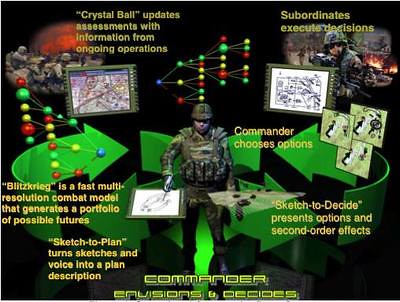
Deep Green has a half-dozen different interlocking components, including a "Sketch to Plan" program that reads a commander’s doodles, listens to his words, and then "accurately induces" a plan, "fill[ing] in missing details."  That allows an officer "to specify an option at a coarse level, then move on to the next cognitive task."  A related program, "Sketch to Decide" allows a commander to "see the future" by producing a "comic strip" to represent his possible options in a given situation.  That may "sound exotic," the Agency notes.  But "since the 1970s (and perhaps earlier), there have been novels and game books in which the reader is asked to make a decision and then is directed to a different page or paragraph, depending on the choice made."

To make these warzone versions of choose-your-own-adventure novels, Darpa proposes two pieces of software. "Blitzkrieg" will quickly model sets of alternatives, while "Crystal Ball" will take information currently coming into a headquarters to figure out which scenarios are the most likely to happen, and which plans are likely to work best.    Crystal Ball will use this estimate to nominate to the commander futures at which he/she should focus some planning effort to build additional options/branches.  Crystal Ball will identify the trajectory of the operation in time to allow the commander to generate options before they are needed.

 So why the name Deep Green? The Register snarkily explains:

The colour presumably alludes to the fact that – at least to start with – the robocommand package is intended to help US Army bird colonels handle their "modular brigade" battle groups. If the project were a British Army one, the project might be known as "Deep Brown" (Or there again, maybe not). As Deep Blue is already taken, future versions for the other US services will presumably be known as Deep Periwinkle (air force) and Actually Deep Blue (navy).

The R&D timeline is slated for just three short years, though that estimate is made without the benefit of a crystal ball, we presume.

Astronauts Toss Junk Overboard from ISS

At 6:24 am EDT this morning, two International Space Station crew members — Astronaut Clay Anderson and cosmonaut and station commander Fyodor Yurchikhin — stepped from the Quest Airlock to take out the trash.

Specifically, they had to get rid of a refrigerator-size ammonia reservoir and a supporting brace.

The Houston Chronicle explains:

After months of deliberation, NASA decided to throw away the coolant tank and a 218-pound brace. Normally, the no-longer-needed pieces of hardware would have been returned to Earth aboard a space shuttle.

However, NASA is planning only 12 to 14 more assembly and supply missions to the 210-mile-high orbital outpost before it retires the shuttle fleet in 2010. There won’t be enough room to bring the ammonia tank and the brace back, space agency officials said earlier this month.

The brace was occupying external stowage space on the station that will be needed to hold a new gyroscope that is awaiting launch aboard the shuttle Endeavour early next month.

But wait — we’ve written before about the dangers that space junk poses to satellites and the ISS. So how will the ISS avoid smacking into a 1,400 pound ammonia coolant tank? 

Late today, NASA plans to raise the altitude of the space station by several miles to lower the risk of a catastrophic collision with the space station. The two objects will be tracked by military radar so the operators of other spacecraft can be notified of a potential collision.

Even in a zero-G environment, of course, trash can be unwieldy. That’s why Cosmonaut Oleg Kotov stayed in the U.S. laboratory Destiny to operate the Canadarm2 and help the two spacewalkers with the morning chores:

Canadarm 2 is a larger and more sophisticated version of the robotic arm built for the space shuttle. Fully extended, the arm is nearly 18 metres long, three metres longer than the shuttle’s arm, and can handle loads up to 116 tonnes.

The new arm also has a hand on either end so one can latch onto the space station while the other end reaches out and picks up things that it needs. Then it can let go and grab on somewhere else.

The real talent in the new design is in its ability to move around where the astronauts most need the robot arm. The Canadarm 2 can crawl along the body of the space station on its two hands, end over end like an inchworm. The outside of the station has a number of sockets where the arm can plug in. As well, the arm can be fixed to a work platform that moves on rails from one end of the station to the other.

For all that sophistication, however, we are sad to report that the Canadarm2 still cannot open a can of beer. (See video.)

Video of this morning’s spacewalk can be seen here. Also check out this news report on astronaut Clay Anderson, who brought a football with him to the ISS in honor of his Nebraska roots.

DIY Fridays: Portable Satellite Radio

Satellite radio is becoming somewhat commonplace while traveling: its a good move if you drive in rural places, many car rental companies offer XM or Sirius standard or as an upgrade, car dealerships throw in satellite radios as promotions, and even airlines are offering satellite content.

It’s even starting to show up in homes, with home receivers and antennas being stacked right next to amps, cd-players, and turntables.

But while iPod’s seem to be taking over, you rarely see someone sporting portable satellite radio. Why not enjoy Bluegrass Junction, XM Cafe, or Sirius Classic Soul in between car-trips and living room lounging? Of course, you could purchase a device, but that wouldn’t be any fun.

Make has the instructions (subscription only):

The basic prescription is to mount a Terk XMicro antenna on headphones and connect to a Delphi roady. There are a few complicated steps:

Modifying the antenna: You need to alter the antenna by…

removing the pink plastic connector shroud. I used a small screwdriver to get between the white and pink plastic and gently extracted the white plastic looking piece. Then I heat-shrank a "strain relief" over the top of the connector and the exposed wire from breaking. This rubber "shrinky dink" tubing will contract tightly over the wires once you apply heat from a hair dryer to it.

Create a power supply: Connect a battery-pack with five AA batteries to the Delphi using a RadioShack Adaptaplug "Type B" tip. This should generate six to nine volts.

Turning it on:

Using the power button to turn the unit on will turn on the display’s LEDs, eating up battery power. Instead, input the sequence "232" into the keypad and then push in the scroll wheel on the side.

Enjoy the tunes!


Cleveland Art Festival Utilizes IPTV for Digital Film Fest

Hello Cleveland!

Tonight marks the kickoff of the three-day Open Student Television Network (OSTN) / Internet 2 Film Festival, which is being run as part of the Ingenuity Festival at Cleveland State University.

OSTN features the only 24/7 worldwide IPTV channel devoted exclusively to student programming, and boasts 41 million subscribers at 4,500 universities in 36 countries. Internet 2 is a higher education research consortium delivering advanced networking capabilities to its members. And the Ingenuity Festival is 4 days of cool creativity — including "opera, theater, ballet, step dancing, breakdancing, contemporary dance," and "cutting-edge, art-and-technology collaborations and integrations" — in Cleveland’s Playhouse Square.

But here at Really Rocket Science, we’re particularly intrigued by the IPTV delivery of the OSTN/Internet 2 Film Festival:

The collaboration between the Open Student Television Network and Internet2 create the perfect mesh for the Ingenuity Festival, combining both technology and media in the ultimate medium – a premiere channel for student produced work. The Internet2 network acts as a backbone for the OSTN channel’s delivery to colleges and universities all over the country, and allows the channel to deliver streaming NTSC quality video through fiber. The OSTN Channel is available to Cleveland State University, Case Western Reserve University, John Carroll University, the University of Akron and other surrounding Intenet2 member schools.

The organizers have used IP at every stage of the festival:

The student directors and producers will use Internet2 technologies to both submit and screen their films, the organizers said. A variety of media formats will be showcased, including short films, documentaries and student television shows.

Digital programming from diverse sources will be shown, including the work of students the University of Southern California, Brown University, Duke University, Oberlin College, John Carroll University, and the University of Akron.

Not in Cleveland? No worries. Each night of the festival (which lasts from 7-9 pm Eastern) is being webcast (schedule here). You can check out the films being shown here. We’re impressed by the high quality of the submissions, with Feedback Fred (pictured above) of particular note — there’s something about it that perfectly captures the vibe of the Berlin art scene as we remember it  from a visit  to Germany nearly 18 years ago.


It Fell Out of the Sky in Bayonne

We’ve seen meteors in New Jersey before, but this is something else. This crashed through a roof in Bayonne and people thought is was space junk, or part of a commercial jet.


The folks at local news radio 1010 WINS explain:

Object That Fell Through Bayonne Roof Identified

BAYONNE, N.J. (AP)  — It didn’t take a rocket scientist to solve the mystery of what it was that fell through the roof of a Bayonne home Tuesday, though some had wondered if it was part of a space craft.

Federal Aviation Administration spokesman Jim Peters on Wednesday said the mystery metal was part of a commercial woodchipper.

For most of a day, the FAA, New Jersey Transit officials and others were scratching their heads about what the hunk of gray metal may have been.

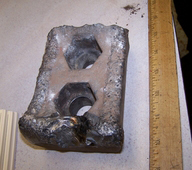
The man who lives in the house was watching television Tuesday when he heard a crash and saw a cloud of dust. In the next room, he found a hunk of gray metal, 3{ inches by 5 inches, with two hexagonal holes in it.

Experts said it was manmade, but couldn’t identify it.

New Jersey Transit has railroad tracks about 100 feet from the house, but spokesman Dan Stessel said the object isn’t something that would have flown off a train.

FAA officials said it wasn’t a part that would have fallen from a plane headed into or out of nearby Newark Liberty International Airport.

A NASA scientist said it did not appear to be part of a spacecraft.

Peters said that when an FAA inspector took the piece back to his office Tuesday afternoon to work on the mystery, a colleague recognized the piece.

The same part from a different machine had caused similar confusion — though it did not get any publicity — last year. Peters said the inspector could not remember where in New Jersey the other one fell.

The part came from the grinder of a woodchipper. Peters said the piece moves very fast and, apparently, can launch into the air if something goes wrong. "Maybe we can use it as a new weapon,” he joked.


Bayonne is located just south of Jersey City and lies across Newark Bay and the Newark Liberty International Airport. The city even has it’s own bridge, to Staten Island


Slim and Sleek in Your New Spacesuit

Back in March, we wrote about the efforts of scientists to build the next generation of spacesuits, and their goal of halving the 300-lb weight of current spacesuits and increasing mobility.

Now, however, Dava Newman, a professor of aeronautics and astronautics and engineering systems at MIT, has a new "Biosuit" design that not only meets those requirements — but adds the all-important element of style.

 MIT News explains:

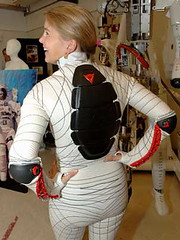
Newman is working on a sleek, advanced suit designed to allow superior mobility when humans eventually reach Mars or return to the moon. Her spandex and nylon BioSuit is not your grandfather’s spacesuit–think more Spiderman, less John Glenn….

Newman’s prototype suit is a revolutionary departure from the traditional model. Instead of using gas pressurization, which exerts a force on the astronaut’s body to protect it from the vacuum of space, the suit relies on mechanical counter-pressure, which involves wrapping tight layers of material around the body. The trick is to make a suit that is skintight but stretches with the body, allowing freedom of movement.

Over the past 40 years, spacesuits have gotten progressively heavier, and they now weigh in at about 300 pounds. That bulk — much of which is due to multiple layers and the life support system coupled with the gas-pressurization — severely constrains astronauts’ movements. About 70 to 80 percent of the energy they exert while wearing the suit goes towards simply working against the suit to bend it.

Working in a three hundred pound suit is only possible in a low-gravity environment. But if humans ever step foot on Mars, they’ll need lighter suits such as the one designed by Newman:

Key to their design is the pattern of lines on the suit, which correspond to lines of non-extension (lines on the skin that don’t extend when you move your leg). Those lines provide a stiff "skeleton" of structural support, while providing maximal mobility….

The suits could also help astronauts stay fit during the six-month journey to Mars. Studies have shown that astronauts lose up to 40 percent of their muscle strength in space, but the new outfits could be designed to offer varying resistance levels, allowing the astronauts to exercise against the suits during a long flight to Mars.

Perhaps most amazing is the Biosuit’s safety aspect:

[I]f a traditional spacesuit is punctured by a tiny meteorite or other object, the astronaut must return to the space station or home base immediately, before life-threatening decompression occurs. With the BioSuit, a small, isolated puncture can be wrapped much like a bandage, and the rest of the suit will be unaffected.

To get a full perspective of the complex requirements that must be met for a spacesuit to function safely in the hostile environment of space, check out this entry from Wikipedia. 


I want my Big Ten Network

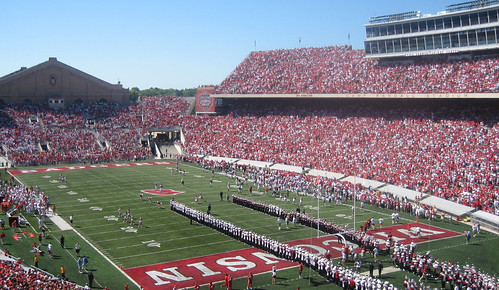
Higher taxes, decreased services, increased crime, atrocious construction—these are the issues that make city residents furious. But last December, absent these circumstances, I’ve never seen more rage in my pleasant home town of Madison, WI. Why? The Green Bay Packers were playing on the NFL Network and the local cable companies refused to carry the network. Listen to the radio or squeeze into an over-packed neighborhood bar — this was a decision Madisonians didn’t want to have to make.

This is a scenario that could play out again in Midwest sports towns, with the launch of the Big Ten Network (BTN) in August. BTN will air 35+ football games, 105+ Men’s basketball games, and 55+ Women’s basketball games a year, in addition to other sports and academic programming. The network currently has national agreements in place with DirecTV and AT&T but many cable operators are still holding-out. This includes Comcast, which responded to BTN sharply:

Indiana basketball fans don’t want to watch Iowa volleyball, but the Big Ten wants everyone to pay for their new network.

Now, BTN is turning to the grassroots to get Comcast and other providers to pay-up (link):

To get the Big Ten Network, Penn State fans should visit www.BigTenNetwork.com and enter your zip code, which will then provide a link to the cable providers in your area, as well as DirecTV and Dish Network, to make a request for them to carry the Big Ten Network.

Back to Madison, WI: cable-subscribing Badger fans are set to be in-the-dark when it comes to the BTN. And, while a lot of reader are outraged at Charter (the dominant local provider), one man is equally ticked-off at the Big Ten:

Commissioner Jim Delany needs to get real about charging Wisconsin fans millions of dollars to watch his new Big Ten Network — the second most expensive national cable channel in the country — which will air what sports columnists are now calling "fifth tier" sporting events such as nonconference tune-up football games and university swim meets.

In order to salvage the BTN into a profit-making venture, Delany says that he will try to migrate to his network many games from the ABC and ESPN networks, thus asking consumers to pay premium fees for many of the games they used to be able to see for free.

But moving the games to the expensive new channel could reduce revenues to our schools and dramatically hurt recruiting efforts. Many high school stars who don’t live in Big Ten states could be effectively shut out of viewing Big Ten games.

To be selfish: as a DC resident with the prospect of getting more Big Ten games out-of-market, I’ll be the first to say: I want my MTV Big Ten Network.


The New Television Situation in Germany

We read this news clip couple of weeks ago how the German Federal Cartel Office (offically Bundeskartellamt) has again contradicted itself whether a "positive signal" for the planned entavio platform was ever given. The proposition to convert TV viewers to a digital platform in Germany has be mired in regulatory proceedings for a while.


Now it seems they’re ready to launch in September with Premiere, via press release (in German and French, too):

Pay-TV broadcaster Premiere has signed an agreement to use SES ASTRA’s digital satellite platform entavio in Germany. Starting on September 1, 2007, new Premiere customers will be offered the Premiere programmes also via entavio. With this agreement, entavio wins a first important pay-TV client for its technical services. entavio-enabled receivers will be widely available in the market.

The new agreement also improves SES ASTRA`s ability to offer all broadcasters access to more than 2.5 million Premiere and Premiere-enabled satellite receivers in German TV households. SES ASTRA will continue to offer this access to other programme operators on neutral and transparent terms. SES ASTRA thereby further increases the attractiveness of its service portfolio to broadcasters.

I believe entavio will gradually replace Premiere set-top boxes over time. Broadband TV News tells us we can expect additional pay-TV companies to come aboard:

The new thematic bouquet from German pay TV operator Premiere is taking shape. The platform, which will use the entavio encryption facilities of SES ASTRA, is close to signing deals with both the RTL Group and ProSiebenSat1 to carry their new thematic channels.

The two contracts would bring RTL Living, RTL Crime, Passion, SAT1 Comedy and kabel eins classics into the fold. Earlier this year a deal was signed with Turner Broadcasting to carry the German language versions of Cartoon Network, TCM and Boomerang.

The total number of channels on the September 1st launch date is going to be twenty. Also planned are a kids channels and thematic channels about literature, music (concerts) and adult entertainment.

Nice video introduction, in German:

See you!