Beer in Space

Let’s start by saying that when you’re truly miles away from ordinary — ie, in space — drinking one of these is no swing in the hammock.

We don’t raise this issue because of Endeavor’s successful launch yesterday with Canadian astronaut Dave Williams on board. On shorter missions such as shuttle flights, we side with the teetotalers — astronauts can do without.

And they generally do, with some exceptions. "Small amounts of alcohol were apparently allowed on the Soviet space station Mir, and when Russian astronauts joined the International Space Station, there were some grumblings about the decree that it be dry," according to NewScientistSpace.

And in 1969, "Buzz Aldrin took communion after landing on the Moon, sipping wine from a small chalice. In the Moon’s feeble gravity, he later wrote, the wine swirled like syrup around the cup."

But when you start talking about multi-year voyages to Mars, for example, the question of beer in space — or any carbonated beverage, for that matter — becomes more than just a question at the bottom of your glass. Keeping astronauts on such extended voyages happy is a concern, and while kegstands in zero G aren’t likely to ever appear on the rec schedule, an occasional beer or even soda pop might help astronauts relax during the 2-year haul to Mars.

One of the chief obstacles to consuming carbonated beverages in space, however, is the wet burp:

Unfortunately for thirsty astronauts, beer is poorly suited to space consumption because of the gas it includes. Without gravity to draw liquids to the bottoms of their stomachs, leaving gases at the top, astronauts tend to produce wet burps.

"That’s one of the reasons why we don’t have carbonated beverages on the space menu," NASA spokesperson William Jeffs told New Scientist.

There are also questions about the effects of alcohol in space:

Jeffs says no research has been done on the effects of alcohol in a microgravity environment. But he says: "There may be differences in alcohol absorption and metabolism in space, which makes one suspect that there may be differences in the effects of alcohol in space."

Clark says medications sometimes have unusual effects in space, which "run the gamut from increased to decreased reactions".

At least one study has been done, however, on where astronauts would get their beer when the closest CircleK is a few million miles away:

 Graduate student Kirsten Sterrett at the University of Colorado in the US wrote a thesis on fermentation in space, with support from US beer behemoth Coors. She sent a miniature brewing kit into orbit aboard a space shuttle several years ago and produced a few sips of beer. She later sampled the space brew, but because of chemicals in and near it from her analysis, it didn’t taste great by the time she tried it.

Ok, so maybe even getting beer in space is still a problem. Still, as extended space voyages become a reality in the future, expect the question of drinks in space to come up — though hopefully not in the form of a wet burp.

Yahsat Means Billions


First, Dubai rises from the desert seemingly overnight to become a first-class economic center. Haliburton’s CEO is moving his office there. It’s becoming a major airline hub. It’s building huge, jaw-dropping buildings and developments. Today we learned they’re ready to spend $1.66 billion to get into the satellite business.


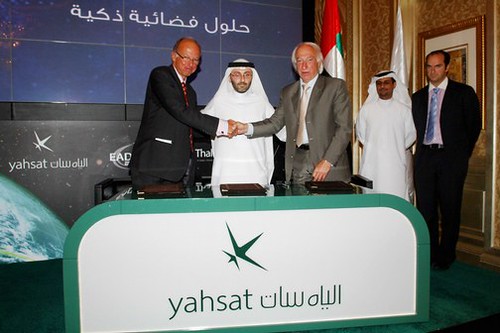
$1.66 billion.  That’s a nice big bag of money. And a consortium of Thales Alenia Space and EADS Astrium are getting it. Abu Dhabi’s Al Yah Satellite Communications Company (Yahsat) announced a contract for the consotium to build a new satellite system, via Gulf News:

Two satellites and an earth station will comprise the system that will serve military and commercial communication purposes, providing broadcasting, tele-communication and broadband services.

"The system initially will serve the Middle East, Africa, most of Europe, and South East Asia regions," Jasem Mohammad Al Za’abi, Yahsat’s chief executive officer, said.

Sixty-five per cent of the financing will be through a syndicated loan, and the remaining 35 per cent will be through Yahsat, 100 per cent owned by Abu Dhabi’s Mubadala Development Company, according to Waleed Ahmad Al Mokarrab, Yahsat’s chairman, and Mubadala’s chief operating officer.


Not a bad idea, considering how the oil market is behaving. Take the money and invest it in something that will last for generations: satcom, baby!  The people who run Yahsat-backers Mubadala seem to know what they’re doing.


Dropping the SpookSat

If you don’t like that headline, try The Register’s leader: "Cheesed-off spooks give up on duff spy-sat."

Reuters explains:

The National Reconnaissance Office has deemed an experimental U.S. spy satellite a total loss and will allow it to slowly drop from orbit and burn up in the atmosphere, two defense officials told Reuters this week.

The classified L-21, built by Lockheed Martin Corp at a cost of hundreds of millions of dollars, was launched on December 14 but has been out of touch since reaching its low-earth orbit, put by satellite watchers at about 220 miles above the earth.

It will now gradually fall out of orbit over the coming decades, said the officials, who asked not to be named. At some later date, it will burn up as it enters the earth’s atmosphere, posing no danger to people below, they said.

We discussed these technology failures earlier in June. Now that the L-21 is a loss, what’s next?

Meanwhile, the Pentagon will likely now have to test aspects of new technologies that were on the L-21 by piggybacking them onto other satellites over the next four to five years, the officials said.

For instance, the military could put the new sensors aboard TacSat 3, the latest in a series of smaller satellites, when it launches later this year.

The NRO could still try to build a new spacecraft to test the technology, but it would take several years to get the funding for such a satellite and build it, one official said.

The U.S. may be lagging behind in this technology race:

The two officials declined to identify what exactly the experimental Lockheed satellite was meant to test, but said its failure was troubling, given that other countries were rapidly plowing ahead with development and launch of new capabilities, especially in the area of synthetic aperture radars.

Synthetic aperture radars offer high-resolution and can pierce darkness and thick clouds to identify targets, even peering below the surface of the ground or peeking into foliage that might obstruct the view of photo-based sensors.

One official said Germany in June launched TerraSAR-X, a sophisticated new satellite armed with a synthetic aperture radar that analysts say marks the start of a new level of quality in the mapping of the earth.

Canada is also working on this technology.

The Bourne Satellites

We haven’t yet seen The Bourne Ultimatum, but at least some of us here at Really Rocket Science are counting the hours until we can sit in the darkness with our bucket of buttered popcorn and soda for the final installment of the series, loosely based on the Robert Ludlum novels.   

This is work-related, we tell ourselves, because of the extensive use of satcom in the film to drive the plot, which centers around rogue baddies in the intelligence community tapping into video surveillance networks (think of our Slingbox webcam on steroids) to track the film’s hero:

The plot goes something like this: London journalist Simon Ross (Paddy Considine) has stumbled onto a hyper-secret CIA black op code named Blackbriar.

It’s so sensitive the whisper of it on Ross’ cellphone sends sinister surveillance technology abuzz an ocean away in midtown Manhattan.

There, the Blackbriar leak may as well be a blot of blood in shark-infested waters, sparking the attention and ire of a Bush-league spook (David Strathairn) and Pam Landry (Joan Allen), the honourable but tough-as-nails CIA bureaucrat from 2004’s Supremacy who, in the last moments of that film, told Bourne his birth name.

Thing is, that still hasn’t happened yet — Ultimatum actually kicks off in Moscow following Bourne’s confession to a young Russian girl whose parents he murdered. Still racked by flashbacks to his vicious past — more replete with post-9/11 imagery than ever before — Bourne’s search for his identity leads him to Ross and, consequently, to Strathairn’s thinly-veiled Republican stooge.

From here, Greengrass piggybacks jaw-dropping set piece upon jaw-dropping set piece. When the ever-resourceful Bourne sets up a meet with Ross at London’s Waterloo Station, he puppeteers the reporter through corridors and crowds to evade a rapidly-constricting network of operatives and video surveillance cameras linked via satellite to Strathairn’s hi-tech hub.

Here’s the trailer:

And here’s the breathless review (one of many) from the Winnipeg Sun

Go ahead and ascribe an adjective — breathtaking, heart-stopping, head-spinning — the fact is no stream-of-consciousness thesaurusizing (pulse-pounding, nerve-rattling, spellbinding) does justice to the experience of this fastest, fiercest Bourne yet….

The best action movie of the summer? Try of a generation.

Director Paul Greengrass hasn’t manufactured a sequel — he’s written code for a template all future Bonds, Ryans and whoever-the-hell-else will have to match or stumble and die trying.

Given that the film brought in more than $70 million in its opening weekend, we suspect we’re not the only fans anxious to get into the theater this week.  What of you? Have you seen the film? What did you think of the director’s use of satcom technology as an integral part of the film?

DIY Friday: Lemon Battery!

We’ve had some nifty DIY Friday projects since the series began: projects that are truly luxury items (the card-dealing robot and the beer-launching fridge); projects that improve upon the latest in tech gadgetry (the slingbox webcam and tivo on your phone); and projects that allow you to save a few bucks on your latest consumer technology upgrade (such as building your own HDTV antenna).

Most of these projects, we readily admit, require some basis of knowledge in electronics and science. Which has us thinking: where and when did we get excited by the realization that a little bit of creativity, some spare time and a sodder gun could create hours of enjoyment?

For ourselves, that answer goes back to 4th grade, and some of those basic science experiments that, while not particularly useful in an commercial sense, revealed to us that the world of science — and indeed the world itself — was full of wonder.

With that in mind, we present to you a DIY Friday project that truly brings us back to our roots: your very own lemon battery!

Th folks at ScienceOnline produced this fine video. It’s mesmerizing in the unique way that only elementary-school documentaries are. Enjoy it — and, if you have kids, consider doing today’s DIY Friday project with them. You may just unlock a world of wonder.

Ukraine Announces New Space Program

Politically, Ukraine is somewhat at a cross-roads, being pulled in one direction by its Russian-Soviet past and in the other direction by its Western EU-NATO neighbors. The 2004 "Orange revolution," which discarded the Kremlin’s favoured candidate, may have been the turning point.

Ukraine’s space program reflects Russia’s declining influence. First it was Ukraine’s agreement to participate in EU’s Galileo System (a system similar to GPS), not joining Russia’s developing Glonass system.

Now, Ukraine has announced an ambitious new 4-year independent space program. An English translation of a Ukranian news report explains:

The Cabinet of Ministers today at the session has affirmed the national target scientific and technical space program of Ukraine for 2008-2012. General Director of National space agency Yuriy Alekseev told journalists.

According to him, financing of the State program amounts UAH 1,5 milliard.

According to the program, in particular, Ukraine should launch two satellites of remote sensing of the Earth, to create a satellite of connection and to participate in tenders of satellites creation for the other countries.

“The satellite has been already made for Egypt, and in autumn it can be given to the customer,” Alekseev noted.

Also, according to Alekseev, the program foresees the training of Ukrainian specialists at the European space enterprises, “UNIAN” reports.

Russia’s WPS news agency (subscription only) has more on the satellites:

Two of the satellites are intended for remote Earth probing and the third is a communication satellite. General Director of the National Space Agency, Yury Alexeev, announced this after approval of the draft space program of the country for the next five years at a meeting of the government. The document makes provisions for active international cooperation including cooperation with Russia, European Union and the US. The costs of the program exceed $400 million and state financing will account for about $300 million of this amount.

Sirius/XM Merger Update

It has been while since we’ve discussed the XM-Sirius merger announced in February. For two companies that had combined losses nearing two billion last year, they are understandably anxious for action.

Whether you favor the merger or not, there has been progress. On the most recent XM earnings call, it was noted that four out of every five comments filed with the Federal Communications Commission (FCC) were in favor of the merger. Twice elaborates:

XM chairman Gary Parsons said that overall the company “feels pretty good” that the merger will pass regulatory hurdles. “We didn’t go to great lengths to generate [public comments to the FCC] and it was 4 to 1 for the merger. And a strong constituency of groups who felt underserved by radio came out positively for this and that’s pretty impactful. And the announcement of the various pricing plans is by any measure a bold and pioneering move” that will add support for the merger, he added.

Sirius adds their take in today’s second-quarter report (link):

"Momentum for the pending merger with XM continues to build," said CEO Mel Karmazin. "Support from our customers, suppliers and other groups representing a diverse cross-section of Americans clearly demonstrates the public interest benefits and enhanced competition that will come from the merger. We continue to work with the [Federal Communications Commission] and the [Department of Justice] to make the case that the merger offers more choices, including a la carte offerings, and lower prices for subscribers, and we continue to expect that the merger will be completed by year-end."

Recognizing this momentum, XM’s CEO, Hugh Panero, has announced he will leave XM, apparently to make room for the merged company:

Noting that Sirius CEO Mel Karmazin would lead the proposed merged Sirius/XM, and that Nate Davis, XM, president and COO had taken over much of the day-to-day operations at XM, he added, “My role was to do strategy and work with bigger partners and I’ve helped with the merger. I felt the merger had progressed and was hitting a number of milestones … And understanding there would be one CEO at the end of it, I felt it was time to move on.”

The 10-year XM veteran told analysts, “When I first came to XM it was merely a PowerPoint presentation and many were skeptical that anyone would pay for radio,” Panero said, noting that now satellite radio has 14 million subscribers.

The companies also laid out their plans for future subscription plans, mimicking content tiers offered by cable and satellite television providers:

Satellite radio providers Sirius and XM said Monday they could offer a variety of subscription packages that cost as much as 46% less than current plans if their merger is approved.

In a bid to allay concerns among lawmakers that their merger would raise prices and limit programming choices, the companies announced several new packages that they say offer subscribers more choice than they can individually.

Under one package, customers could pick 50 channels on either Washington-based XM Satellite Radio Holdings Inc.’s or New York-based Sirius Satellite Radio Inc.’s systems for $6.99 a month. Additional channels could be added for 25 cents apiece. Currently, subscribers of either system pay about $13 a month for more than 100 stations.

"We need to build the subscription business base of satellite radio to strengthen our business and better leverage our high fixed costs," Sirius Chief Executive Mel Karmazin said in Washington. "We are confident that a lower price point [and] more programming choices will help us do just that."

Rolling Out the Big Gun

If you ever read Jules Verne’s From the Earth to the Moon, you’ll recall that it’s the story of three wealthy members of a gun club who build a huge cannon and shoot themselves to the moon.

In writing the novel, Verne did a number of calculations to determine how a space gun would work. Although his figures proved to be surprisingly accurate, space guns have since been ruled as a means of manned space flight because the accelerating forces (up to 2,000 Gs!) are too powerful for any living thing to survive.

But now, a group of graduate students and academics hopes to use a similar concept to launch low-cost satellites into orbit.


Space Review reports: 

Ben Joseph, a 25-year-old aerospace engineering graduate of MIT, and a team of students and professors are resurrecting [the space gun idea… with] a radically new kind of impulsive launch technology known as the “ram accelerator.”

Joseph and his colleagues have formed a company called Ballistic Flight Group, with the goal of commercializing the space gun launch concept for satellites:

A typical artillery weapon uses a large explosive force at the base of a gun to propel a shell down a rifled metal tube, which is angled to provide the projectile with its trajectory.

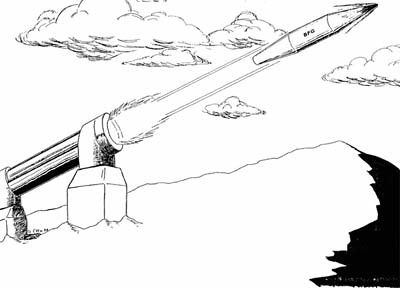
In the space gun launcher being promoted by BFG this cannon type of firing is merely the first step in the process. The main step is the ram accelerator, a technology invented and developed by faculty and staff at the University of Washington in Seattle, where Ben Joseph studied as an undergraduate. After a pre-launcher gun (e.g., light gas or gunpowder propelled) accelerates the projectile up to speeds of over 500 meters per second, the projectile enters the ram accelerator by passing through a breakable diaphragm and entering another tube, this one filled with a more volatile propellant, such as oxygen and methane. Because the projectile enters this second tube at supersonic speeds, it interacts with the tube wall to produce a ramjet–like effect inside the barrel. This ramjet effect forces the projectile to combust the fuel behind it, increasing its acceleration through the tube. The projectile exits the barrel with a muzzle velocity of around 8 kilometers per second. An upper stage rocket would circularize the trajectory of the payload (approximately one third of the projectile’s 2,000-kilogram mass) to a low Earth orbit of around 800 kilometers….

So that’s the technology, as envisioned. What about the cost? 

What makes the ram accelerator so appealing is its economic potential. BFG estimates that the accelerator could be built for an estimated $157 million, a price tag that includes the launch tube and its supports, the pre-launcher gun for initial acceleration, and propellant handling system for the oxygen, hydrogen, and methane gases for the ram accelerator portion of the launch system. This price tag is astonishingly low—cheaper than some expendable rockets—and it could be fired hundreds or thousands of times. Depending on the gun’s final muzzle velocity, prices for payloads could drop to nearly $500 per kilogram, a drastic reduction from current market prices…

During Joseph’s presentation on the commerce track of the International Space Development Conference, he concentrated on the most obvious markets for the ram accelerator: commercial satellite launches. BFG has taken particular interest in the Iridium and Globalstar constellations, which were financial failures but technically viable. Those satellites are nearing the end of their service life, and the ram accelerator would reduce the costs launching new satellites to nearly one tenth of their projected value. At those prices, a large LEO constellation becomes financially competitive with a high-bandwidth satellite chain in geosynchronous orbit. This does not change the economics of human spaceflight, but it does represent the order-of-magnitude cost improvement NASA and the private sector has sought for over 20 years.

Whether a space gun or BFG’s efforts can deliver on the dream of low(er) cost satellite launches remains to be seen. We’ll keep you posted. 


DIY Friday: Installing a Satellite Dish

On Monday, YouTube took over the Democratic Debate. Today, YouTube takes over DIY-Friday. Thank you, user generated content.

The first video explains how to mount a satellite dish using a simple satellite signal meter available for $15 bucks here.

A more detailed installation guide (although some of the connectors are a bit out-dated):

Not working right? Call a professional or just blow it up:

The Internet is Dead


Satellite and Cable systems now have the upper hand. According to Mark Cuban, via Television Week:

Forget the Internet, the Future Is the ‘Intranet’

At CTAM: HDNet Founder Mark Cuban on Why VOD Will Rule

By Andrew Hampp, AdAge

You can’t have a Mark Cuban speech without at least one contrarian statement. In the past year alone, the HDNet founder has sounded off on everything from YouTube ("A million people watching three-minute clips of Lonelygirl is critical mass?" he said during Advertising Week) to local newspapers ("They’re trying to grow like they’re internet companies in 1999," he told Esquire). His latest target? The web. Did you hear? It’s dead.

Speaking at the Cable Telecommunications Association for Marketing (CTAM) Summit in Washington yesterday, Mr. Cuban declared "the Internet is dead" in an otherwise subdued panel that included executives such as ESPN President George Bodenheimer and Time Warner Cable CEO Glenn Britt.

‘Neighborhood feel’
The real growth medium is the "intranet," otherwise defined as the on-demand and digital video-recording platforms provided by cable companies. "There’s less restriction on the intranet, it’s like your own corporate network for all the cable networks and even wireless," he elaborated in an interview after the panel. "It’s all locally driven anyways. It has a true neighborhood feel. If I’m in Dallas and I’m on Time Warner Cable, I want localized content."

Mr. Cuban views the TV as the real computer, citing the decline in sales of desktop computers as a direct result of where media consumption is moving. "All that [content] is moving to the TV. What’s the difference between a PC and a TV? Nothing." Social networking and user-generated content are all the rage for Web 2.0, but there’s "nothing on the horizon" from a content perspective, he said (apparently glossing over the looming launches of NBC and News Corp.’s NewCo web-video venture and Joost). Broadband video, according to Mr. Cuban, has "stopped growing."

"Before the internet, people were doing whatever they were doing, thinking this was the end-all, be-all. I thought by 2007 the pipes would be so huge [for the web], you could do HD content and all that. And everything just didn’t turn out. I was wrong," he said.

Premium price for TV ads
Advertising for TV will also come with more of a premium price tag in the future, Mr. Cuban said. "There will be fewer commercials that cost more. The bang for your buck will become the same."

But not everyone was quite as bullish as Mr. Cuban is on the growth of TV. Debora Wilson, CEO of the Weather Channel, listened to Mr. Cuban’s internet rant and interjected a few thoughts of her own on what she still considers to be a viable medium.

"The internet is still in day two; there’s so much flexibility," she said. "The other opportunities on TV are still in a slow phase. I’ve been in the market for 15 years and we’re still waiting for that tipping point."


A little more detail, via Multichannel News:

Cuban: The Internet Is Dead

HDNet Chairman, Mavericks Owner Who Made Fortune from Web Speaks at CTAM Summit Closing Session

By Tom Steinert-Threlkeld — Multichannel News, 7/25/2007 7:35:00 PM

Washington — The archetype of the Internet-bred billionaire Wednesday declared, “The Internet’s dead. It’s over.”

The speaker was Mark Cuban, who sold Broadcast.com to Internet portal Yahoo in 1999 for $5.7 billion. He is currently the owner of the National Basketball Association’s Dallas Mavericks and HDTV programmer HDNet. He is also considering buying Major League Baseball’s Chicago Cubs, out of his pocket, for about $1 billion.

The venture that made his fortune, Broadcast.com, was the outfit that legally streamed programming from 420 radio stations and networks; 56 TV stations and cable networks; and game broadcasts and other programming for more than 450 college and professional sports teams over the Internet.

And Cuban made his comments to operators of a set of high-bandwidth alternatives to the Internet, known as cable systems.

Speaking on the closing panel of the CTAM Summit here, Cuban declared, “The Internet’s for old people.”

His basic point: The Internet has gone stagnant. The only “new application” on the World Wide Web of recent vintage was, in his view, YouTube — which, unlike Cuban’s Broadcast.com, ripped off the creative content of intellectual-property owners to build its video-based business.

Sour digits aside, Cuban’s view, as repeated in a group interview after the panel with Multichannel News and CableFax Daily, is that cable and satellite networks are now superior to the Internet as platforms for building complex, interactive services.

This is in direct counterpoint to his contention, when he built Broadcast.com a decade ago, that the Internet would — in 10 years’ time — have the bandwidth that would make it a superior home for the development and distribution of video programming.

“I was wrong,” he said.

Networks built by telephone companies, like Verizon Communications, and cable companies, like Comcast, do not easily talk to each other, stymieing development of services (like HD video) that require smooth, seamless transport of lots of digital stuff, he said.

By contrast, so-called clustered collections of cable networks provide an enclosed environment that allows high-bandwidth, complex applications to thrive. Developers will figure this out and develop applications to match. If, for instance, a developer wanted to build suites of office applications, he said, the better environment would be servers on local cable systems. Users would have faster response and better experiences. Such developers could “outgoogle Google,” in effect.

Google, the dominant search engine, is developing and providing a series of office applications for writing and making calculations that operate on the open Internet.

In effect, Cuban said, cable networks are “intranets,” which, by their nature, operate more efficiently than the Internet. Cable-system operators can control the quality of service they supply and the amount of bandwidth that developers can use. Plus, there is no friction in transporting services and data within their networks.

His contention harkens back to @Home, the ill-fated offspring of the cable industry that tried to create a “private” Internet that operated at higher speeds and with greater quality than the “open” Internet, which made “best-efforts” attempts to transfer information, whether text or video or other.

Using standards such as the OpenCable specifications and cooperative efforts to interlink their networks, cable-system operators, he added, could create a high-bandwidth nationwide alternative to the Internet that would attract developers of applications that needed and took advantage of greater capacity and speed of transmission.