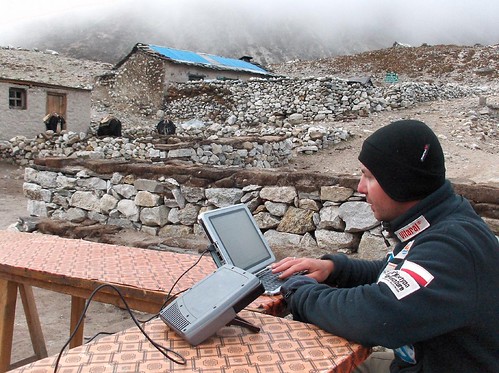
Satellite VoIP

In remote areas with no reliable wired telephone services, deploying a voice over internet protocol system over satellite may be the best voice option. This can be problematic, however, mainly because of satellite latency:

Latency is the term that describes the time it takes to get a packet to its destination. It is usually expressed in milliseconds, or ms. Since the satellites are located 23,000 miles above the equator, and satellite signals travel at the speed of light, this journey takes approximately 540 ms. You then add on the latency of the various Internet hops and servers plus the VoIP provider’s network to end with a total latency in the range of 650 ms to 700ms or more depending on the state of the Internet itself. Another contributing factor could be the quality of your satellite signal which may cause packets to be resent. This latency is heard as a delay between the sender and the receiving ear. Users of VoIP over satellite need to learn how to communicate with this inherent latency much like the older press-to-talk radio phones. Further, the delay requires the users to be patient and refrain from interrupting the caller.

This excerpt comes from an informative white paper produced by Galaxy Broadband (below).

The recently released, DTECH WHISPER V0IP System hopes to solve some of these latency issues:

The integration of the WHISPER system with the iDirect line of satellite hubs and remotes can provide end users with up to a 600 percent increase in V0IP call capacity over a single remote iDirect satellite link. The system can also reduce the amount of bandwidth required to support standard V0IP traffic by more than 30 percent.

With its reliance on large numbers of small, delay sensitive packets, V0IP traffic can quickly stress the resources of a remote satellite link. The WHISPER V0IP System, based on DTECH’s small-footprint, high-performance integrated hardware platform, is powered by VX Software from Network Equipment Technologies to deliver greater network efficiency through packet consolidation, header compression, and call consolidation.

This feature set reduces the number of packets and overhead required to support a V0IP call. A 1.5 Mbps iDirect satellite link can support more than 150 simultaneous V0IP calls, while a 3 Mbps remote link can support more than 250 simultaneous V0IP calls. The combined increase in calls per packet with the reduced bandwidth required allows network operators to utilize the same space segment they currently lease to provide a more robust voice network and greater capacity for data traffic.


India – manned space flight?

A months ago, we discussed Ukraine’s new space program — including its plan to independently launch three new satellites. While we are not seeing a new space race, the list of minor players (beyond the usual U.S.-Russian dominance) is expanding rapidly. The European Space Agency is implementing a number of new programs, from the Galileo positioning system, to the Herschel Space Observatory, to the ExoMars mission.

Now, India plans to join only the U.S., Russia, and China in sending humans into Orbit. Russian news-agency, ITAR-TASS explains:

India will invest within the coming five years some 1.5 billion U.S. dollars in the development of a set of technologies to carry out a manned space flight by 2015. Chairman of the Indian Space Research Organisation (ISRO) ManhaVan Nair said that most of the designing, research and technical jobs would be completed already within the current five-year period – up to 2012.

According to the ISRO-endorsed project, an autonomous orbital reusable space apparatus is to be developed to carry out the first such Indian mission. It is to be launched by means of an Indian-made GSI.V rocket. Nair admitted in his interview, published here on Monday, that Indian experts were yet lacking the necessary experience to build vehicles guaranteeing human safety on board. It is also necessary to increase the dependability of the booster rocket, which was earlier develop to place heavy satellites on a geosynchronic orbit.

ISRO is hatching some other ambitious plans, too. "The leading global space powers have already announced their preparations to set up manned bases on the Moon in 2020," Nair noted. "We believe India should not lag behind them," he added.

The "Chandrayan-1" project, envisaging the launching of an unmanned space vehicle to explore the Earth’s satellite, will be the first step "towards the moon" approximately a year later, stipulated by the Indian space program. The exploration vehicle with a net weight of 560 kilograms is to be lifted by a PSI.V booster from the national launching ground on Shriharikota Island, which is off the coast of the southern state of Andhra-Pradesh. Placed on a round-the-moon, it will take photographs of its surface. The experiment is expected to last about two years. It was earlier reported that the Russian Roskosmos Agency, as well as NASA and the European Space Agency, were invited to take part in the preparation of the Chandrayan-1 project. According to ISRO sources, the preparatory work is proceeding according to schedule. Several of the Chandrayan-1 components are already being tested.

GE’s Hospital Communications Platform

Earlier this year, GE launched its CARESCAPE portfolio, "an integrated suite of patient monitoring devices, communications networks and IT systems designed to transform traditional patient monitoring data into clinical intelligence." GE argues this platform gives providers an integrated suite of technology and communications devices to increase patient care.

As GE explains in its announcement earlier this week, there was a potential problem :

Historically, the use of mobile phones in hospitals has been limited due to unreliable wireless support and the risk of interference between wireless phones and medical equipment.

The solution: partner with Sprint to deliver a seamless, integrated in-hospital communications network:

The new in-building cellular communications network from GE Healthcare and Sprint’s Custom Network Solution (CNS) team leverages GE’s CARESCAPE™ Enterprise Access™, a single, universal wireless platform powered by MobileAccess, and includes Sprint handsets. This solution will provide hospitals with a comprehensive platform for voice and data communications over secure cellular, Wi-Fi and telemetry infrastructure that requires only one installation. Using the combined offering, clinicians, patients and hospital visitors can communicate more efficiently and with ease.

“Sprint CNS provides scalable coverage and a high-capacity platform for wireless voice and data services on the Sprint National Network and Nextel National Network, enhancing the mobility and productivity of staff at hospitals and other businesses,” says Darlene Braunschweig, vice president of CNS at Sprint. “We are very excited to partner with GE Healthcare to provide differentiated and innovative mobile solutions that are critical for every business. This new solution facilitates constant communication of secure information amongst hospital staff; an aspect very critical to patient care.”

This is another layer in GE’s hospital communications drive. GE, in partnership with NBC and AMERICOM, has been offering the Patient Channel to subscribing hospitals, delivering medical and patient care programming for years. Now, GE, in partnership with iVillage.com, has launched the Newborn Channel.

DIY Friday: Satellite Gazebo

Have an old, extra satellite dish? We’ve put them to good use in the past, consructing a wifi directional antenna and, better yet, a solar cooker. But where are you going to point the antenna and enjoy the BBQ (if that’s what you call a solar-baked entree)?

How about a satellite gazebo? These DIY’ers converted a vintage satellite dish (or a "BUD," big-ugly-dish, as they described it) into a surprisingly attractive gazebo.

The plan: Remove the satellite base, dig 2ft holes for six (or four or eight) 4×4 uprights, secure with concrete, mount dish with nails and wire, then nail lattice sides. The result:

Not bad. Not bad, at all.


SNG Costs Less With BGAN

We’ve seen live or near-live video news reports on CNN or the BBC where a journalist uses an inexpensive terminal to uplink to a satellite — alone. No truck, camera operator, teleprompter or boom microphone. At first the frame rate was less than perfect, but hey, it’s live and very cheap. Packs up quickly, too.

Inmarsat’s BGAN service is getting better now. Upgraded equipment on the ground, and in orbit. Traditionally, they’ve promoted themselves by helping extremely remote locations connect, like this Polish expedition on Mt. Everest.


As with the Slingbox Traffic Web Cam in San Francisco, TV news people are getting more creative in using this new technology. We read in Broadcasting & Cable last week how WDIV in Detroit covered the Bayview-Mackinac Yacht Race from Lake Huron:

When WDIV Detroit covered the Bayview-Mackinac yacht race last month, it didn’t rely on traditional microwave or satellite equipment to pull live video from the middle of Lake Huron.

Instead, the Post-Newsweek NBC affiliate used a combination of IP-based streaming technology and wireless EVDO and broadband satellite transmitters to provide live broadcast and Website coverage of the four-day race, which drew more than 250 competing yachts.

WDIV is one of a growing number of news organizations to use the Streambox from Seattle-based Streambox Inc., an IP-based streaming device designed with broadcasters in mind. Costing around $20,000, the system includes a laptop loaded with proprietary compression software that is used to encode and stream images and a rack-mounted receive device that features professional video connections and is designed to interface with conventional broadcast equipment.


$20,000? Even the smallest SNG Trucks cost much more than that. How long before Streambox and NewTek’s "truck-in-a-box" change the game? Probably sooner than we think.

Hughes to Buy Gilat?

Globes Online reports on some major movement in the satcom industry:

Gilat Satellite Networks Ltd. (Nasdaq: GILT; TASE) has reputedly received an offer from Hughes Communications Inc. (Nasdaq:HUGH), the company’s US rival. This is not the first time that Hughes has expressed an interest in Gilat; in 2004, the companies were in negotiations for a possible a merger with Hughes Network Systems, which ultimately did not materialize. The failure led to the resignation of Gilat CEO Oren Most. Both Gilat and Hughes Network Systems manufacture very small aperture terminals (VSAT) for satellite communications.

Haaretz.com provides further analysis: 

Gilat has become a hot item. For two years the company’s results have been picking up and now the satellite division of Rupert Murdoch’s Hughes is bidding to buy the Israeli firm for a high $ 12 per share. …

Hughes’ satellite division is Gilat’s arch-rival in the United States. The two are considered leaders in the U.S. satellite communications industry.

Gilat operates in the U.S. through its subsidiary Spacenet, which reported an upswing in business in the second quarter of this year.

Assuming that Gilat’s board of directors decides to accept the offer, the transaction will require approval of the U.S. Federal Trade Commission, which will consider whether a merger of the two companies would negatively impact the market’s customers.

Hughes is controlled by media baron Rupert Murdoch and the Apollo Management fund, one of the investors in York Capital Management, which is Gilat’s largest shareholder with 20.8 percent. 

On Monday, we previewed yesterday’s launch of Hughes’ Spaceway 3 satellite, which expands Hughes’ ability to provide high-speed, two-way communications for Internet, data, voice, video and multimedia applications. The acquisition of Gilat would enable Hughes to increase its provision of such services to Africa and South America, where Gilat is particularly strong (they signed a deal just last month to provide IP and VOIP services to Tanzania).

The end result of the merger would position Hughes to become a major competitor to satellite internet provider WildBlue.

Street Insider first picked up news of the acquisition on Monday, while Asbury Park Press, which is also reporting the deal, cites Israeli tabloid Yedioth Ahronoth.

The offer comes on the heels of solid Q2 results from both Hughes (reporting a 12% revenue increase over Q1)  and Gilat (opens in PDF).

We’ll keep you updated on the details of the acquisition as they become available. To subscribe to the Business Network blog via RSS, click here.

Perseids Light Up The Sky

Astronomy buffs throughout the Northern Hemisphere have been staying up late recently to view the Perseids meteor shower, which peaked on August 12th during the new moon.

Spaceweather.com has a fine collection of photographs of the meteor shower. (The photo above is taken from their collection.)  

At its peak Sunday night, the Perseids awed observers with up to 80 meteors per minute visible in a clear sky.

We’ve been fans of the Perseids since the early 1990s, when the comet Swift-Tuttle — the parent body of the Perseid meteor cloud — made its closest pass to earth since Abe Lincoln was president. The proximity of Swift-Tuttle meant that the Perseids were particularly spectacular during our salad days of 1993.

None of us, however, are likely to be around for the comet’s next perihelion passage in August of 2126 (when it may be as bright as Hale-Bopp), but until then the Perseids’ peak — usually August 12th — remains one of the best nights of the year to set up an astronomy date.

Several years ago, Space.com published a great article featuring the Top 10 Perseid Meteor Shower facts. Among them:

 1. Perseid meteoroids (which is what they’re called while in space) are fast. They enter Earth’s atmosphere (and are then called meteors) at roughly 133,200 mph (60 kilometers per second) relative to the planet. Most are the size of sand grains; a few are as big as peas or marbles. Almost none hit the ground, but if one does, it’s called a meteorite.

2. Comet Swift-Tuttle, whose debris creates the Perseids, is the largest object known to make repeated passes near Earth. Its nucleus is about 6 miles (9.7 kilometers) across, roughly equal to the object that wiped out the dinosaurs.

3. Back in the early 1990s, astronomer Brian Marsden calculated that Swift-Tuttle might actually hit Earth on a future pass. More observations quickly eliminated all possibility of a collision. Marsden found, however, that the comet and Earth might experience a cosmic near miss (about a million miles) in 3044.


Check out the complete article (and 7 other interesting facts) here

DirecTV Driving Satellite HDTV Expansion

With a huge subscriber base and plenty of existing HD content, DirecTV has been a major force in bringing HD to millions of people through various programming offerings. And it’s about to get even bigger.

About a month ago, DirecTV launched a new satellite to allow them to expand their HD content. So far it’s "going well" and they are on track to rollout a 70-plus HD channel package by the end of 3Q 2007 and build to 100 HD channels by the end of the year, according to notes from a recent investor call. Combined with the lowering costs of HD DVRs also mentioned on the call, the end of 2007 is shaping up to be the beginning of a new HD era for DirecTV.

A large factor driving DirecTV’s current HD success is its "NFL Sunday Ticket" package. DirecTV offers fans the chance to watch every single NFL game live, many in High Definition, making for very busy Sundays in the fall for many NFL fans. With the launch of the "Superfan" package in 2005, fans have been able to watch up to 9 games in HD and can watch games online over a broadband connection and see highlights and clips on their video-enable mobile phones. DirecTV’s new satellite launch and significant HD expansion will make the service even better, possibly increasing the number of available HD games and increasing the available bandwidth to deliver NFL content.

"NFL Sunday Ticket" has no doubt been a huge success for DirecTV. It currently has over 2 million subscribers and has successfully won over many DirecTV subscribers in areas where basic cable fails to meet the demands of NFL fans. The big takeaway here though is that DirecTV’s programming has pushed the industry as a whole to offer more HD content. As Scott Greczkowski from Multichannel News explains:

…I still feel that DirecTV deserves credit for waking up the industry, which is helping to accelerate the rollout of many new high definition channels on all providers. No matter who your cable or satellite provider is ultimately you can thank DirecTV for all the new HD content you will be seeing this fall.

More HD programming means better options for consumers. And in this area, DirecTV is clearly leading the way.


Stay tuned for more on NFL satellite programming later this week. Also, download the MP3 attached to this post for a quick football fix from our favorite sports song.

Arianespace to Lift Hughes, B-Sat Birds Tuesday

If you remember Papillon, you remember that it’s the story of convicted felon Henri Charrière’s numerous attempts to escape from a penal colony on French Guiana.

Hopefully, Arianespace will only require one attempt to break free of the surly bonds of earth when they launch their heavy lift mission with the SPACEWAY 3 (artist’s conception at left) and BSAT-3a satellites tomorrow from the Spaceport in French Guiana:

  Arianespace’s third heavy-lift Ariane 5 mission of 2007 has been cleared for its August 14 liftoff following today’s successful launch readiness review, which was performed at the Spaceport in French Guiana.

All is now set for Ariane 5’s transfer on August 13 from its Final Assembly Building to the ELA-3 launch pad, where the final countdown will lead to a liftoff the following day, at the opening of a window runs from 8:44 p.m. to 9:21 p.m. (local time at French Guiana).

SPACEWAY 3 arrived in French Guiana a month ago; it will be operated by the Maryland-based Hughes Network Systems, LLC to provide satellite-delivered broadband services to enterprise, government and consumer users throughout North America. It was built by Boeing:

SPACEWAYTM is Hughes next generation broadband satellite network that will provide high-speed, two-way communications for Internet, data, voice, video and multimedia applications. The initial contract includes three Boeing 702 geostationary satellites built by Boeing Satellite Systems, (BSS) and will operate in the Ka-band spectrum. The first orbital slot is currently planned for 99 degrees west longitude….

The SPACEWAY satellites feature innovative, on-board digital processors, packet switching and spot beam technology. Spot beam technology will enable the satellite to provide services to small terminals, while on-board routers will enable mesh connectivity; users of the system will be able to directly communicate with any other user of the system without requiring connection through a central hub.

The builder of the B-Sat system is Lockheed-Martin, which began building the satellite in 2005: 

Designated BSAT-3a, the 1.8-kW satellite will provide direct broadcast services throughout Japan following its scheduled launch the second quarter of 2007.  Contract terms were not disclosed.  B-SAT previously issued an authorization to proceed to Lockheed Martin for start of satellite design and construction. 

The BSAT-3a communications payload comprises eight 130-W Ku-band channels and will be located at 110 degrees East longitude.  With a design life of more than 13 years, BSAT-3a is based on the award-winning A2100A platform manufactured by Lockheed Martin Commercial Space Systems (LMCSS), Newtown, Pa.  BSAT-3a marks the 12th Lockheed Martin satellite contract awarded in the 1- to 4-kW small-class satellite range and the second in 2005.

B-SAT3a will provide direct television links for the entire Japanese archipelago, and will be operated by Japan’s B-SAT Corporation. The complete launch kit from Arianespace, featuring information on the payload, launch countdown and flight trajectory, can be found in PDF format here.
 

Surfing Like Grandma

No, not my grandmother. I tried the "computer experiment" with her — huge failure. In Europe, things may be a bit different: "According to a study by the European Interactive Advertising Association (EIAA), 68 per cent of the over 55s now connect to the net through broadband access, while internet adoption among this age group is growing faster than within any other."

Now, one Swedish Grandma sports the world’s fastest residential connection (link):

A 75 year old woman from Karlstad in central Sweden has been thrust into the IT history books – with the world’s fastest internet connection.

Sigbritt Löthberg’s home has been supplied with a blistering 40 Gigabits per second connection, many thousands of times faster than the average residential link and the first time ever that a home user has experienced such a high speed.

But Sigbritt, who had never had a computer until now, is no ordinary 75 year old. She is the mother of Swedish internet legend Peter Löthberg who, along with Karlstad Stadsnät, the local council’s network arm, has arranged the connection.

"This is more than just a demonstration," said network boss Hafsteinn Jonsson.

"As a network owner we’re trying to persuade internet operators to invest in faster connections. And Peter Löthberg wanted to show how you can build a low price, high capacity line over long distances," he told The Local.

Sigbritt will now be able to enjoy 1,500 high definition HDTV channels simultaneously. Or, if there is nothing worth watching there, she will be able to download a full high definition DVD in just two seconds.

The secret behind Sigbritt’s ultra-fast connection is a new modulation technique which allows data to be transferred directly between two routers up to 2,000 kilometres apart, with no intermediary transponders.

According to Karlstad Stadsnät the distance is, in theory, unlimited – there is no data loss as long as the fibre is in place.

"I want to show that there are other methods than the old fashioned ways such as copper wires and radio, which lack the possibilities that fibre has," said Peter Löthberg, who now works at Cisco.

Cisco contributed to the project but the point, said Hafsteinn Jonsson, is that fibre technology makes such high speed connections technically and commercially viable.

Other than providing his grandma with speedy reruns of Matlock (if she is anything like my Grandma), Peter Löthberg is trying to make a point: why are our connection speeds not faster? But it is America that should be complaining: according to a report by the Information Technology and Innovation Foundation, Sweden’s average speed is 18.2 mbps, while the United States crawls at 4.8mbps (Japan averages a whopping 61.0 mbps). It is about time the States starts surfing like Japan (or, better yet, Grandma Löthberg).