Total Lunar Eclipse This Morning

Yeah, I should have warned you yesterday. This isn’t meant as a cruel joke — honestly. NASA has the details:

As August draws to an end, watchers of the night sky will be in for a treat. In the early morning hours of August 28, sky watchers across much of the world can look on as the Moon crosses in to the shadow of the Earth, becoming completely immersed for one-hour and 30 minutes, a period of time much longer than most typical lunar eclipses. In fact, this eclipse will be the deepest and longest in 7 years.

The event begins [began] 54 minutes past midnight PDT (3:54 a.m. EDT) on August 28. At first, there is little change. The outskirts of Earth’s shadow are as pale as the Moon itself; an onlooker might not even realize anything is happening. But as the Moon penetrates deeper in to the Earth’s shadow, a startling metamorphosis occurs. Around 2:52 a.m. PDT (5:52 a.m. EDT) the color of the Moon changes from moondust-gray to sunset-red. This is totality, and it lasts for almost 90 minutes.

With the Sun blocked, you might expect utter darkness, but instead the ground at your feet appears to be aglow. Why? Look back up at Earth. The rim of the planet seems to be on fire. Around the Earth’s circumference you will witness every sunrise and sunset in the world—all at once. This incredible, colorful light beams into the heart of Earth’s shadow, transforming the Moon into a landscape of copper moondust and golden hills. The eclipse will be visible from Australia, parts of Asia and most of the Americas, but not from Africa or Europe. The view is different from each location on the planet. Here in the United States, Pacific observers are favored. For them the entire eclipse will unfold high in the post-midnight sky. However, on the East Coast, totality will be cut off early by sunrise.

It didn’t disappoint. As viewed from Katana, ON (link):

From Manchester, NH (link):

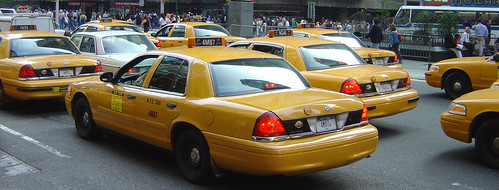
Taxi!

We’ve written before about plans to use satellite tracking technology to follow the progress of New York City Transit buses.

No one seemed to complain about that idea, since being able to see exactly where the bus you’re waiting for is on its route is of undeniable benefit to the riders, and at worst makes no difference to a bus driver.


But a plan to put GPS in New York City taxis has cabbies screaming and honking like — well, like New York City cabbies:

The New York Taxi Workers Alliance — which accounts for more than 8,000 city drivers — is threatening to curb their cabs on Sept. 5 if the Taxi and Limousine Commission does not get rid of their GPS system, which the union says invades a driver’s privacy….

The issue over a driver’s privacy is the driving issue in the debate, with a driver’s location being tracked no matter where he or she goes.

"The Taxi & Limousine Commission wants to spy on drivers and they want drivers to pay for it," argues Desai.

Both sides agree the TLC uses satellite GPS technology to track everywhere a taxi cab goes and keeps a log of that information. The dispute is over how that information will be used and just who will have access to it.

Mateo says it’s understandable that the taxis are fitted with the technology and adds it’s even advantageous to each driver. "It indicates where you’re located, you can see where you’re going," he says.

But Desai says there is a different motive for the TLC to install the satellite. "They will use this information to decide on drivers’ incomes," she says.

Sources within the TLC and individual taxi drivers tell CBS 2 that the GPS fears have nothing to do with privacy and everything to do with money. Many drivers fear the IRS will use the data to audit drivers and alert the INS about illegal immigrants driving cabs.

Could this be the first strike ever started by GPS? 

A.P. Looks at Virgin Galactic’s Lowered Profile

Few space stories have captured the public’s imagination (and the press’ attention) more than the efforts of Virgin Galactic to bring the nascent space tourism business to the (well-heeled) masses via the Burt Rutan-designed SpaceShipTwo.


While the attention is surely a boon to Virgin Galactic (and probably a source of resentment for its competitors), it can be problematic when things go wrong, as when an explosion at the factory of Scaled Composites (which made the first private trip into space with SpaceShipOne) killed three people in July during testing of a propellant system.

Today, the Associated Press looks at how the accident has impacted Virgin Galactic’s public profile: 

The accident at the remote site run by famed aerospace designer Burt Rutan rattled the fledgling space tourism industry, which has enjoyed a honeymoon period since 2004 when Rutan launched SpaceShipOne, the first private manned rocket into space.

It also offered insight into how two pioneering companies that forged an unlikely partnership two years ago to fly civilians to space reacted to the tragedy. In a reversal of roles, Richard Branson’s publicity-seeking Virgin Galactic kept a low profile while its usually silent partner, Rutan’s Scaled Composites LLC, took to the Internet to mourn its workers.

Some space experts believe Virgin Galactic is following the right strategy because the accident was of an industrial nature and not directly related to spaceflight. But eventually customers and the public will demand answers, they say.

While Virgin Galactic kept a low public profile after the accident, the company did reach out privately to reassure its "founding" customers, who have already paid $200,000 to be the first to go up in SpaceShipTwo, according to the AP report.

It was Virgin Galactic’s partner, Scaled Composites, that was forced into the limelight following the accident:

Before the accident, hardly anything was known about Scaled’s progress on its suborbital spaceship program. Afterward, Rutan acknowledged for the first time the company was testing a propellent system for SpaceShipTwo, the successor to SpaceShipOne. Many details about the program are still unknown, including how far along Scaled is….

Scaled has since shed some of its stoic image. Its technical Web site was transformed into a virtual shrine for the three rocket workers killed in the line of duty. It set up a memorial fund, posted poignant online remembrances and gave updates on funeral arrangements and conditions of the injured, who are expected to survive.

Scaled also sought outside experts to determine what went wrong and vowed to share lessons learned with the industry to prevent another accident.

"Burt is taking it hard because it’s the first time he’s lost people. There is a feeling of shock that some of his friends died," said space business consultant Thomas Matula.

The Personal Spaceflight Federation, made up of more than a dozen private space companies, has vowed to plow ahead despite the tragedy in Mojave, according to the article. 

DIY Friday: rocket-powered bionic arm

What used to be just a science-fiction plot-line is quickly becoming reality.

Wired profiles what it calls "The World’s Most Advanced Bionic Arm" — a new design by Johns Hopkins University’s Applied Physics Laboratory (APL).

Jonathan Kuniholm’s right arm terminates in a carbon-fiber sleeve trailing cables connected to a PC. He has no right hand, unless you count the virtual one on a display in front of him. The CG hand, programmed to look like silvery stainless steel, moves through a sequence of motions: spherical grasp, cylindrical grasp, thumb to forefinger — all in response to signals from Kuniholm’s muscles picked up by electrodes in the sleeve.


One of the largest challenges in this field is mimicing the strength of the human arm. This is where rockets come into play (link):

Mechanical engineers at Vanderbilt University are showing off a working prototype of a prosthetic arm whose "monopropellant rocket motor system" allows it to lift up to 25 pounds, more than three times as much as today’s prosthetic limbs.

The device, whose research and design was funded by the Defense Department, runs on a miniature version of the same motor system used to maneuver the Space Shuttle in orbit; the system works by mixing a chemical catalyst with hydrogen peroxide, producing steam, which is then pushed through a series of valves to cause the arm to move.

The researchers say their fuel system is superior to the traditional method of powering prostheses, batteries. Batteries are heavy relative to the power they produce; the rocket-powered arm, says Michael Goldfarb, the professor who led the team, produces more power with less weight than limbs that use other power sources.

The prototype also produces more natural movement that conventional prosthetic arms. Instead of two joints — typical arms only move at the elbow and at the "claw" — the new device has fingers that can open and close independently of each other, and a wrist that twists and bends.

But who wants a rocket attached to their body? What about the heat? The Vanderbilt team figured it out:

One of their immediate concerns was protecting the wearer and others in close proximity from the heat generated by the device. They covered the hottest part, the catalyst pack, with a millimeter-thick coating of a special insulating plastic that reduced the surface temperature enough so it was safe to touch. The hot steam exhaust was also a problem, which they decided to handle in as natural a fashion as possible: by venting it through a porous cover, where it condenses and turns into water droplets. “The amount of water involved is about the same as a person would normally sweat from their arm in a warm day,” Goldfarb says.

To allow for thermal expansion, the engineers replaced the arm’s nine valves with a set machined to a slightly lower tolerance, approximately 100 millionths of an inch. But when they began operating the rebuilt arm, they found that it hissed and leaked. At first, they thought that the arm had only a single leak, and spent several weeks trying to track it down. Finally, they realized that the noise and leakage were coming from all the valves. Replacing the high-precision valve set solved the problem. “We were astonished at by the difference between 50-millionths and 100-millionths: It made all the difference in the world,” says Goldfarb.

Their biggest problem operating with hot gas turned out to be finding belt material that was strong enough and could withstand the high temperatures involved. They tried silk surgical sutures, but found that silk wasn’t strong enough. They tried nylon monofilament, which is stronger than steel, but it couldn’t take the heat. Finally, after a long process of trial and error, they found a material that works: the engineering thermoplastic polyether ether ketone.

A video on the project is available here.

Netcom Africa

Telecommunications has always been a struggle in Nigeria. Outside of Abuja, the nation’s young capital, Nigeria’s infrastructure is "unpredictable," at best. Nigeria’s power supply is insufficient, forcing many hotels, businesses, and homes to own multiple generators. Within this context, it is no surprise that, like many other third world countries, Nigeria’s telecommunications is largely confined to mobile phone networks (1.25 million landline phones versus over 30 million mobile subscribers).

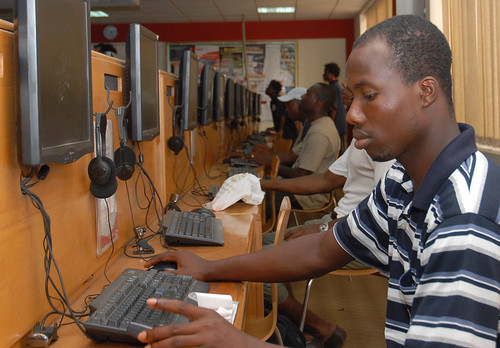
Nigeria’s infrastructure challenges are equally daunting in expanding Internet service throughout the country. Yet, a number of ISP’s are entering this rapidly growing market.

One company, Netcom Africa Ltd, is making especially noticable strides. First it raked in two big awards:

Netcom Africa has emerged as a winner of the ‘Best ISP of the year’ and also won the recognition award for ‘Best Broadband Company of the Year’ at the annual Nigeria Telecom Awards organised by Nigeria Telecom Magazine in Lagos.

Other Internet Service Providers nominated for best ISP of the year award included Swift Networks and Direct on PC.

The Nigeria Telecoms Award recognises leadership, innovation and excellence in services. "We are delighted to be recognised by the industry and receive not one, but two additional prestigious awards this year," stated Lolade Shonubi, Netcom’s marketing manager.

She continues: "As an IP communications provider of satellite and wireless products, Netcom is determined to continue to lead the market with innovative solutions that meet the challenging criteria of our customers, the public and judges."

And now Netcom has acquired one of its main rivals:

Netcom Africa has acquired rival ISP Accelon Africa for an undisclosed price. South Africa’s Dimension Data also made a bid to buy Accelon but was beaten to the punch by Chinese-backed Netcom, which offers satellite broadband services in Nigeria under the MyNetcom banner. Accelon, set up by South African investors in 2002, has operations in Nigeria and Ghana.


Satcom Success at WildBlue

"Dude, I can’t handle dial-up anymore," is probably what people without broadband are saying. I know I can’t. For me, it’s either broadband or nothing at all.

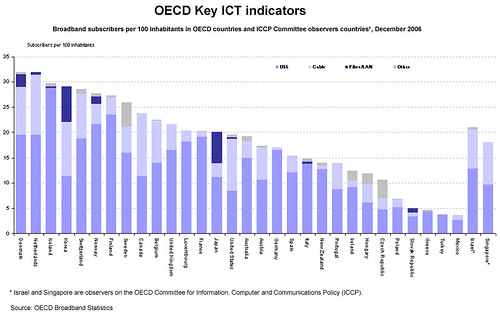
And the number of broadband subscribers keeps growing. According to the OECD (Organization for Economic and Co-operative Development), the U.S. has the most households with broadband, but doesn’t rank in the top 10 in terms of penetration:


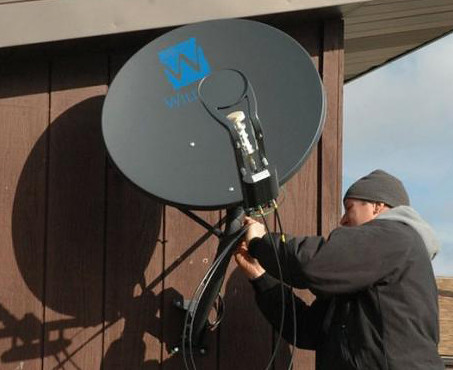
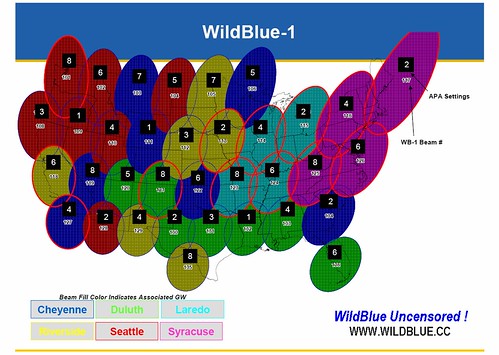
Seems the battle is being waged between cable and DSL providers. But what about people who are rural or ex-urban? Yes, WiMAX is building a following, notably via Clearwire. But satcom remains a viable option, with Hughes (HughesNet) and Spacenet (Starband) grabbing the early lead in providing national service. Now here comes WildBlue. Since launching their own spot-beam Ka-band satellite, they’ve been booking 1,000 and 1,500 new subscribers every week.


They’ve been so successful, in fact, that they’ve been turning away business in some coverage areas. Check this out, via SkyREPORT.com:

Satellite broadband provider WildBlue Communications is suspending sales across several beams due to capacity constraints. In a letter written to dealers this week, the company said it would begin to halt sales on three spot beams beginning Sept. 1.

According to the WildBlue’s Beam Sales Suspension Notice, sales of the company’s satellite broadband product have continued at a "record-breaking pace" since the launch of its new satellite, WildBlue-1. As a result, the company said, WildBlue is experiencing new capacity constraints in certain areas of the U.S.

The beams in question are 131, 132 and 133, which, the company said, are 85 percent full. "Because of this overwhelming demand for WildBlue broadband service, and in order to maintain maximum performance for all of our customers, we are unfortunately left with no choice but to begin our first WildBlue-1 beam suspensions," the company said. The beams in question cover much of eastern Texas and the majority of both Louisiana and Alabama.

WildBlue told its dealers that beginning Sept. 1 the company will suspend all marketing and will not take any new orders in these particular beams. The company also said it has prioritized the portion of the country served by these beams for the next software and hardware upgrades, and it would notify dealers in advance of any additional capacity as it becomes available.

"In an effort to continue to provide the highest quality service for all of our valued WildBlue customers, we carefully monitor and manage the capacity on each of our spot beams throughout the country," the company told SkyREPORT. "As a normal course of business we may from time to time decide to suspend new sales in certain areas of the country, again, so that we can maintain the high quality service that our customers have come to expect from WildBlue."


Wow. Even before the launch, I heard they were selling out some capacity on Anik-F2 over the Ohio River Valley. Now new capacity is being sold out. Good for WildBlue, I say.

In UK, 3 Launches Highspeed Mobile Broadband

I’ve been a big fan of my Verizon National Broadband Access plan since I picked it up back in February. For a little over $60 per month (with taxes), I’m able to connect my laptop to the Internet no matter where I am. No hunting for Wifi, no searching futilely for a nearby Starbucks, no dropping an extra $10 in a $300 hotel room just to check my email. If I’m in a reasonably civilized location (which is not always the case, to be sure), then it’s just a matter of opening the laptop and connecting at speeds between 400 and 700 kbs.

But if I lived in the UK, I’d be mighty tempted to switch to 3’s new Mobile Broadband service, which is offering speeds up to an astounding 2.8 mbs

3 has launched its new Mobile Broadband service, offering HSDPA speeds of up to 2.8Mbps on the go for laptop users, via a USB modem. It’ll use 3’s new ‘Turbo’ network that starts rolling out nationally from 4th September.

There’s three pricing options. Broadband Lite costs £10 a month with a 1GB allowance. Broadband Plus is £15 a month with a 3GB allowance, while Broadband Max is £25 a month with a 7GB allowance. In all cases, if you go over your data limit, you start paying 10p per megabyte. The modem is £0-£99 depending what tariff and how long you sign up for.

Meanwhile, back in Japan — where life is apparently even better — DoCoMo is looking at 300 Mbps with their "Super 3G" service:

 NTT DoCoMo, Inc. announced today that this month it began testing an experimental Super 3G system for mobile communications. With this experiment, DoCoMo will seek to achieve a downlink transmission rate of 300Mbps over a high-speed wireless network.

Super 3G features low-latency data transmission and improved spectrum efficiency. It is a highly advanced version of High-Speed Downlink Packet Access (HSDPA) and High-Speed Uplink Packet Access (HSUPA), which have been evolved from W-CDMA packet transmission technologies standardized by the 3rd Generation Partnership Project (3GPP). The 3GPP, a telecommunications standards organization, is currently discussing standardization of Super 3G under the name Long Term Evolution (LTE).

DoCoMo will begin with an indoor experiment to test transmission speed using one transmitting and one receiving antenna. The company will then expand the experiment to examine downlink transmission by employing up to four Multiple-Input Multiple-Output (MIMO) antennas for both the base station (transmission side) and mobile station (receiving side); the goal is to achieve a downlink transmission speed of 300Mbps.

Wireless Watch Japan has some video of the DoCoMo phones. But there are, of course, satcom options to compete with faster mobile telecom offerings — such as the GLOBETrekker from Norsat or BGAN from Inmarsat — with the added benefit that you don’t necessarily have to be anywhere near someplace civilized to use them.

Whether via mobile telecom or satcom, however, one thing is clear — the race for mobile internet market share is at least partly a race for connection speed. 

Googling the Universe

Without a doubt, Google Earth has put the functional utility of satellite imaging at the fingertips of millions, rekindling for many the shear wonder of what satellites can do to improve our lives.

Now Google’s virtual "satellites" (which aren’t really satellites, of course, but rather "the superimposition of images obtained from satellite imagery, aerial photography and GIS 3D") are doing what no single satellite has yet been designed to do: they’re turning their gaze from the Earth to the Heavens with today’s release of Google Sky:


With Sky, users can now float through the skies via Google Earth. This easy-to-use tool enables all Earth users to view and navigate through 100 million individual stars and 200 million galaxies. High resolution imagery and informative overlays create a unique playground for visualizing and learning about space.

To access Sky, users need only click "Switch to Sky" from the "view" drop-down menu in Google Earth, or click the Sky button on the Google Earth toolbar. The interface and navigation are similar to that of standard Google Earth steering, including dragging, zooming, search, "My Places," and layer selection….

"Never before has a roadmap of the entire sky been made so readily available. Anyone interested in exploring the wonders of our universe can quickly see where the stunning objects photographed by Hubble actually dwell in the heavens. Sky in Google Earth will foster and initiate new understanding of the universe by bringing it to everyone’s home computer," said Dr. Carol Christian of STScI, who co-led the organization’s Sky team with Dr. Alberto Conti.

Google Sky features seven layers, including Hubble Space Telescope Imagery, Constellations, the Moon and Planets, a "Users Guide to Galaxies" and a "Life of a Star" layer, as well "The Backyard Astronomer," which "is useful for the amateur astronomer who may benefit from a comprehensive, organized way to reference fragments of the night sky."

"The Sky imagery was stitched together from more than one million photographs from scientific and academic sources, including the Sloan Digital Sky Survey, the Palomar Observatory at the California Institute of Technology and the NASA-financed Hubble," according to the New York Times.

The BBC also has some good video of the new release. 

To get Google Sky, simply download the latest version of Google Earth.

Voyager, 30 Years On… and On…

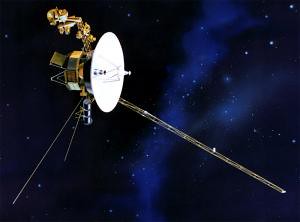
Billions of miles away from earth, way past the edge of our solar system, Voyager 1 is quietly (we assume) celebrating its pearl anniversary this week.


Space.com reminds us of the two Voyagers’ origins: 

Voyager 2 launched on Aug. 20, 1977, and Voyager 1 launched on Sept. 5, 1977. Both spacecraft continue to return information from distances more than three times farther away than Pluto, where the sun’s outer heliosphere meets the boundary of interstellar space…

Voyager 1 currently is the farthest human-made object at a distance from the sun of about 9.7 billion miles (15.6 billion kilometers). Voyager 2 is about 7.8 billion miles (12.6 billion kilometers).

Originally designed as a four-year mission to Jupiter and Saturn, the Voyager tours were extended because of their successful achievements and a rare planetary alignment. The two-planet mission eventually became a four-planet grand tour. After completing that extended mission, the two spacecraft began the task of exploring the outer heliosphere.

During their first dozen years of flight, the spacecraft explored Jupiter, Saturn, Uranus, Neptune and their moons. These planets were previously unknown worlds. The Voyagers returned never-before-seen images and scientific data and helped make fundamental discoveries about the outer planets and their moons.

The spacecraft revealed Jupiter’s turbulent atmosphere, which includes dozens of interacting hurricane-like storm systems, and erupting volcanoes on Jupiter’s moon Io. They also showed waves and fine structure in Saturn’s icy rings from the tugs of nearby moons.

 
The NASA Voyager site also contains some amazing facts about the spacecraft, their navigation and observation technologies, and the scientific discoveries that they have made possible.

30 years is a long time, to be sure — but we should enjoy many more anniversaries to come: 

 Barring any serious spacecraft subsystem failures, the Voyagers may survive until the early twenty-first century (~ 2020), when diminishing power and hydrazine levels will prevent further operation. Were it not for these dwindling consumables and the possibility of losing lock on the faint Sun, our tracking antennas could continue to "talk" with the Voyagers for another century or two!


Invite2