JCSAT-11 Set to Launch Tonight

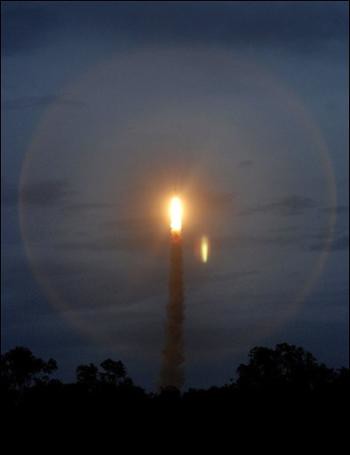
The Japanese telecommunications satellite JCSAT-11 was rolled out over the weekend to launch pad No.200 at the Baikonur cosmodrome. Liftoff of the Proton-M launch vehicle with a Briz-M upper stage is scheduled for 6:43 p.m. EDT tonight.

Built by Lockheed Martin, JCSAT-11 is a hybrid satellite, equipped with Ku-band high-power transponders and C-band medium-power transponders. For the time being, JCSAT-11 will be reserved entirely in orbit as a back up satellite for other JCSAT satellites as part of JSAT’s efforts to build a seamless global network.

ILS is lifting the bird. They’ve set up a launch blog, though the most recent post is a few days old:

 Bright and early Friday morning (well, not that bright, as the sun was just rising), the entire launch vehicle was rolled out to the Breeze M fueling station, where its propellants (fuel and oxidizer) were loaded into the upper stage over a two-day span. These operations are entirely in the hands of our partners at Krunichev and the Russian Space Forces, so our team had a little bit of time to catch up on administrative tasks. In the meantime, the Russian state commission arrived on the second day of fueling and gave the go-ahead for the integrated launch vehicle to roll to the pad with the JCSAT-11 satellite.

During these two fueling days, our team had a chance to sneak in a quick tour of the launch pad, which was used for the Russian N-2 Moon Booster and Energia boosters in years past. These were truly massive rockets, with a lift capability of over 100 metric tons (220,000 pounds) to Low Earth Orbit! The sheer scale of the pad was equally large and impressive.

On a related note, JSAT is helping the Widely Integrated Distributed Environment (WIDE) Project, which is seeking to produce the next generation of communications and broadcasting based on the IPv4 and IPv6 multicast technology. WIDE recently announced an IPTV partnership with the Open Student Television Network (OSTN), which we recently blogged about here.

As always, we’ll update you on the launch in the comments below. 

Two More to Enter Mile(s) High Club

With all the talk and anticipation lately about the nascent space tourism industry, it’s easy to forget that actual travel in space to this day remains one of humanity’s most exclusive clubs.

But soon, two more people may be able to add their name to the (estimated) 400 to 700 people who have truly slipped the surly bonds of earth.

First up is a Russian grocer who made his money with the Seventh Continent grocery chain: 

A grocery tycoon and politician who planted a flag on the North Pole’s seabed last month will now go into orbit as the first Russian space tourist, leading business daily Vedomosti says.

Vladimir Gruzdev, aged 40, underwent medical tests in June and had been formally approved for a flight on board a Soyuz-TMA spacecraft in September 2008, the newspaper quoted an unnamed source from the Russian space company Energia as saying.

He was one of three submariners who on August 2 planted a rust-proof titanium Russian flag at the North Pole, 4,300 metres under water, in order to boost Russia’s claim for a larger chunk of resource-rich Arctic seabed.

The kid-faced Gruzdev can be seen on the left in this photo from a news report about his exploits at the North Pole last month. 

Next up is Korea’s first astronaut, to be announced later today from two remaining candidates: 

 South Korea’s first astronaut who will fly to the International Space Station early next year will be named Wednesday from two candidates, Ko San and Yi So-yeon.

The Ministry of Science and Technology said that a seven-person committee will pick one name this morning after assessing the scores from their six-month training program in Russia.

Ko and Yi, both with outstanding intellectual and physical abilities, were selected from more than 36,000 applicants last year through a series of rigorous tests and a TV popularity poll. They have been receiving spaceman trainings in Russia’s Gagarin Cosmonaut Training Center near Moscow since January.

The ministry said the result will be announced around 10 a.m.

Regardless of who is named by the Ministry of Science and Technology, it’s clear from the numbers that the era of mass space travel is not quite at hand.

Which Satellites Aid Oil Exploration in Africa?


Close observers of the oil industry have been noting for some time now that oil reserves in West Africa are going to play an increasing role in meeting the world’s energy needs in the coming years. That observation is no longer merely predictive; it’s evident in the financial press.

The Financial Times reports that Tullow is expanding its operations in West Africa: 

Tullow Oil told investors to prepare for a significant increase in investment and drove the point home by saying it would maintain, rather than increase, the interim dividend.

It has increased its exploration spend to 45 per cent of a forecast 2007 capital expenditure of £415m. Last year exploration accounted for 30 per cent. More than £100m will go towards accelerating appraisal work in Ghana and Uganda.

Earlier this year the company skewed its capital expenditure away from the North Sea and towards Africa, underlining its reputation as an exploration-driven company. Discoveries in Ghana and Uganda each have the potential to double Tullow’s reserve base, according to Aidan Heavey, chief executive.

India’s Bharat is also looking for a stake, according to Reuters

State-run Bharat Petroleum Corp (BPCL) plans to spend up to 15 billion rupees ($370 million) on exploration over two to three years and is scouting overseas for development or producing fields, its chairman said on Tuesday.

India’s third-largest refiner sees exploration and production as growth drivers and is looking for assets in West Africa, Brazil, South America and Australia, chairman Ashok Sinha told Reuters in an interview.

Offshore, Anadarko has hit paydirt (again) in the waters off Ghana:

Anadarko Petroleum Corporation (NYSE:APC) today announced its second oil discovery offshore the Republic of Ghana. The Hyedua-1 well is located on the Deepwater Tano license in approximately 5,020 feet of water, 3.3 miles southwest and down dip from the Mahogany-1 discovery well, which Anadarko announced in June 2007. 

And, of course, China continues to position itself in an attempt to gain access to Africa’s oil reserves: 

HONG KONG, Aug 30 (Reuters) – China’s top offshore oil and gas producer CNOOC Ltd (0883.HK: QuoteProfile , Research) has defended its search for new acreage in Africa against critics who say China is desperate to secure oil reserves at any price to fuel its roaring economy…

Chief Financial Officer Yang Hua told Reuters that there was one criterion for investments: "Value. If there’s no value, no deal," he said.

CNOOC is already in Nigeria, Kenya and Equitorial Guinea.

The Nigerian presence includes a 45 percent interest in the OML 130 block operated by Total (TOTF.PA: QuoteProfile , Research), which Yang said had been appraised at 1.2 billion barrels of proved and probable reserves by energy consulting firm Wood Mackenzie.

While there’s no doubt from the news that oil exploration in Africa is booming, how do all these companies connect their new drilling platforms once they enter the extraction stage?

The answer, of course, is satellites. Three birds in particular help bring African crude to the global marketplace: SES’s NSS-10Intelsat’s IS-1R, and Eutelsat’s W Series.

Go India, Go!


India’s ISRO had a great launch yesterday, via Hindustan Times:

After more than two hours of tension, space launcher GSLV on Sunday successfully placed in orbit the communication satellite INSAT-4CR. Weighing 2,130 kg, it is the heaviest payload to be placed in orbit by an Indian launcher.

With the failure of the last GSLV mission in July 2006 on their minds, Indian Space Research Organisation scientists had readied the present launch in a record 13 months. But the GSLV-F04 kept them on their toes well beyond the planned schedule time. The launch was delayed by a day due to a sudden change in weather. On Sunday, 15 seconds before lift-off at 4.21 p.m., the launch was once again put on hold. It wasn’t till two hours later that the problem—a failed communication link between the third cryogenic stage and ground link — was rectified and the space vehicle soared in a darkening sky.

The drama wasn’t over yet. Thirteen minutes into the flight path, mission control lost contact with the vehicle. Thankfully, it came back on and a hugely relieved ISRO chairman G. Madhavan Nair was heard muttering “thank god”.

Seventeen minutes after blast-off, as the satellite injected into the slotted transfer orbit, the smiles were back on the faces of the ISRO brass. “It was a dramatic mission with a lot of anxiety but something that gave us immense satisfaction when everything went off successfully. Team ISRO has done it,” said Nair.

B.N. Suresh, director of Vikram Sarabhai Space Centre, which designed the vehicle, said: “It was a small communication glitch.”

Nair said that though mission control had the option of postponing the launch by 48 hours, they were confident the launch sequence was in place. “The perfect and precise launch confirmed our confidence in the system and our team.”

This launch marks the third by ISRO in 2007 with two more scheduled.

Here’s the quick CNN/IBN report:


And here’s the full 5+ minute highlight reel:

DIY Friday: Greenhouse

Labor Day weekend is not my favorite time of the year. The extended weekend and numerous BBQ’s (solar or traditional) are nice. But the lingering sense of disappointment kills me — no more swimming pools, no more long summer nights, no more backyard gardening. Yes, even rocket scientists enjoy these things.

This week’s DIY edition will explore bringing summer inside — it’s time to build a greenhouse. If you’re like me, enjoying fresh veggies for only two months a year, just doesn’t seem right. BuildEazy.com has the plan. You might not finish it over the long-weekend but you should beat the first freeze. If it seems too complicated, consider buying a kit

DIY TV, delivered on DirecTV channel 220 or Dish Network channel 111, has a similar story up about one man’s custom greenhouse:

The temperature outside was close to zero Fahrenheit, but inside Jay Stanton’s greenhouse it was close to tropical. This winter day stood as a testament to Jay’s thoughtful planning and design, which took nearly four years of research. “I talked to a lot of experts,” explains Jay. “I went to an agricultural college and did a field trip to Longwood Gardens, and asked a lot of questions.”

Once you have something constructed (hopefully in less than four years), try making your greenhouse passive-solar:


New Satcom in Texas

ND SatCom is moving to Plano:

ND SatCom Inc., a supplier of satellite-based broadband VSAT, broadcast, government and defense communication network and ground station solutions company, U.S. headquarters has moved into a Plano facility. The state-of-the-art, 23,000 square foot facility will house design, integration and testing of both fixed and mobile satellite earth terminals.

"Today is a milestone in ND Sat-Com Inc.’s history. The more spacious office, customer training and integration facilities are an excellent foundation for the company’s future development in the America’s satellite communications industry and for servicing our customers more efficiently. The attractive package that the City of Plano offered us for this new business location supports us in our progress," said Chris Morris, president & CEO, Americas.

But ND SatCom’s services extend beyond Plano — well beyond Texas. Earlier this year, the company implemented Bulgaria’s first satellite-based telemedicine network. Of all the global sat providers, why did Bulgaria look to ND?

Tzvetelina Dimitrova, CEO of Interactive Technologies, explains why the company chose ND SatCom for this specific project: "ND SatCom’s SkyWAN® is a platform which supports the wide range of applications such as video conferencing, IP video and VoIP needed in this project. Due to its allocation on demand scheme, SkyWAN® offers our end customer an optimized and dynamic bandwidth usage." Dieter Dreizler, Director Sales of ND SatCom, says: "ND SatCom’s SkyWAN® technology supports the network’s performance and offers unique redundancy features. Effectiveness and reliability are key factors in telemedicine communication. Given that parts of Bulgaria are earthquake endangered regions and terrestrial lines might fail, satellite communication is the best solution for providing independent and consistent telemedicine services."

Next Stop is Vietnam


Remember those words from a song by Country Joe & The Fish at Woodstock (1969)? I think of it when I hear somebody mention Vietnam. One of many anti-war songs of its time. Not many people are protesting Vietnam these days. Country Joe McDonald is still busy, however, performing this weekend at the Golden Gate Park "Summer of Love" Event. [Follow that link: Bill O’Reilly of Fox News went to see him at Hippiefest last month]

Vietnam is high-tech now, Joe. Much as many TV/satcom people are converging on Amsterdam next week for the IBC Show, the trade show known as TechMart Vietnam seems to hold its own in Southeast Asia — and the Vietnamese economy is doing very well. In preparation of that show, anticipated to be the biggest ever, we read in VietNamNet Bridge of two new satellite earth stations being built to manage the Vinasat-1 spacecraft:

The Vietnam Telecom International Company (VTI) has set up the Vinasat Satellite Information Centre to manage and operate on-land satellite operating stations.

The centre also will provide services related to Vinasat satellite. The first mission of this new centre is overseeing the installation of two satellite operating stations in Ha Tay province in the north and Binh Duong province in the south and training staffs to operate Vinasat satellite.
 
Vinasat satellite will be launched by Lockheed Martin Corporation of the US while Canada’s Telesat is supervising the construction of the satellite.

According to VTI, the launching of Vinasat is scheduled for March 28, 2008 at Kourou launching pad in French Guiana. Vinasat can cover Vietnam, Southeast Asia, China, North Korea, India, Japan and Australia.

Once the satellite is launched, VTI will provide various services based on Vinasat such as private channel leasing, mobile broadcasting, DTH television, video conference, data transmission service for banks, etc.

The satellite’s expected to go into the 132° East orbital slot, and it’s via in-orbit delivery:

The satellite system will be based on Lockheed Martin’s award-winning A2100A spacecraft platform and represents the first satellite system ever procured by the nation of Vietnam. VINASAT-1, a C-/Ku-band hybrid satellite designed for a minimum service life of 15 years, will be located at orbital slot 132 degrees east. 

Under the terms of the delivery-in-orbit contract signed May 12, 2006 in Hanoi, Lockheed Martin Commercial Space Systems (LMCSS) will manage the project in its entirety, from satellite design and manufacturing to launch procurement arrangements, followed by final extensive in-orbit testing before customer acceptance.

The satellite system is expected to improve telecommunications in Vietnam by transmitting radio, television and telephone communications to all corners of the country.  VINASAT-1 also will improve the nation’s communication networks infrastructure by removing dependence on ground networks and allowing 100% of Vietnam’s rural communities and hamlets to be equipped with telephones and televisions.

“VINASAT-1 will provide state-of-the-art technology that will help Vietnam enhance its role in modern world trade,” said LMCSS President Ted Gavrilis.  “As Vietnam continues to improve its investment and business environment, it will also enter the communications marketplace using a strong, reliable telecommunications network with VINASAT-1 as its anchor.” 

VNPT, the company paying for this bird, is expected to use it very effectively a "leapfrog" technology throughtout the country. Probably will increase competition in Asia, too.


Killer Space Rocks!

Two weeks ago the Perseids lit up the night sky, delighting astronomy buffs with a fireworks display of meteors.

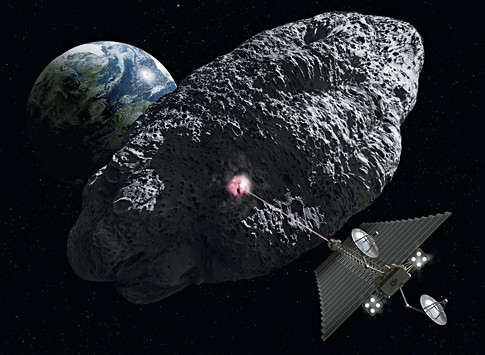
But what would happen if a true grand finale was coming our way in the form of an asteroid that could change life on Earth as we know it?

That’s a question posed in the latest issue of Popular Science.  


From the article

There are between one and two million near-Earth objects (NEOs)—chunks of space rock whose orbits may pass within 30 million miles of Earth—that pose a significant impact threat to the planet. Of the 4,535 NEOs detected and tracked (704 of which are real whoppers), none are on a definite collision course, but there could be millions more, many of them potentially lethal, lurking in the cosmos.

Detection
Who’s Watching? Most spotting is done by half a dozen optical telescopes in the U.S., Italy, Japan and Australia, coordinated by such programs as the Lincoln Near-Earth Asteroid Research (LINEAR) project, a NASA-funded collaboration between MIT’s Lincoln Laboratory and the U.S. Air Force tasked solely with the detection and cataloging of potential NEOs. Amateur astronomers worldwide also aid the effort. Collectively, the programs discover a new NEO every few days.

What’s the Plan? Since 1998, NASA has funded Spaceguard, a consortium of observatories working to find 90 percent of the half-mile-plus NEOs by 2008; the group has found three quarters of the predicted 1,100 NEOs in this size class. Spaceguard’s next step is to find 90 percent of NEOs measuring 460 feet or larger—potentially up to 12,000 objects—by 2020, but funding has not been secured. Larger wide-field scopes should come online in Hawaii, Arizona and Chile in the next decade, greatly speeding detection.

Our knowledge of asteroids and the early formation of our solar system is likely to increase dramatically in the coming decade, thanks to this fall’s launch of NASA’s Dawn mission

[T]he Dawn mission will study the asteroid Vesta and dwarf planet Ceres, celestial bodies believed to have accreted early in the history of the solar system. The mission will characterize the early solar system and the processes that dominated its formation…

Vesta is a dry, differentiated object with a surface that shows signs of resurfacing. It resembles the rocky bodies of the inner solar system, including Earth. Ceres, by contrast, has a primitive surface containing water-bearing minerals, and may possess a weak atmosphere. It appears to have many similarities to the large icy moons of the outer solar system.

By studying both these two distinct bodies with the same complement of instruments on the same spacecraft, the Dawn mission hopes to compare the different evolutionary path each took as well as create a picture of the early solar system overall. Data returned from the Dawn spacecraft could provide opportunities for significant breakthroughs in our knowledge of how the solar system formed.

Where’s the best place to watch the Dawn, er, rise? Apparently, Australia:

A team of four personnel from the United States Air Force will visit Tennant Creek in the Northern Territory to monitor the launch …

The US team will arrive at Alice Springs and travel to Tennant Creek where they will establish a small temporary ground station. Tennant Creek was selected as it affords the best view of the crucial booster separation phase of the launch. As part of the same mission a United States Air Force NKC-135 aircraft will be operating out of Perth International Airport from mid-September and flying over northwest Australia. The launch from Cape Canaveral is planned for between 19 September and 15 October depending on weather and atmospheric conditions.

If you’re more interested in dusk, as it were, be sure to check out Popular Science’s excellent slideshow of past asteroid collisions with our home planet.


Google Continues Foray Into Space

Last week, we told you about Google Sky, which is the Internet company’s effort to point the gaze of its incredibly successful Google Earth platform out into space.

But that’s not Google’s only foray into space:

Google and NASA have worked next to and with each other for a number of years; I’ve never been bothered by this fact, and I’m not complaining now.  Yet the lines are getting even more blurred as former astronaut Ed Lu has gained a job with the search engine giant.

“Lu, who has a doctorate in astrophysics from Stanford University and a strong background in the academic research environment, will have a lot to offer to GoogleSky as well as to GoogleScholar and GoogleBooks,” writes Loretta Whitesides in an article for Wired….

[Lu] "may also play a role in the NASA-Google Space Act Agreement projects, announced in December 2006,” Whitesides continues.  “Lu even has an article published in Nature on his idea for a ‘Gravity Tractor’ mission that could gently pull an asteroid off course over time.”

As WiredPro’s David Caverly points out, Google seems to be intent on covering its lunar bases.

(Hat tip to Wired.

Mind the Gap

We have discussed the necessity of satellite broadband in remote regions and developing countries with weak infrastructures. That doesn’t bring to mind one of the most industrial countries on the planet—Germany.

SES ASTRA2Connect is "a fully satellite-based solution for broadband access that delivers dual- and triple-play services without any terrestrial support." Reaching maximum download speeds of 1024 kbit/s, ASTRA requires no infrastructure investment and is priced at flat-rate monthly fees. The company just signed a contract with H3 Netservice in Germany to market its product to end-users:

H3 Netservice will market ASTRA2Connect through retail partners to end consumers, reaching several thousands of affiliated outlets in Germany. H3 Netservice intends to offer ASTRA2Connect in three service packages. All the necessary hardware – a satellite dish with an interactive device, as well as a low-cost and easy-to-install modem – will be made available through H3 or retailers.

ASTRA2Connect is a fully satellite-based solution for broadband access that delivers dual- and triple-play services without any terrestrial support. This purely satellite-based DSL infrastructure offers a unique possibility for regions without terrestrial broadband access to use high-speed DSL-internet. According to official data from the German Ministry of Economy and Technology, at least 2.9 million German households still do not have any access to Broadband internet. SES ASTRA is offering ASTRA2Connect on a wholesale basis to large service providers such as telecommunication operators, internet service providers and broadband operators across Europe who will market it to their respective end customers.

ASTRA2Connect will help answer a question that remains in one of the most "connected" places on Earth—how do we bridge the European broadband gap? The European Union held a conference on this subject in May. Among the findings: while broadband penetration is growing, there still exists a "double gap" — between some countries in Europe and inside some countries (rural vs. urban). For more info, watch the video or read the powerpoint.