Com in Africa: A Changing Marketplace

Here at the Americom Business Network Blog, we’ve written about expanding telecom needs in Africa and about the role satcom plays in furthering the development of Africa’s oil reserves.

African development continues to be a hot topic in the world of sat- and tele-com, with a debate currently taking place about Telkom’s SAT-3 undersea cable and the countries it does (and doesn’t) serve: 

The biggest problem with Telkom’s SAT-3 undersea cable is that it never went bankrupt, said Johan Meyer, Telkom’s group executive for global capacity service.

Meyer, who has been intimately involved in the SAT-3 West Coast cable, which is SA’s primary undersea link for telecommunications and Internet connectivity with the rest of the world, said: “If SAT-3 had gone bankrupt, then we would have had a very different scenario to what we have today, and may even have found ourselves in a similar position to the North Atlantic cables.”

He was responding yesterday to comments made during a debate on pan-African connectivity at the Capacity Africa 2007 Conference, in Cape Town.

Wessel van der Vyver, GM of international business for Telecom Namibia, opened the discussion by saying that Telkom was one of the key impediments to his company lowering its own broadband and interconnectivity costs.

“Essentially, Nambia is a landlocked country in terms of undersea cable because SAT-3 lands in Angola and in SA. We were hoping to get a landing in Namibia, but this hasn’t happened.”

Later, Van der Vyver said Telecom Namibia was also “disappointed” that the proposed undersea cables being planned by the South African government’s new broadband infrastructure supplier, Infraco, was also ignoring his country.

“It would be a pity if another cable is built and it leaves us in the same situation.”

During the discussion, the lack of satellite capacity came under the spotlight.

Pedro Camacho, CEO and owner of Blue Sky Satellite Communications, said satellite capacity was at a premium, with a long waiting list.

Need some background on the SAT-3 cable? Look here:

SAT3/WASC/SAFE is a historic Achievement made possible by the participation of 36 nations, the majority of the landings are in African states. Together they have fully funded the undersea cable system costing more than US$600 million and will own and operate it for the next 25 years. This results in much of the revenue it generates being ploughed back into the continent. This is a major departure from the current scenario, where many African countries rely on foreign operators to route their international traffic which results in revenue generated in Africa, leaving Africa. 

Meanwhile, Telkom and HCI are expanding South Africa’s pay TV market:

South Africa’s communications authority granted fixed-line operator Telkom’s media unit, Telkom Media, and leisure and media group Hosken Consolidated Investments licences along with two smaller operators — On Digital Media and Walking on Water.

Entry of new operators is expected to stimulate the market, with more money being pushed to marketing pay-TV services, portfolio manager Khulekani Dlamini at Renaissance Specialist Fund Managers said.

Chief Executive Officer Nolo Letele of Naspers’ local pay-TV operation MultiChoice SA said the unit had been gearing up for competition.

"We will have to fight that much harder for the disposable rand in people’s pockets," Letele said after the announcement of the winning bidders.

With increasing demand continent-wide for better broadband, television, and voice connections, the communications landscape in Africa is sure to remain fluid for many years. We’ll keep you updated on the latest developments. 

Penn State and NASA Join in Education Program

If you see a shiny new Airstream trailer in front of your local school, it’s not necessarily because of classroom overcrowding: it’s likely part of the "NASA to the Schools, Penn State" program, a new 5-year cooperative program that’s putting the Big Ten athletic conference school forward as the face of NASA’s K-12 educational outreach.


EarthTimes.org reports: 

 The $27 million agreement comes under NASA’s Aerospace Education Services Program, one of the oldest National Aeronautics and Space Administration programs now in its 35th year.

Penn State took over Sept. 1 from Oklahoma State University.

"This is the only program in the United States that can put professional science educators on the ground in 50 states and territories," said Penn Sate Professor William Carlsen, director of the university’s Center for Science and the Schools.

The Penn State program will shift the existing emphasis from one-time school visits and short teacher seminars to university-based, space-oriented summer courses for teachers.

School visits will continue, but rather than emphasizing auditorium presentations, NASA education specialists will work closely with teachers and school administrators to infuse cutting-edge science content into extended instructional units, officials said.

Penn State’s Center for Science and the Schools website can be found here. They’ve got some innovative plans for curriculum development and teacher training:

A meeting at Cornell University with scientists who study Mars will kick off development of the first course for teachers. To supplement instruction by classroom teachers who have enrolled in summer courseware, the six Airstream “NASA to the Schools” vehicles will crisscross the country with a scaled-down version of a Martian Rover. Just like a real Rover, these half-pints will sport cameras that enable them to monitor their environment in 3-D. In a novel twist, the educational rovers will also have the capability of projecting images in 3-D using "GeoWall" technology, letting students see exactly what the Rovers saw on Mars.

NASA to the Schools will use many new instructional technologies, developing continuing education content for delivery through NASA’s Digital Learning Network. Education specialists will get in on the ground floor of new NASA projects to aid them in their continuing education components as well.

For a preview of what the tots might experience as part of their "Rover" education, check out this video of the latest Rover Flight Director’s report

Télécoms Sans Frontières Reconnects Areas Affected by Disaster

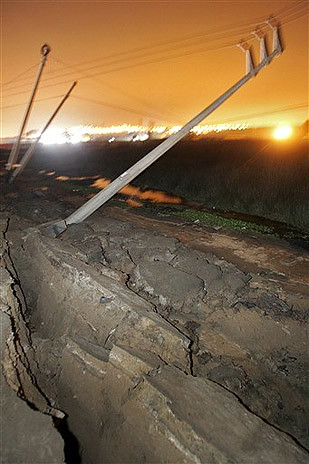
Last month’s devastating magnitude-8 earthquake in Peru killed more than 500 people and knocked down or damaged thousands of buildings in Peru’s southern desert cities of Ica and Pisco.

In the midst of such devastation, conditions are exacerbated by lack of communications with the outside world, as landlines are inevitably severed by falling debris.

That’s why satcom plays such a critical role in disaster recovery. In the days following the earthquake in Peru, engineers from Télécoms Sans Frontières leaped into action. The BBC reported on August 17th: 

The five-strong team will deploy satellite telephone and internet access in three centres – at Pisco, where the quake hit hardest, Ica and Chincha.

Julie Cazenave, who is leading the team, said: "There is a lot of confusion right now because there is little information from the areas hit."

The priority will be to establish telecoms at the airport in Pisco.

Telecoms Sans Frontieres (TSF) is charity that works with the United Nations and the European Commission’s Humanitarian Aid Office (ECHO) to restore communications in disaster-hit areas and the developing world.

"There are no power lines to charge phones. In the affected areas there are no landlines, no internet," said Ms Cazenave.

TSF was critical in reconnecting families that had lost track of each other following the quake:

The relief team from TSF’s Americas base, composed of 5 specialist in emergency communications transports satellite communication equipment (Inmarsat BGan terminals, RBGan, GAN M4 and Mini M) as well as computer equipment to provide internet connections, telephone lines and fax….

During a calling operation on Tuesday, Carmen Hernandez called her son who lives in Spain and testified on the violence of the quake:

"- Mom, where are you calling from? Your voice is trembling, are you sure everything is alright?

"Don’t worry, please keep talking, it’s so good to hear your voice. We’re lacking everything here but we’re alive. When you come back, you won’t recognize Pisco. I’m calling from a satellite phone, a free called offered by an international NGO. Don’t worry son, stay where you are."

The Peruvian earthquake isn’t the only recent natural disaster where TSF has lent a hand:

Still in operation in Pisco following the earthquake which stroke Peru, Télécoms Sans Frontières intervenes in the area of the RAAN (North Atlantic Autonomous Region) from its Latin America base taking care of the victims of the Felix Hurricane.

Tuesday, the Felix cyclone (category 5) devastated Northern Nicaragua, involving the increase of human losses and the number of disaster victims which could exceed 500 000 people. Facing this disaster, the President of Nicaragua invited the international community to provide a humanitarian aid for the victims.

From their base in Managua, 5 logisticians of Telecoms Sans Frontieres arrived on the ground by helicopter, providing assistance to the relief organizations and United Nations agencies by deploying communication centers in Puerto Cabezas. These installations include Inmarsat terminals, BGan, Gan M4, Minis M  and laptops. Efficient telecommunications infrastructure plays a crucial role ensuring the success of emergency coordination. Additional TSF centers will be installed in Sandy Bay and Waspan from today.

At the same time, the TSF teams will offer to each disaster affected family a free call to a relative, which could provide them psychological assistance as well as immediate response to their needs.

ITU has also played a critical role in restoring vital communications to Peru, deploying 50 satellite terminals in remote and underserved areas.

For more information on Télécoms Sans Frontières, click here

inv

Apple’s Own TV Channel


We’ve blogged about the spectrum auction coming up and we see many more interesting ways of how it could play out. Today, via Business Week, we might some day tune our iPhone or iPodTouch to a TV channel being broadcast using UHF frequencies:

Apple Eyes the Wireless Auction

Steve Jobs & Co. consider joining the FCC’s auction of wireless spectrum, and a win would give Apple many intriguing options—for the iPhone and more

by Peter Burrows

Talk of the government’s pending auction of valuable wireless spectrum has focused largely on one intriguing newcomer to the bidding: Google (GOOG). But another tech powerhouse has considered joining the bidding as well: Apple (AAPL).

Two sources tell BusinessWeek that Steve Jobs & Co. have studied the implications of joining the auction, which will be held Jan. 16. The winners will get rights to use the spectrum that analog TV broadcasters are handing back to the government in 2009, given their mandated move to digital television.

Dubbed "beachfront property" by the Federal Communications Commission, it’s the last swathe of wireless spectrum likely to become available that would have the attributes necessary for a new mainstream broadband network (BusinessWeek.com, 8/1/07). Signals at the 700Mhz spectrum, for example, could provide far faster Internet access than today’s cellular or even Wi-Fi networks, and the signals can easily pass through buildings and work glitch-free, even in lousy weather.

Risk for Apple’s Margins
At this point, says one of the sources, Apple is leaning against participating in the auction. It’s not the money. With nearly $14 billion in cash, the company can clearly afford the $4.6 billion minimum bid required by the government, and could probably come up with the $9 billion that’s expected to win a portion of the spectrum to be made available for a nationwide network. There will assuredly be stiff competition from phone companies and other potential bidders such as Google, DirecTV (DTV), and eBay (EBAY), which owns Skype’s Net calling software.

Rather, the risk for Apple is in entering the generally low-margin, hardscrabble world of running a massive-scale network. Rather than focus all of Apple’s entrepreneurial instincts on creating the next innovative gizmo, the company would be on the hook for the massive operational headaches that go with provisioning traffic, activating new subscribers, and fielding their angry calls when service glitches occur.

As with Google, becoming a network operator would drag down Apple’s margins—and could pose a cultural drag on an innovative company. And other than iTunes, Apple has not stood out for its Internet services. Only 1.7 million people pay the $99 annual fee for its .Mac service, disappointing given Apple’s success in so many other areas. "Even for companies like Google, the economics [of owning a network] are barely intelligible," says Amol Sarva, chief executive of Txtbl, a mobile e-mail company. "For Apple, this seems highly implausible."

iPhone Network Solution
Still, even the possibility of an Apple bid is intriguing. For starters, it would mean Apple would no longer need to rely on a phone company to deliver songs, TV shows, and other digital fare purchased at its iTunes Music Store. As it is, the major complaint of iPhone shoppers isn’t with the phone, but with the pokey Net access from Apple’s exclusive U.S. partner, AT&T (T).

If it owned its own spectrum, Apple could provide the network service itself, possibly for far less than the $1,440 iPhone owners must now fork out over the course of the cheapest two-year contract. For example, Apple could hold down costs by letting users choose a Net telephony program such as Skype rather than develop its own voice software, say analysts.

Apple might even be able to give away network service for free, and make its money off services such as iTunes and possibly by selling subscribers advertising space. "With the kind of cash position they have and the kind of push they just made into the handset space [with the iPhone, and now with the iPod touch, which also has Apple’s Safari Web browser built in], it makes a lot of sense for them," says one former Apple executive.

Major Strategy Change?
Indeed, cutting out the carrier would probably be in sync with Steve Jobs’ view of the world. Before striking the iPhone deal with AT&T, he publicly dissed phone companies as little more than "orifices"—good only for providing dumb pipes to deliver more innovative companies’ more innovative services.

"Apple is the most anti-carrier company there is," says the former Apple executive. "They’re probably already frustrated with AT&T. If they put a few billion behind this, they could build a kick-ass network." Indeed, on Sept. 5, Apple announced a new iTunes Wi-Fi Music Store so consumers can buy songs at wireless hotspots, something they can’t do on AT&T’s network. And Jobs made a point of noting Wi-Fi is faster not only than the so-called 2.5G EDGE network, but also than 3G cellular networks.

The fact Jobs was interested enough to investigate bidding for the spectrum opens up the possibility of a major strategy change for Apple. Today, Apple’s approach is built on the idea of the PC—preferably a Mac—being the "hub of the digital lifestyle." If you want content on your iPod or iPhone, or on your TV via an Apple TV settop box, you download it to your PC or Mac, and then sync it with those other devices.

From Devices to Services
But if it had its own network, Apple could conceivably move to a "cloud computing" approach, where it would store customers’ files, music, movies, e-mails, and other content on servers in its own data centers, and dole it out directly to whatever device a customer is using at any given time. If you wanted to purchase the latest Pixar flick from iTunes, you wouldn’t need to schlep over to the Mac to do it; it could be delivered straight to the Apple TV—or even to an Apple TV at the ski house miles away from that Mac.

Taken to its extreme, some experts suggest Apple could one day move to making its money on selling such services, rather than on the devices themselves. "At some point, they’re going to tap out the percentage of people who still need to buy an iPod," says one telecom executive who requested anonymity. "Maybe their strategy is to get into the services business, and switch to getting nice, recurring revenues" from subscribers. Indeed, Apple has already changed its accounting for the Apple TV and for the iPhone. Rather than book revenue when the cash register rings, Apple books the sale over 24 months.

To be sure, Apple has given no hints of any such makeover of its hugely successful strategy. Still, most analysts think this Net-centric model of computing will dominate in the future. Following the success of Google, Yahoo! (YHOO), and others, Microsoft (MSFT) is already signaling it will follow suit. And Apple would have some unique advantages should it head in this direction, particularly the Mac OS. For starters, it’s based on the battle-tested Unix operating system, considered far more reliable and powerful than Microsoft’s Windows.

Superior ‘Walled Garden’
And since the Mac OS lies at the core of the data centers that host the iTunes store as well as almost all of Apple’s commercial products (except for the iPod shuffle, nano, and classic), it could provide a level of glue to help Apple provide a superior experience for its customers. With such a common foundation of software, Apple could more easily ensure that Pixar movie is sent in the proper resolution, whether it’s to be viewed on a large-screen, high-definition TV or on an iPhone. Also, Apple could simplify the job of syncing various devices.

When a new appointment is entered into an iPhone, the network could make sure to update the calendars on the customers’ Mac or laptop, or even the iPod in their car. Says one longtime Net executive: "Apple’s current architecture forces you to designate a Mac as your server where you stream to Apple TV or sync your iPhone. This is really klutzy. So what is the answer? Well, one is to have your media in the cloud. If the performance is there, it would be a superior model."

In a sense, Apple would have created a new kind of "walled garden." Normally, this term refers to Net offerings that limit where consumers can go on the Web. Think about the limited browsing available from most TV cable boxes. But Apple’s walled garden would be defined not by what it limits you from doing, but by the fact it’s tuned to work best with Apple’s own hardware. For Apple fans, they’d only have to be familiar with one user interface. And since Apple’s products all rely on the same set of software—Safari Web browser, the iTunes Music Store, the Quicktime Media player—they wouldn’t have to deal with the many incompatibilities that plague Net users.

Also, Apple includes a wireless networking technology called Bonjour in every download of iTunes that lets any Apple product automatically spot other Apple products within range. Here’s one possibility: An iPhone owner could be able to use the device like a handheld media server, to move movies or songs or files out in the cloud among those devices.

Grunt Work for a Partner
The hardware cost of building out the network would probably not be that huge, measured in hundreds of millions, possibly, rather than billions. And if Apple went to a voice-is-free approach or to a flat fee, many of the administrative tasks—bill tracking, or detailed call data, for example—would be largely unnecessary. And since no lawns would need to be dug up to make way for new fiber cables, Apple could connect homes for less than $300, compared with more than $800 for fiber, say experts.

Of course, there would be enormous complexity in running such a network, given rules set by the FCC. That’s why most sources think Apple would sign up a partner to handle the grunt work—say, an equipment provider such as Ericsson (ERIC) or Alcatel (ALU), or a consulting firm such as EDS (EDS). Even then, skeptics such as Txtbl’s Sarva doubt Apple could ever figure a way to make a return on its network investment.

The rules approved by the FCC on Aug. 31 make the job more difficult as well. Thanks in large part to pressure from Google and other Net companies, owners of the spectrum will be required to allow any device or application to run. Such "open access" rules are an attempt to break the ability of phone companies and cable providers to limit which cell phones or other devices consumers can use, or to prevent them from using competing services for downloading music or playing games. That means Apple would have to think not only about enhancing the use of Apple products, but also take on the gargantuan task of making sure the network also supports competing hardware and software, from Microsoft’s Zune music player to Amazon’s (AMZN) Unbox movie service.

And Jobs might have to beat out Google CEO Eric Schmidt, an Apple director, in a bidding war (BusinessWeek.com, 7/20/07).

Schmidt has said Google, come January, will likely bid.
 

Blog Wild

WildBlue was named Euroconsult’s 2007 Broadband Satellite System Operator of the Year during the 11th World Summit for Satellite Financing in Paris, France. WildBlue provides high-speed Internet access via satellite to homes and small businesses in communities not currently served, or underserved, by other high speed providers. From their press release:

The Broadband Satellite System Operator of the Year award is based on a performance analysis of satellite market players, selected by a jury composed of representatives from Satellite Finance, Space News and from Euroconsult’s analyst team. In selecting the award recipients, the jury reviews each operator’s performance in relation to a number of benchmarks, including: subscribers at year-end 2006 and 2006 subscription growth; penetration of the estimated addressable market at year-end 2006; and strategic decisions and innovative offerings of 2007. WildBlue received the award yesterday during a ceremony held at the Hotel Westin in Paris.

But who is Euroconsult?

Since its creation, the company has become a worldwide reference for research and advice at each step of the value chain in the satellite industry including satellite manufacturers, satellite operators, satellite service providers, launch and services equipment, space agencies, TV platforms & channels as well as bankers, investors and insurers.

A forum on this award dished mixed-reactions. One user notes that the survey did not include—duh—customers! And some of these customers don’t seem too happy — suffering from frequent timeouts, slow speeds, and questionable customer support. Some express their anger on YouTube:


Others however, realize where the satellite broadband industry is — in its infancy, expanding, and still adapting to customer demands. HughesNet (the primary WildBlue alternative) is rising but doesn’t appear to be out-performing WildBlue in value or speed. As one forum particpant puts it: “I wasn’t happy with the spike in latency, but at the end of the day no one else is working any harder to provide this customer with a better alternative, at least not today.”

Phoenix – so far, so good

The Phoenix Mars Lander has passed its first in-flight check. The collaborative project, part of NASA’s Mars Scout class, is headed by the Universtiy of Arizona but includes efforts by Lockheed-Martin and The Max Planck Institute. The mars lander, slated to explore the arctic region of mars, analyzing samples of soil and ice, launched on August 4th and is expected to land on May 25, 2008. Last week, it received its first in-flight report, including a photo taken from its robotic arm camera:

The Robotic Arm Camera took an image of the Robotic Arm scoop using its red LED (Light-Emitting Diode) lamp. Human eyes see this image only in shades of gray, so the picture has been enhanced in false color to better represent what the camera sees.

Images from the Robotic Arm Camera, one of five imaging instruments on the lander, will be the only pictures taken and returned to Earth until Phoenix approaches and lands on Mars on May 25, 2008. Additional images will be taken by the Robotic Arm Camera later in the cruise stage.

The Robotic Arm Camera check was one of a series of instrument tests being completed as Phoenix cruises toward the red planet. Phoenix was about 57 million miles from Earth when the image was sent back. It is traveling at 76,000 miles per hour in relation to the sun.

On Mars, the Robotic Arm will dig trenches, scoop up soil and water-ice samples and deliver them to several instruments on the lander’s deck for chemical and geological analysis.

The Robotic Arm Camera, built by the UA and Max Planck Institute, is attached to the Robotic Arm just above the scoop and will provide close-up, full-color images of the Martian surface, prospective soil and water-ice samples, samples collected in the scoop before delivery to the lander’s science deck, and of the floor and side walls of the trenches.

While the photo doesn’t look like much, it provides welcome relief to the project team. From the project’s excellent blog:

At the moment all we have to look at is the scoop on RA that we’ll use to dig into the surface of Mars. Although we see numbers flow back during these health checks, a picture is something very tangible. It tells us in an image what it takes pages of numbers to understand. We see a sharp focus, the lights are on, the multitude of commands executed properly, the data pipe that the images stream down all work, After all RAC is a camera, all the work is to have an instrument that takes images and the result is we get a picture here on Earth from tens of millions of miles from home. Makes me confident we’ll get back pictures after we land on Mars.

I find this very comforting. Not only have we endured launch, deep cold of space, but we also survived the Van Allen Radiation Belts that surrounds the Earth (some 1500 rems / year compared to 0.04 here on earth). We’ve prepared for this and we’d prepared well. It certainly is exciting to see our hearty little friend is healthy so far from Earth on her extraterrestrial journey to her new home on Mars.

The same in-flight check returned the lander’s cruising temperature (a touch colder than a Wisconsin winter):

So far all looks well on the spacecraft and the instruments are at a balmy -30° C with some places near 0°C. The RAC at a comfortable -15°C!So much for the interplanetary weather report.

Meanwhile, the weather on Mars isn’t much better. Earlier this summer, a global dust storm swept the red planet creating a sky-darkening dust clout, nearly killing NASA’s solar-dependent exploration rovers. The rovers, Spirit and Opportunity, have worked 40 months more than their original 3-month goal. Along the way, they’ve survived a lot:

"These rovers are tough. They faced dusty winds, power starvation and other challenges — and survived. Now they are back to doing groundbreaking field work on Mars. These spacecraft are amazing," said Alan Stern, associate administrator of NASA’s Science Mission Directorate, Washington.

Let’s hope the Phoenix has similar longevity. So far, so good.

DIY Friday: Military Satellite Hacking

Relax. We are not designing instructions on how to take-down U.S. military satellites. But the U.S. Space Countermeasures Hands On Program (Space CHOP, for short) is trying to do just that — using store bought, DIY gear to disrupt or take-down U.S. military satellites. The goal: if we can discover our own vulnerabilities first, we can protect ourselves from the real enemies. Popular Mechanics chronicles Space CHOP’s activities:

Space CHOP was formed in 1999, and one of its earliest experiments used a UHF generator and a small amplifier purchased from an electronics store. The team pieced together an antenna out of copper wire, PVC piping and other easily obtained materials. (The Air Force won’t elaborate on Space CHOP hardware or targets.) By aiming the antenna at the sky and turning on just a few milliwatts of power, the team showed it could block signals from a military communications satellite.

"We demonstrated that a few unsophisticated guys with a few thousand dollars’ worth of equipment could interfere with a seriously sophisticated satellite system," says John Holbrook, Space CHOP’s program manager. "If we had turned on full power, we would’ve knocked [the system] out."

And it is not just DIY, technological experimentation. This team uses good, old-fashioned intelligence and face-to-face investigating:

More often than not, the Space CHOP team doesn’t need any equipment to uncover a vulnerability. They scour the Internet for potentially damaging information. They case out Air Force bases. Or, posing as graduate students, they pump defense contractors and military officers for information until they’ve figured out a way to take down a satellite or its link on the ground.

As the author of this Popular Mechanics article, Noah Shachtman, notes on his blog, this is not a fantasy threat. From the AP:

The Bush administration warned Wednesday against threats by terrorist groups and other nations against U.S. commercial and military satellites, and discounted the need for a treaty aimed at preventing an arms race in space.

Undersecretary of State Robert G. Joseph also reasserted U.S. policy that it has a right to use force against hostile nations or terror groups that might try to attack American satellites or ground installations that support space programs. President Bush adopted a new U.S. space policy earlier this year.

"We reserve the right to defend ourselves against hostile attacks and interference with our space assets," Joseph said in prepared remarks to the George C. Marshall Institute.

Joseph, the senior arms control official at the State Department, said nations cannot all be counted on to use space purely for peaceful purposes.

"A number of countries are exploring and acquiring capabilities to counter, attack, and defeat U.S. space systems," Joseph said

He also said terrorists "understand our vulnerabilities and have targeted our economy in the past, as they did on 9/11." He said terrorists and enemy states might view the U.S. space program as "a highly lucrative target," while sophisticated technologies could improve their ability to interfere with U.S. space systems and services.

Not a member of Space CHOP but still want to hack satellites? Try grabbing free satellite signals.

iCar?

Like many people, the iPhone shook my perspective on technology. It’s no longer about the best laptop, best mp3 player, or best phone. It’s about technological fusion — forging devices that can do it all.

So, why not an iCar? While you can’t carry it in your front pocket, there is no reason you don’t want your car to have the best technological capabilites. A radio is no longer good enough (a sad realization for a ’94 Geo Prism driver). CNET has all the nerd-gossip:

Apple and Volkswagen are reported to be in talks about an "iCar" or car integration system, according to reports from German magazine Capital and the Associated Press.

Apple CEO Steve Jobs and Audi Chairman Martin Winterkorn, who heads the Audi brand group that includes Volkswagen, met recently in California to discuss ideas, but no concrete plans, a Volkswagen representative told the Associated Press.

"We wouldn’t comment on rumors and speculation," said Tom Neumyar, senior manager for iPod and iTunes at Apple.

Volkswagen of America would neither confirm nor deny the reports.

While its currently all speculation, just imagine the possibilities: navigation system, iTunes synching, integrated touchscreens, chatting among back-seat passengers, integrated bluetooth, etc.. LAPTOP Magazine details some more wishlist items (some not-so-serious):

Dashboard on the Dashboard
We can’t wait to slip into our silver, leather-interior car and control everything–from the air conditioning to the gears–via a strictly touch-sensitive dashboard that’s void of any buttons or control wheels. Our fingers will manipulate everything on the panel with simple finger strokes and taps. In keeping with Apple’s current Mac OS X Dashboard, we’re demanding customizable Widgets with everything from Google Maps to current gas prices.

Click Wheel As Steering Wheel
It’s going to take some getting used to, or even a retake of your driver’s test, but replacing the olden-day steering wheel with an iPod-like Click Wheel will make it easier to turn the corner; you’ll merely have to slide your hand over the touch-sensitive plastic wheel. Bonus: A simple push of the center button emits a loud honk that sounds like a Leopard purr.
[…]

Smart Playlists
Using live traffic updates, your music playlists will be automatically generated by the amount of congestion. When you’re about to enter areas with heavy traffic, you’ll be soothed by the mellowest tracks in your collection. When all that’s in front of you is open highway, the bounciest and raciest pop and punk tracks will move to the top of the list. Your iCar will even customize your library based on where you are. If you’re cruising down the Jersey Turnpike, for example, you’ll hear Lynyrd Skynyrd’s "That Smell" blaring through the Apple Hi-Fi sound system.

AirPort Antennas
Pull into the garage and you’ll be able to download iTunes movies over the air to the backseat monitors for the kids to watch, or sync videos, photos, and music with your Apple TV. We’re also excited about the possibility of swapping playlists with other iCar owners via Wi-Fi while you’re at a stoplight-provided they have DRM-free tracks.

Critical to this dream iBeetle (or iPassat) will be Internet-access. What will this iPhone iCar do without the requisite AT&T signal? Perhaps Qualcomm’s Omnivision Mobile Platform can be integrated. Using OmniTracs and OmniExpress, this mobile platform can connect one’s vehicle through satellite and wireless networks.

A Geo driver can dream, right?

On an even lighter note, imagine Microsoft’s retaliation, as one CNET reader jokes:

God help us if Microsoft attempts anything similar. Considering the hackability of their operating system, we’d be in HUGE trouble…

Great Photoshop contest on Fark.com, like this "Zune Buggy:"

DRS Systems Awarded $50 Million to Bring VOIP to DoD

Defense Industry Daily reports that the DoD has awarded a contract to bring Voice Over IP services to military personnel in the field:

DRS Systems, Inc. in Parsippany, NJ received a $50 million indefinite-delivery/ indefinite-quantity, firm-fixed-price contract for a satellite-based internet-broadband service and Voice over Internet Protocol (VoIP) network in support of deployed military personnel. Locations include Iraq and the Balkans, as well as other non-Global Information Grid (GIG) operations in the European Command, Central Command, Pacific Command, and African Command Areas of Responsibility as well as the British Indian Ocean Trust Authority (Diego Garcia), and other unidentified locations per tasking received by the Space and Naval Warfare Systems Europe office. M.C. Dean has also received some contracts along these lines.

The terms of the deal include options that could bring the total value of the contract to $250 million. Approximately 75% of the work will be performed in Iraq, and the project is expected to be complete by August 2008 (or August 2012 if all options are excercised).

Defenselink also has the details (see the Navy section).