DIY Friday: Satellite Monitoring for Next to Nothing
Any satellite geek with a lick of imagination has imagined what it might be like to work at one of the dozens of American intelligence organizations utilizing top-secret government satellites and communicating and transmitting information around the world. It sounds like a sweet deal: a nifty chair, your own spot in the control room, all space-news you can eat — how could it not be awesome?

Well, if you’re anything like me, you’re probably forgetting that making satellite monitoring your job would mean, well, making it your job. All of a sudden, the vision of a job among the stars crashes to reality and, before you know it, that position playing with satellites becomes just another 9-to-5 with the requisite paper pusing, confused middle mangers, and brown-bag lunches on synergy.

So what’s a geek to do?

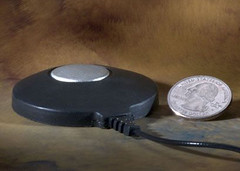
Easy. Make satellite monitoring your hobby. Today’s DIY Friday link brings us to steettech.com and shows us how with a couple antennas, a radio scanner, and short-wave tuner anyone can make their own mission control.

Sure, it might not set you up with a sweet government 401K, but at least a DIY Sat Monitoring rig means you don’t have to seek congressional approval to amp up your transmitter, right?

A Rocket Science Finish to 2006

If the weather cooperates, tonight’s launch of the Space Shuttle Discovery could kick off a "rocket finish" to 2006.

At least nine satellite or shuttle launches are scheduled between now and December 31st.


NASA reports from the launch pad at Kennedy Space Center

All systems onboard the space shuttle are functioning normally this morning, but there’s a 60 percent chance of weather prohibiting a liftoff at 9:35 p.m. EST. A cold front moving through the area is expected to bring with it a lingering blanket of clouds and isolated light rain. The team will press on with the countdown for now, in case the weather cooperates after all.

Starting shortly after 9:00 a.m., Discovery’s orange external tank will begin loading 500,000 gallons of liquid oxygen and hydrogen. This process, called "tanking," takes about three hours to complete. The propellant levels in the tank will be continuously "topped off" until the final minutes of the countdown.

Across the space center, in the Operations and Checkout Building’s crew quarters, the astronauts are scheduled to wake up just as tanking is getting under way. After breakfast, a weather briefing and suiting up, they’ll board the silver Astrovan and leave for the launch pad amid the cheers of Kennedy employees.

The STS-116 mission is the 33rd for Discovery and the 117th space shuttle flight. During the 12-day mission, the crew will continue construction on the International Space Station, rewiring the orbiting laboratory and adding a segment to its integrated truss structure.

But will the weather cooperate? "The forecast has trended for the worse right now," says Kathy Winters, the shuttle’s weather officer.

The weather in French Guiana looks a bit better for tomorrow’s planned launch of Arianespace’s final Ariane 5 mission of the year,  which will lift SES-Americom’s AMC-18 satellite. That launch can be seen live in North America beginning at 4:45 pm EDT.

NASA Says Water Has Flowed on Mars at Least Twice in Last 7 Years


Well, this sure beats Al Capone’s vault.

 The photo to the left shows new deposits of mud, silt or frost on the surface of Mars, which weren’t there several years ago.

As CNN explains:

 "The latest research emerged when the Global Surveyor spotted gullies and trenches that scientists believed were geologically young and carved by fast-moving water coursing down cliffs and steep crater walls.

"Scientists at the San Diego-based Malin Space Science Systems, who operate a camera aboard the spacecraft, decided to retake photos of thousands of gullies in search of evidence of recent water activity.

"Two gullies that were originally photographed in 1999 and 2001 and re-imaged in 2004 and 2005 showed changes consistent with water flowing down the crater walls, according to the study."

The Christian Science Monitor has more: 

For years, evidence from Mars has supported the idea that billions of years ago, large amounts of water flowed on the planet. Surface-penetrating radar on Europe’s Mars Express orbiter has found large ice deposits several kilometers below the surface.

But the strongest evidence for potential watery habitats today had come from NASA’s Galileo orbiter and from the Cassini orbiter, which is currently touring Saturn and its moons. Galileo’s evidence points to a slushy ocean beneath the thick ice crust of Jupiter’s moon Europa.

Cassini tracked watery geysers bursting from Enceladus, suggesting that this moon of Saturn holds reservoirs of liquid water.

But now, Mars is back on the leader board.

"I think they’ve gotten it right," says Bruce Jakosky, director of the Center for Astrobiology at the University of Colorado at Boulder, of the new results.

The presence of liquid water below the Martian surface doesn’t prove that organisms live there, he cautions. But it does change the discussion.

"People have talked about ancient life, given the evidence for ancient liquid water" turned up by orbiters and surface rovers, Dr. Jakosky explains. And evidence continues to mount that liquid water has been present in the red planet’s geologically recent past. "This is the first piece of evidence that says ‘now,’ not ‘a million years ago,’ " he says.

What is your reaction to today’s announcement from NASA? 


NASA to Make Major Mars Announcement at 1 PM EDT

We’re eagerly awaiting NASA’s live briefing this afternoon at 1 p.m. Eastern, while keeping our enthusiasm in check with memories of Geraldo Rivera opening Al Capone’s vault.

That said, the rumors that water may have been found on the Red Planet are enticing.

You can watch the briefing live on NASA TV, or check back here this afternoon for the full story. 


Thuraya Reduces Cell Coverage in Iraq

While intense debates continue in Washington and capitals throughout the world regarding what to do about the increasing violence in Iraq, the leading cell phone provider in the region has already decided upon its course of action.

Thuraya Satellite Telecommunications Co. has been cutting business in Iraq due to mounting security concerns

Yousuf Al Sayed, chief executive officer of the Middle East company, t[said] on the sidelines of the ongoing Telecom World2006 show that Iraq [represented a] mere seven percent of Thuraya’s mobile satellite phone business so far this year.

Iraq boasted a 60-percent and a 40-percent business share of the company in 2004 and 2005 respectively, said the CEO.

Thuraya, based in the United Arab Emirates and founded in 1997, commands a 26 percent share in the global mobile satellite phone market. This map provides a good illustration of the scope of their coverage, which serves a region 2.3 billion people with 2 Boeing GEO-Mobile Satellites:
 "The Thuraya coverage area encompasses the Middle East, North and Central Africa, Europe, Central Asia and the Indian subcontinent. Thuraya offers GSM-compatible mobile telephone services, transmitting and receiving calls through each satellite’s 12.25-meter-aperture reflector. The satellites employ state-of-the-art on-board digital signal processing to create more than 200 spot beams that can be redirected on-orbit, allowing the Thuraya system to adapt to business demands in real time. Calls are routed directly from one handheld unit to another, or to a terrestrial network. The system has the capacity for 13,750 simultaneous voice circuits."

Moon Base Alpha


NASA unveiled plans for building a base on the Moon today:

NASA Deputy Administrator Shana Dale, who is guiding the long-term strategy development effort among 14 of the world’s space agencies, said, "This strategy will enable interested nations to leverage their capabilities and financial and technical contributions, making optimum use of globally available knowledge and resources to help energize a coordinated effort that will propel us into this new age of discovery and exploration."

The Global Exploration Strategy focuses on two overarching issues: Why we are returning to the moon and what we plan to do when we get there. The strategy includes a comprehensive set of the reasons for embarking upon human and robotic exploration of the moon. NASA’s proposed lunar architecture focuses on a third issue: How humans might accomplish the mission of exploring the moon.

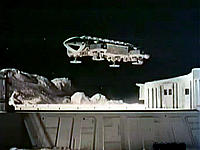
I can’t help it: every time somebody mentions going to the Moon, I think of the British sci-fi show from the 70’s, SPACE:1999. You can still buy the videos on Amazon.

It begins with the Lunar Reconnaissance Orbiter in 2008. This is going to be a pretty cool mission.

Sirius Satellite Television?

We’ve been to the back seat to watch TV, but the antenna was a little on the big side. With a few modifications, Sirius Satellite Radio can send TV to their subscribers (probably for an extra fee). They’ve been talking about this for a while, and we heard Bell Labs was working on something for them. Some think TV in cars is dangerousSkyreport reports on CEO Mel Karmazin’s revelation at the Reuters Media Summit:

"We have three content deals that are very close to being finalized. I don’t know if they will be done by CES, but that is what we are shooting for," he said. "We will have video in the rear seat of the car up and running."

While the comments aren’t completely new – the company said in 2004 it would offer video by mid-2005, Oppenheimer’s Thomas Eagan said they are "intriguing" because Sirius could cost-effectively improve its financial and operational wellbeing with a video service.

Sirius could launch a video service with its existing satellite and repeater infrastructure without reducing its audio content, the analyst said, but consumers would need new or different handsets/in-car receivers to get the signal. Eagan said the video product would consist of three or more children’s channels (i.e. Nickelodeon, Disney and HBO Family) with a DVR downloading service sometime down the line.

"We don’t expect significant difficulties integrating a video service into OEM assembly as many of Sirius’ auto partners, such as Ford and Chrysler are already assembling SUVs with drop down LCD screens," Eagan said. "The size of the video market is clearly smaller than the audio market (and) without significant costs we expect the higher OEM conversion rate and higher ARPU would be accretive."


Watch this Reuters clip of the Karmazin interview. I found it interesting.

When the Moon Hits Your Eye and you… ask who is “Tye”?

It seems like satellites with room for names of supporters is the new UGG boots of the space agencies — everyone’s gotta have them. But, as a savvy consumer, you know you’re better off shopping around. I mean, sure you could have your name on MIT & GeorgiaTech satellite, as we suggested a couple of weeks ago, or you could get your name on Japan’s new lunar orbiter, SELENE.

Here’s the whole story, in only the slightest "All your bases are belong to us" english:

"The Japan Aerospace Exploration Agency (JAXA) plans to launch the lunar orbiter ‘SELENE’ on a H-IIA Launch Vehicle from Tanegashima Space Center in the summer of 2007.

The SELENE is an artificial satellite that aims to collect closely featured scientific data on “The formation of the moon and its transitional history up to today,” which is the biggest lunar exploration project since the Apollo Project.

JAXA will accept from the public names and messages to deliver to the moon aboard the SELENE. Please send us your wishful messages."

The real question: If getting your name blasted into space on a satellite is the new in thing, which one is Brangelina going to choose?


DIY Friday: Launch Your Own Satellite

Got a spare $80,000 and a dream of putting your own satellite into space?

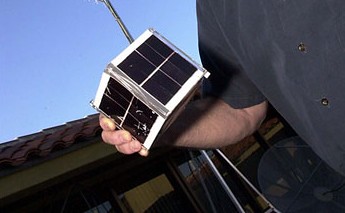
Well, you’ve come to the right place. A recent article from News.com showcases the exciting CubeSat program, based at Stanford and California Polytechnic State University, San Luis Obispo, which allows students and companies from a around the world to launch tiny satellites for cut-rate prices without the bureaucratic and logistical hurdles they might experience if they tried to launch them on their own.

For around $40,000 for development and $40,000 for launch, the CubeSat program has put dozens of one kilogram, ten-centimeter cubed satellites 240-360 miles up in the heavens. Says one of the program’s principle founders Prof. Bob Twiggs:

"I kind of look at this as the Apple II. The ordinary person can get something into space. We don’t know what the ultimate use is, but look what happened to the Internet.”

So what are these mini satellites doing other than helping schools and individuals claim their own chunk of Space? Well, Stanford launch a three-cubed CubeSat in 2003, called QuakeSat, which monitors the seismic energy released over faults which could be used to predict earthquakes… a useful device if there ever was one for quake-prone California.

Students around the world have been using the CubeSat program to gain a working knowledge of spacecraft design that they might not otherwise have the opportunity to engage in. University students in Columbia and Romania are currently in the process of putting together their own CubeSat, as are high school students at San Jose’s Independence High.

While no word is out yet about how you could go about building your own CubeSat with the declining price of space technology, here’s $5 saying you’ll find a CubeSat in a box of Cracker Jacks in the next twenty years.

A Successful Telemedicine Story

I used to live in a remote town that, for a time, literally had no doctors. One doctor moved away, another retired, and poof! — for six months you had to drive 100 miles to get your sore throat looked at.

Many people who’ve lived in rural areas, particularly in the West (where there’s a lot of dirt between the lights) can tell similar stories. Delivering quality healthcare in a remote place is difficult and economically challenging. And when the promptness of care is important, the long travel times that many rural residents must endure to get the services they need can be detrimental.

But satellites and cellular technology are helping to change that, and one particularly heartwarming success story comes to us today from the Dakotas: 

By using digital mammograms and a satellite link-up, radiologists in Michigan were able to examine the mammograms of rural Native American women in North Dakota and South Dakota.

This pilot program by University of Michigan researchers was designed as an improvement over the use of films typically used in mobile mammography. Currently, it can take up to a week for women to get their results after having a mobile mammogram, and it can also be difficult to arrange for additional tests.

"Mobile mammography is a critical way for Native American women to get a mammogram. But what happens when a woman needs to be called back for more images? By transmitting the mammograms by satellite, a radiologist could read them on the spot, and three-quarters of the women who needed new images had those done immediately or within fewer than three days," Dr. Marilyn Roubidoux, professor of radiology at the U-M Medical School, said in a prepared statement.

In this pilot program, a mobile mammography unit performed 515 digital mammograms on women living on seven reservations in North Dakota and South Dakota. The images were then transmitted by satellite to the Breast Imaging Division of the university’s radiology department.

On average, it took about 50 minutes from the time the mammography images were sent until the women received a report about the findings. In some cases, when weather and technological factors were perfect, results came back within 30 minutes.


 The University of Michigan press release on the pilot program can be found here.