Arabsat Launches Today

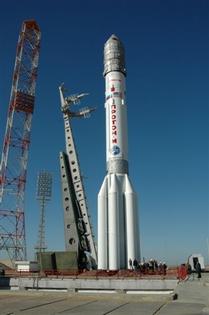
ILS is launching the BADR-4 satellite today from Baikonur at 19:40 GMT. Watch it live or tune your satellite receivers to…
In North America:
IA-6 @ 93 West
C-band, analog/NTSC
Transponder 14, 3980H
In Europe & Asia:
NSS-7 @ 338 East
Ku-band, digital/PAL
Transponder: WHL4/EUH3,Channel-1, 11,098.9H
Symbol Rate: 6.1113 Msps
FEC: 3/4
In Africa & Asia:
BADR-C (formerly Arabsat 2C) @ 26 East
Ku-band, digital/PAL
Transponder: C21, 4,120H
Symbol Rate: 27.5 Msps
FEC: 3/4

We like their blog.


BIG Airplane Lands in Cayenne

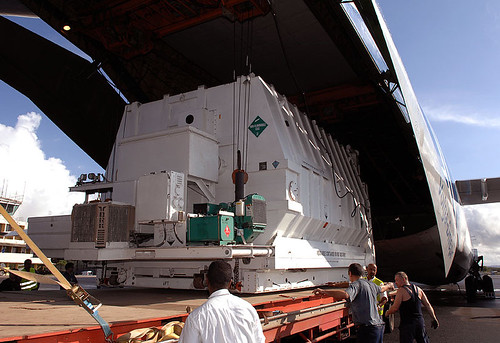
What is THAT? Is it the Big Kahuna landing for Election Day in Florida? No, that’s an Antonov 124 delivering the AMC-18 satellite at Cayenne’s Rochambeau International Airport. The satellite, scheduled for launch in December, is now being transferred to Europe’s Spaceport.

Earth-Wide A/C?

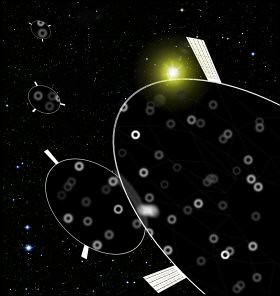
The great science blog, Science-a-go-go, posted in an interesting story last night about an interesting last ditch solution to global warming problems, should the ice caps melt and, as Al Gore predicted, the sea start filling up lower Manhattan. The great idea? Some "sun parasols," according to University of Arizona’s Roger Angel.

"Angel’s plan involves launching a flotilla of trillions of small free-flying spacecraft a million miles above Earth into an orbit aligned with the sun, called the L1 Lagrange orbit. The spacecraft would form a long, cylindrical cloud about 4,000 miles in diameter and 60,000 miles in length. About 10 percent of the sunlight passing through the length of the cloud would be diverted away from Earth, uniformly reducing sunlight by about 2 percent over the entire planet. Enough to balance the heating caused by a doubling of atmospheric carbon dioxide in Earth’s atmosphere, believes Angel."

Not a half bad plan, but, if you ask me, I think we might be a little better off beating this problem to the pass, parking our harms, and enjoying a few crisp, fall bike rides.

DMSP-17 Launched

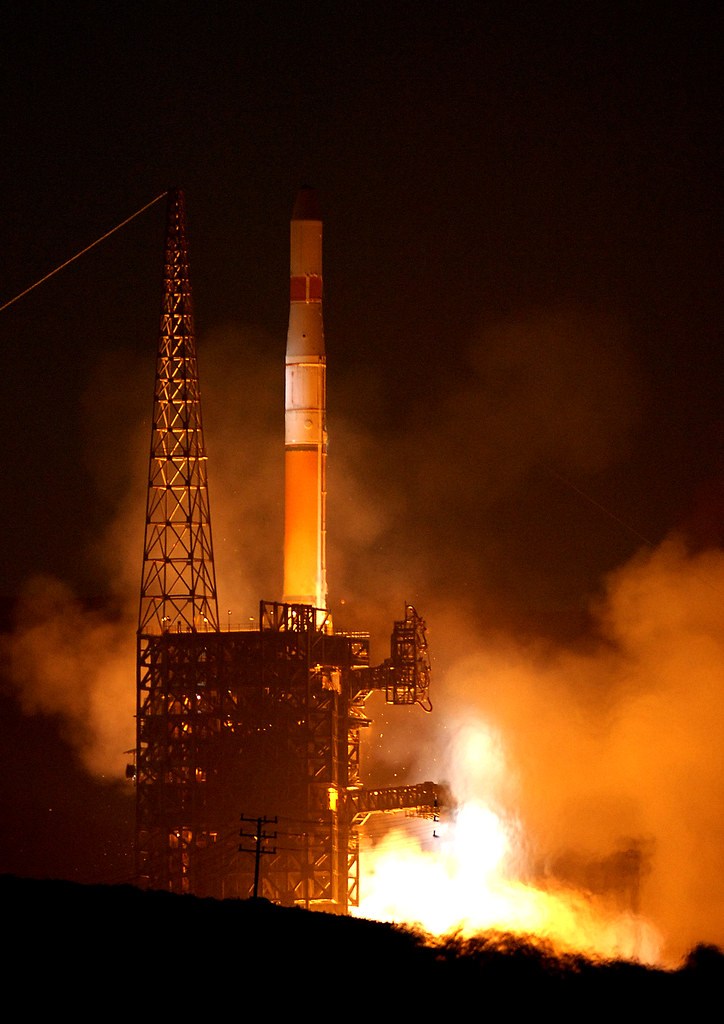
A Delta IV rocket launches at 5:53 a.m. on Nov. 4 from Vandenberg’s Space Launch Complex-6. The rocket carried a Defense Meteorological Satellite Program satellite in to space. The satellite will transition into a polar earth orbit to provide weather forcasts for servicemembers on battlefields around the world. (U.S. Air Force photo/Joe Davila)

DIY Friday: Build Your Own HDTV Antenna

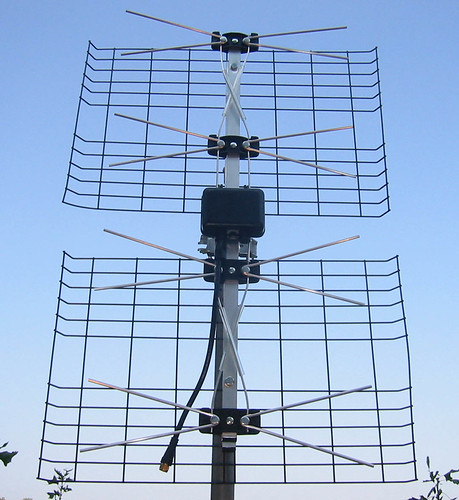
Sure, you just spent $10,000 on a sweet Plasma HDTV Monitor and another $400 on a kick a$$ receiver, but that doesn’t mean you have to break the bank buying a super-expensive HDTV antenna, does it?

Not at all, according to pitman2 over in the Lumenlab 2.1 ("Saving the World from Bad TV") forums, who posted instructions on how to build your very own HD antenna using cardboard, a few hangers, and something called a UHF Matching Transformer. While its not entirely a MacGyver-esque construction (no saliva and papertowel tubes required), it seems to do the job.

"In my un-scientific tests this antenna seems to hold it’s own against the DB2 as an indoor antenna . In outdoor tests it performed almost as well as the DB2. Although I wouldn’t use this one outdoors, being card board and having a solid reflector. One good gust of wind and it’ll fly away. But there is no reason why you can’t build one with higher quality materials to be used outside. Like a cooling rack for a reflector so that it doesn’t catch the wind."

What’s that you say? You haven’t shelled out yet for a new HDTV monitor and receiver yet? You’re waiting for the price of your next generation television to drop below the price of the house your grandparents bought in 1956? Oh, well, have no fear, we hear at RRS have you covered too. Actually, Popular Mechanics has the information, but we’ll link to their how-to on turning your PC into a lean, mean HDTV viewing machine and you can thank us later.

One word of warning on the last bit though: While turning your PC into an HDTV and building your own antenna maybe cheap, explaining to your significant other why you have to watch television under the phosphorescent glow of your computer monitor while coaxial cable from the antenna on the roof dangle overhead… well, that’s priceless.


Cuba Funding the Internet?

According to government official in its Commission of Electronic Commerce, Juan Fernandez, Cuba is funding the Internet. While this may seem a little bit surprising, coming from a country whose widely known for limiting citizen access to the ‘net and censoring any access a citizen does find, the problem is a little complicated:

"Once the underdeveloped countries have undertaken this tremendous effort and sacrifice to create the minimum conditions for them to be able to connect up to the Internet, then they find themselves confronted with a situation whereby they have to pay for the connection up to the Internet at the same level as the developed countries, even though this might also be a channel used by users in the developed countries.

Which means that you can have technical means whereby you can do away with this paradox. And these poor countries seem to be financing (the) Internet by this system."

The only problem with making this argument, Wired’s Declan McCullagh points out, was that representatives from industry and researchers responsible for hooking Latin American countries up to the net were at the UN Internet Governance Forum during which Fernandez posed his argument and could respond, citing instead Cuba’s telecommunications monopoly and censorship policies as the source of the island nation’s struggle to pay for its Internet connection. Bill Woodcock, research director for the non-profit Packet Clearing House, stepped up and noted these challenges:

"Remember that the Internet is an end-to-end model. Zero percent of Cubans are connected to the Internet. The Cuban government operates an incumbent phone company, which maintains a Web cache. Cubans who wish to use the Internet browse the government Web cache. They do not have unrestricted access to the Internet.

And the question about whether there is an inequality in Cuban access to the global Internet, ask yourself whether a Cuban Internet service provider would face any challenges in connecting to a network in the United States or in Europe. And the answer is that, no, these are unregulated markets. They would face exactly the same costs as anyone anywhere else in the world."

The ultimate bit of irony? The UN Summit that this is all taking place at, opened by UN Secretary General Kofi Annan, is occurring at a hotel in Athens that — get this — doesn’t have working Internet. Ooops…

NASA Looking to Invest in the Future

According the Washington Post, NASA is getting into the ventura capital biz with a new firm, Red Planet Capital, aimed at investing in start-ups developing emerging technologies that might someday prove useful to NASA. (NASA Watch, of course, had the story in February)

Peter Banks, an organizer and manager of the Red Planet project noted:

"We will invest with others in companies making products that aren’t being made elsewhere and that NASA might be able to use. We don’t really expect the companies to be making products that can be used as is on the moon, or in other low-gravity environments. NASA would do the adapting once the technology is developed."

While this is the first time the "federal government has started a venture capital fund for civilian purposes", its not the first time its utilized the venture capital model of investment for the purposes of government technology development. In fact, the present administrator of NASA, Michael D. Griffin, former president of the CIA-sponsored venture fund, In-Q-Tel, which was very successful in delivering technologies to the Agency… some 130 at last count.

Still, the plan is not without its critics already, some of whom wonder how the federal government can really make it in the cutthroat world of venture capital investing. Blogger Rick Rickertsen doubted, in particular, the usefulness of setting up an investment fund, when present VCs would be more than willing to tell the government what technologies are worth investing in:

"The U.S. has the largest, smartest, best funded venture capital industry on the planet (of Earth). There are hundreds of firms with brilliant technologists investing billions of dollars per year in leading technologies of all types — including private space exploration, which will hopefully put NASA out of business. Why on earth does NASA think they need to add to that? It is truly crazy and beyond wasteful. If NASA wanted a window on technology for the Federal Government, all they needed to do was write a letter to all VCs thought the National Venture Capital Association (Cost: about $200) and all of these good patriots would have sent them every promising business plan in their files. Then they would have had a REAL window on technology."

While Rickertsen may have a point, the success of In-Q-Tel and the fact that Red Planet Capital would basically do just what he requested (asking other VCs to send it the "best" business plans in their files) and then evaluate the quality of those business plans, makes me think that his argument might be a little naive. Oh sure, I imagine VC would be more than willing to send the Feds some pretty slick business plans, spending the next few nights dreaming while federal dollar signs danced over their heads, but to think that they’d do so out of the goodness of their hearts… well, that’s just dumb.

WirelessHD Could Clip Cords in 2007

For all the advances in cool consumer gadgetry in the last decade — from Ipods to High Definition Television to the proliferation of satellite radio and television — there is one thing that keeps contemporary gadgets tethered to the past: their wires.

That may begin to change in the next year. CNET reports today that "several leading consumer electronics companies are expected to announce… that they are working together to develop a new standard for transmitting high-definition audio and video signals wirelessly."

The new standard is to be known as WirelessHD, "with the stated goal of enabling wireless connectivity for streaming HD content between source devices and high-definition displays."

From the CNET report: 

 Televisions are the "natural" application for [WirelessHD], said John Marshall, president of WirelessHD. Eventually the technology will make its way into adapters for source devices like notebook PCs, digital video recorders, HD disc players, digital audio players and digital cameras. Because it does not compress the digital video, the experience will be the same as using a high-definition multimedia interface (HDMI) or digital video interface (DVI) cable, he said.

The specification will maintain high-quality video, ensure the interoperability of CE devices, protect from signal interference and use existing content protection techniques, Marshall said.

WirelessHD will use the unlicensed 60GHz radio frequency band to send uncompressed HD video and audio at 5 gigabits per second at distances of up to 30 feet, or within one room of a house. While most other wireless audio and video transmissions occur in the 2.4GHz-to-5GHz range, WirelessHD says neither will allow the fast transmition speeds required for high-definition content.

WirlessHD will rely upon the new 802.11n WLAN system, which is supported by… well, just about everybody. (Check out the Enhanced Wireless Consortium  for a list of companies that are working together to accelerate the development process of 802.11n.)

Among consumer electronics companies that are already releasing products capable of interoperability with the draft specifications is Apple, new line of Intel Core 2 Duo-based iMacs sport AirPort cards capable of supporting 802.11n, "which supports connection speeds of up to 540Mbps, or a 10-fold increase compared to existing 802.11g networks," according to Think Secret.

Speaking of Apple — rumors persist that the company is set to unveil both a 50 inch monitor and the new iPhone in January. 

But will we need to connect them with cords? 

XM-4 Satellite Sea-Launched


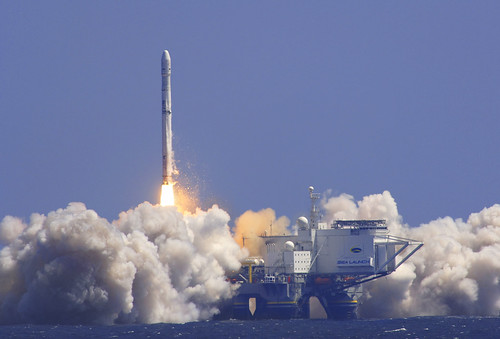
The XM-4 satellite was successfully launched on Monday:

A Zenit-3SL vehicle lifted off at 3:49 pm Pacific Standard Time (23:49 GMT) from the Odyssey Launch Platform, positioned at 154 degrees West Longitude in the equatorial Pacific. All systems performed nominally throughout the flight. The Block DM upper stage inserted the 5,193 kg (11,448 lbs.) spacecraft into geosynchronous transfer orbit, on its way to final orbital position of 115 degrees West Longitude. A ground station at Hartebeesthoek, near Pretoria, South Africa, acquired the first signal from the satellite in orbit.

I think you’ll enjoy the video.

Hubble Decision


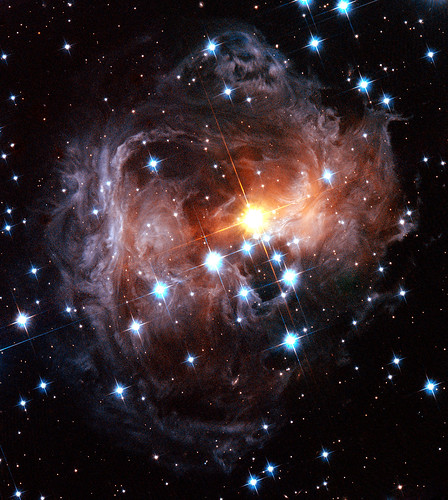
The unusual variable star V838 Monocerotis (V838 Mon) continues to puzzle astronomers. This previously inconspicuous star underwent an outburst early in 2002, during which it temporarily increased in brightness to become 600,000 times more luminous than our Sun. Light from this sudden eruption is illuminating the interstellar dust surrounding the star, producing the most spectacular "light echo" in the history of astronomy.

The image above was recently captured by the Hubble Space Telescope, which is in need of repair, according to this (among others)  CBC report:

NASA officials met Friday to decide whether to risk a space shuttle flight on a mission to repair the Hubble space telescope.

Michael Griffin, the agency administrator, is scheduled to announce Tuesday at Goddard Space Flight Center in Greenbelt, Md., whether the mission will take place.

NASA says a mission to repair the Hubble telescope carries a higher risk.
(NASA/Associated Press) Although the space agency hasn’t said anything officially, University of Wisconsin-Madison astronomer Jay Gallagher, a member of a science team responsible for a camera in the Hubble telescope, says the signs are promising.

The 16-year-old telescope has been repaired four times since its launch in 1990. A fifth repair mission was cancelled after the 2003 space shuttle Columbia tragedy that killed seven astronauts.

NASA officials decided to cancel any future repairs of Hubble, saying it was a matter of shuttle safety. If a spacecraft heading to the telescope encountered a problem, there would be no safety net, since the astronauts would not be able to reach the International Space Station from Hubble’s orbit.

If Tuesday’s announcement gives the go-ahead for the mission, it could prolong Hubble’s ability to capture some of the most spectacular images of the universe well into the next decade. If the repair doesn’t take place, the telescope will deteriorate by 2009 or 2010.