Well, it looks like the party might soon be over for the generations of euro-tripping backpackers who’ve snuck a few bottles of French wine into Germany or bottle of the illicit green stuff from central europe into Ole’ Blighty… shucks!
Our good friends at vnunet are reporting that Heineken Brewery (makers of Dutch delight drunk around the world), in association with IBM, international shipping company Safmarine, Vrije Universiteit Amsterdam (University of Amsterdam), and customs agencies in the US, UK, and the Netherlands, are beginning a program to track cargo container shipments of Heineken beer from Europe to the United States using satellite and cellular technology.
Called the "Beer Living Lab," the main goal of the project is to create a paperless documentation trail using IBM technology to provide real-time visibility of the product and interoperability through wireless sensors linked to its WebSphere platform.
According to IBM project Manager, Steffan Reidy, the results of this research effort could be used to improve customs processes around the world:
"[It’s] the first step in building the ‘Intranet of Trade’, which will help to substantially improve efficiency and security in the global supply chain."
Or, as Vnunet reported:
"Once accepted and implemented widely, paperless trade will support initiatives that will eliminate most inspections on arrival, thus significantly speeding up ocean freight shipments and improving the profit margins for shippers."
While this might mean it might be a little harder to sneak some booze across the border (especially if and when the technology is combined with RFID tagging of shipped spirits), the potential savings that could be passed down to consumers and improved port security probably evens things out a bit.
Want even more information about the Beer Living Lab? Think about taking a brief sojourn to Amsterdam in the next few days… the lab seems to be having a workshop on the technology on Thursday.
Posted
October 30th, 2006 in Front Page, Observation, Rockets & Launches, Satellite TV
|
No Comments »
With the safe arrival of Anousheh Ansari, the first female space tourist, as we reported a few weeks ago, life continues to be interesting aboard the International Space Station. Today, the Space Stations residents were finally able to open the hatch leading to an unmanned supply shipped that docked with the station 24-hours before. As CBS News reports:
"The Progress M-58 cargo ship, carrying supplies to the station’s three-man crew, docked at the station Thursday at 6:28 p.m. Moscow time (10:28 a.m. EDT) on autopilot, as planned.
Mission Control could not confirm, however, that its antenna had folded as required for the craft to clamp securely on the station although later it announced that it had solved the glitch."
Fortunately, Mission control reports, the crew, which was never in danger of being without food or oxygen, has opened the cargo ship and begun unloading supplies.
In other ISS related news, the billionaire who helped create Microsoft Excel and Word, Charles Simonyi, is supposedly set to be the next space tourist according to the Seattle Post Intelligencer. Simonyi is currently set to join the Space Station crew for eight days (during a ten day mission) aboard a Russian Soyuz spacecraft set to launch on March 9,2007.
Everyone will, of course, be able to follow Simonyi on his travels through his blog at charlesinspace.com.
Posted
October 27th, 2006 in Analog Deathwatch, Around the Blogs, Astronomy, Business Network
|
No Comments »
While I’m not really certain what this all means, it has lead to some really amazing images and movies.
Astronomers have new evidence that the Andromeda spiral galaxy was involved in a violent head-on collision with the neighboring dwarf galaxy Messier 32 (M32) more than 200 million years ago. This infrared photograph taken with NASA’s Spitzer Space Telescope revealed a never-before-seen dust ring deep within the Andromeda galaxy (highlighted by the inset). When combined with a previously observed outer ring, the presence of both dust rings suggests that M32 plunged through the disk of Andromeda along Andromeda’s polar axis approximately 210 million years ago.
Check-out a high resolution image of the collision (2.1 MB) and a great simulation of the collision.
According to a press release connected to the images, the findings may be important for the clues they might provide about our own galaxies’ future. Similar to collision pictured above,
"Astronomers have predicted that Andromeda and the Milky Way will collide in approximately 5 to 10 billion years. That collision will erase the separate identities of each galaxy, leaving a single elliptical galaxy in their place."
At least we’re not going to be around for that one, right? 🙂
Posted
October 26th, 2006 in Cool Stuff
|
No Comments »

Sea Launch is now preparing for the launch of the XM-4 satellite on 26 October 2006, at 23:49 GMT. Here’s the feed from their webcam:

Live broadcast of the launch will be available in North America via the AMC-3 satellite’s Ku-band payload, transponder 18. The satellite is located at 87 degrees West Longitude. Here are the particulars:
Downlink Frequency: 12064 Mhz Vertical
DIGITAL PARAMETERS: 4:2:0 FEC: 3 / 4 Symbol Rate: 6.1113
Audios: Audio channel 1 / Audio channel 2 = Program Mix ( English)
Standard: 525 NTSC
Transmission test begins at 23:00 GMT, with the live transmission beginning at 23:35. Launch window opens at 23:49 and closes 00:57 on 27 October 2006.
Or you can watch the webcast.
Posted
October 26th, 2006 in Around the Blogs, Astronomy, Front Page, Observation, Rockets & Launches
|
3 Comments »
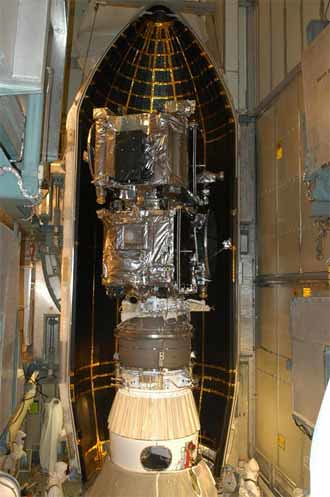
NASA’s STEREO Mission is set to launch this evening at 8:53 PM EST and things seem to be going well, according to the mission website:
"The STEREO mission is about to begin. Safely installed atop a Boeing Delta II rocket, the twin spacecraft are ready for launch Wednesday at 8:38 p.m. EDT. The vehicle’s second stage was loaded with storable propellants on Monday. The launch weather forecast remains favorable, with virtually no concerns. High pressure behind a passing front has brought pleasant conditions for the next two days. There is still only a 5% chance of weather violating launch constraints, due to possible development of thick clouds."
The launch blog will start reporting the happenings starting two hours before the launch (around 7pm EST).
The STEREO (Solar TErrestrial RElations Observatory) Mission, for those who don’t already know, intends to use stereoscopic 3D vision to construct a complete picture of a sun and the nature of solar flares. In addition to helping us know a great deal more about the world’s most important star, the mission should help us learn how we can best protect future astronauts from the dangerous effects of solar flares.
Posted
October 25th, 2006 in Cool Stuff
|
1 Comment »

The Nihon Keizai Shimbun reported that Japanese DTH service SKY Perfect is merging with satellite operator JSAT, which provides carriage for the satellite TV service. The news report prompted this reply from SKY Perfect:
SKY Perfect is currently looking into strengthening its relationship with and possible merger with JSAT, but nothing definite, including the stock transfer ratio, has been decided on at this stage. SKY Perfect will immediately disclose if anything on this matter is decided.
But Reuters goes a little deeper:
Japanese satellite broadcaster Sky Perfect Communications Inc. will acquire satellite communications company JSAT Corp. and create a holding company next spring, the Nihon Keizai business daily reported in its evening edition on Wednesday.
The paper said Sky Perfect will become a holding company, while creating a new entity for its operations. The holding company will bring the new firm and JSAT under its umbrella.
Each JSAT share will likely be swapped for about 4 shares in the holding company, the paper said.
Based on Sky Perfect’s closing share price on Wednesday, the deal would value JSAT at around 93.7 billion yen ($786 million), 7.5 percent below actual market capitalisation.
Shares in Sky Perfect closed down 1.9 percent at 65,700 yen, and JSAT ended down 2.4 percent at 284,000 yen. They underperformed the benchmark Nikkei average’s 0.48 percent fall.
Sky Perfect currently does not own JSAT shares. JSAT, which transmits programming for Sky Perfect’s Sky PerfecTV, holds a 6.9 percent stake in Sky Perfect.
Interesting to note SKY Perfect, the leading satellite TV service in Japan,  started up its own IPTV service, OptiCast. For about $25 (3,000 yen), you get 68 channels. Such a deal.
Posted
October 25th, 2006 in Astronomy, NASA, Observation, Rockets & Launches
|
No Comments »
Looks like there were no winners in the X Prize Cup’s space elevator cup competition this past weekend in Las Cruces, NM. The competition, which  we wrote about last week, put twenty teams against one another in two categories, climbing and tether strength. According to an article on earthtimes.org:
Although none of the teams were declared winners, the University of Saskatchewan Team (USST) was just two seconds short of winning the prize, as they managed to climb 200-foot- high carbon fiber ribbon in two seconds over the time allotted to them.
While there weren’t any winners, this year teams did far better than they have previously, according to Ben Shelef, an executive at the Spaceward Foundation that sponsored the competition. Shelef reminded those interested interested in the competition that:
"For year one, we attracted seven teams and didn’t climb the tether. This year we had four teams make it up to the top, and one came very close to claiming the prize. We didn’t want to make the competition too easy and we can’t make it too hard, so it looks like we are walking the line."
Interested in taking a stab at the challenge during next year’s cup? Looks like you might have an even greater incentive to succeed: Shelef announced that the prize money from this year’s competition will rollover to next year’s, leaving the climbing and tether strength competitions with a combined purse of $500,000.
Even if it means having to take the stairs this year, building the (space) elevator next year has become even sweeter…
Posted
October 24th, 2006 in Cool Stuff
|
No Comments »
The latest on Wildblue’s upgrade from 10/24/06 Skyreport:
The date to which WildBlue Communications planned on reopening its currently-inoperable spot beams – shut down for system upgrades – has been pushed back another month to ensure the software has been thoroughly tested. To avoid potential network disruptions for the company’s subscribers, WildBlue has extended its network upgrade schedule from Nov. 1 to Dec. 1 of this year.
In a letter written to its dealer base obtained by SkyREPORT, WildBlue said it expects "many or all of the beams that reopen will have to be suspended again before our second satellite is operational. How long they stay open for new orders is dependent on how much additional capacity was added by the upgrade and at the rate at which new orders are being entered."
The date extension comes on the heels of WildBlue’s announcement with satellite TV provider EchoStar and its DISH Network to provide customers with a high-speed internet solution. The push back has affected DISH dealers as well forcing the company to issue a statement of its own.
In a letter posted on its dealer website, DISH said it will be suspending new customer orders in certain regions affected by the extension and have taken the measures to "ensure quality service levels for current WildBlue customers in the affected beams."
DISH said it was encouraging its dealers to enter "as many orders as possible prior to the suspensions" because those "will be able to be installed after the suspensions take place." Both companies urged their dealers to create a waiting list for the customers who placed their orders after the suspensions because the stoppage will be "relatively short."
WildBlue said its new satellite is slated for launch before the end of this year and will become operational sometime during the first quarter of 2007.
Posted
October 24th, 2006 in Cool Stuff
|
1 Comment »

Via MosNews.com:
An unmanned Russian cargo ship carrying 2.76 U.S. tons of supplies, equipment and gifts blasted off Monday en route to the international space station, a space official quoted by AP said.
The Progress M-58 mounted atop a Soyuz-U booster rocket lifted off at 5:41 p.m. from the Baikonur cosmodrome in Kazakhstan and entered orbit about 10 minutes later, Federal Space Agency spokesman Valery Lyndin said.
The ship was scheduled to reach the orbiting station Thursday evening, delivering fresh fruit and vegetables, compact discs and DVDs and other gifts to the station’s current crew — cosmonaut
Mikhail Tyurin, U.S. astronaut Michael Lopez-Alegria and German astronaut Thomas Reiter.
Also included in the shipment, according to Itar-Tass, will be equipment for repairing a Russian-built Elektron oxygen generator, which overheated last month, spreading burnt-rubber smell and leaking potassium hydroxide.
While the incident forced the crew to don masks and gloves in the first emergency ever declared aboard the 8-year-old orbiting outpost, Russian and U.S. space officials downplayed it, saying crew members’ lives were never in any danger.
Posted
October 24th, 2006 in Around the Blogs, Front Page, Navigation/GPS
|
No Comments »
 Longtime Really Rocket Science readers will recall our intrepid reporting on the "Ipod From Space" rumor that went around the Internets back in March.
As it turned out, there was no grand marketing plan to unveil an Ipod that was viewable from space. But since then, at least one Ipod has gone into space: Anousheh Ansari brought her Ipod with her when she became the first female space tourist (and first female Muslimin in space) when she travelled to the International Space Station last month. (Ansari blogged about her cosmic music selection here.)
Hey, who doesn’t like a little electronic diversion on a long commercial flight?
All of this is to say that sometimes a technological and design break through isn’t really rocket science — but it can change the world nonetheless.
And today, on the Ipod’s fifth birthday, we doff our hats to the beautiful design and transformative power of what is — let’s face it — not much more than a portable hard drive with an occassionally buggy OS.
But our Ipods are something we just can’t imagine living without. And that, ultimately, is the most meaningful testament to any technology.
But we’re not alone in singing the Ipod’s praises today: it’s been hailed as "The Perfect Thing" and "The Poster Child for the 21st Century."
Everyone from Queen Elizabeth to the janitor in our building has one. It’s been to space. Thousands of them have entertained our troops abroad. And they’ve changed the way we purchase and listen to music — transforming the entire music industry in the process.
Not bad for a cute little piece of plastic.
Posted
October 23rd, 2006 in Front Page
|
No Comments »