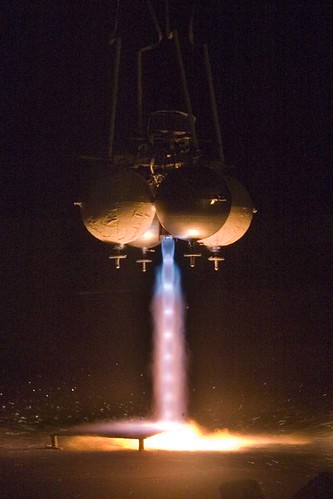
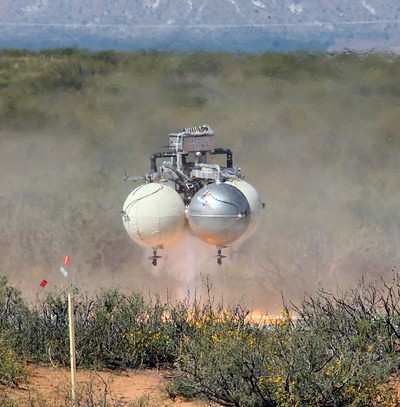
Armadillo Aerospace’s lunar lander impressed quite a few people at the XPrize Cup in Las Cruces this weekend. Aero-News Net gives this account:
…the final flight on Saturday, the one that would have earned Armadillo the first tier prize, was frustrated when minor damage done in the previous landing caused a series of events that initiated an inflight abort when the vehicle banked too aggressively shortly after liftoff, and the vehicle went down, damaging itself beyond the ability to fly again.
Posted
October 23rd, 2006 in Around the Blogs, Astronomy, Business Network, Front Page
|
1 Comment »
Following up on Spektor’s post on Wednesday about the Wirefly X-Prize Cup (which begins today in Las Cruces, New Mexico), Space.com reports that the first first Mark-1 X-Racer will be known as the Thunderhawk:
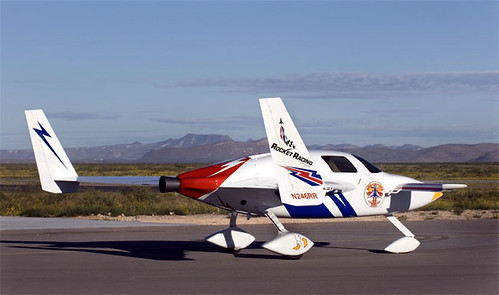
Unveiling the Thunderhawk [image] today at the Wirefly X Prize Cup, RRL officials said that the moniker beat out names like Banshee and Sky Warrior in an online contest that generated more than 2,000 submissions from fans around the planet.
The world headquarters of the Rocket Racing League is based here. The RRL aims to debut its first NASCAR-style races in late Fall 2007 – a first-of-its-kind aerospace sports and entertainment league formed by X Prize founder Peter Diamandis and Granger Whitelaw, a two-time Indy 500 champion team partner….
The fan submitting the winning name is Michael Higgins of New Market, Maryland. He’s an engineer and manager working in the composite pressure vessel industry serving life-support and aerospace/defense applications.
Higgins outlined today how he came up with the Thunderhawk moniker.
“The aircraft, with its rocket propulsion, combines thunderous sound with brilliant flame and light. So I worked up several names focused on thunder and light, and tried to connect those with a bird of prey,” he explained.
Higgins said he expected the RRL races will put rocket propulsion technology in front of thousands of people through thrilling events.
“They should generate public interest in rockets and space, much like the famous air races of the 1920s and 1930s did during the golden era of aviation,” Higgins said.
The contest began January 30 and attracted over 2,000 submissions. The top 1,000 names were whittled down to ten semi-finalists by a panel of RRL judges. Fans then were able to vote for their favorite name from the top ten on AOL.
Nearly 20,000 votes were cast via AOL, selecting Thunderhawk the most popular name.
The live webcast from events at the Wirefly X-Prize Cup is now up; Really Rocket Scientists like us (who couldn’t attend in person) will be glued to the webcast and news coming out of Las Cruces today and tomorrow. (On-demand video from the event can be found here.)
Posted
October 20th, 2006 in Around the Blogs, Front Page
|
No Comments »
The MetOp satellite was finally launched into polar orbit on 19 October 2006 on a Soyuz rocket:
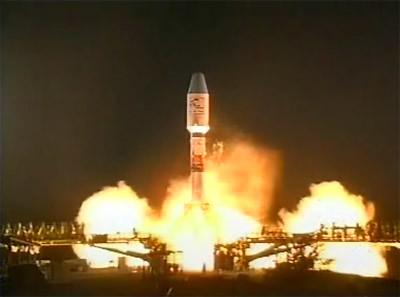
The Soyuz 2-1a, an enhanced version of the Soyuz launcher, lifted off from the Baikonur Cosmodrome in Kazakhstan right on schedule at 10:28 p.m. local time (04:28 p.m. UTC, 06:28 p.m. in Paris). It is the 1,714th launch of a rocket from the Soyuz family.
Starsem and its Russian partners confirmed that the Fregat orbital stage accurately injected Eumetsat’s MetOp-A satellite into its Sun-Synchronous Orbit (SSO). The Fregat upper stage was ignited twice to place MetOp-A into orbit 1 hour, 8 minutes after lift-off.
The MetOp-A satellite will provide more precise details about atmospheric temperature and moisture profiles, invaluable for weather forecasting and climate monitoring. The MetOp program was jointly established by the European Organisation for the Exploitation of Meteorological Satellites (EUMETSAT) and the European Space Agency (ESA). Their main partners in this co-operative venture are the Centre National d’Etudes Spatiales (CNES) in France and the United States National Oceanic and Atmospheric Administration (NOAA).
For this flight, Starsem used the upgraded Soyuz 2-1a, flown with the new ST fairing. The 2-1a configuration features improved navigation accuracy and control capability provided by a digital control system. The 2-1a configuration also enables Starsem to introduce the ST payload fairing with an external diameter of 4.1 meters and a length of 11.4 meters.
This latest successful launch by Soyuz reflects the industrial capabilities of the Samara Space Center (TsSKB-Progress) and the skills of all the operating teams, working under the authority of the Russian Federal Space Agency (Roscosmos).
Starsem is responsible for the international marketing and operation of Soyuz launchers. Its shareholders are Arianespace, EADS, Roscosmos and the Samara Space Center.
Check out the launch highlights.
Posted
October 20th, 2006 in Around the Blogs, Navigation/GPS, Observation, Satellite TV
|
1 Comment »
That’s the question many are asking when they see this stunning new image of the merging Antennae galaxies taken by the Hubble Space Telescope:

Reuters explains:
A seemingly violent collision of two galaxies is in fact a fertile marriage that has birthed billions of new stars, and an image released on Tuesday gives astronomers their best view yet.
The new image of the Antennae galaxies allows astronomers working with the orbiting Hubble Space Telescope to distinguish between new stars and the star clusters that form them.
Most of these clusters, created in the collision of the two galaxies, will disperse within 10 million years but about 100 of the largest will grow into "globular clusters" — large groups of stars found in many galaxies, including our own Milky Way.
The Antennae galaxies, 68 million light years from Earth, began to fuse 500 million years ago.
The image serves as a preview for the Milky Way’s likely collision with the nearby Andromeda Galaxy, about 6 billion years from now.
So if you’ve ever gotten the feeling that everything was heading towards a tremendous smash-up — well, you’re right.
You can zoom in on the above image at the HubbleSite.
Posted
October 19th, 2006 in Business Network, Observation, Satellite TV, Space Tourism
|
No Comments »
"Consistent with this policy, the United States will: preserve its rights, capabilities, and freedom of action in space; dissuade or deter others from either impeding those rights or developing capabilities intended to do so; take those actions necessary to protect its space capabilities; respond to interference; and deny, if necessary, adversaries the use of space capabilities hostile to U.S. national interests."
Click here to read the unclassified version.
Interesting: a comparison to Clinton’s policy of 1996.

Posted
October 18th, 2006 in Astronomy, Cool Stuff
|
No Comments »
 For readers that haven’t established weekend plans just yet, you might want to consider a quick jaunt out to La Cruces, NM where the Wirefly X-Prize Cup will be taking place this coming Friday and Saturday (Oct. 20 & 21).
The main event of the weekend will, of course, be the $2.5 million in Prize competitions that will being going on throughout the exposition.
The Northrop Grumman Lunar Lander and Vertical Lander Challenge will probably be on of the most watched events, but the Spaceward Foundation‘s Space Elevator Challenge may be among its most technically interesting. In the Space Elevator Games, teams will be competing for two, separate $200,000 prizes, one for who builds the best climber (a machine capable of traveling up and down a tether ribbon, with powering being beamed to a transmitter on the device) and the team that builds the strongest tether (first competing against other teams and then by proving that its tether is 50% stronger than the off-the-shelf variety.
While we’ve written about the space elevator competition in the past, Really Rocket Science readers will also have a leg-up on other attendees in terms of other events going on at the space exposition. Also taking place during the fair will be the unveiling of the Rocket Racing League’s X-Racer (written about at RRS here) and meet and greet with the world’s first space tourist, Anousheh Ansari (written about on RRS just a few weeks ago).
Stay tuned to Really Rocket Science for all the information coming out of New Mexico in the next few days. While we won’t be there, we’re going to stick to this story in the days ahead.
Posted
October 18th, 2006 in Analog Deathwatch, Astronomy, Front Page
|
No Comments »

The BBC reports on Europe’s first polar-orbit satellite:
Europe is set to launch its most sophisticated weather and climate satellite to date.
The MetOp spacecraft will be lofted into its 850km-high polar orbit by a Soyuz-Fregat vehicle from Kazakhstan.
The platform should improve forecasting globally, and give scientists detailed data they can use to refine models describing how Earth’s systems work.
Metop has eight instruments to gather a range of data about the planet’s atmospheric and surface conditions….
Metop is a joint project of the European Space Agency (Esa) and Eumetsat, the intergovernmental organisation charged by European member states with operating a series of orbiting weather observatories….
The new platform weighs more than four tonnes and measures almost 18m (60ft) with its solar wing unfurled.
The Eumetsat website will feature a stream broadcasting the launch live. For more information on the satellite, visit the ESA Portal, or click here for a cool animated video explaining the satellite and its mission.
Posted
October 17th, 2006 in Around the Blogs, Observation, Satellite TV
|
No Comments »
"Most technical systems that employ satellites, including GPS technology, make use of atomic clocks; these technologies can now operate much more accurately," thanks to a recent breakthrough in understanding errors in atomic clock technology, ScienceDaily reports:
Andrei Derevianko, Kyle Beloy, and Ulyana Safronova [of the University of Nevada, Reno] sat down six months ago and began work on a calculation that will help the world keep better time….
Associate physics professor Andrei Derevianko and his team isolated and explained a significant portion of the error in atomic clock output….
In its research, the University team was able to isolate and explain a significant portion of the error in atomic clock output. The portion of error that the team studied has now been cut to one-fiftieth of its original size. The team’s research was based solely on calculations, many of which were conducted on high performance computers…
In 2004, an Italian research team found some convincing evidence that suggested that atomic clocks were less accurate then previously thought. This evidence concerned the scientific community and gave the theory behind atomic clocks renewed international attention….
Atomic clock technology is based on the fact that atoms emit a fixed frequency. Lasers, which also have operating frequencies, can be calibrated so that their frequencies match that of a given atom. Since atomic frequencies are constant, syncing a laser with an atom and counting the laser’s oscillations will always provide a steady measurement of time….
The new findings are also paving the way for all kinds of new scientific experimentation. Extremely accurate measurements are required to make estimations about the behaviors of the universe. The extra time-keeping precision will allow scientists to explore hypotheses about the big-bang theory. The improved technology might even be accurate enough to provide evidence related to the controversial theory that universal constants, as in the amount of charge in an electron, are changing.
So how does one tune in to the more accurate atomic clock? Why, with an atomic clock receiver, of course:
A radio system is available in North America set up and operated by NIST – the National Institute of Standards and Technology, located in Fort Collins, Colorado. NIST operates radio station WWVB, which is the station that transmits the time codes. WWVB has high transmitter power (50,000 watts), a very efficient antenna and an extremely low frequency (60,000 Hz). For comparison, a typical AM radio station broadcasts at a frequency of 1,000,000 Hz. The combination of high power and low frequency gives the radio waves from WWVB a lot of bounce, and this single station can therefore cover the entire continental United States plus much of Canada and Central America. The time codes are sent from WWVB using one of the simplest systems possible, and at a very low data rate of one bit per second. The 60,000 Hz signal is always transmitted, but every second it is significantly reduced in power for a period of 0.2, 0.5 or 0.8 seconds: • 0.2 seconds of reduced power means a binary zero • 0.5 seconds of reduced power is a binary one. • 0.8 seconds of reduced power is a separator. The time code is sent in BCD (Binary Coded Decimal) and indicates minutes, hours, day of the year and year, along with information about daylight savings time and leap years. The time is transmitted using 53 bits and 7 separators, and therefore takes 60 seconds to transmit. A clock or watch can contain an extremely small and relatively simple antenna and receiver to decode the information in the signal and set the clock’s time accurately. All that you have to do is set the time zone, and the atomic clock will display the correct time.
Posted
October 16th, 2006 in Front Page, Observation
|
No Comments »
Mission réussie pour Ariane 5 ECA
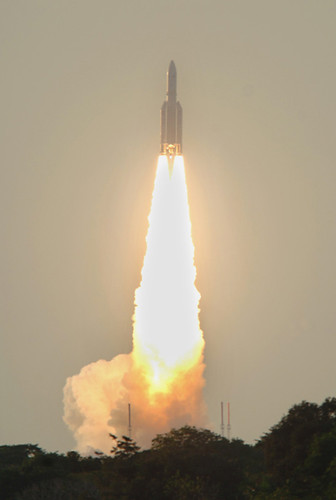
Dans la nuit du vendredi 13 au samedi 14 octobre 2006, Arianespace a mis en orbite de transfert géostationnaire le satellite DIRECTV 9S pour l’opérateur américain DIRECTV et le satellite OPTUS D1 pour l’opérateur australien OPTUS. Grâce au plateau ASAP 5, le lancement emportait également le réflecteur expérimental LDREX-2 pour l’agence spatiale japonaise JAXA.
Arianespace placed two satellites into geostationary transfer orbit: DIRECTV 9S for the U.S. operator DIRECTV Inc., and OPTUS D1 for the Australian operator OPTUS. The Ariane 5 ECA launcher was also fitted with the ASAP 5 platform, allowing it to deploy the LDREX-2 experimental reflector for the Japanese space agency JAXA.
Provisional parameters at injection of the cryogenic upper stage (ESC-A) were:
Perigee: 249.4 km for a target of 249.5 km (±3)
Apogee: 35,940 km for a target of 35,946 km (±160)
Inclination: 6.98 º for a target of 7.0 degrees (±0.06º)
DIRECTV 9S was built by Space Systems/Loral in Palo Alto, California, and will be positioned at 101 degrees West. Weighing approximately 5,530 kg at liftoff, DIRECTV 9S is fitted with 52 high-power Ku-band transponders and 2 Ka-band transponders. It will provide direct TV broadcasts using digital compression technology. DIRECTV 9S will give American TV viewers a greater choice of broadcast services, while prefiguring tomorrow’s multibeam satellites for multimedia applications. Design life is about 15 years.
OPTUS D1 was integrated by American manufacturer Orbital Sciences Corporation in Dulles, Virginia, based on a Star-2 platform. OPTUS D1 will weigh about 2,300 kg at launch. Positioned at 160 degrees East, it will provide direct TV broadcasts, Internet links, voice and data services for Australia and New Zealand. Its design life is 15 years.
LDREX-2 (Large-scale Deployable Reflector Experiment 2), launched on behalf of the Japan Aerospace Exploration Agency (JAXA), is a small-sized partial model representing the large deployable antenna to be used on the ETS-8 technology satellite, which will be launched in December 2006.
Posted
October 16th, 2006 in Around the Blogs, Astronomy, NASA, Observation, Rockets & Launches
|
No Comments »
So you’ve made the decision to get a C-Band receiver at home, so you can watch (what else?) NASA TV and other free to air channels from around the globe.
Now, you think, it’s DIY Firday — and how the heck do you hook the thing up to your dish?
HomeCable.com offers a set of standard instructions and diagrams to help you get started.
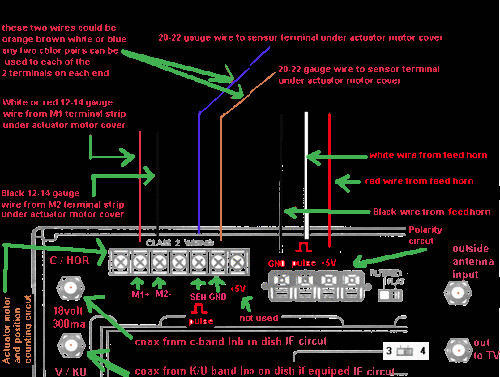
There are several places online where you can get C-band receivers and antennas. Sadoun Satellite sales offers the Fortec Star FC6D. Mechtech and RPS Satellite offer several models, as does Global Communications.
What other sources do readers turn to for their antenna and receiver needs? Let us know in the comment threads — or if there are other DIY Friday topics you’d like to see us cover.
Posted
October 13th, 2006 in Observation, Rockets & Launches
|
No Comments »
