Arianespace to Launch DirecTV Satellite Tomorrow

Among those who aren’t suspicious of undertaking major endeavors on Friday the 13th, you can include both Arianespace and DirecTV.

The Ariane 5ECA rocket is scheduled to launch tomorrow afternoon between 4:56 and 5:56 pm, U.S. Eastern time. The launch will take place from the ESA spaceport in Kourou, French Guiana.

The launch will service three customers and deploy three satellites: DirecTV’s 9S, Optus’ Optus D1, and JAXA’s LDREX-2.  

The 9S satellite "will be capable of providing up to 54 transponders for high-quality local and national digital video service broadcast into 27 beams. In an alternate configuration, the satellite will be capable of providing up to 44 transponders broadcast into 30 beams."

Want to know what to expect from the launch, second by second? Check out Spaceflight Now’s cool launch cue card

Dust Devils on Mars

This morning we stumbled across this article in the Columbus Dispatch (written under contract by NASA), and we were reminded again of one of the cooler images to come from our solar system in the last few years.

The image is of a dust devil moving across a Martian plain on a hot spring afternoon a year ago:


The image was caught by NASA’s ‘Spirit’ Mars Rover in April, 2005. 

Both rovers (Spirit and Opportunity) have recently been upgraded with new software that enables them to better understand when a dust devil is moving across the martian surface, and to begin snapping pictures when they sense that movement:

NASA’s Space Technology 6 mission, or ST6, had already proven this "artificial intelligence" software in space. ST6 used it to help an Earth-orbiting satellite take pictures of erupting volcanoes on Earth. So NASA knew the software would help Spirit and Opportunity capture images of dust devils.

ST6 is part of NASA’s New Millennium Program, whose job is to test new technologies in space before putting them on NASA missions of discovery.

Other images and video from Mars can be found on NASA’s Mars Exploration Program website. 

Labrador Internet Connections At Risk

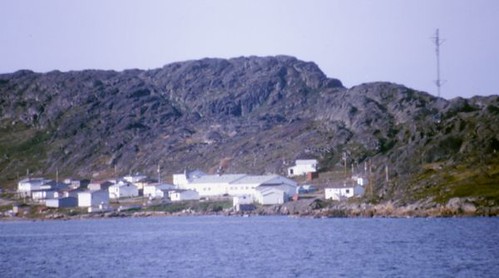
Sailing from England with one vessel, the Matthew, on 20 May 1497, John Cabot (Giovanni Caboto) and a crew of 18 reached what some historians now believe was Labrador on 24 June 1497. He went ashore to take possession of the land, exploring the coast for some time and departing on or about the 20th of July.

Upon his return to England, Cabot was well rewarded (a pension of 20 pounds a year), and a patent was written for a new voyage. In 1498, he sailed for America with 5 ships. One of the ships became distressed and diverted to an Irish port. Nothing was ever heard of the other — or John Cabot — ever since.

Will the same happen to Internet connections in Labrador today? The CBC reports that’s what might happen if Industry Canada’s Community Access Program (CAP) cuts funding. In a town like Black Tickle, where dial-up service became available only recently, people see the need:

The cut may mean the closure of 21 internet sites in Labrador. In many coastal communities, the only efficient way to connect to the internet is via satellite.

Brenda Roberts, principal of St. Peter’s school in the southern Labrador community of Black Tickle, said CAP sites are used broadly. Students use the connection for research, and the school’s administration depends on it.

"Our fee for this internet connection to [the] satellite system is around $220 a month, so basically, if you compare it to a human body, well, we’re going to die of heart failure in January," Roberts said.

Residents in the community rely on satellite-based CAP sites for everyday things, including commerce and filling out government forms.

"We’ve got no bank here now and it’s easier to get a piece of gold nugget here than cash, so being able to bank online is all right," she said.

Who will step in to help? Will it be Canada’s dominant satellite operator, Telesat? Perhaps this is the type of situation where Telesat’s new competitor, Ciel Satellite, saves the day? There are other options, of course: resellers such as Barrett Xplore, who use satellites operated by Intelsat.

Korean Ping-Pong

As the debate rages in the press as to whether Pyongyang’s 60-year obsession came to fruition on Sunday — or, if, as Drudge is reporting, the North Korean blast was a  "dud" — it’s worth taking a moment to ask: how do we come to conclusions about what really happened?

To do so, it’s worth recounting how the United States learned about the blast.  

Our initial warning that the nuclear test was about to take place came not from a high-tech gizmo, but in a phone call from the Chinese:

The White House said Monday the United States received word from China of North Korea’s intent to conduct a nuclear test minutes ahead of the reported event.

According to spokesman Tony Snow, North Korea had called its ally China to advise them on the imminent explosion at about 9 p.m. EST Sunday. China in turn notified the U.S. Embassy in Beijing, which relayed the message to Washington.

Secretary of State Condoleeza Rice received notification about 9:45 p.m. and notified national security adviser Stephen Hadley. Hadley called President George W. Bush at about 9:52 p.m.

South Korean authorities said they felt the seismic tremor from an apparent explosion in North Korea in about the same time frame of Hadley and Bush being notified.

 In addition to indications on the ground in South Korea, there was the on-the-air announcement in North Korea:

 

Soon thereafter, the USGS and other agencies began to analyze the seismic data to locate the epicenter and identify the magnitude of the tremors that were registered on seismic monitors. In this case, the magnitude was 4.2, and the location was pinned down (though not literally, of course) on the map.

NOAA’s NESDIS satellite likely played a key role in communicating the scientific (non-intelligence) data, and satellite telemetry helped pinpoint the location of the tremor. 

The result? So far, a good deal of doubt on behalf of the West in regards to North Korea’s claims of success:

U.S. officials, speaking on the condition of anonymity, said that seismic readings show that the conventional high explosives used to create a chain reaction in a plutonium-based device went off, but that the blast’s readings were shy of a typical nuclear detonation.
   
"We’re still evaluating the data, and as more data comes in, we hope to develop a clearer picture," said one official familiar with intelligence reports.
   
"There was a seismic event that registered about 4 on the Richter scale, but it still isn’t clear if it was a nuclear test. You can get that kind of seismic reading from high explosives."
   
The underground explosion, which Pyongyang dubbed a historic nuclear test, is thought to have been the equivalent of several hundred tons of TNT, far short of the several thousand tons of TNT, or kilotons, that are signs of a nuclear blast, the official said.

The official said that so far, "it appears there was more fizz than pop."

Without satellites and seismic monitors, however, it would be impossible to say whether it was fizz, pop, or outright propaganda on the part of North Korea.


Saab, Polish Navy Ink Surface to Surface Missile Deal

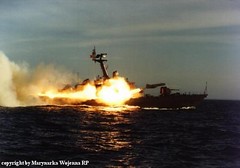
Defense Industry Daily reports that Saab will be delivering RBS15 surface-to-surface missles — which use a combination of radar and GPS guidance to deliver stealth attacks — to the Polish Navy:

 On October 6, 2006, Saab Bofors Dynamics and the Polish companies MESKO and BUMAR signed a contract for production of the RBS15 Mk3 anti-ship missile. MESKO and BUMAR are procuring the RBS15 Mk3 on behalf of the Polish Ministry of Defence, and the contract value is EUR 110 million (about $140 million). The ordered missiles will arm Poland’s Project 660 Orkan Class corvettes, which are currently part of a broad fleet modernization effort via a 2001 upgrade contract with Thales Naval Netherlands. The RBS15 Mk3 is currently in service with Sweden and Germany (via partner Diehl BGT Defence in September 2005); Poland is the second NATO country to adopt it….

RBS-15 fire-and-forget missiles grew out of Sweden’s need for missiles that excelled in littoral warfare situations like Sweden’s fractured coastlines and innumerable bays. They have a longer reach and heavier punch than counterparts like the USA’s Harpoon, with a range up to 200 km (120 miles) but a weight of 800 kg (1,750 pounds) and corresponding size. A set of rocket boosters are used to launch the missiles, after which they use their turbojets until target impact. They can be fired from ships, land vehicles, or aircraft to hit ships or land targets as required, using a combination of radar and GPS guidance during an stealthy, terrain-hugging approach that includes programming for indirect attack vectors, evasive maneuvers, and re-attacks. Additional features like salvo launch, which allows several missiles to arrive at the same target simultaneously from different directions, increase the missile’s lethality.

The SAAB press release can be found here


PRC to Broadcast Folk Tunes from Moon, Raises Concerns

Chinese news service, Xinhua, reports that government officials in the PRC have announced what songs will be broadcast back to earth from the country’s first lunar-probing during next year’s Mid-Autumn Festival. According to the Commission of Science, Technology and Industry for NationalPRC Flag Defense, the organization in charge of the lunar project:

"Most of the songs [will be] Chinese folk songs. The song [that] got [the] most votes was [the] folk song ‘My Wonderful Home Town’, followed by ‘I Love China’, ‘Singing Praises of Motherland’ and 27 others."

In other Chinese space-related news, the U.S.A. Today reported yesterday that U.S. defense officials are concerned tests China has been conducting of ground-based laser devices capable of jamming U.S. spy satellites over their country. Given the amount of money the U.S. has poured into developing satellites for intelligence gathering purposes, defense analyst with the Lexington Institute Loren Thompson suggests we have cause for concern:

"Space is a much bigger part of our military posture than it used to be, so any effort by the Chinese or anybody else to jam our satellites is potentially a big deal."

While these new devices merely jam the satellite signal over PRC territory, some are saying that it might be possible to disable satellites using lasers in the future… certainly something the U.S. is going to have to consider in spy satellite construction in the future.

The Years Fly By

MSNBC reports on the most recent Hubble exoplanet discovery:


WASHINGTON – A recently spied planet orbits so close to its star that a new year comes every 10 hours.

Called SWEEPS-10, the planet belongs to a newfound class of zippy exoplanets called ultra-short-period planets that have orbits of less than a day.

The Hubble Space Telescope recently spotted five ultra-short-period planets, all about the size of Jupiter, in a crowded star field near the galactic bulge of our Milky Way galaxy as part of an exoplanet survey called the Sagittarius Window Eclipsing Extrasolar Planet Search, or SWEEPS. A total of 16 planet candidates were found, all with relatively short orbital periods…

"These are the farthest planets detected so far around some of the faintest stars," study leader Kailash Sahu of the Space Telescope Science Institute in Maryland told reporters at a NASA press conference.

Extrapolated to the entire galaxy, the Hubble results suggest the Milky Way contains at least 6 billion Jupiter-sized planets, researchers say.

The findings are detailed in Thursday’s issue of the journal Nature.

More info and images can be found on the HubbleSite.

“The Greatest Discovery of All Time”

The big astronomy news today, of course, is the award of the Nobel Prize in Physics to American physicists John C. Mather and George F. Smoot "for their discovery of the blackbody form and anisotropy of the cosmic microwave background radiation"  — or, more popularly, "cosmic ripples."

 "Cosmologists have praised the discovery by Americans John Mather and George Smoot of "cosmic ripples" as the greatest discovery of all time," according to SABC News.

The Boston Globe has more on this "inspiring example of scientific investigation and progress": 

In 1989, the Big Bang theory was backed up by striking corroborative evidence. NASA’s COBE satellite (for Cosmic Background Explorer) measured background radiation and helped scientists calculate tiny temperature variations that theories had predicted a big bang would produce.

These measurements “marked the inception of cosmology as a precise science," not just a theoretical one, Nobel Prize officials said in a statement announcing that this year’s physics prize goes to NASA scientist John C. Mather, who oversaw the COBE work, and to University of California/Berkeley physicist George F. Smoot, who worked on the temperature measurements….

Even more than honoring scientists, the Nobel Prize awards science itself: the work of forming and testing hypotheses that leads to abandoning old ideas and settling on new conclusions and, inevitably, new questions. It is often a team effort, the work of more than 1,000 people supported the COBE satellite. It is work that relies on the seemingly outrageous ideas of insightful individuals who frequently outrage establishment thinking and sometimes tear it down and rebuild it.

(The Globe also has a good story on Smoot’s days as a prankster at MIT.) 

Be sure to check out NASA’s COBE satellite page for details on the satellite and its three instruments, which each yielded a major discovery in cosmology — but which also raised a number of questions that the European Space Agency hopes to answer with the 2008 launch of its Planck satellite.

Remember The Schwartz!

We recently heard about a new venture between Brooksfilms Ltd. and MGM Studios to produce and distribute a new animated TV series based on the 1987 Mel Brooks feature film "Spaceballs." The G4 cable network and Berliner Film Companie are also in on the development and production.

The show is set to debut on G4 in the fall of 2007. Owned by Comcast, the G4 channel is distributed to nearly 60 million households in the U.S. via satellite and cable systems. G4 has exclusive U.S. distribution rights.


Checking in On Space Weather

We’re all familiar with standard weather reports: rain in the western U.S., Ohio Valley, a nice high-pressure system over the southeast, with plasmaspheric hiss at higher altitudes.

Wait — plasmaspheric hiss? Space.com explains:

Plasmaspheric hiss consists of extremely low frequency radio waves with frequencies ranging from 100 Hz to several kHz. These waves scatter energetic electrons and divert some of them into the Earthís upper atmosphere, thereby creating the gap in the Van Allen radiation belts.

Fluxes of high-energy, or relativisitic, electrons which occur during space weather events such as coronal mass ejections and sunspot activity, are a risk to humans in space and damage spacecraft. Fluxes in the outer Van Allen radiation belt are particularly erratic and even the gap can be filled with killer electrons during intense solar weather events, such as the Halloween Storm in 2003, Meredith said.

A better understanding of solar weather and the source of plasmaspheric hiss will help scientists improve their forecasts of space conditions and make space travel safer for humans, he said.

"Understanding the source of hiss will help scientists produce the next generation of radiation belt models that will eventually be used for predictive purposes," Meredith told SPACE.com. "This will help humans in space plan their activities to avoid unnecessary exposure to extreme levels of radiation."

For those who are really rocket scientists, understanding the weather in space is critical to maintaining full satellite functionality on a day to day basis.

So where does one get a forecast of the day’s space weather?

Why, from NOAA, of course. 

This site gives a good overview of what a daily space weather forecast looks like, with predictions of solar X-ray flux and links to auroral activity estimates and information on solar protons. A similar page provides predictions of solar wind speeds at earth; a complete list of NOAA’s space weather and data products can be found here.

And here’s a tidbit: Unlike the old joke about wind chill factor, solar wind effects you whether you believe in it or not. And it can make itself known in some amazing ways.