Mach 23 Will Set You Free

The U.S. Air Force Office of Scientific Research thinks it’s possible, and a company in California wants to prove it: a large electromagnetic ring will be able to launch small satellites into space. Discovery Channel Canada gives us the scoop:
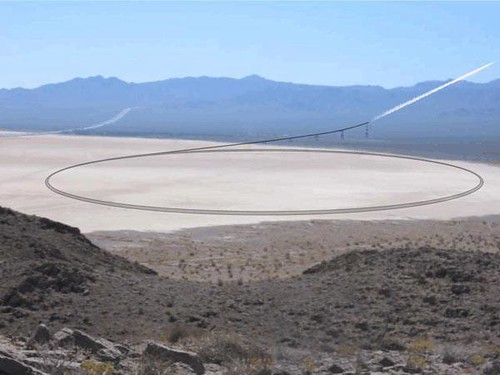
A large circular metal track could accelerate objects to supersonic speed using electromagnets and spit them out into space, says a report from the U.S. air force’s Office of Scientific research.

Tagged as the Launch Ring by its inventing company, Launch Point Technologies, the track would be several kilometers in diameter. Similar to trains that hover on electromagnetic tracks, a sled would hover over the ring and be propelled forward using powerful magnets.

According to the company, a satellite protected by an eggshell-like capsule could sit atop the sled and slowly accelerate over a matter of hours to a supersonic 10 km/sec. Then a small explosion could detach the capsule from the sled and it would hurtle into a side tunnel.

From there, it would shoot up a ramp and through the atmosphere into outer space. Traveling at a 23 times the speed of sound, the capsule would experience forces 2,000 times that of normal gravity on Earth.

A rocket strapped on the capsule would correct the trajectory so that it correctly aligned itself in orbit.

The Goleta California company has received funding to begin a two-year study within several weeks. Boosters of the ring hope to one day use it for thousands of launches a year, at a fraction of today’s cost of putting things in space.

Humans could never withstand the forces exerted during the ring’s launch process. Under existing technological limitations, it could only be used to propel supplies to be used by humans on a long-term mission in outer space, or to put satellites into orbit.

The Air Force also suggests it could be used for military purposes, quickly launching weapons around the world.

For more details, try NewScientist.com.


Thai Business Destabilized, Thai Satellite Deorbited

Let’s face it: military juntas make businessmen nervous.

Last week’s military coup in Thailand has destabilized the business climate — if only briefly — with many business leaders holding off on planned deals as they assess the situation in Bangkok.

One big example of the law of unintended consequences: GE Capital put its deal with Bank of Ayudhya on hold until the situation clarifies itself.

But what impact has the coup had on satcom in Thailand?

For Shin Satellite Plc, the greatest problem in recent weeks is not change in power in the governement but a sudden loss of power on their Thaicom 3 satellite:

Shin Satellite Plc yesterday immediately de-orbited its glitch-ridden Thaicom 3 broadcasting satellite, following its power loss, which affects its plan to tap the Middle East market.

However, the company’s executive chairman Dumrong Kasemset denied that the de-orbit would affect the company’s projected revenue this year as it has yet to include Thaicom 3 income’s from the Middle East into the calculation.

He added during the teleconference with the presses that the company is also evaluating the deeper financial impact of the de-orbit incidence. He said ShinSat de-orbited Thaicom 3 at approximately 01.37 am, due to the power loss to such extent that it could not provide further service.

t de-orbited Thaicom 3 by moving it beyond its existing orbital slot of 50.5 Degrees East.

Thaicom 3 has had its share of problems, as has Thaicom’s owner, Shincorp. Thailand’s Ministry of Commerce recentely completed its investigations of the sale of Shin Corp to Singapore’s Temasek Holdings.

One thing’s for certain — businessmen, and those of us hoping for a Christmas trip to Phuket, will welcome a return to normalcy.

Hand-Held at Sea

According to Lloyd’s List (subscription required), Inmarsat is focusing on hand-held satellite communications devices for maritime service:

LEADING satellite communications provider Inmarsat is gearing up for a major entry into the hand-held market after signing off the deal with voice service provider ACeS International.

“This was the final piece in the jigsaw for our services, and we are now ready to make big strides in the mobile voice sector,” said Robert Johnson, director of maritime services for Inmarsat.

The deal will give Inmarsat the means to compete with Iridium, its principal rival in the commodity voice segment.

The London-listed company bought the intellectual property rights of ACeS International last month and expects initial annualised revenues from the collaboration to be in the region of $3m-$5m from capital expenditures of approximately $40-$50m over two years for ground infrastructure and development on the ACeS R190 phone. 

The ACeS press release on the partnership can be found here. The InMarsat/ACeS system relies upon low-bandwidth communications using geosynchronous satellites in the L-band, which is a global allocation. Thus, you can operate in the same frequency anywhere in the world.

Iridium tried (and failed in) the hand-held satcom market in the 1990s, as The Wall Street Journal recently reminded us:

"They were targeting people in deserts and on ships in the middle of oceans, and one of my life lessons is that you can’t get a good business serving the fringe," said George Calhoun, a telecom entrepreneur and professor of technology management at Stevens Institute of Technology in Hoboken, N.J. "I remember thinking at the time that this was a trial balloon and that they weren’t serious."

Well, the creditors to Iridium remain serious; now they’re going after parent company Motorola to recoup their losses.

So who, exactly, needs handheld satcom equipment? The big boats with lots of people (cruise ships, naval vessels) have big dishes for TV — and they can spend the money required for marine-stabilized antennas.

The Inmarsat maritime service is useful, we suppose, if you want to blog while floating on a raft in the middle of the ocean. Or if you’re rowing a boat to the Canary Islands. But the question remains — is there a mass market for handheld sat phones?

What do you think? 

DIY Friday: Dude, Where’s My Droid?

If you’re like some of us here at Really Rocket Science, you look back upon 1977 as a watershed year — a year when, for the first time, you realized what you wanted more than anything else in the world.

And what you wanted, of course, was to be Luke Skywalker. Or maybe Han Solo. At the very least, you wanted to have your own droid — a faithful mechanical friend like R2-D2.

Fast forward nearly thirty years. Dude, where’s my droid? Technology and industry haven’t exactly delivered the type of personal-pal robot that we saw in Star Wars.

But there’s no need to wait any longer. Want a droid? Do it yourself at Astromech.net

Astromech has a complete tutorial page that will help you build your droid — with instructions and real-world experiences on every part, from the dome to the feet to the lights and and cute little R2-D2-like sounds. 

For inspiration, be sure to check out the photogalleries of droids built by other fans. There’s even a video section showing close-ups of completed droids beeping and blinking in action, and (as an added bonus) this video of droid bloopers taken from the original filming of Star Wars.

The articles section of the Astromech site is a fine place to idle a few hours away before you get to work on your droid (you are going to get to work, aren’t you?);  we recommend taking a quick gander at this review of the original R2-D2 robot from the December, 1977 Electronics Today.

Farm Aid 2006 on Satellite

 FARM AID® 2006 takes place on Saturday, September 30 at the Tweeter Center at the Waterfront in Camden, New Jersey. The entire event will be broadcast live on XM Satellite Radio starting at 3:30 p.m., EDT (on X Country, XM Channel 12).

The event will feature president and founder Willie Nelson, board members Neil Young, John Mellencamp and Dave Matthews, as well as Jerry Lee Lewis with Roy Head, Los Lonely Boys, Arlo Guthrie, Gov’t Mule, Steve Earle, Allison Moorer, Steel Pulse, Shelby Lynne, Nitty Gritty Dirt Band, Jimmy Sturr & his Orchestra, Pauline Reese and Danielle Evin.

Of course, there’s also a webcast. I like their blog, too. Philly’s Bling blog will be covering it as well.

What’s espcially interesting is how the environmental impact of this year’s concert is being worked. Purchasing Green Tags from the Bonneville Environmental Foundation is offsetting all of the electricity used at the concert, replacing it with sustainable wind energy. Title sponsor Silk Soymilk has also purchased additional Green Tags to offset the energy used for an estimated 25,000 attendees to drive to the venue. Last I checked, tickets were still available.

Their local promotion, Fresh from the Family Farm, a restaurant promotion to benefit Farm Aid, is well worth it (if you live, work or plan to visit the area this weekend).

Inside SpaceShipTwo

Virgin Galactic has unveiled a concept interior for its (not-too-distant) future spaceliner SpaceShipTwo — and they’ve also released a great computer animated video showing what it will be like for passengers to travel into space on their flagship.


Space.com has more: 

NEW YORK – Future passengers aboard Virgin Galactic spaceliners can look forward to cushioned reclining seats and lots of windows during suborbital flights aboard SpaceShipTwo, a concept interior of which was unveiled by British entrepreneur Sir Richard Branson Thursday….

“It won’t be much different than this,” Branson told reporters here at Wired Magazine’s NextFest forum. “It’s strange to think that in 12 months we’ll be unveiling the actual plane, and then test flights will commence right after that.”

Virgin Galactic’s spaceliners will be specially-outfitted SpaceShipTwo vehicles built by Mojave, California-based Scaled Composites and veteran aerospace designer Burt Rutan. The new spacecraft, designed specifically for space tourism, will be three times the size of Rutan’s SpaceShipOne, which won the $10 million Ansari X Prize for privately-developed piloted spacecraft capable of reaching suborbital space twice in two weeks.

The air-launched SpaceShipTwo is designed to seat eight people – six passengers and two pilots – and be hauled into launch position by WhiteKnightTwo, a massive carrier craft currently under construction by Scaled Composites, Virgin Galactic president Will Whitehorn said.

For an initial ticket price of $200,000, Virgin Galactic passengers will buy a 2.5-hour flight aboard SpaceShipTwo and launch from an altitude of about 60,000 feet (18,288 meters), while buckled safely in seats that recline flat after reaching suborbital space. A flight animation depicted passengers clad in their own personal spacesuits as they reached a maximum altitude of at least 68 miles (110 kilometers).

While the spacesuit designs are not yet final, they will likely be equipped with personal data and image recorders to add to SpaceShipTwo’s in-cabin cameras, Whitehorn said….

Branson’s Virgin Galactic spaceliners are slated to roll out and begin test flights by early 2008 in Mojave, California, with future operational spaceflights to be staged from New Mexico’s Spaceport America beginning in 2009.

“Pale Blue Dot”

Yesterday’s Astronomy Picture of the Day was particularly beautiful:


From the NASA website:

Explanation: What’s that pale blue dot in this image taken from Saturn? Earth. The robotic Cassini spacecraft looked back toward its old home world earlier this month as it orbited Saturn. Using Saturn itself to block the bright Sun, Cassini imaged a faint dot on the right of the above photograph. That dot is expanded on the image inset, where a slight elongation in the direction of Earth’s Moon is visible. Vast water oceans make Earth’s reflection of sunlight somewhat blue. Earth is home to over six billion humans and over one octillion Prochlorococcus.

Throw Out Them Bunny Ears

We’ve written before about how dramatically the intersection of television and computers — particularly through IPTV and satcom– will transform the media marketplace and the media consumption habits of ordinary people.

That transformation is several steps closer to reality, if news of new gadgets today is any indication.

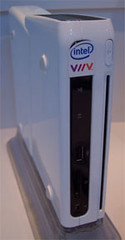
First up is the DirecTV Plus HD DVR — the result of a partnership between DirecTV and Intel:

[I]n other news to come out of the Intel Developers Forum, DirecTV and Intel are joining forces to produce the DirecTV Plus HD DVR — which we first heard about all the way back at CES — allowing viewers to check out content via the interweb when connected to a Viiv PC. In addition, there will be a new software update for DirecTV subscribers by the end of the year that turns subscribers’ set-top-boxes into digital media adapters, the companies said in a press release earlier today. The new DVR, to be released later this fall, will capture 200 hours of standard definition programming or 50 hours of HD, or whatever combination of the two your little heart desires.

CNET also reports that Apple’s iTV wireless router — connecting TV to PC or Mac — will be coming out soon:

 Apple Computer’s take on the living room became a little clearer… with its preview of a new networking product….

CEO Steve Jobs announced that Apple is working on a product code-named iTV that will allow both Mac and PC users to watch movies or television shows purchased from the iTunes store in their living rooms….

The iTV box won’t be available until the first quarter of 2007, but Jobs said it will cost $299 and walked attendees at Apple’s press event in San Francisco through a brief demonstration of its capabilities.

The iTV unit is basically a wireless router with ports for video connections to televisions, including an HDMI port for high-definition digital televisions. The idea is to hook it up to a television or set-top box as another video input device, and access video content stored on a Mac or PC through a special Apple remote control, Jobs said.

And if neither Apple nor DirecTV whet your whistle in anticipation of the coming transformation in consumer media choice, AT&T’s U-Verse fiber-based television service is set to offer some cool options, according to Engadget

 U-verse users, meet HDTV. We just got word that AT&T’s IPTV service is going to be blessed with numerous upgrades within the next few weeks that will include HDTV support, more channels, more VOD, games, personal photos and other unannounced features. This rollout seems to be within the same speculated time frame of October 25th to coincide with the launch of those brand spanking new Motorola DVR’s; whenever it does happen, though, these features will be implemented during the slow viewing times between 11 PM and 5 AM with the hope of minimizing service interruption. On a similar note, AT&T is upgrading DVRs to prep for this rollout, with customers seeing all previously recorded programs erased and all scheduled recordings canceled after October 5th. But keep in mind this is for high-def along with more content, so hopefully the ends will justify the means — you can deal with a few Adult Swim-free nights for the greater good, right?

 The times, they certainly are a-changin’.


Japanese Launch Sun Microscope

On Saturday, the Japanese Aerospace Exploration Agency (JAXA) successfully launched  the M-V Launch Vehicle No. 7 (M-V-7) at 6:36 a.m. Japan Standard Time from the Uchinoura Space Center.

Within an hour, JAXA started receiving signals from the rocket’s satellite payload —  the SOLAR-B, a sun observation "microscrope" nicknamed "Hinode" ("sunrise") by JAXA engineers.

The BBC has more
on the SOLAR-B and its mission of studying solar flares, which "release the equivalent of tens of millions of hydrogen bombs in just a few minutes:"

 The probe will attempt to find out more about the magnetic fields thought to power solar flares, and try to identify the trigger that sets them off.

The ultimate goal for scientists is to use the new insights to make better forecasts of the Sun’s behaviour.

Flares can hurl radiation and super-fast particles in the direction of the Earth, disrupting radio signals, frying satellite electronics, and damaging the health of astronauts….

Solar-B is expected to transform our understanding [of solar flares].

It carries three instruments: a Solar Optical Telescope (SOT), an X-ray Telescope and an Extreme Ultraviolet Imaging Spectrometer.

They will make continuous, simultaneous observations of specific solar features, to observe how changes in the magnetic field at the Sun’s surface can spread through the layers of the solar atmosphere to produce, ultimately, a flare.

"Solar-B acts essentially like a microscope, probing the fine details of what the magnetic field is doing as it builds up to a flare," said mission scientist Professor Louise Harra, from the Mullard Space Science Laboratory, UCL, UK.

"What we don’t know is what triggers a flare; we don’t understand the physics of that phase at all. Solar-B will show us how tangled the field is, and how the field lines collide to produce all that energy."

In October, NASA will contribute to the growing understanding of solar flares when it launches its Stereo mission – twin spacecraft that will make 3D observations of the sun.

Better understanding of solar flares is critical, as John Davis, Solar-B project scientist at Nasa’s Marshall Center, told the BBC.

"The information that Solar-B will provide is significant for understanding and forecasting of solar disturbances, which can interfere with satellite communications, electric power transmission grids, and threaten the safety of astronauts travelling beyond the safety of the Earth’s magnetic field," he said.

(Video of the M-V-7 launch can be found here (in the right hand column).) 

Launch Day Monday — Delta II: Good; SpaceLoft XL1: Almost.

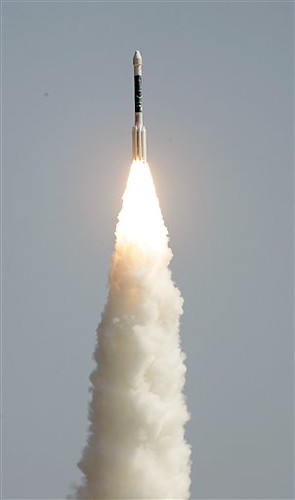
Watched the Delta II launch a GPS payload yesterday, live on HD-Net. Gorgeous launch on a beautiful day at Cape Canaveral Air Force Station in Florida. Seeing it in HDTV does make a difference.

Boeing’s workhouse did its job:

The Delta II rocket carrying the GPS IIR-15 (M) spacecraft lifted off from Space Launch Complex 17A at Cape Canaveral Air Force Station, Fla., at 2:50 p.m. EDT, Sept. 24. Following a nominal 68-minute flight, the rocket deployed the satellite to a transfer orbit.

The Boeing Delta II 7925-9.5 configuration vehicle used for today’s mission featured a Boeing first stage booster powered by a Pratt & Whitney Rocketdyne RS-27A main engine and nine Alliant Techsystems (ATK) solid rocket boosters. An Aerojet AJ10-118K engine powered the storable propellant restartable second stage. A Thiokol Star-48B solid rocket motor propelled the third stage prior to spacecraft deployment. The rocket also flew with a nine-and-a-half-foot-diameter Boeing payload fairing.

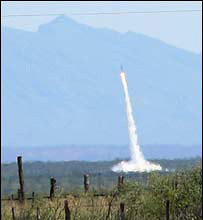
Monday’s other launch event, at Spaceport America in New Mexico, did not do as well. The SpaceLoft XL1 rocket failed at around 40,000 feet, eliciting this gem of a quote from launch logistical coordinator Tracey Larson:

"If it was easy, everyone would be doing it."