Chemical Leak Causes Scare on Space Station

NASA declared an emergency on the International Space Station briefly this morning after technicians discovered that potassium hydroxide was leaking into living quarters. The leak of the odorless chemical was found after a smoke alarm went off while the crew was conducting some work on an Elektron oxygen-generating device and reported a "chemical smell."

Fortunately, the crew was never in any danger — at its worst potassium hydroxide can irritate the skin and eyes — and NASA reacted swiftly. Following the incident, the crew put on surgical masks and gloves and inserted a charcoal filter into the station’s ventilation system, which will supposedly clean the air and eliminate the odor.

Reportedly, Problems with the Elektron should have been expected given the track record of the device. Over the past few years the Elektro nhas been a source of a fair amount of trouble, requiring regular maintenance and troubleshooting. Still, its not known why the problem with the unit has popped up now. According to the New York Times[Registration Required], Michael T. Suffredini, NASA head of the ISS program, had said:

"he did not yet know why the crew had been working on the Elektron. ‘We’re trying to figure out why,’ he said. ‘This Elektron has been working very well.’"

For those who are curious, no word has gotten out on how the whole incident may or may not effect Anousheh Ansari’s historic journey to the station, although her blog has documented the take off that occurred much earlier this morning.

First Female Space Tourist Readies for Monday Launch

American entrepreneur Anousheh Ansari is set to become the world’s first female space tourist on Monday when she departs the Baikonur cosmodrome in Kazakhstan on a Russian Soyuz rocket as part of Virginia-based Space Adventures plan to bring ordinary (if wealthy) tourists to the stars. 

The AP provides details: 

After months of preparation at Moscow’s Star City training centre and a payment of some 25 million dollars (20 million euros), Ansari is due to spend 10 days on board the ISS, fast becoming the world’s most exclusive resort.

After Ansari, Michael Lopez-Alegria of the United States and Mikhail Tyurin of Russia have adapted to weightlessness, the Soyuz TMA-9 capsule will dock at the ISS on Wednesday.

Ansari, a 40-year-old engineer who made her millions in the US telecoms sector, is planning to take pictures, shoot film and write an Internet travel blog during her stay.

Space.com notes that Ansari is no stranger to space flight:

Ansari’s family made a multimillion-dollar contribution to back the Ansari X Prize, a $10 million suborbital competition for privately-developed, reusable spacecraft. A team led by veteran aerospace designer Burt Rutan and backed by millionaire Paul Allen won the contest in 2004 when their piloted SpaceShipOne vehicle launched into suborbital space twice in two weeks.

Together with her husband Hamid and brother-in-law Amir, Ansari also co-founded the Dallas-based company Prodea to develop the Explorer line of air-launched suborbital vehicles under a partnership with Space Adventures.

Explorer spaceport plans in the United Arab Emirates and Singapore are moving ahead in anticipation of the spacecraft’s development.

Space.com also offers a great interview with Ansari.

We’ll have more coverage of the launch and, of course, Ansari’s blog, on Monday.
 

China to Launch New Communications Satellite in October

We wrote last month about the Chinese launch of their seed-breeding satellite.

Now the Chinese hope to breed lots of new channels for millions of people with the launch of its SinoSat 2 satellite at the end of October:

A Chinese Chang Zheng (Long March) 3B carrier rocket is scheduled to launch the SinoSat 2 (a.k.a. Xinnuo 2), satellite… from Launch Complex 2 at the Xichang Satellite Launch Centre. According to Sun Laiyan, administrator of the China National Space Administration, the Xinnuo 2 large-capacity communications satellite, with an anti-jamming system, will provide direct television broadcasting services to the Chinese mainland, as well as Hong Kong, Macao and Taiwan. On Monday, August 4, the satellite left the production facility after receiving its final checks by the Commission of Science, Technology and Industry for National Defence. Xinnuo 2 is based on the Dongfanghong 4 platform and has been designed to work with the ChinaSat 9 satellite in the same orbit, to provide communications services to the Chinese mainland. The ChinaSat 9 satellite is based on the Spacebus 4000 C1 platform and will be positioned at 92.2 degrees east. The Xinnuo 2 satellite, which has taken China six years to develop, is designed to have a lifespan of 15 years, and operated in geosynchronous orbit at 110.5 deg E. China has managed to launch 70 satellites since the 1970’s, of which, currently only 20 are still in service today.

China Daily has additonal information on how the Chinasat 9 and Sinosat 2 satellites will improve television coverage in local areas; the Asia-Pacific Broadcasting Union notes that the new satellite will provide up to 300 million mainland households with "access to cable-quality TV services that have so far been restricted to China’s more urban areas."

The launch of SinoSat 9 comes just in time a new cultural great leap forward in China, as January, 2007 will bring the introduction of a Chinese version of America’s Next Top Model to Chinese television.

(The photo above shows the areas of coverage for the new satellite.)

NASA Play-by-Play

Great piece on NPR yesterday:

All Things Considered, September 13, 2006 · Astronauts working on the International Space Station lost another screw today — but they made it through a seven-hour spacewalk. NASA provided coverage, with commentary, of the entire event. That got producer Jeremy Hobson thinking what it would be like to have a "color guy" to spice up NASA’s coverage.

You’ve got to listen to the podcast yourself.

Complete STS-115 and ISS coverage is on NASA TV.

MobiTV looking into WiMAX

The Wireless Report notes that mobile-delivered television service provider MobiTV is looking into the much discussed WiMAX technology as an "alternative delivery platform." Sure to take notice are those, such as Rupert Murdoch, who think television might just be the "killer app" that helps the last-mile connection method take off.

Personally, I’m probably in line with Om Malick on this one. While WiMAX could do a serviceable job delivering tv programing to an array of devices (especially those with smaller screens), the HD future means that a lot more bandwidth is going to be needed to deliver the kind of signal people are going to expect to see on the 137-in Plasma/Organic LED display of choice.

My bet for WiMax "killer app"? VoIP/Interent telephony, which is far more compatible with the bandwidth limitations of the technology and could do a lot to free us from the crappy mobile phone networks that plague the rural areas where WiMax will first emerge.

NRTC Announces Recipients of ‘WildBlue U’ Scholarships

Back in June, the National Rural Telecommunications Cooperative (NRTC) and satellite internet provider WildBlue announced the creation of "WildBlue U" (opens in PDF) — a program and contest to promote the use of WildBlue’s satellite internet services in rural areas where DSL or traditional cable access to high speed internet service is unavailable.

Today the NRTC awarded Bobby Mills a $10,000 scholarship for selling the most WildBlue satellite Internet subscriptions over the summer. From the NRTC press release:

Mills was one of 28 students who participated in "WildBlue U," a program NRTC created and implemented in partnership with local utilities. The program provided paid internships to students to market WildBlue in their communities. As of Sept. 1, 2006, the interns participating in WildBlue U sold nearly 1,500 WildBlue subscriptions over the summer. Mills attends the University of Nevada, Reno where he is majoring in journalism. To help drive WildBlue sales, Plumas Sierra and Mills developed a "Got Bobby?" campaign, which featured information about Bobby and WildBlue on its Web site with an appeal to help Bobby win the contest and earn a $10,000 scholarship. "The style and coordination of the WildBlue U program offered up a competitive atmosphere that provided one with a real sense of job contentment, and an uplifting feeling of success with each closed sale," said Mills. "Commissions and rewards within the program were extremely generous, especially when taking the state of a typical college student’s wages into consideration." In addition to the $10,000 scholarship, NRTC awarded eight $1,000 scholarships. 

 
The NRTC contest isn’t the only contest promoting the intersection of today’s students with satellite technology. Next Friday marks the final deadline for submissions to the SES Americom Arthur C. Clarke Challenge (preliminary applications were due Sepember 1st. The Clarke Challenge is a "new annual award program for the very best creative, problem-solving idea that can propel the continued growth and expansion of commercial communications services and applications from satellites operating in the Clarke Orbit." More information on the Clarke Challenge can be found here; we’ll also bring you updates on the submissions and awards here at Really Rocket Science after the application date closes.

Japan Launches New Spy Satellite

Japan, seeking to reduce its dependence on the United States and other countries for its foreign intelligence capabilities, launched its third spy satellite into orbit today aboard an H2-A rocket, the BBC reports:

Japan has two spy satellites already in orbit. Two others were lost when a rocket failed in November 2003.

Japan began its intelligence-gathering satellite programme following North Korea’s test launch of a long-range missile that flew over Japan in 1998.

This launch follows a series of missile tests by Pyongyang in July, which included a new weapon, the Taepodong-2, which is potentially capable of hitting parts of the United States.

The Japan Times provides more detail on the need for the satellite in a preview article published on Saturday:

The satellite will likely focus mainly on North Korea, particularly its ballistic missile sites. Tokyo considers the missiles one of the main threats to the country.

But since Japan’s spy satellites are inferior to those of the U.S. military, and even some newer commercial satellites, government officials say Japan must keep developing its own surveillance technology to ensure it has an independent source of intelligence.

"We have been far behind the U.S. To put it bluntly, the gap is like the one between a kindergartner and a college student," said Yoshio Omori, former head of the Cabinet Intelligence and Research Office, an intelligence-gathering body that reports directly to the prime minister.

"Without independent information-gathering capability, Japan will be a blind follower (of other countries)," Omori warned.

Space Shuttle Launched


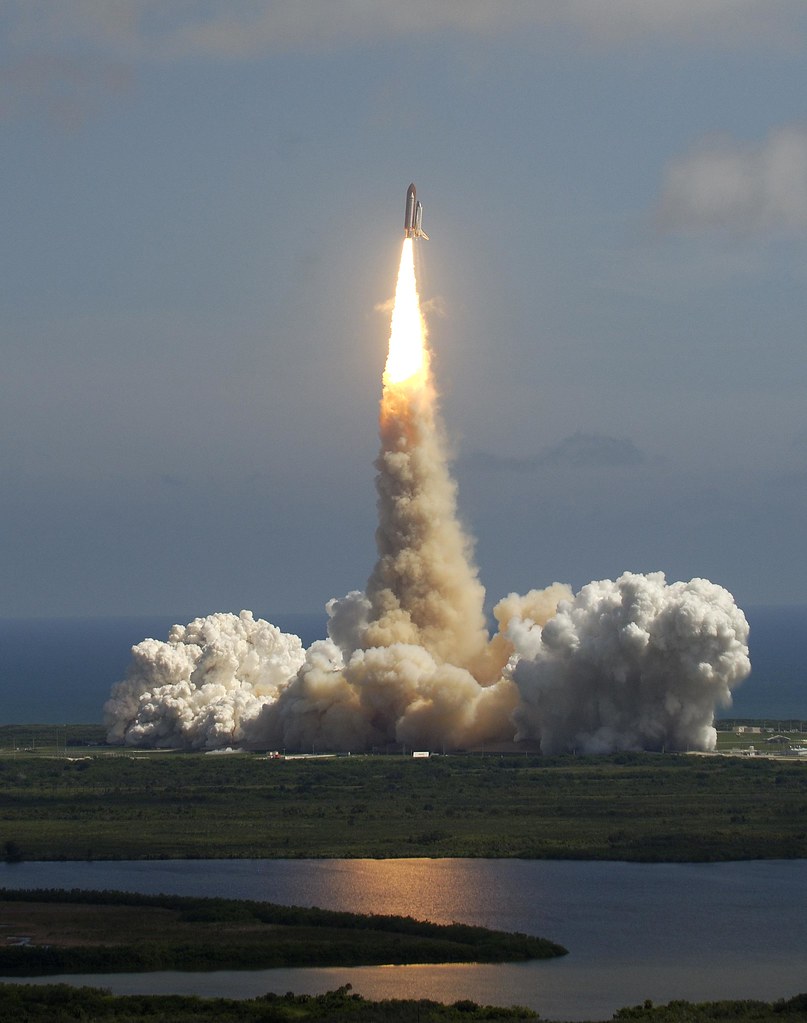
KENNEDY SPACE CENTER, FLA. – From the top of the Vehicle Assembly Building, the fiery launch of Space Shuttle Atlantis is seen against the background of the Atlantic Ocean to the east while billows of smoke and steam roll across the launch pad. Atlantis is heading for a rendezvous with the International Space Station on mission STS-115. After launch attempts were scrubbed Aug. 27 and 29 and Sept. 3 and 8 due to weather and technical concerns, this launch was executed perfectly. During the STS-115 mission, Atlantis’ astronauts will deliver and install the 17.5-ton, bus-sized P3/P4 integrated truss segment on the station. The girder-like truss includes a set of giant solar arrays, batteries and associated electronics and will provide one-fourth of the total power-generation capability for the completed station. This mission is the 116th space shuttle flight, the 27th flight for orbiter Atlantis, and the 19th U.S. flight to the ISS. STS-115 is scheduled to last 11 days with a planned landing at KSC. Photo credit: NASA/George Shelton


NASA videos rock.

Lockheed Pulls Out of Russian J.V.

As reported in this morning’s Kommersant (Коммерсантъ):

The Lockheed Martin Corp. announced yesterday that it will withdraw from the Russian-American joint venture that markets Russian Proton rockets. The company cited the rising prices being demanded by the rockets maker, the Khrunichev State Space Research Center, and a number of unfulfilled obligations of the center, as the motivation for its decision. In the 11 years of its existence, the International Launch Services sold 37 Proton rockets for a total of $2.5 billion.

Lockheed Martin said yesterday that Space Transport Inc., a company registered in the Virgin Islands, would be the purchaser of its shares in ILS as well as Lockheed Khrunichev Energia International. A source in the Russian space industry said that Space Transport was being launched as a temporary holder of the assets Lockheed is selling. Eventually, those assets will be bought by Khrunichev, apparently with Vneshtorgbank acting as creditor. The value of the deal was estimated by the source as about $150 million. He added that the ILS would remain as a company registered in the United States and would also market Khrunichev’s new Angara rocket in the future. Lockheed Martin will sell its Atlas rockets through its Lockheed Martin Commercial Launch Services.

ILS has 11 open contracts for launches with a value of $500 million. At the center, they told Kommersant yesterday that they expect orders to increase. Analysts also predict that the industry will have a healthy growth rate in the next several years. Vitaly Davydov, deputy head of Roscosmos, the Russian space agency, predicted recently that Russian rockets account for 40 percent of the world market. Roscosmos press secretary Igor Panarin commented to Kommersant yesterday that “Lockheed Martin’s decision will not affect Russian interests in launch services in the least. On the contrary, it will strengthen bilateral relations between Russia and the U.S. in the space field.” Khrunichev press secretary Alexander Bobrenev concurred, saying that “The Russian side will continue marketing the Proton and Angara carrier rockets. We are capable of meeting our obligations to our clients.”

A Lockheed Martin spokesman told Kommersant that that ending its partnership with Khrunichev was a purely business decision and does not affect its joint ventures with other Russian enterprises, such as Energomash. “Our collaboration with them [Khrunichev] was very fruitful and we still have projects that we will possibly work on jointly in the future,” the spokesman said.

Kommersant has learned that Lockheed informed Khrunichev of its intentions to pull out of the joint business in May. The official explanation for the move is a change in Lockheed’s marketing strategy. “After analyzing conditions on the world market, we decided to concentrate on launches of satellites with masses of 4.5-6.5 tons,” ILS president Dr. Mark Albrecht said in June. In essence, that means that Lockheed has decided to leave the commercial market in favor of more profitable state orders. Boeing made the same decision in 2003. Of the 11 Proton launches in the last three years only five of them were heavier then 4.5 tons.

Another source at Lockheed said that the company disagreed with Khrunichev’s decision to raise the price of the rockets by 15 percent, to $45-50 million each, to pay for the services of an intermediary to conclude contracts with ILS. ILS also received 15 percent of every contract. Another source of contention was $68 million that Lockheed paid in 1999 under an agreement to market the new Angara rocket. The first launch of that rocket was to take place in 2003, but now plans call for the first launch in 2010. “Lockheed Martin will consider its investment in the purchase of the marketing rights to the Angara and include them in the cost of its package in ILS and LKEI,” a source said.

DIY Friday: Satellite Reception on the Move

On Wednesday, Rocco scooped the world with the first photographs of the Lyngbox, which was officially unveiled today in Europe.

What makes the Lyngbox "officially cool" by Really Rocket Science standards is its database of worldwide satellite ladder charts, which essentially allows users to "plug and play" the Lyngbox anywhere in the world. Travelling from London to Capetown? Just bring your Lyngbox with you, plug it in, peruse the database, and within moments you’ll be watching the local satellite channels.

Of course, there has always been an alternative to purchasing cool gadgets — and that alternative is to Do It Yourself. This site has long offered instructions on Satellite for Caravans — how you can rig your RV (or car or "caravan") and stay connected to the world of satellite TV while on the road in Europe: 

You will not get a picture by simply waving the dish around; the digibox has to decode the signal before a picture can appear for the first time and that can take a couple of minutes or more. So if you just swing the dish around, you’ll have already moved it out of the signal again long before the picture has a chance to appear. Providing you know the technique however, it is fairly straightforward to tune in a digital system and once you’ve got the hang of it you would be very unlucky if it took longer than about 5 minutes. I’ve had people writing to say they got a signal within a few minutes, others took longer. For myself, it normally takes me only a minute or two these days. My own record is 10 seconds – pure fluke, I stuck the dish on its mast and obtained an immediate signal – just happened to point it in precisely the right direction first time!

You’ll need a satellite dish, a digibox, and a TV (don’t forget that) to catch signals while on the road from Astra or Sky:

 The Astra 2 system consists of 3 satellites close together in space so that your dish will ‘see’ all of them as if they were a single unit. All 3 transmit signals aimed at Europe but the coverage on the ground varies considerably. The 2 older satellites, 2A and 2B, can be thought of as flood lights, lighting up a huge area of Europe, whereas the newer Astra 2D is more like a spot light focused on the British Isles. For the sake of convenience the signals are referred to as the north beam, south beam and narrow beam (or more usually just the 2D beam).

If all of this is sounding confusing, the alternative to DIY is always to buy. Newsfactor magazine has a great article on gadgets available to bring you satellite content while in the fast lane, including some DIY tips for acquiring satellite radio in the U.S.:

Do-it-yourselfers have plenty of options too. There are two ways to go with DIY satellite radio: purchasing a car stereo with satellite radio built-in (requires professional installation) or purchasing a dashboard mounted controller that uses a vacant FM frequency to provide the satellite programming.

Dashboard-mounted models, such as the Delphi Roady XT ($79.99) or the Sirius Sportster Replay radio ($139.99), plug into the vehicle’s cigarette adapter and use a roof mounted magnetic antenna to capture the satellite signal. There is a caveat: as a vehicle travels over long distances an FM channel may no longer be unused and available for satellite signals, so the satellite signal will lose clarity as the FM signal gains strength. At that point, a new vacant FM frequency will have to be selected to improve satellite signal clarity. In spite of the limitations, these dash-mounted models provide a quick way to get satellite radio without having to install a compatible stereo system professionally.

So when it comes to acquiring satellite signals while on the road, the question is not whether or not you can receive them. The question is simply: DIY or buy?