How’d They Get That Shot?

More UAV posting. Have you ever watched a movie or even a television commercial and asked "How’d they get that shot?" I know I have, and I usually find myself wondering just how they maneuvered a helicopter to get that shot. Until now I thought that maybe it was due some pilots with very steady hands. Now it turns out there aren’t any pilots at all.

Companies like 1 Advanced Technologies employ UAVs (those flying robots that haunt my dreams) to get some of the best shots in film and television. But some of these shots would be impossible with a helicopter. (Where’s the wind?) That’s where this little thing comes in.

I don’t know what it’s called, but it gets into some tight spots that no manned aerial vehicle could, to produce the kinds of visual shots that we pretty much take for granted. And I won’t even get into the maneuvers it makes possible. I’m not sure how it all happens, but the company has a video demo on its "Film Industry" page that shows this flying robot in action, making movie and commercial magic (OK, "commercial magic is probably a stretch) you might have seen before.

Finland’s Phone Toss

This is one I couldn’t quite believe, especially after World Jump Day, but apparently the Finns have come up with a special day for every frustrated mobile phone user who’s ever wanted to toss the darn thing.

Phone TossEver heard of the Mobile Phone Throwing World Championship? It was held in Finland this weekend. Old phones were supplied for contestants who were allowed to pick which kind of phone they wanted to throw.

The men’s winner threw his phone 292 feet. The women’s winner tossed her phone 167 feet, a new world record according to the organizers. She said she has tossed a cell phone a time or two before.

Apparently, it’s real. And there’s even video.

I suppose it makes for a convenient excuse to upgrade your phone. I just hope all those tossed phones were properly recycled afterwards.

Flying Robots & Free Fuel?

I don’t mean to go on about those flying robots. You know, the ones with the tentacles? In Europe? Yeah, those. I don’t mean to go on about them, but they always seem to be in the news.

This time they’re going by a different name: Stratellites. And they’re taking up a new function: wi-fi.

StratelliteBob Jones has a lofty idea for improving communications around the world: Strategically float robotic airships above Earth as an alternative to unsightly telecom towers on the ground and expensive satellites in space.

Jones, a former NASA manager, envisions a fleet of unmanned “Stratellites” hovering in the atmosphere and blanketing large swaths of territory with wireless access for high-speed data and voice communications.

…Jones believes his solar-powered, helium-filled Stratellites _ so named because they would hang in the stratosphere — could replace unsightly cell towers and cost less than satellites. Because of the airship’s altitude according to Jones, its radio equipment can cover an area the size of Texas.

Cell towers are hampered by line-of-sight limitations and limited range. Geostationary satellites suffer from the quarter-second it takes a signal to travel out 22,300 miles and back — insignificant in one-way TV transmissions, but terrible for two-way Internet computer communications.

The idea bubbled up and popped around the same time as the dot.com bust, yet it may be an idea whose time has come again. If so, Jones might want to consider some alternative fuels for getting his stratellites aloft.


Fuel Cell UAV

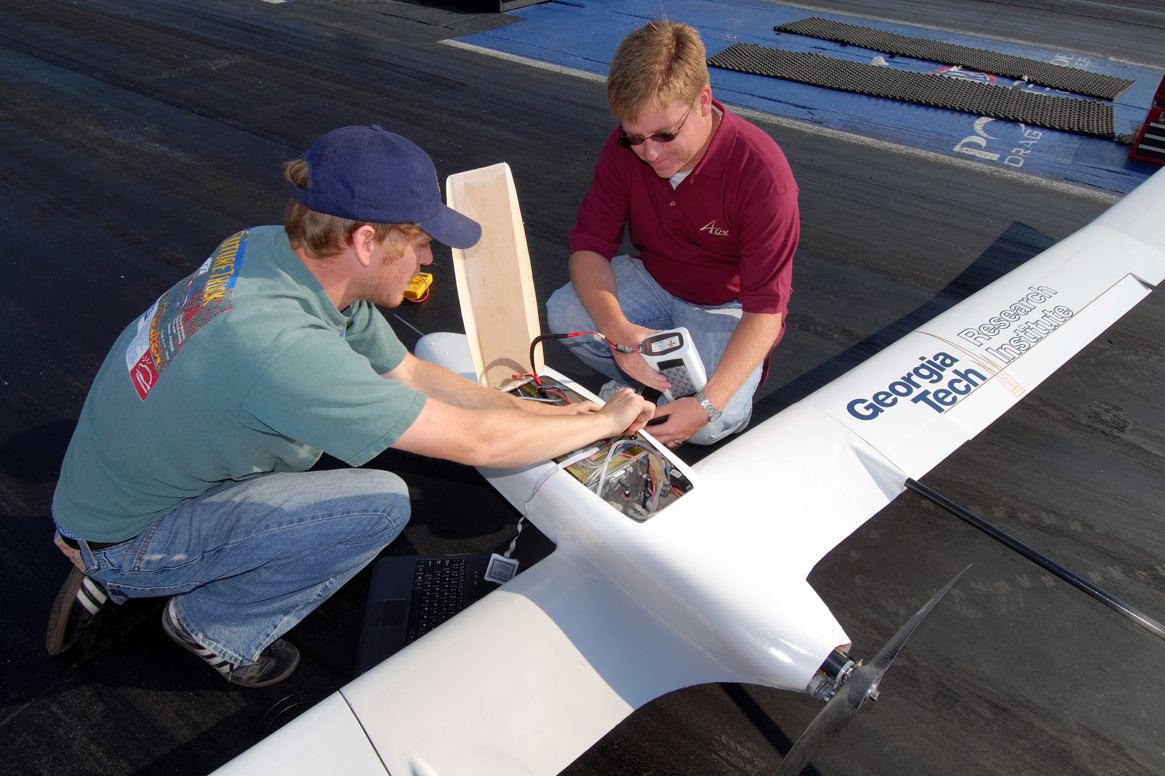
For example, he might look into fuel cells. These guys at the Georgia Institute of Technology got their flying robot aloft using a hydrogen fuel cell. And if hydrogen is cost prohibitive, Boing Boing says this company has build a machine that generates free energy.

Then again, if the comments and tags on that Google video are right, maybe not.

Katrina: How Satcom Walked the Talk

Hurricane Katrina was the costliest storm in American history, which occurred during what became one of the nation’s busiest hurricane seasons. The category 5 hurricane hit the Gulf of Mexico’s northern coastlilne on 29 August 2005, including the city of Biloxi, Miss.

Sustained winds of approximately 150 miles per hour, accompanied by its rain and storm surge, caused catastrophic flooding in Biloxi – dozens of feet above and further inland than normal – destroying important terrestrial infrastructures vital for adequate shelter, economic sustainability and civic functions. Homes, office buildings, telephone poles, hospitals, television and cell phone antennas, government headquarters and places of worship, were completely flattened.

Since most of the area’s terrestrial-based forms of communication had been destroyed and were near useless, a satellite-based WiMAX (Worldwide Interoperability for Microwave Access) WAN (Wide Area Network) communication network for the city of Biloxi was a viable option. WiMAX is a wireless communications technology that provides high-throughput broadband connections for considerably longer distances than that offered via a WiFi (Wireless Fidelity) LAN (Local Area Network) network.

Motivated to immediately help in relief efforts after the hurricane dissipated, Craig McCaw, who through his investment company Eagle River, has an ownership in Clearwire, offered the Clearwire WiMAX service to government leaders in Mississippi in order to provide the needed communications after the hurricane. Clearwire is a high-speed, wireless broadband Internet service provider. SES AMERICOM was then contacted to join in his quest to help reestablish Biloxi’s communication network.

SES AMERICOM employees were dispatched to Biloxi, and immediately installed and connected two-way satellite ground stations called VSATs (Very Small Aperture Terminals) to Clearwire’s WiMAX towers. Relief agencies, hospitals, fire, police as well as businesses and residences within the established WiMAX network were able to get reliable, 24×7 voice and data connectivity to the outside world via this hybrid satellite/WiMAX network.

It’s experiences like these that prompted the Satellite Industry Association to publish a "First Reponder’s Guide to Satellite Communications" earlier this summer.

A year later, businesses in the area are still squabbling over what resources get restored first.

A Sputnik Moment?

Earlier this month I was somewhat obsessively following the story of China’s space program and U.S. concerns about a looming "Sputnik moment" with China. Well, it looks like using "Sputnik" and China in the same breath may be appropriate as China teams up with Russia for a mission to Mars.

China and Russia are planning a joint mission to Mars that will not only bring samples back to earth but also land on one of the red planet’s tiny moons, a Chinese space scientist here has said.

SputnikYe Peijian, a leading scientist with the Chinese Research Institute of Space Technology, made the announcement at an ongoing forum on China’s space technology development.

Ye said Russia will launch the spacecraft in 2009 and it will carry China-made survey equipment. It will collect samples on Mars and the planet’s nearest moon.

Sun Laiyan, administrator of the China National Space Administration said last month at an international space conference that China is actively planning its deep space exploration over the next five years, focusing on lunar and Mars exploration.

"We will encourage other countries to take part in space science programs initiated by China, and Chinese scientists will participate in international space science programs," Sun said.

The lunar mission definitely jibes with previous reports of China’s space-related ambitions. And the invitation for other countries to take part might bode well for similar U.S. ambitions, in light of China’s earlier invitation to a NASA official to visit the country next month, and check out their space program.

But it sounds like the Russians are already on board. So does this qualify as a "Sputnik Moment" yet?

DIY Friday: Install Your Own Dish

I gotta admit, there are times when I’m just not feeling the DIY vibe. One of them is when I have a satellite dish that needs installing. The last couple of times I’ve moved, I’ve had someone some an install the dish for me, but apparently there are some folks out there who just want to do it themselves. And I salute them. After all, better them than me.

They may just be better at it than I am. Or more creative. I’m just a "bolt-it-to-the-side-of-the-house-and-call-it-a-day" kind of guy. Who knew there’s a better way to do it? Well, some people do.

For example, can you spot the dish in this picture?

Spot Dish

The author goes into some detail on just how an apartment dweller can achieve an aesthetically pleasing satellite installation.
Spot Dish 2

So as we all know, to use satellite TV, I needed to install a dish. I elected for the Dish500 dish, which is slightly larger than your normal 18-inch DBS dish, but it can also lock on to 2 satellites at once, giving me a wider channel range. The real difficulty was going to be where to install the dish, and would the apartment complex let me. The second problem was solved by the FCC last year. They issued a resolution that says that no one, not an HOA, locality, or my landlord, can prevent me from installing a dish of less than 36 inches in diameter somewhere that I have exclusive access to (like my balcony). However, in the interest of keeping up good relations, I told my landlord before I started the install. They wanted me to sign a lease addendum, which I did because it didn’t have any significant language in it. Having done that, I proceeded to the question of how to install the dish securely on the balcony.

I elected to go with the concrete bucket install described by a couple people on some of the DBS message boards. Basically, I mounted a piece of metal conduit in a bucket full of concrete, mounted the dish on top of the conduit, and bungeed the whole assembly to the rails of my balcony. It provides a very stable installation. I haven’t had any problems with the dish so far, and we’ve gotten some really high winds for the area since I got it set up.

It actually looks like quite an effective setup, and easier than drilling holes in an external wall.

There’s some pretty good advice for householders too, such as painting it the same color(s) as your house, in order to camouflage it.

Spot Dish 3

There are also some other suggestions, like hiding it under an artificial rock or in the attic, in front a conveniently-placed window (which would be great in the winter, because you don’t have to go out and brush the snow off the dish to get your picture back.)

Me? I’ll stick to calling the guys with the tools, to come bolt it to the wall. Unless someone else has another idea.

Smart Cart to the Rescue

Of all the cool robot contraptions I’ve seen and blogged about lately, I haven’t come across one that sound like something I can actually use in my every day life. Until now, that is. That’s in part because I have a secret phobia: runaway shopping cart. When we go shopping on weekends, I fear a runway shopping (or one hastily abandoned, rather than being put away) cart will "ding" the car, or that ours will slip out of control.

But now that some University of Florida Students have invented a kind of Smart Cart, I may finally be able to shop for groceries without fear.

Smart Cart

It looks almost like any other shopping cart, except sensors let it follow the shopper around the supermarket and slow down when needed so items can be placed in it. And it never crashes into anyone’s heels.

"The immediate thing that jumped to my mind was all those times as a kid when my sister would accidentally hit me with a cart," said its inventor, Gregory Garcia. "It seems like the public would really want this, since everybody shops."

Sounds like a good idea to me. So I gotta respectfully disagree that the Smart Cart is a sign that we’ve become irredeemably lazy. (If you ask me, the advent of the Segway and the self-flushing toilet long since heralded that human reality.) It just means I no longer have to fear runaway shopping carts.

All I need now is map of the grocery store and I’m all set.

Webinar on Satellite Communications

Here’s a plug: SES AMERICOM is presenting a Webinar next Tuesday called "Satcom Talk" — a discussion of how businesses are using a mix of both land-based and space-based communications.  As new and innovative technologies continue to evolve and converge with established approaches, enhanced business solutions are developing in:  

  • Corporate Communications and Intranets
  • Training and Distance Learning
  • File Transfers and Information Delivery
  • Inventory Management
  • News Media and Financial Market Updates
  • Business Continuity and Disaster Recovery

Tuesday, 29 August 2006 @ 11:30 a.m. EDT (15:30 GMT). Click here for more details and how to register.

Cosmonauts to Commemorate Shepard’s Moon Golf with a Drive from the ISS

According to the AP, Russian flight engineer Mikhail Tyurin will drive a golf ball back to mother earth from atop the International Space Station on Thanksgiving Day 2006 in a publicity stunt to promote Canadian golf club manufacturer, Element 21 Golf Co.

Element 21 asked the Cosmonaut to pull the stunt to publisize its new line of golf clubs and to commemorate the 35th anniversary of the time astronaut Alan Shepard hit golf balls on the moon during the Apollo 14 mission. The stunt, which cost the company an undisclosed amount of money, was originally planned for a June spacewalk, but was pushed back so other tasks could be accomplished.

Oh, and don’t worry about being knocked out by dimpled piece of plastic. The golf ball will most likely return to the earth’s atmosphere in three days, burning up upon reentry.

Satellite-based Bar Game Provider Offers New Game

Even the best rocket scientists need a beer from time to time, so that’s why we were heartened to find out one of our favorite bar game vendor and satellite-based, interactive game provider, Buzztime, has announced a new product, Crazy Golf.

For those that haven’t gotten to use Buzztime products in the past, the company’s most popular games (by far) are trivia-based, spicing up the standard pub quiz by automating the process and pitting you against fellow booze-hounds around the country and the world via satellite. Those that are really into the trivia can form a team, keep the name, and log on to the company’s player’s forum and trash talk that team in Tucson that kept on demanding Lord of the Rings questions to their heart’s content.

Pique your interest? Use Buzztime’s website to find a bar near you that has the service. For those of you who are already Buzztime junkies, you might want to consider subscribing via Dish Network, it only costs $3.99/month and it’ll definitely save you on your bar tab. As for your dating opportunities? Well, it’s probably not going to help — but that’s why you took up bar trivia, right?